
NEW
Font size
 Worksheets
9289 unit 301 outcome 6
Total questions: 62
Worksheet time: 31mins
In site work involving fuel gases, what is the written permit system commonly called?
Cold work
Hot work
Safe work
Gas pass
Which statement best describes the purpose of a hot work permit?
It certifies the worker's employment status.
It details the type of work, how and when it will be carried out, and the precautions to be taken.
It authorizes the purchase of gas equipment.
It serves as a checklist for tool maintenance only.
Gas equipment should not be used unless you have received adequate training in which of the following? Select the single best option.
Only tool selection
Safe use of the equipment, required precautions, correct fire extinguisher types, and emergency procedures
Accounting procedures for site costs
Welding aesthetics
Which item is specifically included in emergency procedures training for using gas equipment on site?
Calibrating pressure gauges
Raising the fire alarm and calling the fire brigade
Painting equipment to prevent rust
Filing hot work permits with the finance department

Which bottled gas is typically supplied in a red cylinder with a left-hand thread?
Propane
Butane
Methane
Ammonia
Liquefied petroleum gas (LPG) includes which of the following gases?
Propane and butane
Methane and ethane
Hydrogen and helium
Oxygen and nitrogen
At approximately what temperature does propane turn from liquid to gas?
0°C
21°C
42°C
100°C
When LPG is burned in confined spaces, what harmful build-up can occur?
Ozone (O3)
Carbon dioxide (CO2)
Sulfur dioxide (SO2)
Nitrogen (N2)
Which statement correctly describes LPG compared to air?
LPG is lighter than air and disperses upward
LPG is heavier than air and can pool at low levels
LPG has the same density as air
LPG is non-flammable
What safety equipment must be present when LPG is in use?
Foam fire extinguisher
Water fire extinguisher
CO2 fire extinguisher
Dry powder fire extinguisher
Which storage practice is NOT permitted for LPG cylinders?
Storing in well-ventilated and signed areas
Storing in cellars
Keeping away from naked flames
Using left-hand thread connections
Which hazard is specifically highlighted for loft areas when using naked flames?
Oxygen depletion
Dust and insulation ignition; not allowed near thatched roofs
Excessive humidity
Electrical interference
Which statement best describes a general danger of gas in confined spaces?
Only nitrogen builds up
CO2 or CO can accumulate
Helium leaks are common
No significant risk if doors are closed
Which bottled gas uses a cylinder with a yellow colour and has a left-hand thread direction?
MAPP (mix)
Acetylene
Oxygen
Propane
Which gas listed uses a right-hand thread direction?
MAPP (mix)
Acetylene
Oxygen
Oxy-propane
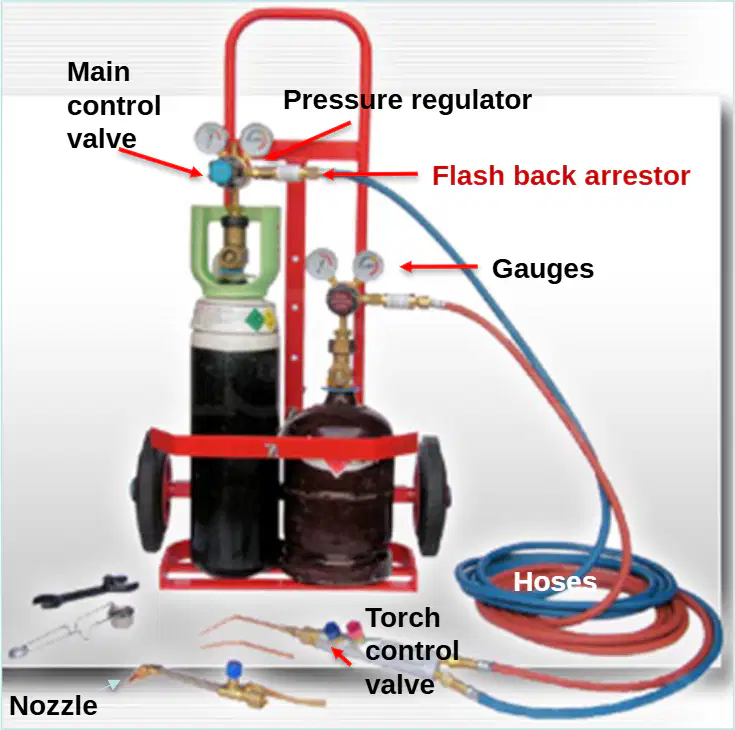
According to the diagram, which component helps prevent flame traveling back into the equipment?
Pressure regulator
Flash back arrestor
Main control valve
Torch control valve
Plumbers may use oxy-propane primarily for which purpose mentioned?
To reduce oxygen consumption
To gain additional heat to solder or weld
To cool equipment quickly
To replace flash back arrestors
When visually inspecting gas equipment, which item is specifically recommended to check for leaks at joints?
Soapy water only
Leak detection fluid
Compressed air
Grease
Which of the following is NOT listed as a visual inspection point for gas equipment?
Damage to hoses
Expiry date of hoses and equipment
Damage to gauges
Calibration of thermometers
Which step helps prevent a dust explosion when preparing the oxygen side of an oxy/acetylene setup?
Open the acetylene control valve briefly before fitting the regulator
Open the oxygen valve assembly briefly before attaching the oxygen regulator
Wipe connection seats with a clean cloth before connecting hoses
Turn the acetylene regulator handle clockwise to increase pressure
What is the correct action if oils or grease are present on the regulator or cylinder valve during assembly?
Proceed carefully and wipe after use
Apply thread sealant to neutralize the residue
Do not use the equipment
Open the oxygen valve fully to purge contaminants
During assembly, what must be verified about each regulator?
It is brand new
It is the correct type for the cylinder
It has a built-in flashback arrestor
It is calibrated in bar only
Why must the acetylene control valve never be opened to ‘blow-out’?
It wastes gas and lowers cylinder pressure
It could cause a fire
It damages the regulator seat
It can lead to inaccurate gauge readings
Which tool is specified for tightening gauge connections to the cylinders?
Adjustable wrench
Correctly sized, open-ended spanner
Pipe wrench
Torque screwdriver
What precaution should be taken to avoid thread damage during assembly?
Apply high-strength threadlocker
Use excessive force to ensure seal
Take care not to damage the brass threads
Reverse the threads to left-hand
Which inspection ensures the torch tip can be secured correctly?
Check the torch’s paint finish
Check that the threads are satisfactory on the head of the torch
Check the hose colour coding
Check the oxygen cylinder label
Before turning on the acetylene cylinder gas valve, how should the regulator be set?
Regulator handle fully clockwise
Regulator handle anticlockwise out a few turns (turned off)
Regulator set to 15 PSI
Regulator handle removed
How far should you turn the acetylene cylinder control valve initially, and why?
Fully open to maximize flow
Half turn to stabilize pressure
One turn of the wrist to allow quick shut-off in an emergency
Quarter turn to protect threads
What is the maximum safe acetylene gas pressure stated for the system?
2 PSI
10 PSI
15 PSI
20 PSI
When opening the acetylene regulator valve after the cylinder control valve is on, how should this be done and to what indicated pressure?
Quickly open to 1 bar
Very slowly while watching the low-pressure gauge, to 0.14 bar (2 PSI)
Rapidly open until the high-pressure gauge peaks
Slowly open to 15 PSI on the low-pressure gauge
Before igniting an oxy/acetylene torch, what is the first safety step you must perform on both lines?
Check regulator pressures
Purge both acetylene and oxygen lines
Open the oxygen blowpipe valve fully
Light the acetylene with a match
When lighting the torch, which gas is lit first and how is it ignited?
Oxygen first with a spark from the torch
Acetylene first with a friction-type lighter
Both gases together using a pilot flame
Oxygen first using a friction-type lighter
Which action is specifically warned against during the lighting procedure?
Opening the acetylene valve a quarter turn
Using a friction-type lighter
Lighting the torch with a mixed gas
Purging the hoses
What is the correct order for switching off gases when extinguishing the oxy/acetylene torch?
Oxygen first, then acetylene
Acetylene first, then oxygen
Both together
Depends on the flame type
For lead welding, how should the flame be adjusted after opening the oxygen blowpipe valve?
Carburising flame
Neutral flame
Strongly oxidising flame
No adjustment needed
For brazing or bronze welding, which flame setting is recommended after opening the oxygen blowpipe valve?
Neutral flame with equal gases
Slightly oxidising flame with more oxygen than acetylene
Carburising flame with more acetylene than oxygen
No flame adjustment
Which method is recommended for checking gas leaks from a cylinder?
Using an open flame
Smelling for gas only
Applying suitable non-greasy leak-detection fluid
Immersing the cylinder in water
What is the first action you should take if you smell gas and detect a leak from a cylinder?
Call the fire department immediately
Close the cylinder valve
Move the cylinder indoors for inspection
Vent the room with a fan
Which statement aligns with the safety protocol after confirming a cylinder is leaking?
Continue using the cylinder until the supplier arrives
Never use a leaking cylinder
Store the cylinder in a closed cabinet
Attempt repairs using household tools
After securing and labeling a leaking cylinder outdoors, who should be contacted to collect it as soon as possible?
Local waste disposal service
Gas supplier
Building maintenance team
Emergency medical services
When storing gas cylinders, what is the recommended position and location?
Laid horizontally indoors
Upright outside in a well-ventilated, lockable store with labels
Upside down in a sealed cabinet
Suspended from chains in a basement
During transport in an enclosed vehicle, how should gas cylinders be arranged?
Loose on the floor without labels
Upright with ventilation and an external label on the vehicle
Horizontal with windows closed
Stacked more than four high
What document must a driver carry when transporting quantities of gas under the Carriage of Dangerous Goods by Road Regulations?
Safety Data Sheet
Tremcard
Permit to Work
Risk Assessment
Which statement about oxygen cylinder placement is correct?
They may be stored next to acetylene cylinders if labelled
They must be at least three metres from acetylene or LPG cylinders or separated by a wall
They should be buried to reduce ignition risk
They must always be indoors
Gas cylinders must be stored away from which of the following?
Combustible materials, sources of ignition, and corrosive/toxic/oxidant materials
Water and concrete surfaces only
Labels and ventilation
Empty cylinders
Which storage surface is preferable for gas cylinders?
Soft ground
Hard surface in a secure, open-air compound
Wooden pallet indoors
Carpeted area
Acetylene and LPG cylinders should be kept upright during which phases?
Only during transport
Only when full
During use, storage, and transport—even when empty
Only during storage
What is the safe limit for horizontally stacked oxygen cylinders, and what must be done to prevent movement?
No limit; leave free to roll
Two high; strapped loosely
Four high maximum; wedged to prevent rolling
Six high; tied with rope
Why should cylinders be shielded from direct sunlight and heat sources?
To keep labels visible
To prevent pressure build-up that could cause gas leakage or bursting
To improve ventilation
To reduce cylinder weight
Which handling practice is prohibited for oxy/acetylene or LPG bottles?
Securing vertically stacked cylinders
Lifting bottles by their control valves
Labelling transport vehicles externally
Wedging horizontally stacked oxygen cylinders
Which statement best describes how cylinders should be positioned when transported around a site to prevent weakening of the cylinder walls?
Laid horizontally and cushioned
Secured upright to avoid violent contact
Tilted at a 45° angle on a dolly
Stacked in pairs with straps
What type of trolley is stated as safer for transporting gas cylinders?
Two-wheeled trolley
Three-wheeled trolley
Flatbed cart
Forklift attachment
Before moving cylinders, how should they be treated to avoid damage?
Exposed to minor shocks but not falls
Handled casually since they are robust
Treated with care and not subjected to shocks or falls
Rolled gently on the ground
Which statement about trolleys for cylinder transport is correct?
Any general-purpose trolley is acceptable if balanced
Only purpose-designed trolleys of the correct size should be used
Hand-carrying is preferable to using trolleys
Four-wheeled warehouse carts are specified
What must be present and in good condition on both oxygen and acetylene lines?
Pressure gauges only
Flashback arresters, regulators, and non-return valves
Hose clamps and tape
Quick-release couplings
Which statement best defines combustion as described in the material?
A physical change caused by heating a substance
A chemical reaction with oxygen
A process that removes heat from fuel
The cooling of gases below ignition temperature
According to the fire triangle concept, which three elements must be present for a fire to occur?
Fuel, oxygen, heat
Fuel, water, spark
Oxygen, nitrogen, heat
Fuel, carbon dioxide, heat

In the example given, what combination produces a flame?
Propane + Nitrogen + Spark
Propane + Oxygen + Spark
Propane + Oxygen + Water
Propane + Carbon Dioxide + Heat
Which action directly targets the oxygen side of the fire triangle?
Cooling the fire with water
Smothering the fire to remove air
Starving the fire by isolating fuel
Adding heat to accelerate combustion
Which item is listed as an example of fuel in the material?
Nitrogen
Water
Furniture
Carbon dioxide
A spark contacts a flammable liquid. Which fire triangle component does the spark represent?
Fuel
Oxygen
Heat
Inert gas
Which principle is most effective when you remove the fuel source from a fire?
Smothering the fire
Starving the fire
Cooling the fire
Ventilating the area

