
 Worksheets
Nutrition
Total questions: 65
Worksheet time: 33mins

Which prompt best aligns with reflecting on energy needs before studying nutrition in sports?
Calculate your exact daily calorie intake using a nutrition app.
List daily activities you perform that you think require energy.
Memorize the macronutrient ratios for endurance athletes.
Identify the biochemical pathway that produces ATP during sprints.
Which statement best defines nutrition as presented in the material?
The study of cooking methods to enhance flavor
The process by which a living organism assimilates food and uses it for growth and replacement of tissues
The measurement of body composition using height and weight
The practice of avoiding certain foods to prevent allergies
An athlete wants to decrease injury risk and improve performance. Based on the material, which action aligns with this goal?
Increase training intensity while skipping meals
Rely solely on supplements without changing diet
Maintain proper nutrition
Eliminate all carbohydrates from the diet
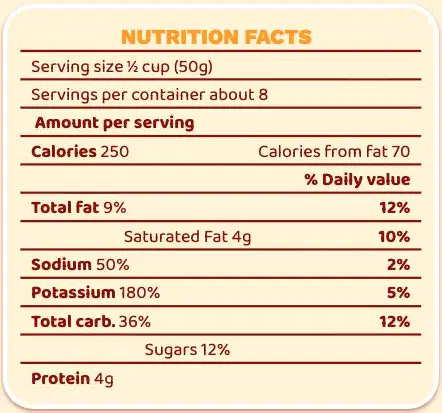
A nutrition facts panel shows: Serving size 1/2 cup (50 g); Servings per container about 8; Calories 250; Calories from fat 70; Total fat 9% (Saturated fat 4 g, 10%); Sodium 50%; Potassium 180%; Total carbohydrate 36% (Sugars 12%); Protein 4 g. Based on this label, what is the serving size?
1 cup (200 g)
1/2 cup (50 g)
3/4 cup (75 g)
2/3 cup (60 g)

According to the nutrition facts panel, how many calories are in one serving?
70
180
250
300
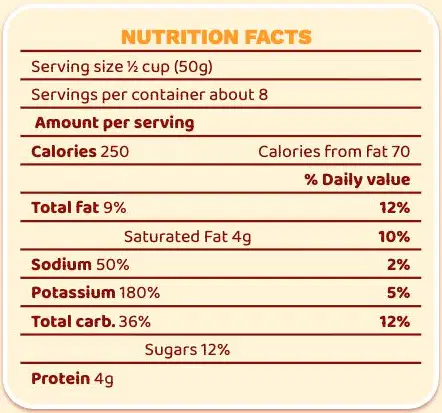
The label lists sodium at 50%. What does this percentage represent?
The percent of total calories that come from sodium
The percent of the Daily Value for sodium provided by one serving
The percent of the product that is sodium by weight
The percent of recommended protein replaced by sodium
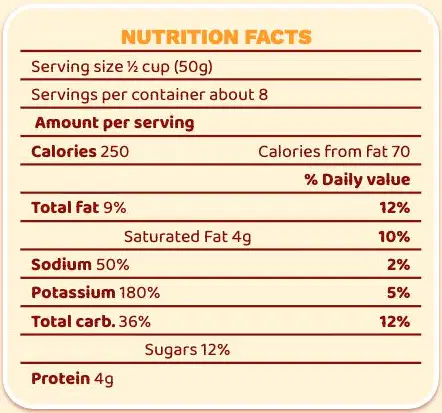
Which statement about macronutrients on this label is correct?
Protein content is 4 g per serving
Total carbohydrate is listed as 12 g per serving
Saturated fat is 9 g per serving
Potassium is a macronutrient listed as 180 g
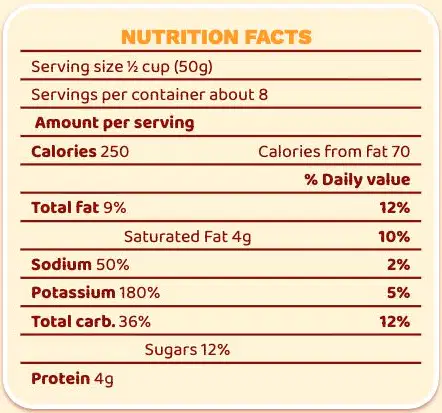
If there are about 8 servings per container, approximately how many total calories are in the entire container?
500 calories
1,000 calories
1,500 calories
2,000 calories
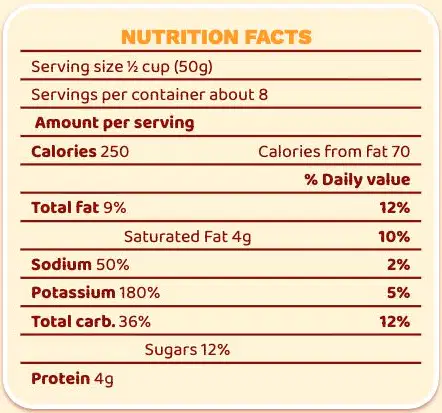
What is the total carbohydrate Daily Value percentage shown on the label?
10%
12%
36%
50%
Which molecule is explicitly identified as the body’s immediate energy currency produced from food breakdown?
Glucose
ATP
Oxygen
Carbon dioxide
According to the energy extraction equation shown (Glucose + O2 → CO2 + H2O + ATP), which pair represents waste products of metabolism?
Glucose and ATP
Oxygen and water
Carbon dioxide and water
ATP and glucose
What does the material state is the easiest macronutrient for the body to break down for energy, even though lipids and proteins can also be used?
Proteins
Lipids
Glucose
Fiber
Metabolism is best described as which of the following?
Only the process of digesting food in the stomach
All of the chemical and physical reactions that happen in the body to help it function properly
Only aerobic respiration in muscles
Only the conversion of carbohydrates into fat
Basal Metabolic Rate (BMR) refers to:
The energy used during intense exercise
How much energy it takes a person to survive one day at rest
The calories stored as body fat in a day
The total heat produced during digestion
Two students have similar bodies, but one is more active while the other is more sedentary. Based on the definition provided, whose BMR is likely higher?
They will have identical BMRs regardless of activity
The more active student
The more sedentary student
BMR is unrelated to activity level
Which group contains the macronutrients that act as fuel nutrients by supplying energy (calories) for work and normal body functions?
Vitamins, minerals, water
Carbohydrates, fats, proteins
Proteins, vitamins, minerals
Carbohydrates, vitamins, water
Regulatory nutrients have no caloric value but are necessary for normal function and good health. Which of the following are regulatory nutrients?
Carbohydrates, fats, proteins
Fats, proteins, water
Vitamins, minerals, water
Carbohydrates, vitamins, proteins
What is the best definition of nutrient density according to the material?
The number of servings recommended per day
The amount of nutrients and calories a food contains
How quickly food is digested
The percentage of macronutrients in a meal
A food that is packed with nutrients and contains few or a moderate number of calories is described as:
Low nutrient density
High nutrient density
Regulatory nutrient
Macronutrient
Which description best matches low nutrient density foods?
Few calories and many nutrients
High number of calories and very few nutrients
Moderate calories and balanced nutrients
No calories and many vitamins
Which statement best defines a calorie in nutrition?
The amount of energy stored as body fat
The amount of energy needed to raise the temperature of 1 gram of water by 1 degree
The amount of energy required to digest carbohydrates
The amount of energy muscles use during exercise
Which macronutrient provides the highest calories per gram?
Carbohydrates
Protein
Fats
Alcohol
Carbohydrates primarily serve which role for the body, especially for athletes?
Building muscle tissue
Fueling muscle action as the first and most efficient source of glucose
Transporting vitamins and minerals
Maintaining body temperature
Which pairing correctly matches carbohydrate type with its description from the material?
Simple carbs – starches; Complex carbs – sugars
Simple carbs – sugars; Complex carbs – starches
Simple carbs – fiber; Complex carbs – proteins
Simple carbs – fats; Complex carbs – oils
Excess carbohydrates are first converted to glycogen. Where is glycogen stored according to the material?
In adipose tissue
In muscle and the liver
In the bloodstream
In the kidneys
When glycogen stores in muscle and liver are full, what happens to additional excess carbohydrates?
They are excreted in urine
They are converted to protein
They are turned into adipose tissue (fat)
They remain as glucose in the blood indefinitely
Which pairing correctly identifies a disaccharide and its component monosaccharides?
Sucrose = glucose + galactose
Lactose = glucose + fructose
Maltose = glucose + glucose
Fructose = glucose + fructose
What is the primary characteristic that distinguishes disaccharides from monosaccharides?
Disaccharides are made of three monosaccharides
Disaccharides are combinations of two types of monosaccharides
Monosaccharides are produced only by animals
Monosaccharides cannot be converted to glucose
Which statement about glucose is accurate based on the material?
It is only found in plants
It is stored as glycogen in the body
It cannot be produced by the body
It is converted to fructose in the body
Which complex carbohydrate is the storage form of glucose in plants and commonly found in grains, seeds, roots, potatoes, and legumes?
Glycogen
Dextrins
Starches
Sucrose
Dextrins are formed by which process according to the content?
Enzymatic digestion of proteins
Breakdown of large starch molecules after exposure to dry heat
Fermentation of fiber in the colon
Conversion of glucose to glycogen
Which statement correctly describes glycogen from the complex carbohydrate section?
It is manufactured only by plants
It is found organically in trace amounts in some meats and is also manufactured by the body
It is the main source of dietary fiber
It dissolves in water to excrete fats
Which description matches soluble fiber?
Not digestible but makes stool bulky, increasing peristalsis
Dissolves in water and forms a "glue" that excretes fats from the body
A simple carbohydrate stored as glycogen
A nutrient fully digested by the body
What is one health-related benefit of dietary fiber noted in the material?
Increases risk of gallbladder disease
Decreases the risk for diseases such as CHD, infections, and constipation
Is fully digested to provide extra calories
Reduces peristalsis
Which of these foods would have the lowest glycemic index?
Crackers
White bread
Rice
Scrambled eggs
A student eats a meal of starchy carbohydrates with added fiber (e.g., vegetables). Compared with eating the same starchy foods without fiber, what is the most likely digestive system effect?
Faster gastric emptying and a sharper rise in blood glucose
Slower digestion and a more gradual rise in blood glucose
No change in digestion or blood glucose response
Complete prevention of carbohydrate absorption
Why might understanding glycemic index help someone achieve better control of their glucose?
It reveals calorie content so they can reduce total energy intake
It indicates how quickly foods raise blood glucose, helping with meal planning to avoid sharp spikes
It shows protein quality for building muscle, which stabilizes glucose
It lists fiber grams so they can precisely match insulin doses
Which is NOT listed as a use of protein in the body?
Building and repairing muscle tissue
Actin and myosin function
Maintaining salt/water balance
Primary source of energy
According to the guidance, how many grams of protein per kilogram of body weight per day is typical on average?
0.25–0.5 g/kg
1–2 g/kg
2–4 g/kg
5–6 g/kg
Which food is identified as a great source of protein?
White rice
Greek yogurt
Apples
Lettuce
Most of the amino acids your body requires are described as essential. What does essential mean in this context?
The body can synthesize them
They must be obtained from the diet
They are only needed during exercise
They are stored in fat tissue
In the digestion of protein, where does chemical digestion primarily begin according to the material?
Mouth
Stomach
Pancreas
Large intestine
Which sequence best matches the steps of protein digestion described?
Chemical in mouth → Physical in stomach → Absorption in pancreas
Physical in mouth → Chemical in stomach → Further digestion and breakdown to amino acids in small intestine
Absorption in mouth → Breakdown in liver → Excretion in kidneys
Chemical in mouth → Mechanical in stomach → Final digestion in large intestine
Why is protein supplementation generally NOT recommended according to the material?
It is too expensive
Proper diet can meet needs; increases saturated fat; overstresses liver/kidneys; no scientific evidence it enhances muscles
It tastes bad
It reduces carbohydrate intake
Which statement aligns with the recommendation about daily protein intake distribution?
Consume all protein at dinner
Spread protein intake throughout the day
Avoid protein at breakfast
Only eat protein from supplements
Which is a listed function of fats in the body?
Primary fuel source for sprinting
Insulate the body and organs
Increase blood sugar levels directly
Transport oxygen to muscles
According to the material, saturated (trans) fats are described as:
The healthy fat
The unhealthy fat
A micronutrient
Only found in plants
Which food is identified as a source of unsaturated fats?
Most dairy products
Fried foods
Avocados
Meats
In the macronutrient Venn diagram, which item appears under Fats, not overlapping with Protein or Carbs?
Avocado
Dairy
Buckwheat
Rice
A student wants to choose a protein-rich food that also contributes dietary fat. Based on the diagram, which option fits both categories (overlap of Protein and Fats)?
Oats
Dairy
Corn
Bread
Which statement best defines micronutrients in the context of sports nutrition?
Nutrients needed in large amounts that provide energy
Nutrients needed in small amounts with no caloric value
Compounds the body can make to boost energy
Only water-soluble nutrients that are excreted in urine
Which characteristic distinguishes minerals from vitamins according to the material?
Minerals are raw elements that cannot be changed or broken down
Minerals can be made by the body
Minerals are primarily water soluble
Minerals provide calories and energy
An athlete is considering taking high doses of fat-soluble vitamins. Based on the material, what is the most appropriate action to avoid risk?
Increase intake because excess is removed via urine
Avoid high doses since excessive amounts can be stored in fat and lead to overdose
Rely on the body to produce needed vitamins
Take more minerals to counteract the vitamins
Which of the following lists includes only minerals identified as among the seven most crucial?
Calcium, Potassium, Chloride, Magnesium
Vitamin C, Sodium, Phosphorus, Iron
Sodium, B12, Potassium, Chloride
Magnesium, Folate, Calcium, Potassium
Which statement about vitamins is accurate based on the instructional material?
They can be broken down to create energy
They can be synthesized by the body
Most are water soluble, so excess is removed via urine
They are raw elements from the periodic table
Which statement best describes a key function of Vitamin A (Retinol) relevant to athletes’ health?
Supports good vision, especially in dim light
Provides quick energy during endurance events
Regulates water-soluble vitamin absorption
Directly builds muscle proteins
A student wants to increase Vitamin A intake using whole foods. Which choice is the most appropriate source based on the material?
White rice
Leafy green vegetables
Plain pasta
Soda
Which function is primarily associated with Vitamin B1 (Thiamin)?
Contributes to energy release from macronutrients and healthy skin
Helps convert carbohydrates into energy and helps maintain a healthy appetite
Formation of hormones and nerve-regulating substances
Improves mineral absorption in bones
An athlete has cracking at the corners of the mouth and inflamed skin. Based on the symptoms, which vitamin deficiency is most likely?
Vitamin B1 (Thiamin)
Vitamin B2 (Riboflavin)
Vitamin B3 (Niacin)
Vitamin C
A long-distance runner wants foods rich in Vitamin B3 (Niacin) to support energy release and hormone formation. Which combination best fits recommended sources?
Whole grains and nuts
Eggs and milk
Organ meats and green leafy vegetables
Lean meats and fish only
Which function is primarily associated with Vitamin B5 (Pantothenic Acid)?
Normal RBC formation
Carbohydrate and fat metabolism
Bone mineralization
Immune response
A student shows depression, irritability, muscle spasms, nausea, skin changes, and anemia. Which vitamin deficiency best matches these symptoms?
Vitamin B5 (Pantothenic Acid)
Vitamin B6 (Pyridoxine)
Vitamin B7 (Biotin)
Vitamin C
Which food list is the best source set for Biotin (Vitamin B7)?
Organ meats, eggs, nuts, green leafy vegetables
Vegetables, meats, whole-grains, soybeans, peanuts, potatoes
Liver, kidney, eggs, dark-green vegetables, milk, nuts
Citrus fruits, berries, peppers
Which function is most directly supported by Folic Acid (Vitamin B9)?
Bone mineralization
Red blood cell formation and cell division
Vision in low light
Blood clotting
A vegan athlete is concerned about Vitamin B12 intake. Which food from the list is the best source of B12?
Leafy green vegetables
Whole grains
Eggs
Avocados

