
 Worksheets
A&P 1st quarter review
Total questions: 63
Worksheet time: 32mins
Which part of the neuron increases the strength of a nerve signal by increasing the voltage of the action potential?
Neuroglia
Glial cells
Neurons
Schwann cells
What do vesicles in nerve cells do?
Release neurotransmitters into the synaptic cleft.
Store energy for cell functions.
Protect the cell from viruses.
Facilitate cell replication.
What is the function of the nodes of Ranvier in the myelination process?
Speed up transmission of nerve impulses.
Protect the neuron from damage.
Store neurotransmitters for quick release.
Provide structural integrity to the axon.
Which nervous system division controls voluntary movements?
Somatic
Parasympathetic
Autonomic
Sympathetic
Which type of cells transmit electrical signals in the nervous system?
Neurons
Glial cells
Blood cells
Muscle cells
What type of joint allows for movements such as flexion, extension, abduction, and adduction?
Ball and Socket
Gliding
Pivot
Hinge
What division of the autonomic nervous system is responsible for 'fight or flight' responses?
Parasympathetic
Sympathetic
Somatic
Autonomic
Which structure in the brain is responsible for coordination and balance?
Cerebellum
Cerebrum
Frontal Lobe
Brain Stem
Which process in bones involves creating new bone cells?
Osteogenesis
Hematopoiesis
Myelination
Glycolysis
Which part of the neuron is involved in transmitting impulses towards the synapse?
Dendrite
Cell Body
Axon
Myelin Sheath
In which cavity is the heart located?
Cranial
Spinal
Thoracic
Abdominal
Which type of fracture results in the bone breaking the skin?
Greenstick
Simple
Compound
Stress
Which structure contains bone marrow?
Periosteum
Medullary cavity
Haversian canal
Lamellae
What type of joint involves synovial cavities?
Cartilaginous joints
Fibrous joints
Synovial joints
Ball and Socket
The largest part of the human brain is called the cerebrum.
True
False
The femur is longer than any other bone in the human body.
True
False
The occipital lobe is primarily responsible for visual processing.
True
False
Synovial joints do not have a synovial cavity.
True
False
The lumbar vertebrae are located in the lower back region of the spine.
True
False
Which type of joint is found in the shoulder and allows for a wide range of motion?
Hinge joint
Saddle joint
Ball and socket joint
Pivot joint
Which anatomical plane divides the body into anterior and posterior parts?
Coronal plane
Sagittal plane
Transverse plane
Oblique plane
Which body cavity houses the spinal cord?
Vertebral cavity
Thoracic cavity
Cranial cavity
Abdominal cavity
What is the significance of the transverse plane in anatomical studies?
A) Divides the body into right and left halves
B) Divides the body into front and back portions
C) Divides the body into superior and inferior parts
D) Divides the body at an angle
Which anatomical term of direction describes the position of the nose relative to the eyes?
Lateral
Posterior
Superior
Medial
What is the primary mineral found in bone that contributes to its hardness?
Magnesium
Calcium phosphate
Iron
Potassium
Which type of bone cell is primarily responsible for breaking down bone tissue?
Osteoblasts
Chondrocytes
Osteoclasts
Osteocytes
Which anatomical term refers to a position closer to the midline of the body?
Lateral
Distal
Proximal
Medial
Which anatomical term describes the back side of the human body?
Dorsal
Ventral
Anterior
Distal
What structure connects bones to muscles?
Ligament
Tendon
Fascia
Cartilage
Which anatomical term refers to the front of the body?
Dorsal
Posterior
Anterior
Lateral
Which lobe of the brain is primarily responsible for processing auditory information and memory?
Frontal lobe
Parietal lobe
Occipital lobe
Temporal lobe
Which classification of bones can support weight and facilitate movement, often found in the limbs?
Long bones
Short bones
Flat bones
Irregular bones
Which lobe of the brain is involved in decision making and problem solving?
Frontal lobe
Temporal lobe
Parietal lobe
Occipital lobe
Which lobe of the brain is primarily responsible for processing visual information?
Parietal lobe
Occipital lobe
Temporal lobe
Frontal lobe
Which of the following is NOT a primary taste sensation?
sweet
salty
spicy
umami
___a___ detects black and white and outlines while ___b___ detects colors and sharpness.
cones
rods
The junction between two communicating neurons is called a ________
synapse
axon
dendrite
myelin sheath
Place the regions of the vertebral column in the correct order, starting in the neck.
Cervical, Thoracic, Lumbar, Sacral, Coccyx
Thoracic, Cervical, Lumbar, Sacral, Coccyx
Lumbar, Cervical, Thoracic, Sacral, Coccyx
Cervical, Lumbar, Thoracic, Sacral, Coccyx
The olfactory system is another name for the sense of _____
touch
smell
hearing
taste
Which type of muscle is striated and found in the heart?
Cardiac muscle
Smooth muscle
Skeletal muscle
Fascia
What is the functional unit of a muscle?
Sarcomere
Fascia
Neuron
Axon
Which muscles move the entire eye up, down, left, and right to look in different directions?
Extraocular muscles
Pupil
Adipose tissue
Oblique muscles
What is the main role of the corpus callosum in the brain?
To serve as a conduit allowing information to transmit from one side of the brain to the other.
To control the heartbeat.
To produce hormones.
To regulate the temperature of the body.
The following are all examples of our special senses: Smell, Taste, Hearing, and Equilibrium
True
False
The function of the cochlea in the inner ear is ________.
balance
hearing
sight

The cerebellum is labeled as #...
1
2
3


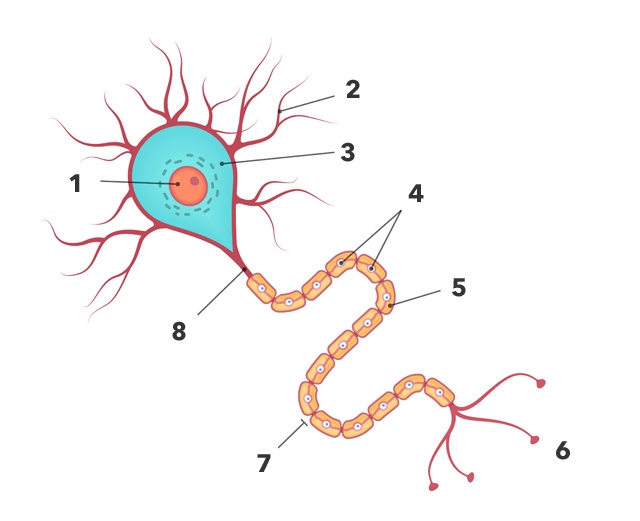
Identify #1
axon
cell body
myelin sheath
nucleus
Identify #3
axon
cell body
dendrite
myelin sheath
Identify #6
axon terminals
dendrites
dendrite
schwann cells
Gaps between Schwann cells that increase the speed of the transmission of the signal down the neuron are called
axon terminals
dendrites
myelin
nodes of Ranvier

This plane divides the body into superior and inferior parts.
coronal plane
frontal plane
transverse plane
sagittal plane

The midsagittal plane separates the body into...
top and bottom
left and right
front and back

Which anatomical plane divides the body into anterior and posterior
frontal
transverse
sagittal
midsagittal

name the muscle
trapezius
latissiumus dorsi
recuts abdominis
transverse abdominis

Name the muscle
latissimus dorsi
levator scapula
trapezius
pectoralis major

Name the muscle
pectoralis major
subscapularis
deltoid
triceps

Gastrocnemius
12
2
5
4
1
Gluteus maximus
Gluteus minimus
Biceps gluteus
Anconeus

Trapezius
10
11
9
6
9
Lattisimus dorsi
Trapezius
Gluteus maximus
Teres major
7
Teres major
Trapezius
Triceps brachii
Deltoid

