
 Worksheets
QUARTER 2 REVIEWER
Total questions: 50
Worksheet time: 25mins
Who contributed to developing equations that show the relationship between electricity and magnetism?
Andre Marie Ampere
Isaac Newton
James Clerk Maxwell
Michael Faraday
Heinrich Hertz is known for his work with radio waves. How did his discoveries influence modern communication technology?
invented the first radio receiver.
created the first FM radio station.
developed the first television broadcasting system.
proved the existence of electromagnetic waves, paving the way for wireless communication.
In an electromagnetic wave, how are the electric field, magnetic field, and direction of propagation oriented with respect to one another?
form a circular pattern.
oscillates in a linear fashion.
perpendicular to each other.
all aligned in the same direction.

Radio waves are part of the electromagnetic waves. Electromagnetic waves are created by accelerating charges; moving charges back and forth will produce oscillating electric and magnetic fields, and this travel at the speed of light. Based on the diagram, which describe radio waves?
Longitudinal waves in which the displacement of the medium is in the same direction as, or the opposite direction to, the direction of travel of the wave.
Mechanical waves in which propagate through a material medium (solid, liquid, or gas) at a wave speed which depends on the elastic and inertial properties of that medium.
Transverse waves that are moving waves consist of oscillations occurring perpendicular (or right angled) to the direction of energy transfer.
Standing waves that are produced whenever two waves of identical frequency interfere with one another while travelling opposite directions along the same medium.
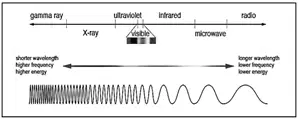
Which of the relationships will describe the wavelength, frequency, and energy in the electromagnetic spectrum?
Wavelength is directly proportional to frequency and energy.
Wavelength is inversely proportional to frequency and directly proportional to energy.
Frequency is directly proportional to energy and inversely proportional to wavelength.
Frequency is directly proportional to wavelength and inversely proportional to energy.
Which of the following description/s is/are NOT TRUE about the infrared radiation as shown in the illustration? Its energy is _____.
I. Lower than the visible light you see.
II. Greater than the radio wave.
III. The same with the gamma ray.
IV. Almost close to the energy of the X-ray.
I only
II only
I and II
III and IV
Mr. Pedro asked his students to give an example of the sources that are arranged in a way that will pose an increasing risk to humans when exposed to the different sources of electromagnetic radiation at the same time duration and distance. Jean raises her hand and gives an answer to Sir Pedro. Observe the class conversation below:
Jean: “mobile AM/FM --> WiFi --> sunlight --> radioactive source”
Sir Pedro: “Very Good. Can you explain to your classmates the reason for your answer?
Which could be Jean’s possible answer to Sir Pedro’s follow-up questions?
Energy decreases, frequency remains the same.
Energy increases, frequency remains constant.
Frequency increases, energy decreases.
Frequency increases so as the energy.
An FM radio station broadcasts its signal at a frequency of 107.5 x 10^6 Hz using powerful transmitters. Calculate the wavelength of the radio wave to determine the signal reception at residential locations.
0.92 m
1.40 m
2.79 m
3.00 m
Violet light has a wavelength of 2.50 x 10^-7 m. Solve for the frequency?
1.20 x 10^15 Hz
2.40x10^15 Hz
3.00x10^14 Hz
6.00x10^12 Hz
During a live TV news report, a small satellite dish is used to send video signals to the broadcast station. What is being transmitted through the air?
Light waves
Microwaves
Radio waves
Sound waves
A science student notices that when he moves his portable radio closer to the window, the sound becomes clearer. Why is that?
The window blocks light waves.
The radio converts sound to light.
The window acts as a sound amplifier.
The radio can receive stronger radio waves near open space.
Compare the characteristics of AM and FM radio broadcasting. Which statement accurately describes a key difference?
AM has a higher frequency than FM.
FM uses a simpler modulation technique than AM.
AM signals can carry more information than FM signals
FM is less susceptible to noise and interference than AM.
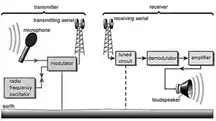
What is the CORRECT sequence of how radio waves are generated, transmitted, and received?
I. The two signals will combine with the help of a modulator. The combined signal is called a modulated RF signal. These are amplified with the help of an amplifier and sent to a transmitting antenna that will generate electromagnetic waves (radio waves) and sent out in all directions.
II. The amplified AF signal is sent to the speaker that converts the AF signal back into sound energy.
III. The demodulator separates the AF and the RF signals from the modulated RF signal, leaving only the AF signals which will be amplified with the help of an amplifier.
IV. The modulated RF signals will be received by the receiving antenna, as you tune in with a tuner into a particular station, it will pass through a device called demodulator.
V. Sounds are converted by a microphone into patterns of electric current called audio frequency (AF) signals, while radio frequency (RF) signals are produced in oscillator circuits.
II-IV-I-V-III
I-II-III-IV-V
III-V-I-IV-II
V-I-IV-III-II
How does the microwave oven utilize the properties of microwaves to cook food? By __________.
heating the air around the food
creating a vacuum around the food
using infrared radiation to cook food
agitating water molecules within the food
What are the potential societal implications of using microwaves in GPS technology?
Increased accuracy in navigation
Decreased reliance on traditional maps
Potential privacy concerns due to location tracking
All of the above
How do night vision goggles utilize infrared waves?
Amplify visible light.
Block all light except infrared waves.
Reflect infrared waves to create a clearer image.
Detect infrared waves emitted by warm objects and convert them into visible light.
How has the development of infrared technology influenced medical diagnostics?
Only used for monitoring temperature.
Made all medical procedures more painful.
Allows for non-invasive monitoring of bodily functions.
Has eliminated the need for any other diagnostic tools.
In telecommunication, how does the use of lasers compare to traditional light sources like incandescent bulbs?
Provide a wider spectrum of colors
Less efficient than incandescent bulbs
Require more energy to operate than traditional light sources.
Produce a focused beam that can travel longer distances without losing intensity.
Which statements BEST evaluate the impact of lasers and fiber optics on data transmission?
Only useful for transmitting video data.
No significant effect on telecommunications
Made data transmission slower and less efficient
Improved data transmission speed and reduced signal loss.
How do banks utilize UV lights in their operations?
disinfect the bank environment.
enhance the color of banknotes.
generate energy for their operations.
check the signature on passbooks using fluorescent ink.
Which statement is more accurate about UV radiation's role in vitamin D production?
UV radiation is essential for vitamin D synthesis but can also lead to skin cancer.
Vitamin D can only be obtained through dietary sources, not UV radiation.
Overexposure to UV radiation is beneficial for skin health.
UV radiation has no health benefits.
Which factors would influence the use of X-rays in both medical and engineering fields?
The age of the person or material
The density of the material or tissue
The external temperature of the object
The color of the material being examined
Consider the applications of X-rays:
I. Detecting tumors III. Curing skin diseases
II. Analyzing the structure of alloy IV. Testing the homogeneity of welded joints
Which statement is true regarding these applications?
I, II, III, and IV are strictly medical
II and IV are only for scientific research.
I is industrial, while II, III and IV are medical.
I and III are medical, while II and IV are industrial.
How do gamma rays help in sterilization?
adding flavor to food
cooling down medical instruments
emitting light that makes things bright
killing bacteria and other harmful microorganisms
Consider the use of gamma rays in cancer treatment. What is a potential benefit of using gamma rays instead of surgery? Gamma rays _______.
can be used to treat other diseases.
do not require any special equipment.
are always safer than any other treatment.
can target cancer cells without cutting into the body.
In electromagnetic spectrum, where would you classify gamma rays, and what is their primary risk?
Non-ionizing radiation; they cause burns.
Non-ionizing radiation; they can lead to overheating.
Ionizing radiation; they are harmless to human cells.
Ionizing radiation; they can cause DNA mutations and cancer.
Which sets of sources are arranged in a way that will pose an increasing risk to humans when exposed to the different non-ionizing and ionizing radiation at the same time duration and distance?
A. Wifi -> Sunlight -> TV -> Radioactive sources
Medical X-ray -> Cordless phones -> TV -> CRT monitor
Cellphone -> Microwave ovens -> Sunlight -> Medical X-ray
Sunlight -> Microwave ovens -> Cellphones -> Radioactive sources
One of the favorite places people love to go is the beach. Either the reason is for family events, special occasions or simply for relaxation. Oftentimes, we see a lot of beach lovers put on their sunblock creams before going swimming. Which BEST explains this?
Make their skin look glowing and healthier.
Prevent the ultraviolet radiation to reach the skin.
Prevent their skin from being irritated from the seawater.
To have a cooling effect on the skin after swimming in the beach.
Gamma rays are also used in medicine for killing cancer cells. Knowing the characteristics properties and uses of gamma rays, what will you remember when dealing with gamma radiation?
Gamma rays do not exist around us because they are not visible in our naked eye.
The effects of gamma radiation can only be applied in hospitals to treat cancer cells.
Gamma rays have high penetrating power, and it has the ability to travel great distances.
Gamma rays are the same with any other forms of electromagnetic waves because they all travel at the speed of light.
In the context of patient safety, why is it important to differentiate between radiation therapy and diagnostic imaging? Because _____________.
A. they use different types of machines.
radiation therapy is only used for cancer patients.
diagnostic imaging is always safer than radiation therapy.
the risks and doses associated with each are significantly different.
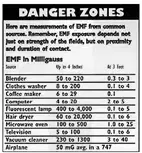
If you are going to explain the diagram to the people in the barangay, which can be used so that the people will be aware of the risks and hazards brought about by the electromagnetic fields?
I. Distance from the source is a consideration when exposed to different forms of electromagnetic waves because electromagnetic radiation is greatest close to the source and decreases with distance from the source.
II. The strength of electromagnetic field is a factor to consider when exposed to electromagnetic waves because the greater the strength of the electromagnetic field, the greater the energy involved.
III. Electromagnetic field is measured in milligauss which means that the higher the value of the electromagnetic field, the higher the risks when exposed to this type of electromagnetic wave.
I only
II only
III only
I, II, and III
If a hospital in the Philippines has been cited for misuse of radiation, what is the MOST appropriate course of action for the facility?
A. Close the facility permanently
B. Ignore the citation and continue operations as usual
C. Review and improve the safety protocols and staff training
If you are going to conduct an information drive on the effect of radiations exposure, which statement will be your consideration?
Dependent on the level, type, and duration of exposure to the source.
Negligible because we cannot feel the electromagnetic radiation around us.
The same to all forms of electromagnetic waves because they travel at the same speed.
Only applicable to visible light because this is the only form of electromagnetic radiation that we can see.

The image of the cube in the mirror appears left-right reversed. What do we call this effect?
Diagonal inversion
Horizontal inversion
Lateral inversion
Vertical inversion
If two objects are placed at different distances from the same mirror, how will their images compare?
Closer object will have a larger image.
Farther object will have a larger image.
Different sizes and distances from the mirror.
Same size but at different distances from the mirror.
How does the distance of an image from a plane mirror compared to the distance of the object from the mirror?
always closer than the object.
always farther than the object.
the same distance from the mirror as the object.
distance of the image varies based on the angle of incidence.
Which BEST describes the difference between concave and convex mirrors? Concave mirrors ________ while convex mirrors ________.
reflect light inward, reflect light outward.
are used only in telescopes, are used in vehicles.
always produce smaller images, produce larger images.
can only form virtual images, can only form real images.
Sarah is a high school student, getting ready for the junior prom. She wants to ensure her makeup looks flawless, so she decides to use a concave mirror. Why did she prefer concave over a convex mirror?
Reflects light in a way that creates a virtual image.
Provides a smaller image, making details harder to see.
Produces an inverted image, which is more aesthetically pleasing.
Allows for a magnified view of the face, enhancing detailed visibility.

If an object is placed between the focal point (F) and the vertex (A) of a concave mirror as illustrated in Figure 1, what type of image will be formed?
Real and inverted
Virtual and upright
Real and enlarged
No image will be formed
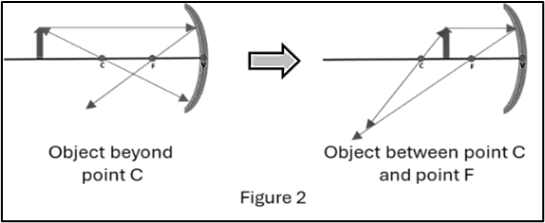
Look at Figure 2, how does the orientation of the image change in a concave mirror?
It changes from real to virtual.
It changes from inverted to upright.
It remains the same but changes in size.
It remains upright regardless of the position of the object.
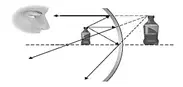
Refer to the figure: How will you describe the characteristic in the image formed?
Real, upright
Real, inverted
Virtual, upright
Virtual, inverted
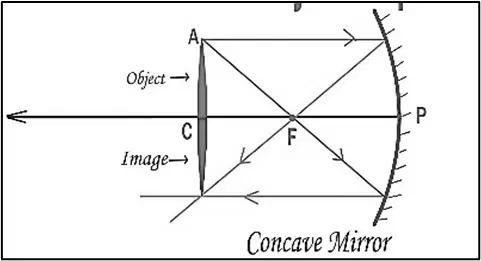
When an object is placed at the center of curvature of a concave mirror as seen in the figure, the image is _____________.
real, upright, bigger than the object
real, inverted, and bigger than the object
virtual, upright, and bigger than the object
real, inverted, and the same size as the object
If a 5 cm tall object is placed 45 cm from a concave mirror with a focal length of 15 cm, and the calculated image height is -1.5 cm, what can you conclude about the image? The image is _______.
real and upright
real and inverted
virtual and upright
virtual and inverted
A real image having a size of 10 cm is formed by a concave mirror. The size of the object is 5 cm. Calculate the magnification of the object.
-5
5
2
-2
The side-view mirrors of most cars are convex mirrors which are used by drivers to have a wider view of the angle behind the car. Suppose that the side-view mirror of the car has a focal length of -6 m and the distance from the mirror is 6m, calculate how far the other car appears to be from the mirror.
-3m
3m
-6m
6m
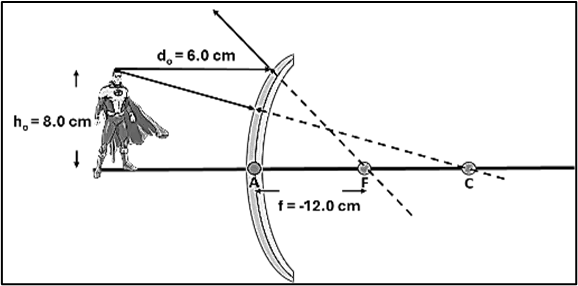
A Captain Barbell action figure is placed in front of a convex mirror. Using the image at the right, determine where the image will form.
4cm
-4cm
5cm
-5cm

Which figure represents the path light takes through a convex lens?
A
B
C
D
You are tasked with designing a new optical device that uses a convex lens. Which material would you choose to maximize light convergence and why?
Air, because it is transparent.
Plastic, because it is lightweight.
Water, because it is abundant and easy to obtain.
Glass, because it has a higher optical density that enhances refraction.
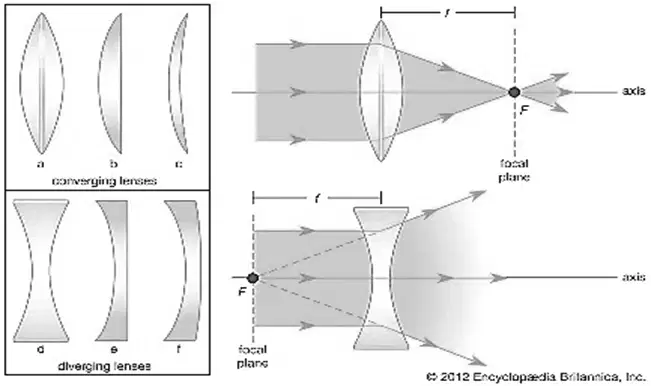
Which characteristics distinguishes diverging lenses from converging lenses? Diverging lenses ___.
only form virtual images
are thicker in the middle
have a positive focal length
can form both real and virtual images

The student is asked to choose the correct lens for a task where the goal is to focus light to form a real image. Based on the passage, which lens should the student choose, and why?
Diverging lens, because it converges light and forms real images.
Converging lens, because it diverges light and forms virtual images.
Diverging lens, because it converges light and can form both real and virtual images.
Converging lens, because it converges light and can form both real and virtual images.

