
 Worksheets
Food Safety and Kitchen Vocabulary
Total questions: 95
Worksheet time: 48mins
What is the term used to describe vegetables that have been cooked to the proper degree of doneness (the opposite of mushy)?
Crisp Tender
Overcooked
Wilted
Soggy
A form of complex carbohydrate from plants that humans cannot digest is called _______.
Fiber
Starch
Glucose
Sucrose
Fry over a high heat while rapidly stirring is called _______.
Stir Fry
Deep Fry
Braising
Steaming
One of the six main nutrients is called _______.
Vitamin
Fiber
Sugar
Starch
Contamination from virus, fungi and bacteria is known as:
Chemical Contaminants
Biological Contaminants
Cleaning
Cross Contamination
Chemicals such as cleaners and polishes that contaminate foods are called:
Chemical Contaminants
Biological Contaminants
Cleaning
Cross Contamination
The process of removing visible organic matter and debris is called:
Cleaning
Cross Contamination
Danger Zone
FIFO Method
The transfer of harmful bacteria or other microorganisms from one substance or surface to another is called:
Cleaning
Cross Contamination
Danger Zone
FIFO Method
The temperatures between 40 - 140 degrees F, where food can only be left for two hours before it should be thrown out, is called the _______.
Danger Zone
Safe Zone
Cold Zone
Hot Zone
The authority that forms the law that food handlers must abide by is called the _______.
FDA (Food and Drug Administration)
CDC (Centers for Disease Control and Prevention)
USDA (United States Department of Agriculture)
EPA (Environmental Protection Agency)
A system of rotating food stock so that the oldest is used first is called the _______.
FIFO Method (First In, First Out)
LIFO Method (Last In, First Out)
Random Selection Method
Stockpile Method
Highly susceptible population includes which groups?
Elderly, immunocompromised, young children
Healthy adults, athletes, teenagers
Middle-aged professionals, college students, travelers
Office workers, artists, engineers
Fill in the blank: ________ is a method of getting everything out and setting up your workplace.
Mise En Place
Julienne
Sauté
Bain-marie
Fill in the blank: ________ are foreign objects like hair, fingernails, or pests that can end up in food and pose a safety hazard.
Physical Contaminants
Chemical Contaminants
Biological Contaminants
Nutritional Additives
Fill in the blank: ________ stands for Ready to Eat Foods.
RTE
RTF
REF
RET
Fill in the blank: ________ is the process of destroying pathogenic microorganisms.
Sanitation
Fermentation
Photosynthesis
Respiration
What does the 'F' in FAT TOM stand for in food safety?
Food
Fungi
Fat
Fiber
What does the 'A' in FAT TOM stand for in food safety?
Acidity
Aeration
Absorption
Alkalinity
What does the 'T' in FAT TOM stand for in food safety?
Time
Temperature
Taste
Texture
What does the second 'T' in FAT TOM stand for in food safety?
Temperature
Time
Toxin
Taste
What does the 'O' in FAT TOM stand for in food safety?
Oxygen
Oil
Oregano
Osmosis
What does the 'M' in FAT TOM stand for in food safety?
Moisture
Mold
Minerals
Meat
Herbs: Oils are found in the _________?
leaves or stems
roots
flowers
seeds
Spices: Oils are found in the _________?
roots, berries, fruits, bark of a plant
leaves, stems, flowers, seeds
petals, thorns, tubers, bulbs
branches, shoots, tendrils, pods
Which part of garlic is made up of individual cloves?
Bulb
Clove
Sprout
What does it mean if you see a green sprout growing from a garlic clove?
The garlic is fresh
The garlic is trying to grow new bulbs
The garlic is spoiled
Insoluble fiber does NOT dissolve in water. What is one benefit of insoluble fiber?
It helps prevent constipation
It dissolves in water
It turns into a gel-like substance
What type of fiber helps slow down digestion, keeps you feeling full longer, lowers cholesterol, and controls blood sugar?
Soluble fiber
Insoluble fiber
Dietary fat
Simple sugars
Which foods are sources of soluble fiber?
Oats, apples, oranges, carrots, and beans
White rice, chicken, eggs, and butter
Beef, pork, cheese, and ice cream
Potatoes, corn chips, bacon, and soda
Insoluble fiber is found in which types of foods?
Whole wheat bread, brown rice, nuts, and the skins of fruits and vegetables
Milk, cheese, and yogurt
Chicken, fish, and eggs
White bread, pasta, and sugary snacks
What is the fiber content in 1 cup of Broccoli?
5 grams
1 gram
10 grams
0 grams
What type of fiber is mostly found in Bell Pepper?
Mostly insoluble
Mostly soluble
No fiber
Only protein
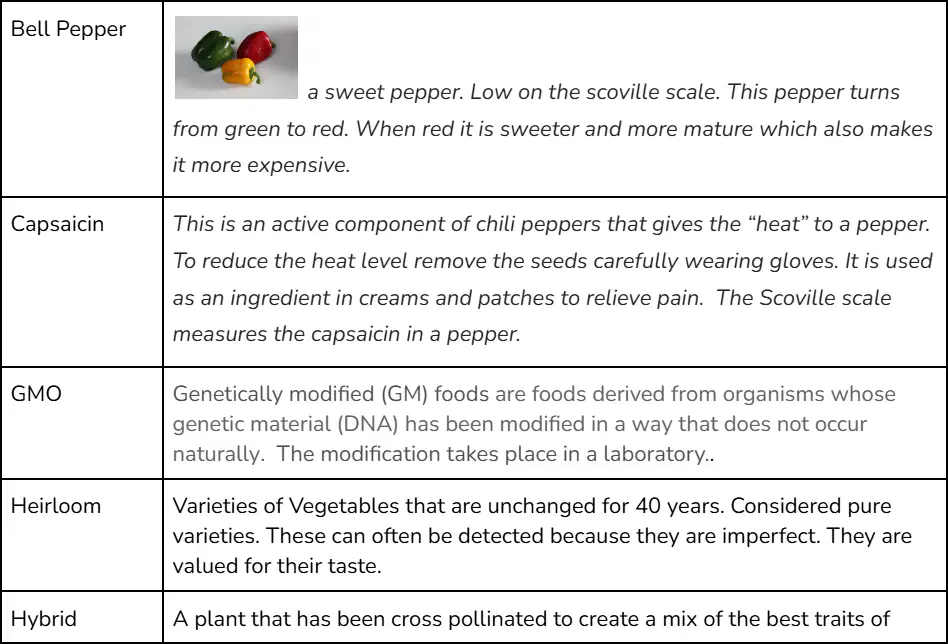
What is a sweet pepper that turns from green to red and is low on the scoville scale?
Bell Pepper
Jalapeño
Habanero
Serrano
What is the active component in chili peppers that gives them heat?
Capsaicin
Lycopene
Curcumin
Piperine
Genetically modified (GM) foods are foods derived from organisms whose genetic material has been modified in a way that does not occur naturally.
True
False
What is a Heirloom vegetable?
A variety of vegetable that is unchanged for 40 years and considered pure.
A vegetable that is only grown in greenhouses.
A genetically modified vegetable for higher yield.
A vegetable that is harvested before it matures.
A plant that has been cross pollinated to create a mix of the best traits is called a _______.
Hybrid
Clone
Graft
Seedling
What is a medium sized pepper that can have a pungency running from 4,000 to 8,000 on the scoville scale and is recommended to be handled with gloves?
Jalapeno
Bell Pepper
Banana Pepper
Poblano
What term is used for food grown with no pesticides or chemicals, and must be grown in soil that is pesticide free for many years to be labeled as such?
Organic
Processed
Genetically Modified
Hydroponic
These can be called chilies or peppers. What are they?
Peppers
Tomatoes
Carrots
Potatoes
What scale gives an idea of the heat or capsaicin in a pepper, where smaller peppers have more heat and peppers turn from green to red as they mature?
Scoville Scale
Richter Scale
Beaufort Scale
Mohs Scale
This is a vegetable that is considered a cancer fighting vegetable. Its skin has fiber and vitamins. The seeds can be bitter in recipes. What is this vegetable?
Tomato
Potato
Cucumber
Carrot
According to USDA Guidelines for Healthy Eating, how many cups of vegetables should teenagers have per day?
2 ½ to 4 Cups a Day
1 Cup a Day
5 to 6 Cups a Day
½ Cup a Day
Formation of curds that can happen when milk is overheated or an acid is added. What is this process called?
Curdling
Pasteurization
Fermentation
Homogenization
The solid portion of milk formed from curdling or adding an acid. This is the part that cheese is made from. What is this called?
Curds
Whey
Cream
Butter
60% water removed. What is this milk product called?
Evaporated Milk
Condensed Milk
Skimmed Milk
Buttermilk
Dairy products inspected for quality and sanitation (high rating). The milk sold to drink is always Grade ___.
Grade A
Grade B
Grade C
Grade D
Dairy products that have met lower standards for sanitation are called Grade ___.
Grade B
Grade A
Grade C
Grade D
Yogurt that is higher in protein. The difference between this and 'regular' yogurt is that more whey protein is strained out of it. What is this yogurt called?
Greek Yogurt
Icelandic Yogurt
Swiss Yogurt
French Yogurt
Mechanical process by which milk fat globules are broken and tiny particles are spread. What is this process called?
Homogenization
Pasteurization
Fermentation
Clarification
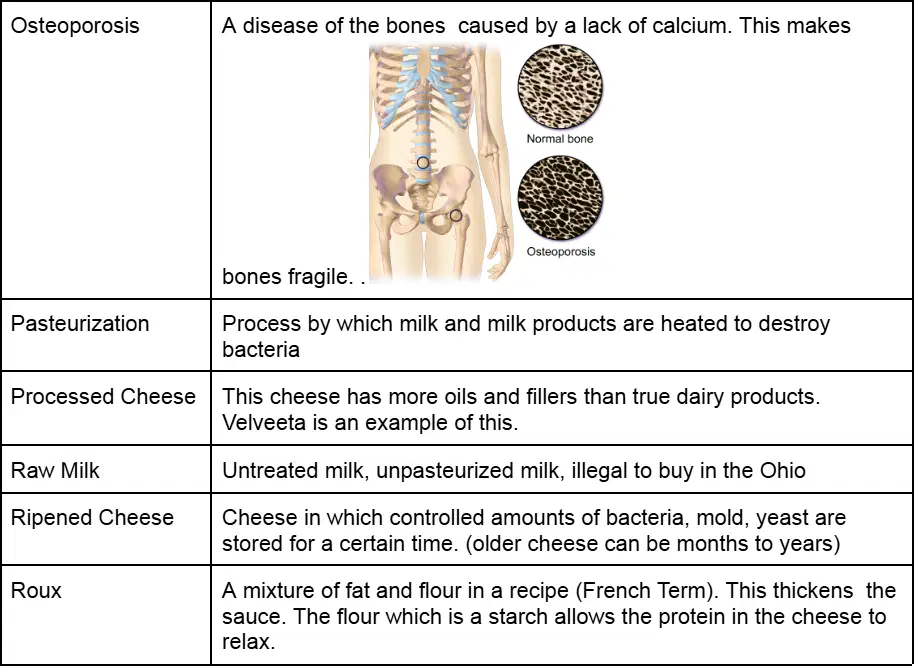
A disease of the bones caused by a lack of calcium. This makes bones fragile. What is this disease called?
Osteoporosis
Arthritis
Scoliosis
Rickets
Process by which milk and milk products are heated to destroy bacteria. What is this process called?
Pasteurization
Fermentation
Homogenization
Condensation
This cheese has more oils and fillers than true dairy products. Velveeta is an example of this. What is this type of cheese called?
Processed Cheese
Cheddar Cheese
Goat Cheese
Blue Cheese
Untreated milk, unpasteurized milk, illegal to buy in the Ohio. What is this milk called?
Raw Milk
Skim Milk
Condensed Milk
Evaporated Milk
Cheese in which controlled amounts of bacteria, mold, yeast are stored for a certain time. (older cheese can be months to years) What is this cheese called?
Ripened Cheese
Processed Cheese
Fresh Cheese
Cottage Cheese
A mixture of fat and flour in a recipe (French Term). This thickens the sauce. The flour which is a starch allows the protein in the cheese to relax. What is this called?
Roux
Béchamel
Velouté
Emulsion
What is the recommended daily serving size of milk to prevent weakening of the bones?
1 cup, 2-3 cups needed daily to prevent weakening of the bones.
1/2 cup, 1 cup needed daily to prevent weakening of the bones.
4 cups, 5-6 cups needed daily to prevent weakening of the bones.
3 tablespoons, 1-2 tablespoons needed daily to prevent weakening of the bones.
What is Unripened Cheese?
Cheese marketed as soon as the whey is removed. Examples are cottage cheese and cream cheese.
Cheese that has been aged for several months to develop flavor.
Cheese that is made only from goat's milk and aged for a year.
Cheese that is smoked to enhance its flavor.
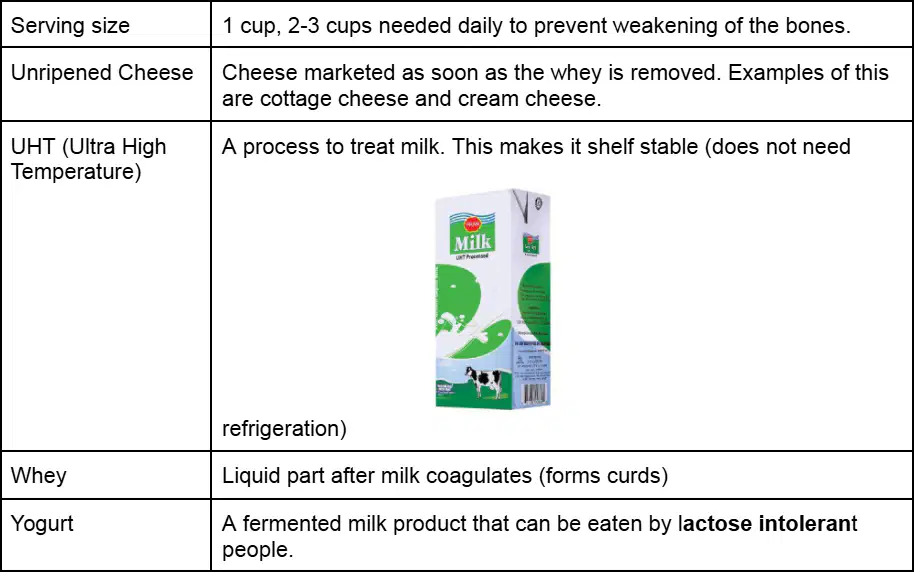
What is UHT (Ultra High Temperature) milk? Refer to the image of the milk carton.
A process to treat milk. This makes it shelf stable (does not need refrigeration).
A type of milk that is only used for making cheese.
A milk product that contains added sugar and flavors.
A traditional method of boiling milk at home.
What is Whey?
Liquid part after milk coagulates (forms curds).
A type of cheese made from goat milk.
A solid fat found in butter.
A fermented drink made from soybeans.
What is Yogurt and who can eat it?
A fermented milk product that can be eaten by lactose intolerant people.
A type of bread made from wheat and water.
A carbonated soft drink consumed by athletes.
A spicy sauce used in Asian cuisine.
What are auto stimulators in fruit?
A fruit that will ripen on its own after being picked.
A fruit that requires chemicals to ripen.
A fruit that never ripens after being picked.
A fruit that only ripens on the tree.
What is Enzymatic Browning?
An oxidation reaction that takes place when the fruit is exposed to oxygen.
A process of fruit ripening due to sunlight.
A method of preserving fruit using sugar.
A reaction that occurs when fruit is frozen.
What is the hull of a fruit or seed?
The dry outer covering of a fruit or seed.
The sweet inner part of a fruit.
The stem that attaches the fruit to the plant.
The juice found inside a fruit.
What is the rind of a fruit?
Outer protective layer of a fruit that can be peeled off.
The seed found inside the fruit.
The juice extracted from the fruit.
The stem attached to the fruit.
What is the skin of a fruit and what nutrients are found there?
This is often the most nutritious part where vitamins and fiber are found.
It is the seed and contains mostly water.
It is the core and contains only sugar.
It is the stem and contains only fat.
What is zest in fruit terminology?
The fragrant skin of tropical fruit.
The juice extracted from fruit pulp.
The seeds found inside the fruit.
The fibrous part of the fruit.
What are biological contaminants in food safety?
Contamination from virus, fungi and bacteria.
Contamination from plastic and glass pieces.
Contamination from pesticides and fertilizers.
Contamination from cleaning chemicals.
Fill in the blank: Chemicals such as cleaners and polishes that contaminate foods are called _________.
Chemical Contaminants
Physical Contaminants
Biological Contaminants
Food Allergens
Fill in the blank: The process of removing visible organic matter and debris is called _________.
Cleaning
Sterilization
Disinfection
Sanitization
Fill in the blank: The transfer of harmful bacteria or other microorganisms from one substance or surface to another is called _________.
Cross Contamination
Sterilization
Pasteurization
Fermentation
Fill in the blank: The temperatures between 40 - 140 degrees F, where food can only be left for two hours before it should be thrown out, is known as the _________
Danger Zone
Safe Zone
Cold Zone
Hot Zone
Fill in the blank: The authority that forms the law that food handlers must abide by is the _________
FDA
CDC
USDA
EPA
Fill in the blank: A system of rotating food stock so that the oldest is used first is called the _________.
FIFO Method
LIFO Method
Batch Cooking
Stock Rotation
Fill in the blank: Highly susceptible population (elderly, immunocompromised, young children) is referred to as _________.
HSP
MSP
LSP
CSP
Fill in the blank: A method of getting everything out and setting up your workplace is called _________.
Mise En Place
Sous Vide
Julienne
Al Dente
Fill in the blank: Foreign objects like hair, fingernails, or pests that can end up in food and pose a safety hazard are called _________.
Physical Contaminants
Chemical Contaminants
Biological Hazards
Nutritional Additives
Fill in the blank: Ready to Eat Foods are referred to as _________.
RTE
RTF
ETF
REF
Fill in the blank: The process of destroying pathogenic microorganisms is called _________.
Sanitation
Fermentation
Contamination
Preservation
What does the 'F' in FAT TOM stand for in food safety? Fill in the blank: F stands for _________.
Food
Fungi
Fat
Fiber
What does the 'A' in FAT TOM stand for in food safety? Fill in the blank: A stands for _________?
Acidity
Air
Additives
Aroma
What does the 'T' in FAT TOM stand for in food safety? Fill in the blank: T stands for _________.
Time
Temperature
Taste
Texture
What does the second 'T' in FAT TOM stand for in food safety? Fill in the blank: T stands for _________?
Temperature
Time
Toxin
Taste
What does the 'O' in FAT TOM stand for in food safety? Fill in the blank: O stands for _________?
Oxygen
Osmosis
Oil
Oxide
What does the 'M' in FAT TOM stand for in food safety? Fill in the blank: M stands for _________?
Moisture
Mold
Minerals
Meat
Fill in the blank: Carotene is a chemical substance found in _______ and _______ fruits and vegetables that can be converted into vitamin A by the body. Chemical substance that gives these fruits and vegetables their color.
dark red, yellow
green, blue
white, purple
brown, black
Fill in the blank: Chlorophyll is a green pigment found in _______ & _______ that can be adversely affected by heat.
green plants, vegetables
fruits, grains
roots, seeds
flowers, stems
Fill in the blank: Crisp Tender is the term used to describe vegetables that have been cooked to the proper degree of _______. (the opposite of mushy)
doneness
softness
ripeness
sweetness
Fill in the blank: Fiber is a form of complex _______ from plants that humans cannot digest.
carbohydrate
protein
fat
vitamin
Fill in the blank: Stir Fry means to fry over a _______ while rapidly stirring.
high heat
low flame
medium heat
cold pan
Fill in the blank: Vitamin is one of the six main _______.
nutrients
minerals
vitamins
proteins
Match the following knife cuts with their descriptions:
Large Dice
Consistent in size/shape of playing dice
Small Dice
Smaller than large dice
Julienne
Match size sticks
Mince
Cut into very small pieces
Chiffonade
Fine cut leaf vegetables
Which knife cut is described as 'Fine cut leaf vegetables'?
Large Dice
Small Dice
Julienne
Mince
Chiffonade
Which knife cut is described as 'Cut into very small pieces'?
Large Dice
Small Dice
Julienne
Mince
Chiffonade
Which knife cut is described as 'Consistent in size/shape of playing dice'?
Large Dice
Small Dice
Julienne
Mince
Chiffonade

