
NEW
Font size
 Worksheets
Lesson 1 Study Guide
Total questions: 20
Worksheet time: 10mins
What are the six steps to the engineering design process?
1. Define Problem 2. Generate Concepts 3. Design a Solution 4. Build and Test 5. Evaluate 6. Present
1. Research, 2. Design, 3. Build, 4. Test, 5. Present, 6. Reflect
1. Identify, 2. Brainstorm, 3. Select, 4. Develop, 5. Evaluate, 6. Communicate
1. Discover, 2. Analyze, 3. Prototype, 4. Test, 5. Launch, 6. Review
What is a repeat loop?
A repeat loop is a programming structure that repeats a set of instructions a specified number of times or until a condition is met.
A repeat loop is used to store data permanently in a database.
A repeat loop is a function that sorts a list of numbers in ascending order.
A repeat loop is a command that stops the execution of a program immediately.
What does it mean when a robot moves autonomously?
Moves with the help of a person (ex. Use of a hand crank)
Moves when code is not downloaded
Moves when coded and downloaded to the robot
Moves when code is downloaded, but a person pushes the robot to make it move faster
The driven gear is referred to as the _______________________
output
driver
idler
rotor
The driving gear is referred to as the _______________________.
input
driven
idler
follower
The idler gear _________________________________________________ .
The idler gear transmits motion and force between the driver and the follower gear without changing their direction.
The idler gear increases the speed of the driver gear.
The idler gear reverses the direction of the follower gear.
The idler gear directly connects the driver and follower gear without any intermediate motion.
In a simple gear train, what would be the correct movement of the gears
The first gear rotates clockwise, the second gear rotates counterclockwise, and the third gear rotates clockwise.
All gears rotate clockwise.
The first gear rotates counterclockwise, the second gear rotates counterclockwise, and the third gear rotates clockwise.
All gears rotate counterclockwise.
The purpose of a flowchart before coding is:
to visually plan the logic and structure of a program
to write the actual code for the program
to test the program for errors
to compile the program into machine language
What is an example of an event handler?
"When bumper A pressed"
Start motor
Repeat 10
Wait 5 sec
It is okay if a prototype does not work the first time because:
it allows for learning and improvement.
it means the idea is bad.
it should always work perfectly.
it is a waste of time.
A forever loop is:
a loop that runs endlessly until stopped
a loop that runs only once
a loop that runs a fixed number of times
a loop that never starts
A concept sketch should include which of the following components?
Labels, details, and notes
Only colors and shading
Just a title and date
Random shapes without explanation
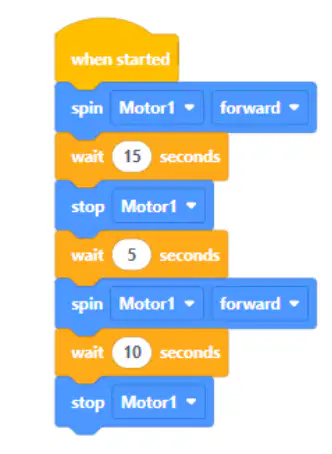
Alexa wants her robot to move forward 15 seconds, stop for 5 seconds, and move in reverse for 10 seconds. She creates the following code. Will this code execute what she intends for her robot to do? If not, what is wrong with the code?
Yes, the code will execute exactly as intended for the robot.
No, the code will not execute as intended because the first spin motor block moves it forward.
No, the code will not execute as intended because the wait block lasts 10 seconds.
No, the code will not execute as intended because the second spin motor block moves it forward.
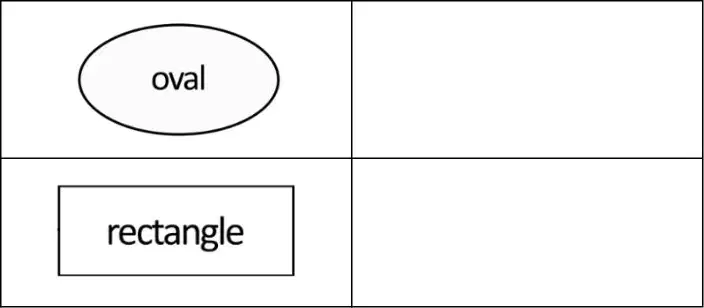
What do each of the following indicate in a flowchart? 1. oval ________ 2. rectangle ________
1. oval: Start/End 2. rectangle: Action
1. oval: Decision 2. rectangle: Input/Output
1. oval: Process 2. rectangle: Decision
1. oval: Input/Output 2. rectangle: Start/End
You and your group members are working on a complex code. It is a code that requires several days to execute. What would help your team stay on task the entire time?
Setting regular check-ins and progress updates
Ignoring communication until the code is finished
Working individually without collaboration
Waiting until the last day to review the code
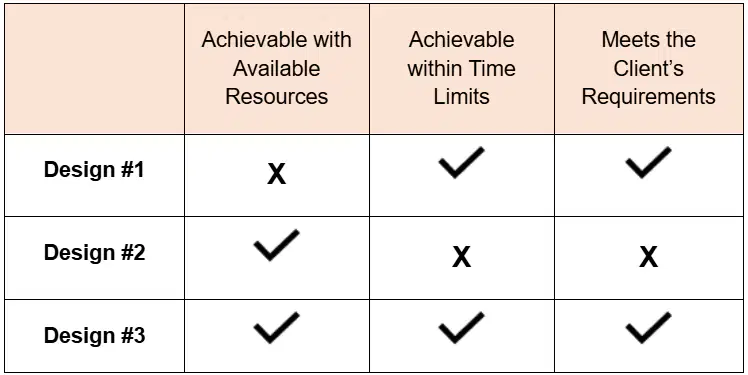
Using the decision matrix below, which design idea should the group create?
Design #1
Design #2
Design #3
None of them
You are a designer and have been asked to create a prototype of an electric fan that spins at least 300 rpm. Your materials for the prototype include an electric motor that spins at 150 rpm and a variety of gear sizes. Which gear train setup would you use to meet the requirement?
Use a gear train that doubles the speed of the motor, such as a 1:2 gear ratio.
Use a gear train that halves the speed of the motor, such as a 2:1 gear ratio.
Use a gear train that maintains the same speed, such as a 1:1 gear ratio.
Use a gear train that reduces the speed to one-third, such as a 3:1 gear ratio.

Fill in the following table. Describe how the output speed will be related to the input speed for the gear setup shown in the diagram (orange large gear driving blue small gear).
The output speed will be faster than the input speed (the smaller gear turns faster than the larger driving gear).
The output speed will be slower than the input speed (the smaller gear turns slower than the larger driving gear).
The output speed will be the same as the input speed (both gears turn at the same speed).
The output speed will stop completely while the input gear turns.
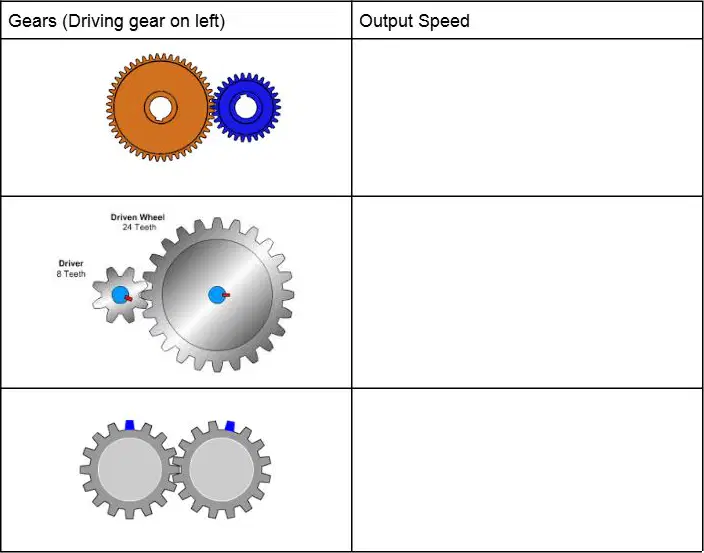
Fill in the following table. Describe how the output speed will be related to the input speed for the gear setup shown in the diagram (Driver: 8 teeth, Driven Wheel: 24 teeth).
The output speed will be slower than the input speed (the larger driven gear turns slower than the smaller driving gear).
The output speed will be faster than the input speed (the larger driven gear turns faster than the smaller driving gear).
The output speed will be equal to the input speed (both gears turn at the same rate).
The output speed will be unpredictable and not related to the input speed.
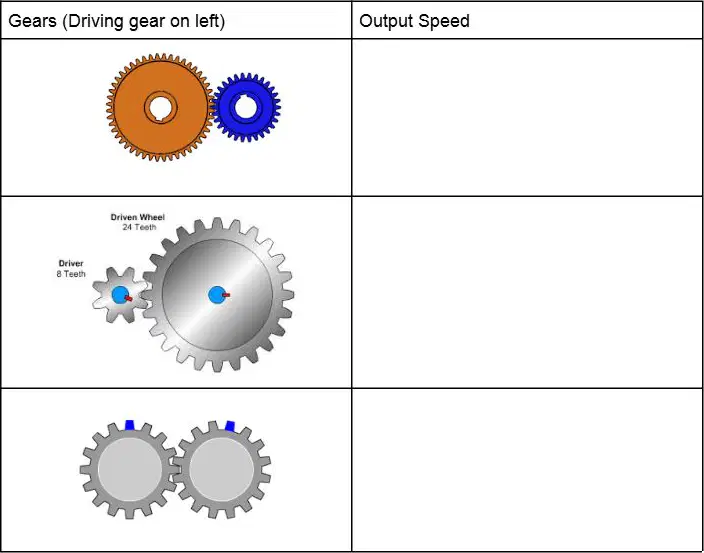
Fill in the following table. Describe how the output speed will be related to the input speed for the gear setup shown in the diagram (two equal-sized gears).
The output speed will be equal to the input speed (both gears are the same size, so they turn at the same speed).
The output speed will be twice the input speed.
The output speed will be half the input speed.
The output speed will be zero.

