
Font size
 Worksheets
Son Tinh and Thuy Tinh Story Comprehension
Total questions: 56
Worksheet time: 28mins
Read the passage below: King Hung Vuong VI had a beautiful daughter. He did not want her to marry just any prince. So, he made an announcement that he was looking for the right husband for her. Many princes came from faraway lands, but none of them was a good match for the princess. Son Tinh was the Spirit of the Mountain, and Thuy Tinh was the Spirit of the Waters. One day, they both appeared as young noblemen and asked to marry the princess. They were equally talented, powerful, and respected. The King found it hard to choose, so he decided to give them a test. He said that the one who brought the proper wedding gifts first the next morning would marry his daughter. The next day, Son Tinh arrived early with his gifts. The King kept his promise and gave the princess to him. Thuy Tinh was angry about losing. He challenged Son Tinh to fight for the princess. But Son Tinh refused, believing he had already won fairly. Furious, Thuy Tinh used his power to call the rivers and streams to rise. Soon, the land was covered with floods that destroyed crops and homes. Son Tinh stayed calm in his mountain palace. Whenever the water rose, he made his mountains higher. After many days of fighting, Thuy Tinh grew tired and ordered the waters to retreat. Still, he never accepted his defeat. Every year, he tried again to attack, and this is how monsoons came to Vietnam.
Son Tinh and Thuy Tinh both wanted to marry her.
Many princes came but none was suitable.
King Hung Vuong VI wanted the best husband for his daughter.
Thuy Tinh arrived first with the wedding gifts.
The King gave them a test.
According to the first passage, who did King Hung Vuong VI want to find for his daughter?
A friend
A husband
A teacher
A servant
In the first passage, what test did the King give to Son Tinh and Thuy Tinh?
A race
A test with wedding gifts
A math test
A singing contest
In the first passage, Son Tinh arrived first and married the princess.
True
False
In the first passage, Thuy Tinh attacked with ______ but was defeated.
floods
fire
arrows
earthquakes
According to the second passage, who did the princess like?
Only Son Tinh
Only Thuy Tinh
Both Son Tinh and Thuy Tinh
Neither
In the second passage, Thuy Tinh won the battle and ruled the land.
True
False
Fill in the blank: In the second passage, the country never suffered from ______ again.
floods
droughts
earthquakes
famines
According to the third passage, what did the King give Son Tinh and Thuy Tinh?
A gift
A challenge
A crown
A house
In the third passage, Son Tinh drowned in the floods.
True
False
Fill in the blank: In the third passage, Thuy Tinh lost the test and became ______.
angry
happy
confused
excited
According to the fourth passage, who did the King choose as the winner?
Son Tinh
Thuy Tinh
The princess
Himself
In the fourth passage, Son Tinh refused the challenge of gifts.
True
False
Fill in the blank: In the fourth passage, Thuy Tinh ruled peacefully without ______.
floods
wars
droughts
rebellions
Why did Thuy Tinh attack Son Tinh after the wedding?
He was jealous of Son Tinh’s victory
He believed the King had lied to him.
Why did Thuy Tinh challenge Son Tinh to fight for the princess?
He thought the princess loved him more.
He wanted to show off his power to the king.
He had promised to fight until death.
Read the passage about King Hung Vuong VI, Son Tinh, and Thuy Tinh. The king decided to give a test to the two young noblemen because:
he wanted to choose a worthy husband for his daughter
he wanted to test their magical powers
he wanted to see who was stronger
he wanted to punish them for fighting
What did Thuy Tinh do after losing the test?
Thuy Tinh attacked Son Tinh with storms and floods.
Thuy Tinh congratulated Son Tinh and left peacefully.
Thuy Tinh asked for a rematch.
Thuy Tinh became friends with Son Tinh.
Son Tinh responded to Thuy Tinh's attacks by:
raising the mountains higher to block the floodwaters
joining forces with Thuy Tinh
retreating from the battle
negotiating peace with Thuy Tinh
Why did King Hung Vuong VI not want his daughter to marry just any prince?
He wanted to find the right husband for her, not just any prince.
He did not believe in marriage.
He wanted her to become queen herself.
He disliked all princes.
Who were Son Tinh and Thuy Tinh?
Son Tinh was the Spirit of the Mountain, and Thuy Tinh was the Spirit of the Waters.
Son Tinh was the Spirit of the Sea, and Thuy Tinh was the Spirit of the Forest.
Son Tinh was the Spirit of the Wind, and Thuy Tinh was the Spirit of Fire.
Son Tinh was the Spirit of the Sun, and Thuy Tinh was the Spirit of the Moon.
What test did the King give to Son Tinh and Thuy Tinh?
The King said that the one who brought the proper wedding gifts first the next morning would marry his daughter.
The King asked them to solve a riddle to win his daughter's hand.
The King challenged them to a duel to prove their strength.
The King told them to build a palace overnight to marry his daughter.
What did Thuy Tinh do after losing to Son Tinh?
Thuy Tinh used his power to call the rivers and streams to rise, causing floods that destroyed crops and homes.
Thuy Tinh left peacefully and congratulated Son Tinh.
Thuy Tinh built a new kingdom far away from Son Tinh.
Thuy Tinh asked for help from other gods to challenge Son Tinh again.
How does the story explain the origin of monsoons in Vietnam?
Every year, Thuy Tinh tried again to attack, which is how monsoons came to Vietnam.
The monsoons began when the king ordered Thuy Tinh to create storms.
Monsoons started after Son Tinh and Thuy Tinh became friends.
The monsoons are caused by the tears of the villagers.
Match the following traits to Son Tinh and Thuy Tinh:
Both are not humans.
Both
They can control the elements.
Both
They love the king's daughter.
Both
What does the phrase "kept his promise" in the text mean?
Forgot about his decision.
Changed his mind about the wedding.
Did what he had promised to do.
Delayed the marriage for many days.
The King asked the princes to bring more gifts.
What is the main lesson of the story?
Accept defeat gracefully to prevent harm to others.
Be fair and follow the agreed rules in competitions.
Choose peaceful solutions rather than angry reactions.
Prepare honestly and present your gifts properly.
Respect leaders’ decisions and community agreements.
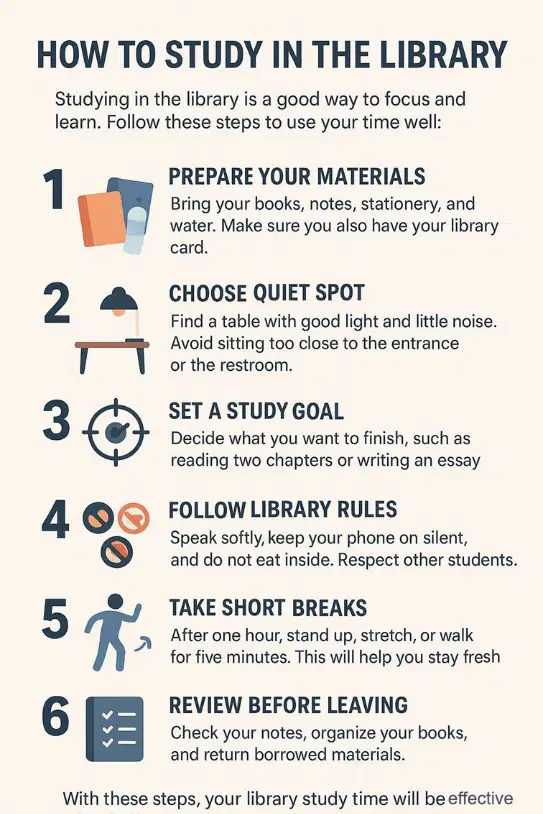
Is this activity a preparation or a break during study?
Break during study
Preparation before study
Revision after study
Group discussion
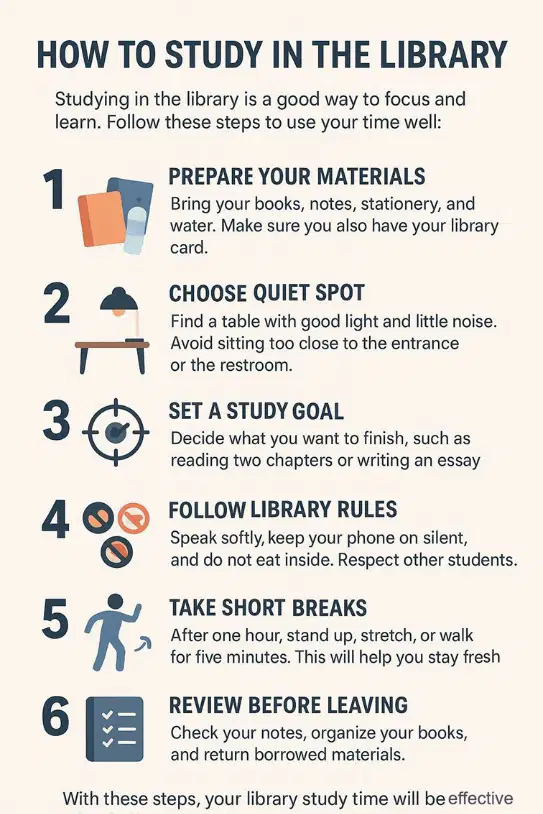
Is this activity a preparation or a break during study?
Preparation
Break
Revision
Relaxation
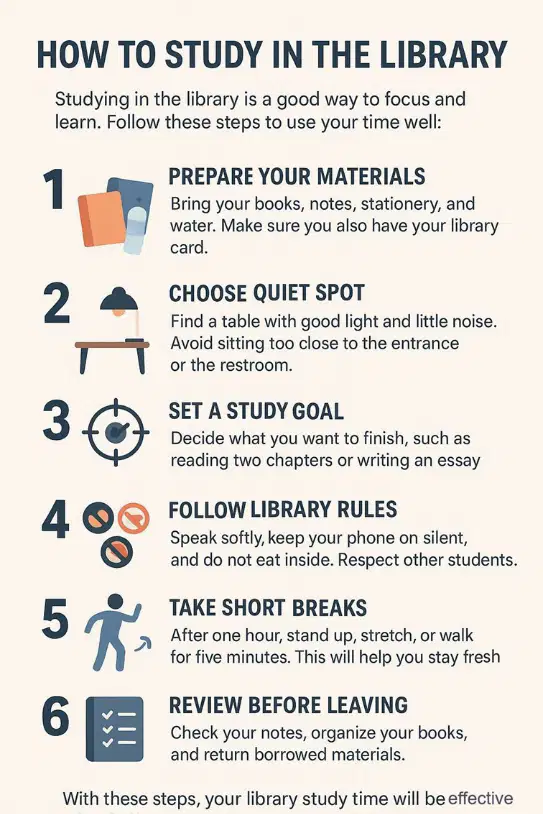
Is this activity a preparation or a break during study?
Break during study
Preparation before study
Revision after study
Group discussion
How can we decide a certain table is perfect for studying according to the text?
It has good lighting
It provides white noise
It is located near the entrance
It is far from the toilet
It provides stationery
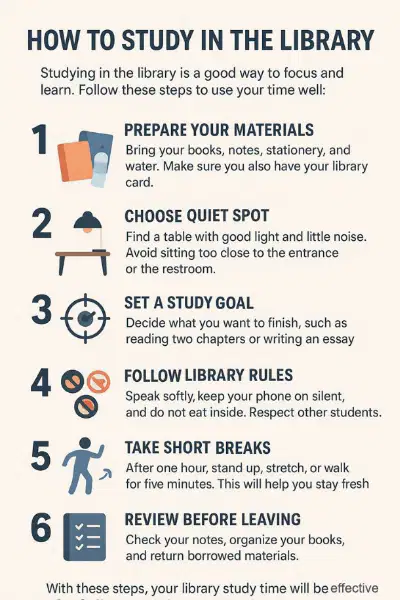
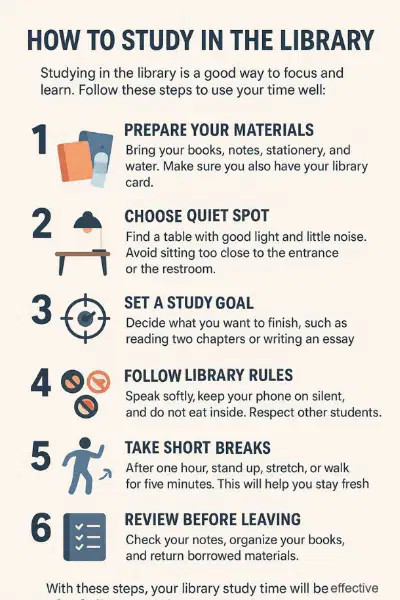
Who needs to read this infographic?
The students of that school
People who happen to visit the school
The librarian of another school
The headmaster of that school
Parents who come to pick up their kids
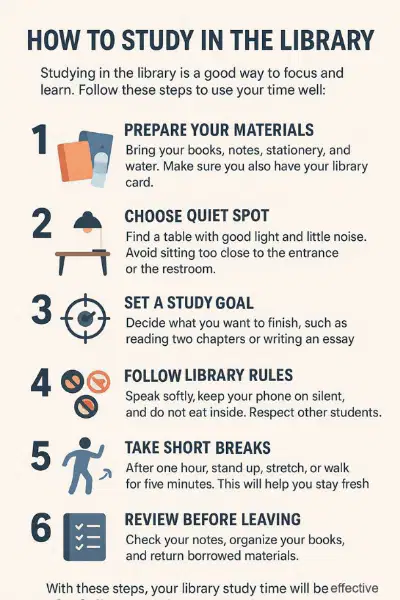
According to the infographic 'How to Study in the Library', what should you bring to the library?
Books, notes, stationery, water, and library card
Only your mobile phone and snacks
Just a laptop and headphones
Nothing, just yourself
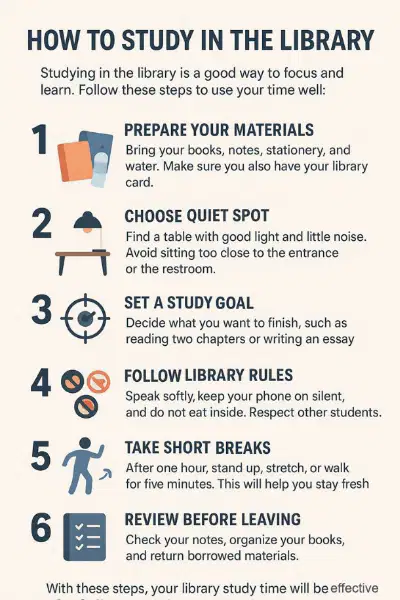
According to the infographic 'How to Study in the Library', where should you avoid sitting in the library?
Near the entrance or the restroom
By the windows
In the study rooms
Next to the bookshelves
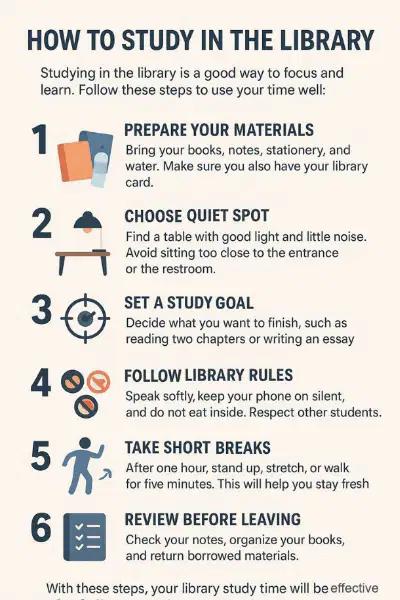
According to the infographic 'How to Study in the Library', what is an example of a study goal you can set?
Reading two chapters or writing an essay
Taking a nap in the library
Chatting with friends
Browsing social media
Organizing your backpack
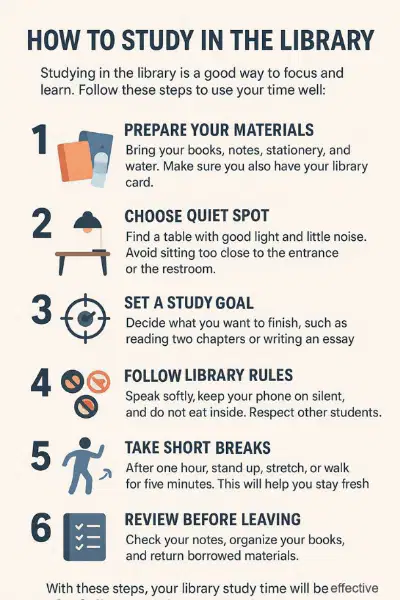
According to the infographic 'How to Study in the Library', what should you do to respect other students?
Speak softly, keep your phone on silent, and do not eat inside
Play loud music and talk on the phone
Eat snacks and chat with friends
Move furniture and make noise
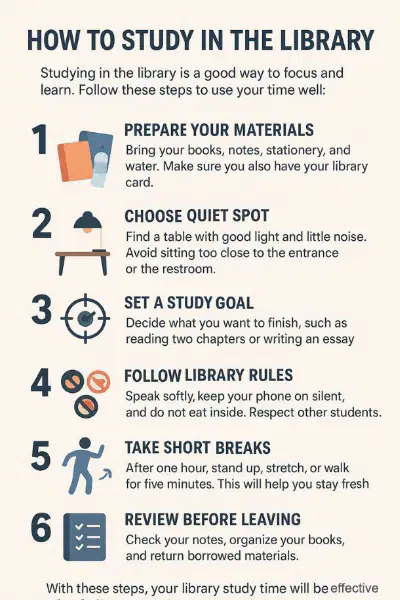
According to the infographic 'How to Study in the Library', what should you do after one hour of studying?
Stand up, stretch, or walk for five minutes
Continue studying without a break
Take a nap at your desk
Start chatting with friends
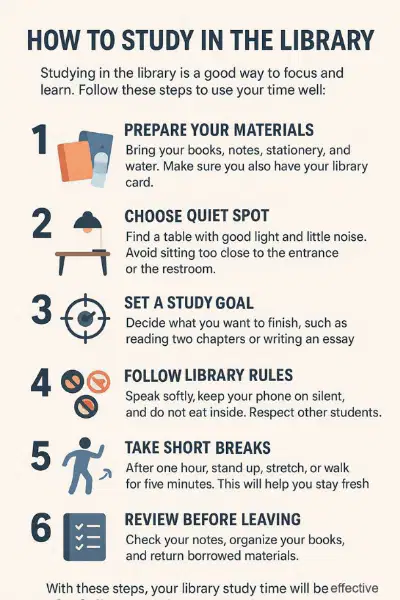
According to the infographic 'How to Study in the Library', what should you do before leaving the library?
Check your notes, organize your books, and return borrowed materials
Leave your books on the table and exit quietly
Take photos of all library materials before leaving
Ask the librarian to do your homework for you
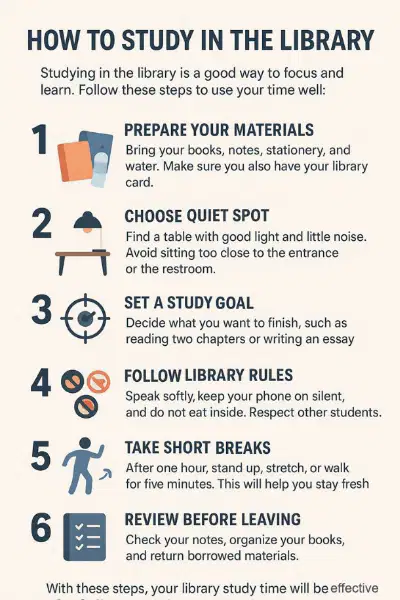
According to the infographic 'How to Study in the Library', what should you bring to prepare your materials?
Books, notes, stationery, water, and your library card.
Only your laptop and headphones.
Snacks, games, and your phone.
Just your library card and nothing else.
According to the infographic 'How to Study in the Library', where should you choose to sit in the library?
A table with good light and little noise, away from the entrance or restroom.
Near the entrance for easy access to resources.
Next to the restroom for convenience.
In a dark corner to avoid distractions.
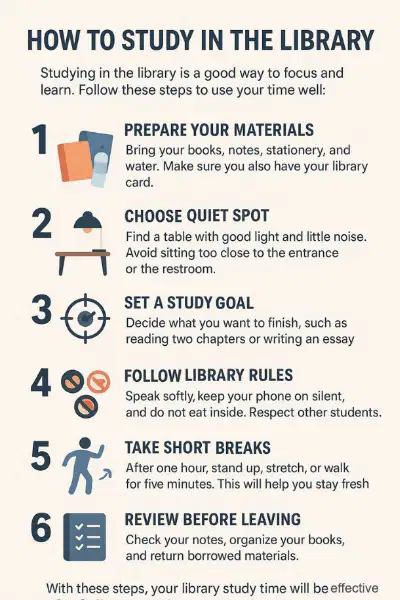
According to the infographic 'How to Study in the Library', what should you do to set a study goal?
Decide what you want to finish, such as reading two chapters or writing an essay.
Choose a comfortable chair to sit in.
Make a list of snacks to bring to the library.
Ask a friend to study with you.
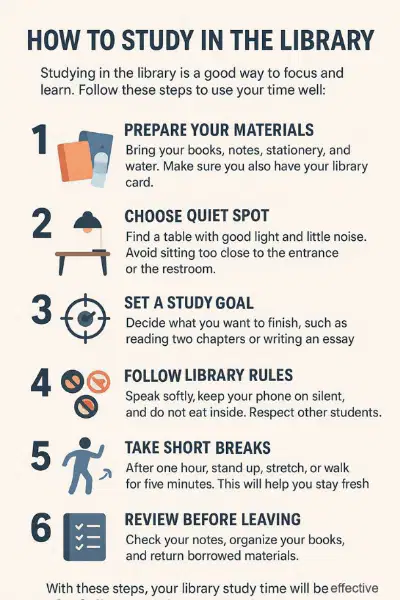
According to the infographic 'How to Study in the Library', what are some library rules you should follow?
Speak softly, keep your phone on silent, do not eat inside, and respect other students.
Talk loudly, use your phone freely, eat snacks, and ignore others.
Play music, bring pets, rearrange furniture, and shout answers.
Run in the aisles, make phone calls, eat meals, and disturb other students.
You find this infographic in front of your school library. What will you do before your next visit to the library?
Making sure that I bring my water bottle and lunch with me.
Bringing the books and stationery that I will use.
Organizing the book that I borrowed from the library.
Walking for five minutes so I can focus more when studying.
Making sure you look fresh because you will meet other students.
The main purpose of visiting Bali's natural attractions is:
to enjoy the beauty of nature
to attend business meetings
to shop for luxury goods
to study ancient architecture
The text mainly talks about Bali’s …
wildlife species and nature lovers
unique cultural treasures and sites.
stunning nature and remarkable sites.
generations and cultural conservation.
scenic beauty and local farming practices.
Which parts of the text best support the description of Bali as a "Bali is full of natural beauty"?
A. A peaceful area filled with green forests, calm mangrove swamps, and colorful coral reefs along the sea.
B. These terraces are shaped by generations of farmers who work the land by hand.
C. Water flows gently over rocky cliffs into a cool, clear pool. Mist rises into the air, mixing with the calming sound of falling water.
D. In the morning, mist rises above the fields, and sunlight reflects off the water in the paddies.
What was the writer's first experience working in a professional sports environment?
Working as an intern at a local sports club.
Attending a professional sports match as a spectator.
Coaching a youth sports team.
Writing articles for a sports magazine.
On the first day, what tasks did the head coach assign to the writer?
Set up cones for drills, bring water for the players, and check the training schedules.
Prepare the team uniforms, organize a team meeting, and write a match report.
Design a new team logo, schedule a press conference, and recruit new players.
Manage ticket sales, update the team website, and arrange transportation for fans.
Why were the first few days challenging for the writer during the internship?
Because the writer was not used to the morning routine and had to wake up early, arrive on time, and follow instructions carefully.
Because the writer was already familiar with the routine and found it too easy.
Because the writer was given too much free time and no tasks to complete.
Because the writer was working from home and did not have to commute.
During football practice, what emergency did the writer help handle?
A player fell and hurt his ankle.
A player fainted from heat.
A player lost his helmet.
A player was stung by a bee.
What important lesson did the writer learn from handling the emergency situation?
Staying alert and prepared during emergencies can make a big difference.
Ignoring emergencies is usually the best approach.
Panicking helps solve problems quickly.
Waiting for others to act is always safer.
At the end of the internship, what did the coaches highlight as the writer's strengths?
Teamwork, responsibility, and communication.
Technical skills, punctuality, and creativity.
Leadership, innovation, and adaptability.
Problem-solving, independence, and analytical thinking.
The writer received a club T-shirt as a gift at the end of the internship.
True
False
During the internship, what did the writer do every morning?
Made schedules and explained them to the coaches.
Played football with the team and got the first aid kit.
Prepared a club gift, guided the coaches, and gave t-shirts.
Woke up early, arrived on time, and followed the instructions.
Set up cones, brought water, and checked emergency schedules.
What are the best words to describe the writer’s personality during the internship?
Careful and ready to help
Confident and enjoys working alone
Responsible and willing to learn
Friendly and works well with others
Creative and likes to try new things
What will the writer most likely do after finishing the internship?
Considering a career in sports medicine
Stop working and focus only on school
Look for another chance to work in a sports club
Study medicine to become a doctor
Train as a professional football player

