
 Worksheets
Review SMI: Bleeding, Shock and Wound Care
Total questions: 75
Worksheet time: 38mins
Arteries are defined as:
Blood vessels that carry blood away from the heart.
Blood vessels that carry blood to the heart.
Vessels that transport oxygen directly to tissues.
Vessels that only carry deoxygenated blood.
Veins are defined as:
Blood vessels that carry blood toward the heart.
Blood vessels that carry blood away from the heart.
Organs that pump blood throughout the body.
Tubes that transport oxygen from the lungs to the tissues.
Capillaries are defined as:
The smallest blood vessels that connect arteries and veins
Large vessels that carry blood away from the heart
Vessels that carry blood back to the heart
Chambers of the heart that pump blood
Septa is defined as:
Thin walls or partitions dividing two cavities or spaces.
A type of muscle tissue found in the heart.
A pigment responsible for skin color.
A type of nerve cell in the brain.
Atria are defined as:
The upper chambers of the heart that receive blood
The lower chambers of the heart that pump blood
Blood vessels that carry oxygenated blood
Valves that prevent backflow of blood
Ventricles are best defined as:
Chambers in the heart that pump blood
Tubes that carry blood away from the heart
Valves that prevent backflow of blood
Muscles that contract to move the heart
The aorta is defined as:
The largest artery in the body
A vein that carries blood to the heart
A nerve in the spinal cord
A muscle in the leg
Vena Cava is defined as:
The large vein that carries deoxygenated blood into the heart
The artery that supplies blood to the brain
A small capillary in the lungs
The vessel that carries oxygenated blood from the heart to the body
Platelets are defined as:
Small blood cells that help in clotting
Cells that carry oxygen in the blood
White blood cells that fight infection
Plasma proteins that transport hormones
Hemoglobin is defined as:
A protein in red blood cells that carries oxygen.
A type of white blood cell involved in immunity.
A hormone that regulates blood sugar levels.
A mineral found in bones.
Systolic Pressure is defined as:
The pressure in the arteries when the heart beats
The pressure in the arteries when the heart rests between beats
The pressure in the veins during relaxation
The pressure in the capillaries during contraction
Diastolic Pressure is defined as:
The pressure in the arteries when the heart rests between beats.
The pressure in the arteries during the contraction of the heart.
The total blood volume in the body.
The rate at which the heart beats.
Pulse is defined as:
The rhythmic throbbing of arteries as blood is propelled through them
The amount of blood pumped by the heart in one minute
The pressure exerted by blood on the walls of blood vessels
The electrical activity of the heart
Hemorrhagic Shock is defined as:
A condition caused by severe blood loss leading to inadequate tissue perfusion.
A condition caused by excessive fluid intake.
A condition resulting from an allergic reaction.
A condition caused by high blood sugar levels.
Neurogenic Shock is defined as:
A type of shock resulting from the loss of sympathetic tone leading to vasodilation and hypotension.
A condition caused by severe blood loss leading to decreased tissue perfusion.
A shock state due to an allergic reaction causing airway constriction and low blood pressure.
A shock caused by infection leading to widespread inflammation and organ dysfunction.
Anaphylactic Shock is defined as:
A severe, life-threatening allergic reaction that occurs rapidly.
A mild skin rash caused by an allergy.
A slow, progressive loss of consciousness due to dehydration.
A minor swelling of the throat after eating spicy food.
Dressing is defined as:
A covering applied to a wound to promote healing and protect from further harm.
A type of surgical instrument used to cut tissue.
A medication given to reduce pain.
A process of sterilizing surgical tools.
Bandage is defined as:
A strip of material used to bind a wound or to protect an injured part of the body.
A type of surgical instrument used to cut tissue.
A medication applied to reduce fever.
A device used to measure blood pressure.
Cyanotic is defined as:
A bluish discoloration of the skin due to lack of oxygen
A yellowing of the skin due to liver problems
A reddening of the skin due to increased blood flow
A pale appearance of the skin due to anemia
Fill in the blank: The heart pumps blood throughout the body through a system of ________.
pathways
muscles
bones
nerves
Which of the following are the main types of blood vessels in the cardiovascular system?
A) Arteries, veins, and capillaries
B) Nerves, tendons, and ligaments
C) Bones, muscles, and skin
D) Lungs, liver, and kidneys
The blood is enriched with oxygen when it passes through the lungs.
True
False
What is the name of the blood vessel that carries blood from the heart to the lungs?
Pulmonary artery
Aorta
Pulmonary vein
Vena cava
What is the name of the blood vessel that returns oxygenated blood from the lungs to the heart?
Pulmonary vein
Pulmonary artery
Aorta
Vena cava
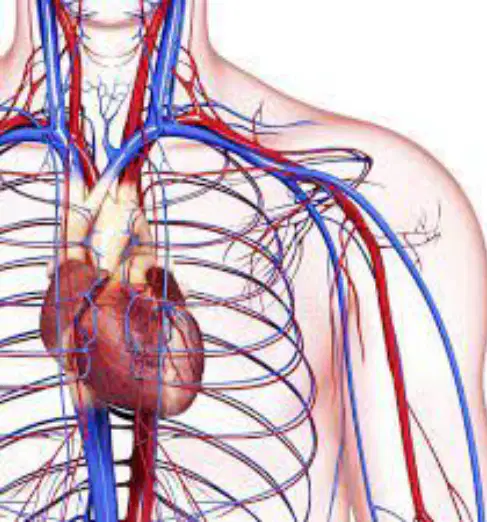
What is the main function of the circulatory system?
To digest food
To transport dissolved materials throughout the body
To control movement
To produce hormones
The course taken by the blood through the arteries, capillaries and veins, then back to the heart is called the ________ system.
circulatory
digestive
respiratory
nervous
The circulatory system uses blood to transport which of the following throughout the body?
Oxygen
Carbon dioxide
Nutrients
Waste products
All of the above

The heart consists of how many independent pumps?
Two
One
Three
Four
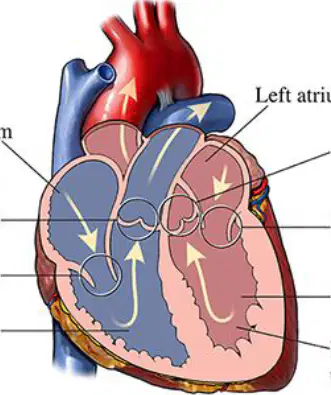
What are the two pumps of the heart separated by?
Partitions called septa
Valves called cusps
Muscles called myofibrils
Chambers called atria
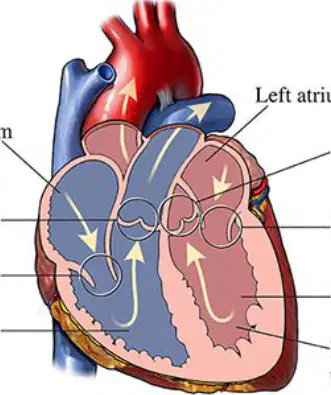
The right side of the heart pumps blood through which circulation?
Systemic circulation
Pulmonary circulation
Digestive circulation
Renal circulation

The left side of the heart pumps blood through the _______ circulation.
systemic
pulmonary
coronary
hepatic
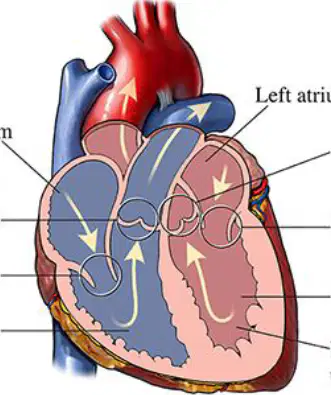
Match the following heart parts with their correct location as shown in the diagram:
Right atrium
Top right
Left atrium
Top left
Right ventricle
Bottom right
Left ventricle
Bottom left
How many cavities does the heart have that fill with blood?
Two
Four
Six
Eight
Name the two types of chambers found in the heart.
Atria and ventricles
Auricles and septa
Ventricles and valves
Atria and arteries
Which chambers are the upper chambers of the heart?
A) Atria
B) Ventricles
C) Both
D) Neither
The aorta is the largest artery that carries blood ______ from the heart.
away
towards
within
around
Which artery carries blood away from the heart to the lungs?
Aorta
Pulmonary artery
Superior vena cava
Inferior vena cava
The two main veins that carry blood back to the heart are the ______ and the ______.
superior vena cava, inferior vena cava
pulmonary artery, aorta
jugular vein, carotid artery
femoral vein, subclavian vein
True or False: The pulmonary artery carries blood away from the heart.
True
False
On average, the heart contracts and relaxes about ___ times a minute.
70-80
30-40
100-110
50-60
Nerves will regulate the speed of heart contractions.
True
False
The faster the heart pumps, the more ___ and ___ are carried throughout the body.
oxygen and nutrients
carbon dioxide and waste
sugar and salt
hormones and enzymes
Blood is composed of ______ (yellowish liquid), red blood cells, infection fighting white blood cells, and tiny cell fragments called platelets.
plasma
hemoglobin
serum
lymph
The average adult's body has how many pints of blood?
2-4
5-7
8-10
12-14
A loss of 2 pints or more of blood at one time can have serious consequences.
True
False
Plasma composes what percentage of total blood volume?
55%
25%
70%
40%
What is the main purpose of Red Blood Cells (RBC or Erythrocytes)?
Oxygen transport
Digestion of food
Production of hormones
Transmission of nerve impulses
What is the main purpose of White Blood Cells (WBC)?
To fight infection
To transport oxygen
To clot blood
To produce hormones
Platelets are small cell fragments responsible for ________.
blood clotting
oxygen transport
hormone production
nerve impulse transmission
What is the main function of arteries?
Carry blood back to the heart
Carry blood from the heart to all the organs and cells in the body
Store blood
Filter blood
True or False: Arteries increase in size the closer they are to the cells they are nourishing.
True
False
What is the main function of veins?
Carry blood from the heart to the organs
Carry blood back to the heart
Store oxygen
Remove waste from the body
Muscles in the extremities compress the veins to assist in blood flow.
True
False
What is the main function of capillaries?
Transferring oxygen and nutrients to the cells.
Pumping blood throughout the body.
Filtering waste from the blood.
Producing hormones.
What is the role of coronary arteries?
To provide blood and oxygen to the heart.
To filter waste from the blood.
To produce hormones for the body.
To help in the digestion of food.
What does systolic blood pressure represent?
The lowest pressure in the heart, relates to ventricular relaxation
The highest pressure in the heart, correlates to the ventricular contraction
The average pressure in the arteries
The pressure in the veins
What does diastolic blood pressure represent?
The highest pressure in the heart, correlates to the ventricular contraction
The lowest pressure, relates to ventricular relaxation and the pressure exerted within the arteries between beats
The average pressure in the arteries
The pressure in the veins
Blood pressure is measured in _________.
mm/mercury or mm/Hg
cm/water or cm/H2O
kg/meter or kg/m
liters/second or L/s
The average blood pressure is _________.
120/80
140/90
100/60
130/85
What is a pulse?
A) A type of muscle
B) Rhythmical beating of the heart, can be felt at different points of the body
C) A type of nerve
D) A type of bone
Pulse is created by alternating ________ and contraction of an artery as blood flows through it.
expansion
relaxation
compression
dilation
Pulse rate of athletes may be significantly lower than average because as the heart becomes more efficient, it does not have to pump as often.
True
False
Where can the Brachial artery pulse be felt?
At the crook of the elbow, along inner border of the biceps.
On the side of the neck, beside the trachea.
On the back of the knee, in the popliteal fossa.
On the wrist, lateral to the flexor carpi radialis tendon.
Where can the Common Carotid artery pulse be felt?
In the neck, along the front margin of the sternocleidomastoid muscle.
On the back of the hand, near the thumb.
At the bend of the elbow, on the inner side.
Behind the knee joint.
Where can the Dorsal Pedal artery pulse be felt?
Anterior surface of the foot, below the ankle.
Medial side of the ankle, behind the malleolus.
Posterior aspect of the knee joint.
Lateral side of the wrist, above the thumb.
Where can the Radial artery pulse be felt?
At the wrist, on the same side as the thumb.
At the ankle, behind the medial malleolus.
At the neck, beside the trachea.
At the elbow, in the cubital fossa.
According to the Wound Care Guidelines, what should you use to irrigate the wound to wash away any foreign particles?
Clean water
Alcohol
Vinegar
Hydrogen peroxide
According to the Wound Care Guidelines, gently washing with mild soap is recommended for which type of wounds?
Superficial wounds only
Deep puncture wounds
Burn wounds only
Chronic ulcers
According to the Wound Care Guidelines, after washing, what is the next step in wound care?
Dry the wound
Apply antibiotic ointment before drying
Cover the wound with a bandage immediately
Leave the wound open to air
According to the Wound Care Guidelines, what type of ointment should be applied to the wound?
Triple antibiotic ointment
Hydrocortisone cream
Petroleum jelly
Antifungal ointment
According to the Wound Care Guidelines, what should you use to cover the wound?
A sterile gauze or bandage
A piece of plastic wrap
A dirty cloth
Sandpaper
According to the Wound Care Guidelines, how often should you change the dressing on a wound?
Daily or if it becomes wet or soaked with drainage
Once a week regardless of condition
Only when the wound is completely healed
Every month
According to the Wound Care Guidelines, which of the following are signs of infection to check for daily?
Increased body temperature
Increased pain
Swelling
Redness
Oozing of pus
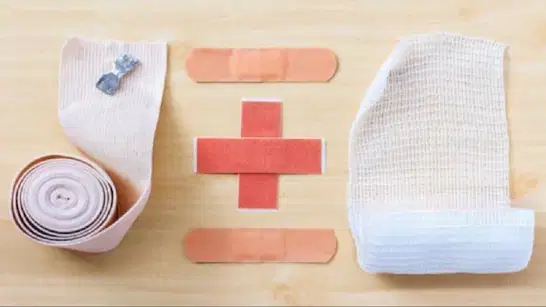
What is a Dressing? Fill in the blank: A Dressing is the material placed directly on the _______.
wound
table
instrument
patient's chart
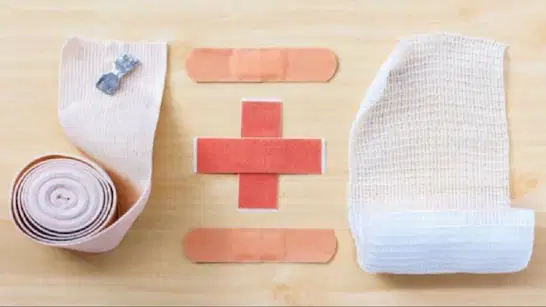
What is a Bandage? Fill in the blank: A Bandage is the material that holds the _______ in place.
dressing
splint
cast
ointment

