
 Worksheets
Ecosystem Services
Total questions: 86
Worksheet time: 43mins
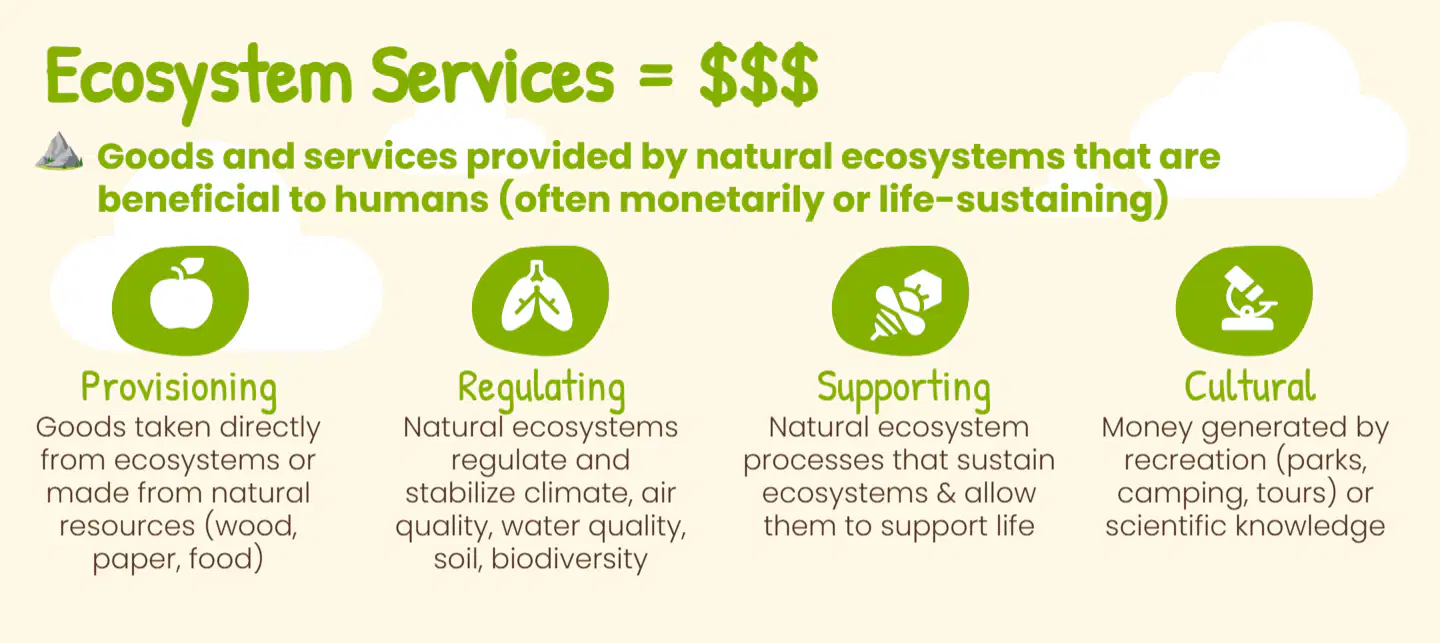
What is the main topic shown in the image?
Ecosystem Services
Urban Development
Space Exploration
Oceanography
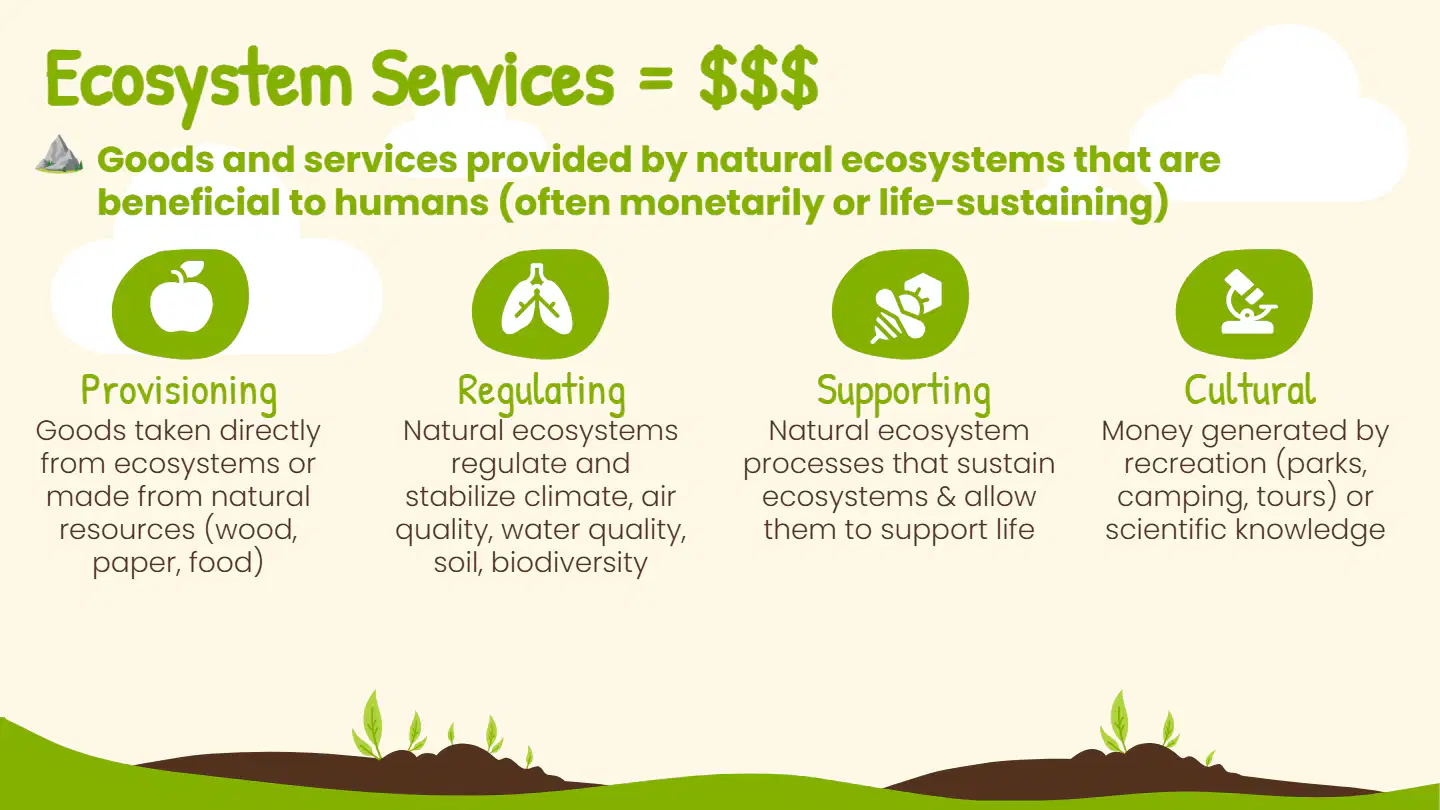
Which of the following best describes "Provisioning" ecosystem services?
Goods taken directly from ecosystems or made from natural resources (wood, paper, food)
Processes that sustain ecosystems and allow them to support life
Regulation and stabilization of climate, air quality, and water quality
Money generated by recreation or scientific knowledge
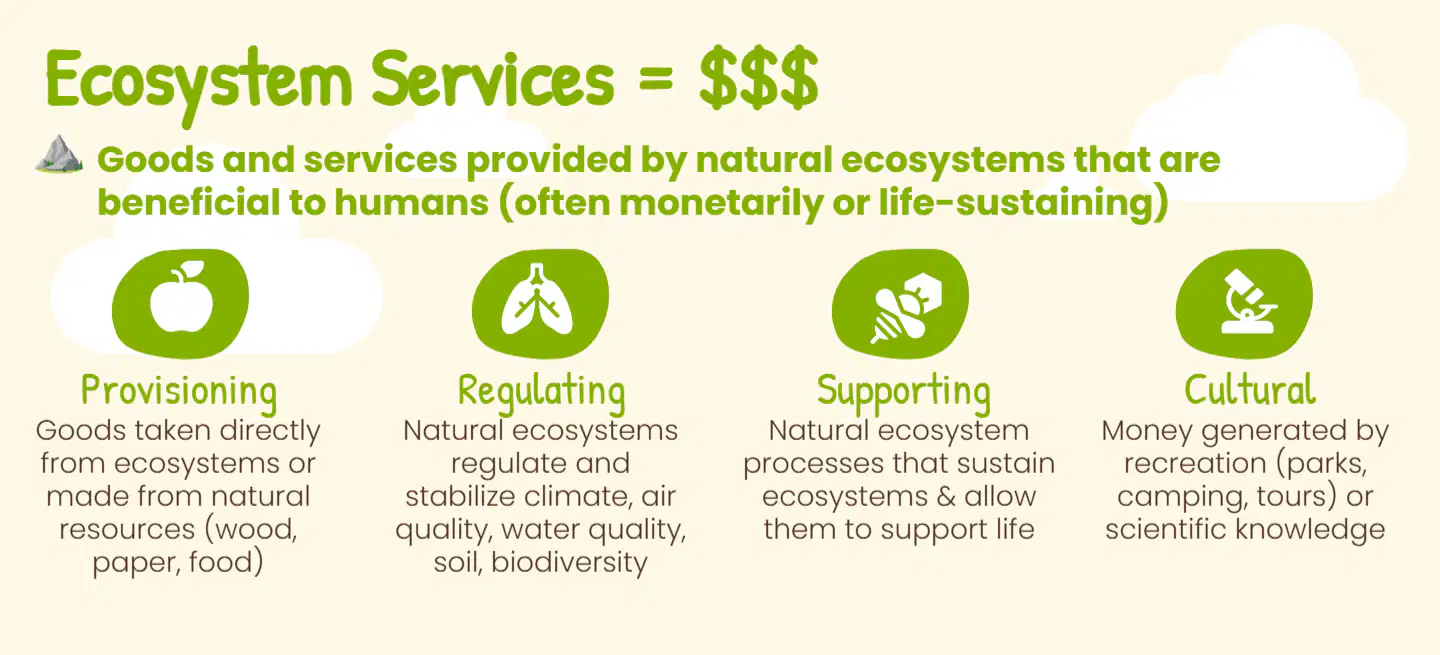
Which type of ecosystem service involves the regulation and stabilization of climate, air quality, water quality, soil, and biodiversity?
Provisioning
Regulating
Supporting
Cultural
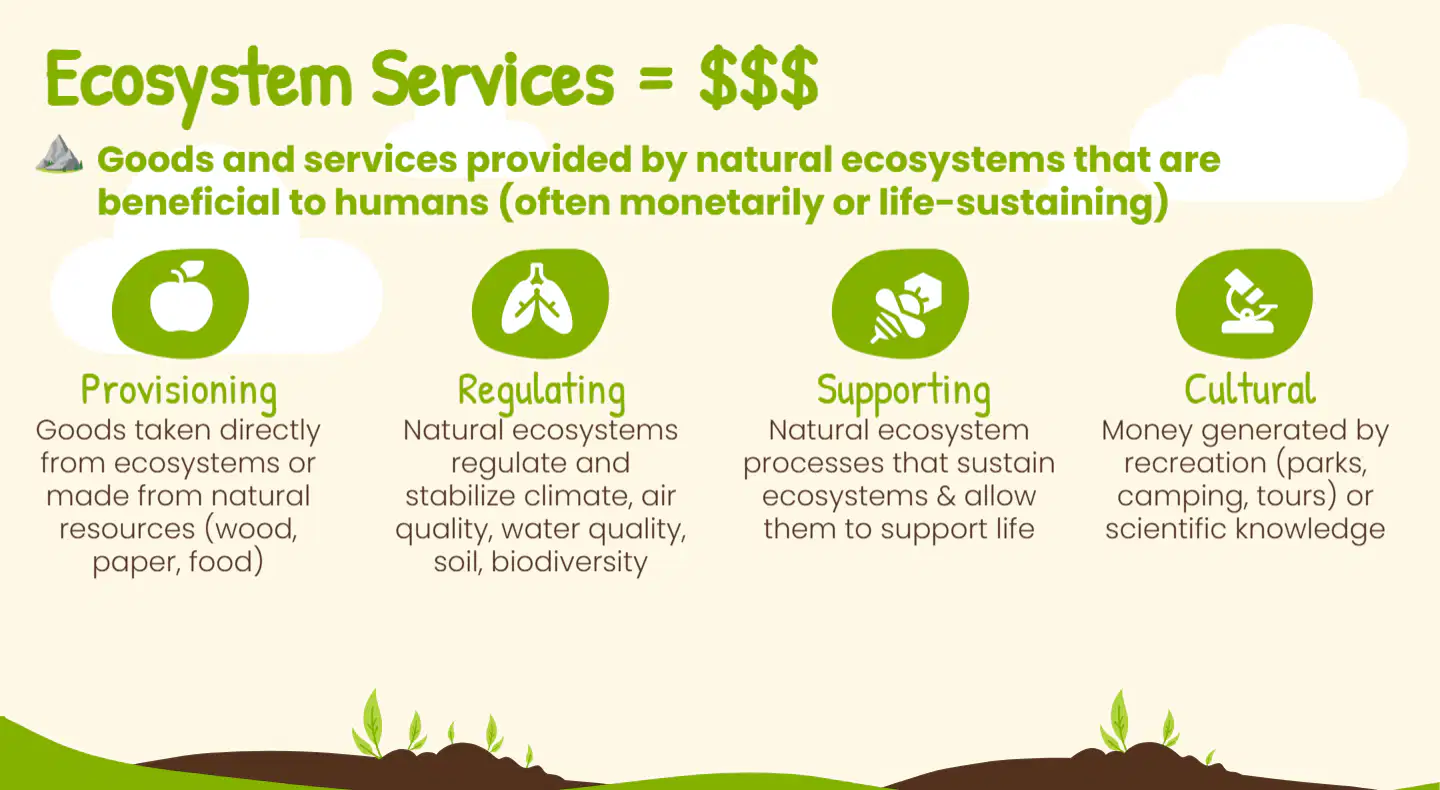
What is an example of a cultural ecosystem service?
Food production
Air quality regulation
Money generated by recreation or scientific knowledge
Soil formation

How do supporting ecosystem services contribute to human well-being?
By providing goods like wood and food
By regulating climate and water quality
By sustaining ecosystem processes that allow life to be supported
By generating money through tourism
A city wants to improve air quality and stabilize its local climate. Which ecosystem service should it focus on enhancing?
Provisioning
Regulating
Supporting
Cultural
What is one way human activities disrupt ecosystem services?
By increasing the number of trees in forests
By disrupting the ability of ecosystems to function
By reducing atmospheric CO₂ levels
By creating more fish populations
Which of the following is an ecological consequence of disrupting ecosystem services?
Increased economic growth
Increased atmospheric temperature
Decreased storm damage
Higher crop yields
What is a possible economic consequence of overfishing?
More fish available for sale
Lost fishing jobs and lower fish sales in the future
Increased crop production
Higher tree population
Why does clearing land for agriculture or cities increase atmospheric CO₂?
It adds more water vapor to the air
It removes trees that store CO₂
It increases the number of fish in the ocean
It reduces the amount of sunlight
Explain how human activities can have both ecological and economic consequences on ecosystem services. (DoK Level 3)
Human activities only affect the natural environment, not the economy.
Human activities can disrupt natural processes, leading to issues like increased storms and crop failure, and also cause economic problems such as job loss and reduced sales.
Human activities always improve both ecological and economic outcomes.
Human activities have no impact on ecosystem services.
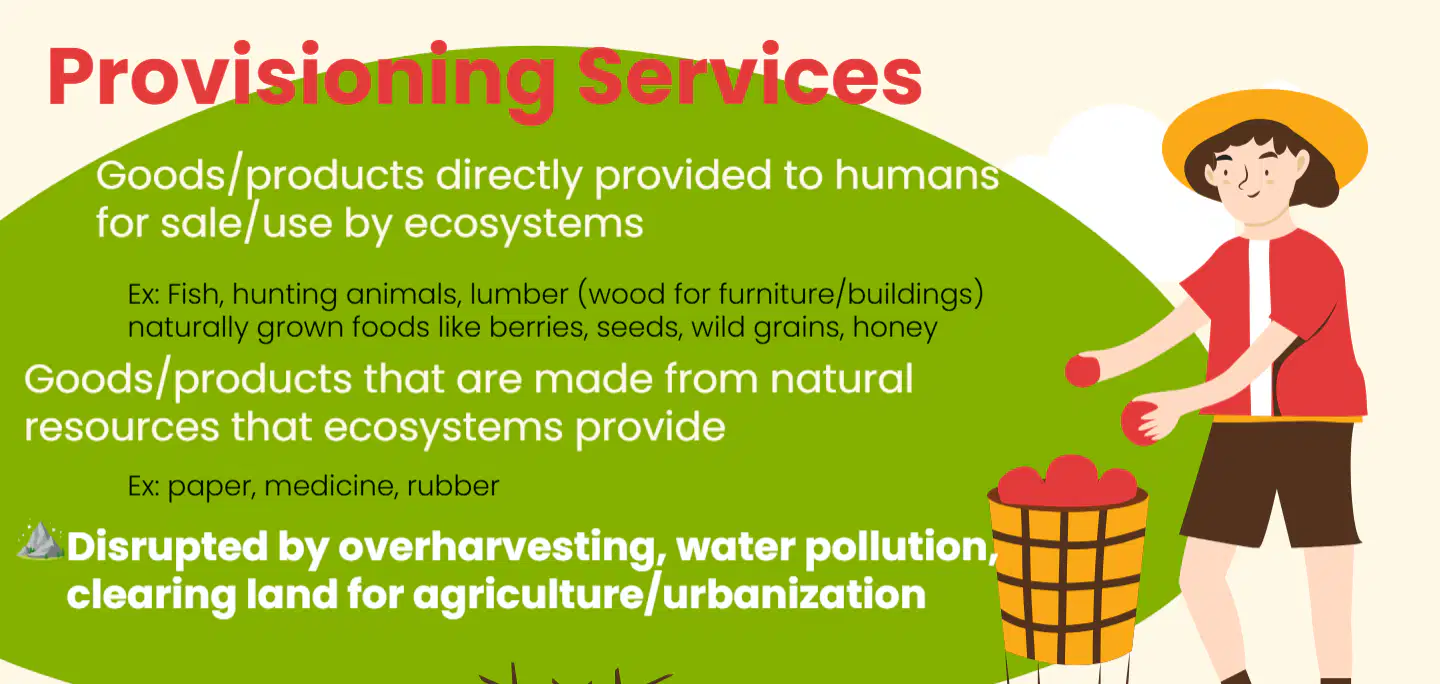
Which of the following is an example of a provisioning service directly provided to humans by ecosystems?
Fish
Electricity
Plastic
Concrete
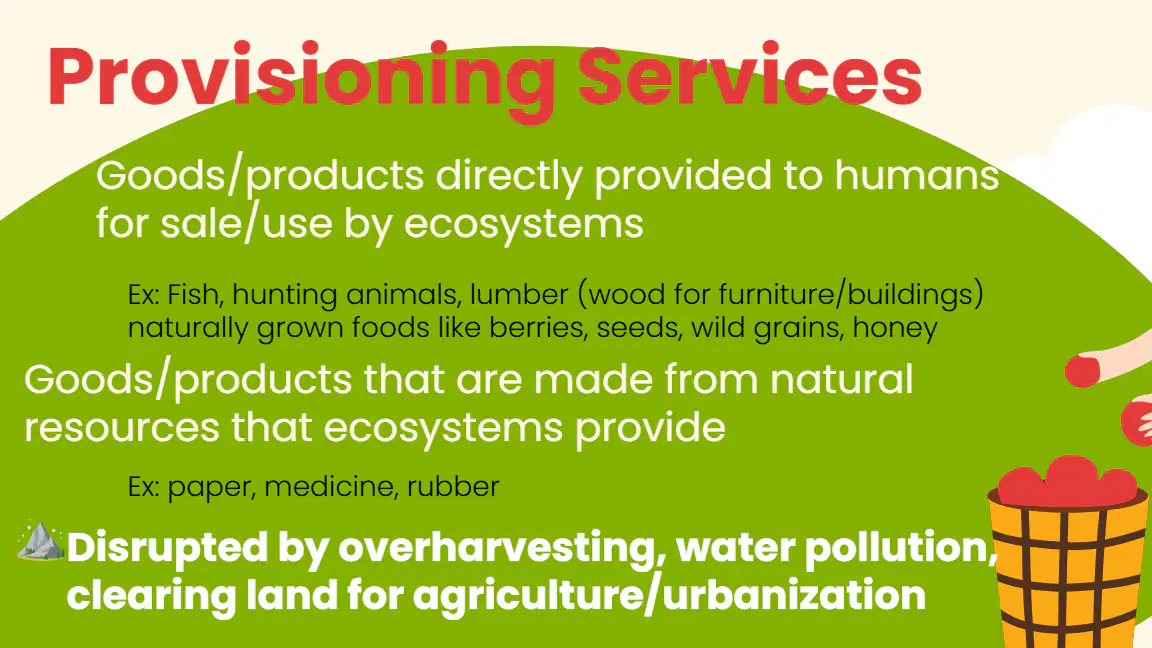
Which of the following products is made from natural resources that ecosystems provide?
Paper
Steel
Glass
Aluminum
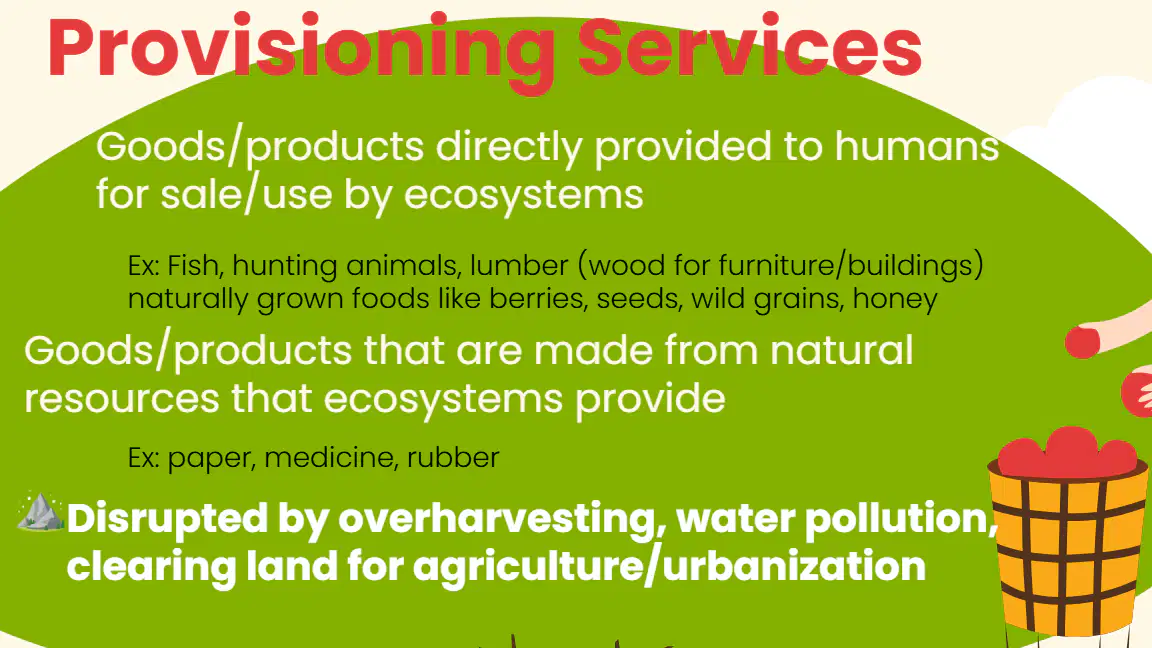
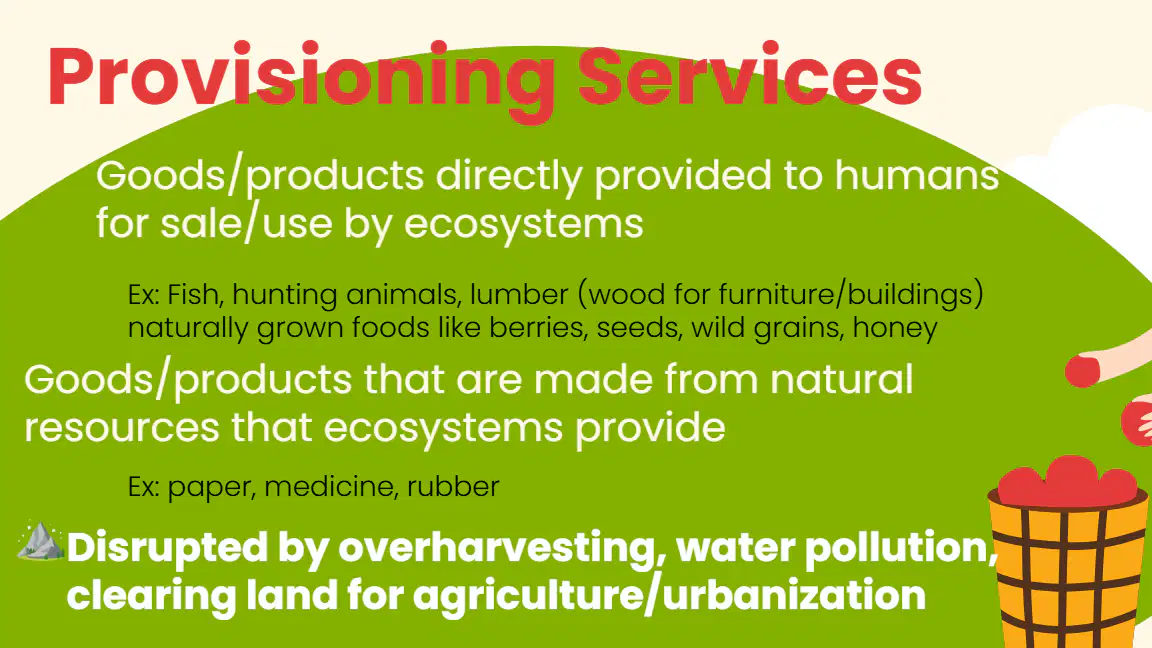
What are some human activities that can disrupt provisioning services provided by ecosystems?
Overharvesting, water pollution, clearing land for agriculture/urbanization
Recycling, composting, planting trees
Using solar panels, riding bicycles, conserving water
Building parks, creating wildlife reserves, cleaning beaches
Explain how clearing land for agriculture can impact provisioning services from ecosystems.
It can reduce the availability of natural resources and disrupt the supply of goods like food and medicine.
It increases the number of wild animals in the area.
It improves water quality in nearby rivers.
It makes ecosystems more diverse and productive.
Which of the following best describes "regulating services" provided by ecosystems?
Benefits from ecosystem processes that moderate natural conditions like climate, air quality, biodiversity, and soil quality
The production of food and raw materials by ecosystems
The recreational and cultural benefits provided by nature
The direct extraction of minerals from the earth
Which of the following is an example of a regulating service provided by ecosystems?
Mining for coal
Filtration and purification of water by wetlands
Building roads
Harvesting timber
How do trees help reduce the impacts of atmospheric warming and costly events like storm damage or crop loss?
By providing shade for animals
By sequestering CO₂ via photosynthesis
By producing fruit for humans
By increasing soil erosion
Which process is disrupted by deforestation, pollinator habitat loss, and filling in wetlands?
Regulating services
Mining operations
Urban development
Transportation services
Explain how pollination acts as a regulating service and why its disruption could impact food production and biodiversity.
Pollination helps plants reproduce, supporting food production and biodiversity; its disruption can reduce crop yields and decrease plant diversity.
Pollination only affects animal populations, not plants.
Pollination increases soil erosion, which is harmful to crops.
Pollination is unrelated to ecosystem services.
Trees play a role in reducing health care costs for diseases like asthma and bronchitis. What is the mechanism behind this benefit?
Trees provide shade for hospitals
Trees absorb air pollutants, improving air quality
Trees produce medicine directly
Trees increase humidity, which helps patients
Which of the following is an example of a supporting service in an ecosystem?
Photosynthesis
Transportation
Internet access
Manufacturing
What is the main function of supporting services in ecosystems?
To provide food directly to humans
To sustain ecosystems and support all other ecosystem services
To increase urbanization
To create pollution
Which process is NOT mentioned as a supporting service in the material?
Soil creation
Nutrient cycling
Habitat creation
Fossil fuel burning
How does habitat loss due to deforestation, agriculture, and urbanization affect supporting services?
It enhances supporting services
It has no effect on supporting services
It leads to the loss of supporting services
It only affects human populations
Explain why supporting services are essential for the functioning of ecosystems and the provision of other ecosystem services.
They provide entertainment for humans
They maintain ecosystem functions, which support all other ecosystem services
They only benefit plants
They are not necessary for ecosystem health
According to AP Classroom and the UN Food and Agriculture Organization, why is pollination classified as a regulating ecosystem service?
Because it assists plant reproduction, fruit production, and fosters biodiversity.
Because it reduces the cost of water purification.
Because it increases soil fertility.
Because it prevents soil erosion.
How do AP Classroom and the UN Food and Agriculture Organization classify water purification/treatment?
As a regulating service, since ecosystems like wetlands regulate water quality by removing pollutants.
As a supporting service, since it aids agriculture.
As a provisioning service, since it provides clean water.
As a cultural service, since it benefits human recreation.
How does Friedland 4th edition classify pollination?
As a supporting service, since it aids human agriculture and makes it more productive.
As a regulating service, since it controls pests.
As a provisioning service, since it provides food.
As a cultural service, since it supports traditions.
According to Friedland 4th edition, why is water filtration by ecosystems considered a supporting service?
Because it reduces the cost humans need to pay to purify water.
Because it increases biodiversity.
Because it provides recreational opportunities.
Because it prevents flooding.
Why do the updated slides use the College Board and UN classifications of ecosystem services?
To provide a clear answer to the distinctions between supporting and regulating services.
To focus on cultural services.
To emphasize only provisioning services.
To ignore human-defined categories.
Which of the following is an example of a cultural service provided by ecosystems?
Production of oxygen by plants
Tourists paying to enter parks and spend money at local stores
Decomposition of organic matter
Regulation of climate by forests
What is one way that scientific discoveries in ecosystems can generate profit?
By increasing rainfall
By creating new medicines from plant compounds
By reducing soil erosion
By providing shade for animals
Which of the following activities is most likely to disrupt cultural services provided by ecosystems?
Planting more trees
Deforestation, pollution, and urbanization
Practicing sustainable fishing
Building eco-friendly campsites
A fisherman pays for a license to catch fish in a clean river. This is an example of which type of ecosystem service?
Supporting service
Cultural service
Regulating service
Provisioning service
Why might local communities benefit economically from the preservation of beautiful landscapes?
Because it increases the amount of rainfall
Because tourists are attracted and spend money at local businesses
Because it reduces the need for scientific research
Because it eliminates the need for fishing licenses
Which of the following best describes "instrumental value" in the context of ecosystem values?
The worth of ecosystems in terms of goods and services
The value of ecosystems based on religious beliefs
The value of ecosystems independent of human needs
The obligation to protect ecosystems
What does "intrinsic value" of an ecosystem mean?
Ecosystems are valuable only if they provide resources to humans
Ecosystems have their own value independent from human needs and desires
Ecosystems are important for economic development
Ecosystems should be protected only for future generations
Which of the following is often related to the intrinsic value of ecosystems?
Economic growth
Scientific research
Religion and/or philosophy
Industrial development
Why might someone feel a moral obligation to protect ecosystems?
Because ecosystems provide entertainment
Because ecosystems have intrinsic value
Because ecosystems are easy to replace
Because ecosystems are not important to humans

A company is focused only on extracting the last profits from a devastated natural world, as shown in the cartoon. Which ecosystem value are they ignoring?
Instrumental value
Intrinsic value
Economic value
Recreational value
Which of the following is an example of a provisioning service provided by ecosystems?
Pollination of crops by bees
Regulation of climate
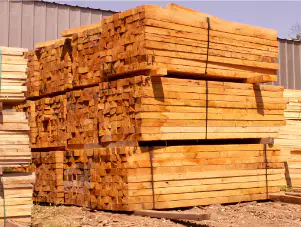
Lumber used for building
Decomposition of organic matter
What does the term "provisioning" refer to in the context of ecosystem services?
The regulation of environmental conditions
The goods that humans use directly from nature
The cultural benefits provided by nature
The recycling of nutrients in the soil
Which of the following is NOT listed as a provisioning good in the material?
Rubber
Medicinal plants (Taxol)
Food crops
Clean air
If a pharmaceutical company develops a new medicine from a plant found in the wild, which ecosystem service is being utilized?
Cultural
Provisioning
Supporting
Regulating
Which of the following is an example of a provisioning ecosystem service that humans use directly?
Air purification
Lumber
Climate regulation
Soil formation
Which anthropogenic activity could negatively affect provisioning ecosystem services?
Natural disasters
Urban development
Photosynthesis
Soil erosion by wind
What is one ecological consequence of illegal wildlife trade and urban development?
Increase in food production
Loss of forests
Improved air quality
Enhanced biodiversity
How can deforestation and habitat destruction impact the economy?
Increase in food supply
Loss of food, lumber, and medicine
Growth in tourism
Higher employment rates
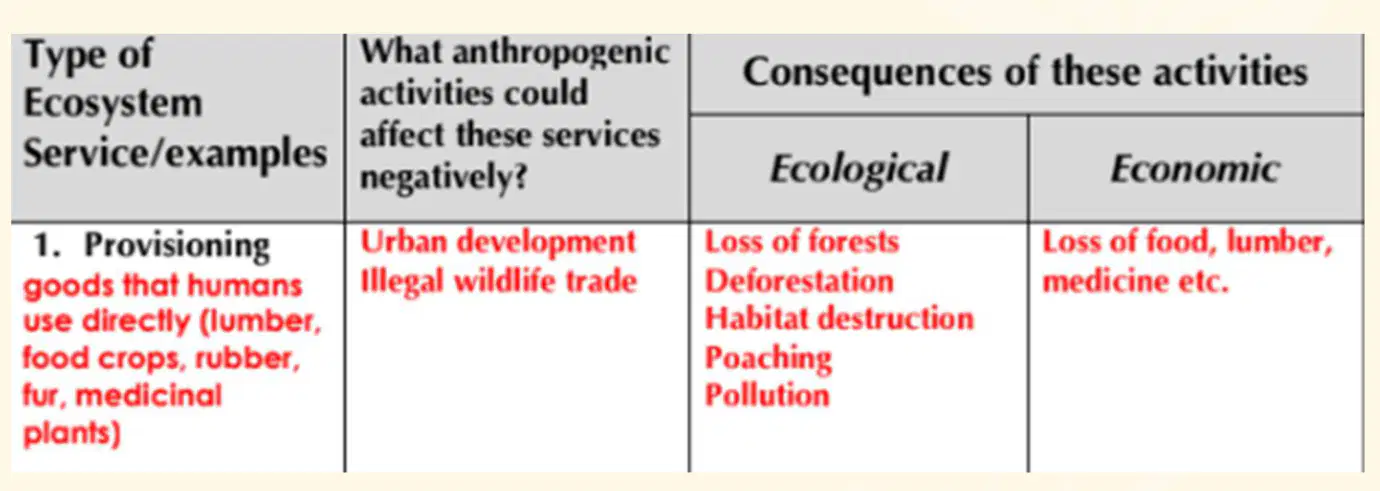
Explain how urban development can lead to both ecological and economic consequences, using evidence from the table.
Urban development increases biodiversity and reduces costs.
Urban development causes loss of forests and results in loss of food, lumber, and medicine.
Urban development improves soil quality and increases crop yield.
Urban development has no impact on ecosystem services.
Which organisms are responsible for removing 4 gigatons of carbon from the atmosphere as mentioned in the learning material?
Animals and fungi
Phytoplankton and plants
Insects and bacteria
Rocks and minerals
What is one of the main functions of regulating services in ecosystems?
Producing food for humans
Supporting recreational activities
Maintaining nutrient and water cycles
Providing shelter for animals

Based on the diagram, which process is responsible for converting atmospheric nitrogen into a form usable by plants?
Denitrification
Nitrification
Nitrogen fixation
Assimilation
Why is the removal of carbon by phytoplankton and plants important for the environment?
It increases the amount of oxygen in the soil
It helps regulate the Earth's climate by reducing greenhouse gases
It provides food for herbivores
It prevents soil erosion
Which of the following is an example of a regulating ecosystem service?
Pollination by bees
4 gigatons of carbon removed by phytoplankton and plants
Recreational fishing
Timber production
Which anthropogenic activities could negatively affect regulating ecosystem services?
Urbanization and mining
Deforestation and agriculture
Fishing and tourism
Transportation and construction
What is an ecological consequence of deforestation and agriculture on ecosystem services?
Increased biodiversity
Erosion/Soil degradation
Improved air quality
Enhanced water storage
What is an economic consequence of pollution resulting from negative impacts on ecosystem services?
Decreased food prices
Health care costs of pollution
Increased tourism revenue
Lower energy bills
Explain how deforestation can lead to both ecological and economic consequences, using evidence from the provided information.
Deforestation increases soil fertility and reduces costs.
Deforestation causes soil degradation and increases health care costs due to pollution.
Deforestation improves water cycles and reduces pollution.
Deforestation has no significant impact on ecosystems or the economy.

Which of the following is NOT an example of a support system provided by ecosystems?
Pollination
Water filtration
Natural pest control
Photosynthesis
What is the main role of natural pest control in ecosystems?
To increase the number of pests
To reduce the need for chemical pesticides
To filter water in rivers
To help plants grow faster
Explain how pollination acts as a support system in an ecosystem and why it is important for biodiversity.
Pollination helps plants reproduce, supporting food webs and biodiversity.
Pollination cleans water in rivers and streams.
Pollination removes pests from crops.
Pollination increases soil nutrients directly.
Which of the following is an example of a support ecosystem service?
Pollination
Logging
Mining
Fossil fuel extraction
Which anthropogenic activities could negatively affect support ecosystem services such as pollination and water filtration?
Agriculture and urban development
Fishing and tourism
Mining and forestry
Transportation and communication
What is one ecological consequence of agriculture and urban development on support ecosystem services?
Pesticide resistance
Increased biodiversity
Improved air quality
Enhanced soil fertility
Which of the following is an economic consequence of activities that negatively affect support ecosystem services?
Artificial pest control
Increased rainfall
Improved crop yield
Enhanced water quality
Explain how urban development can lead to water pollution and its impact on ecosystem services.
Urban development increases impervious surfaces, leading to runoff that carries pollutants into water bodies, which disrupts water filtration services.
Urban development always improves water quality by adding more green spaces.
Urban development has no effect on water filtration services.
Urban development only affects air quality, not water quality.

Which of the following is an example of a cultural service or aesthetic value provided by the environment?
Tourism
Food production
Water purification
Soil formation

Cultural services and aesthetic value from the environment can contribute to which of the following industries?
Real estate
Mining
Manufacturing
Agriculture

Which activity best demonstrates the recreational value of natural environments?
White-water rafting
Logging
Oil drilling
Factory work

Explain how aesthetic value in nature can impact human activities and economic sectors.
It attracts tourists, increases property values, and supports recreation-based businesses.
It reduces the need for environmental protection laws.
It leads to more industrial development in natural areas.
It decreases the importance of preserving wildlife.
Which of the following is an example of a cultural ecosystem service?
Water purification
Tourism and recreation
Soil formation
Pollination
What anthropogenic activity could negatively affect cultural ecosystem services such as tourism and recreation?
Planting trees
Development of industry and factories
Wildlife conservation
Organic farming
Which ecological consequence can result from the development of industries and factories in areas that provide cultural ecosystem services?
Increased biodiversity
Air and water pollution
Improved soil fertility
Enhanced recreational opportunities
How can the loss of cultural ecosystem services economically impact developing countries?
Increase in agricultural exports
Loss of money where tourism is the #1 industry
Growth in manufacturing jobs
Decrease in urbanization
Suppose a developing country relies heavily on tourism for its economy. If factories are built near popular tourist sites, what is a likely chain of consequences?
Increased tourism, improved air quality, economic growth
Air/water pollution, erosion, loss of tourism revenue
More recreational opportunities, higher biodiversity, economic stability
Decreased pollution, increased real estate value, more tourists
What is the main reason for maintaining genetic diversity according to the concept of resilience?
To have varieties to address needs of the future
To increase the population of a single species
To reduce the number of species in an ecosystem
To eliminate genetic mutations
Which of the following best describes genetic diversity?
The variety of genes within a species
The number of animals in a zoo
The amount of food produced by plants
The height of trees in a forest
Why is it important to maintain genetic diversity for future needs? (DoK Level 2)
It allows species to adapt to changing environments
It makes all organisms look the same
It reduces the number of plants and animals
It stops evolution from occurring
Suppose a disease affects a plant species. How could genetic diversity help the species survive? (DoK Level 3)
Some plants may have genes that make them resistant to the disease
All plants will be equally affected and die
Genetic diversity will make the disease stronger
It will have no effect on the survival of the species
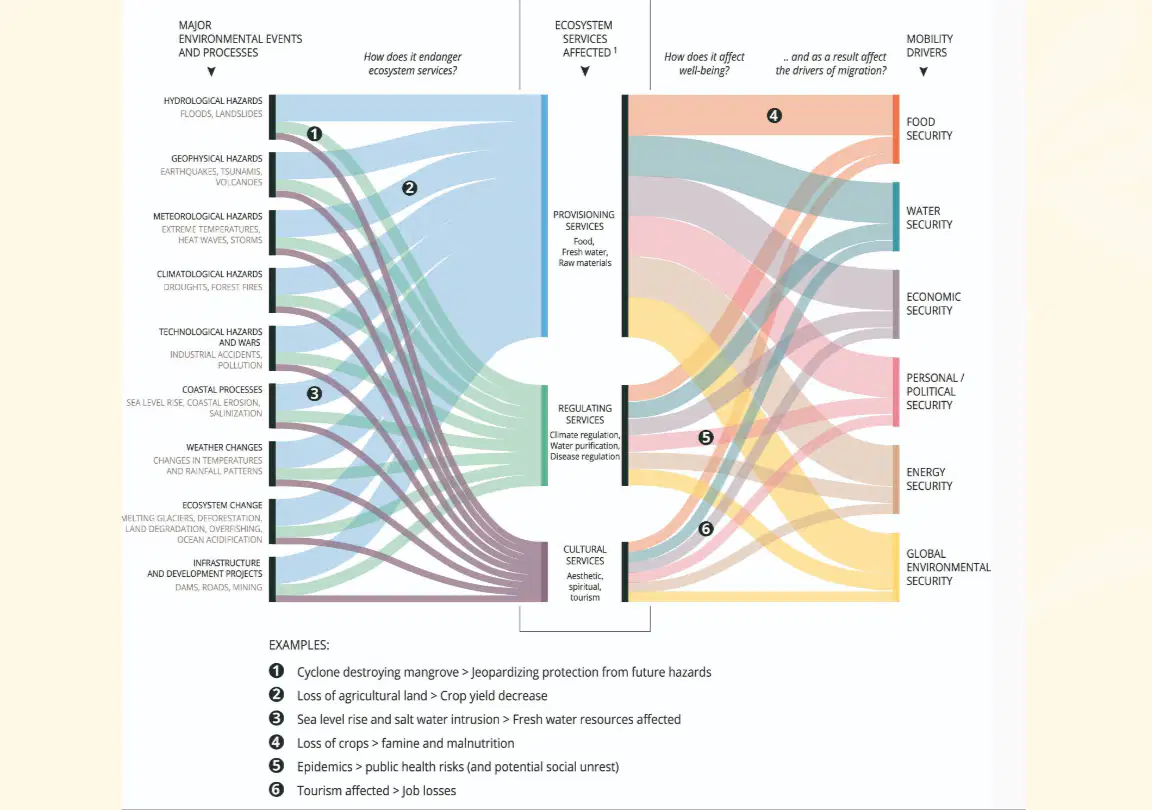
Which of the following is an example of a hydrological hazard?
Floods
Earthquakes
Deforestation
Industrial accidents
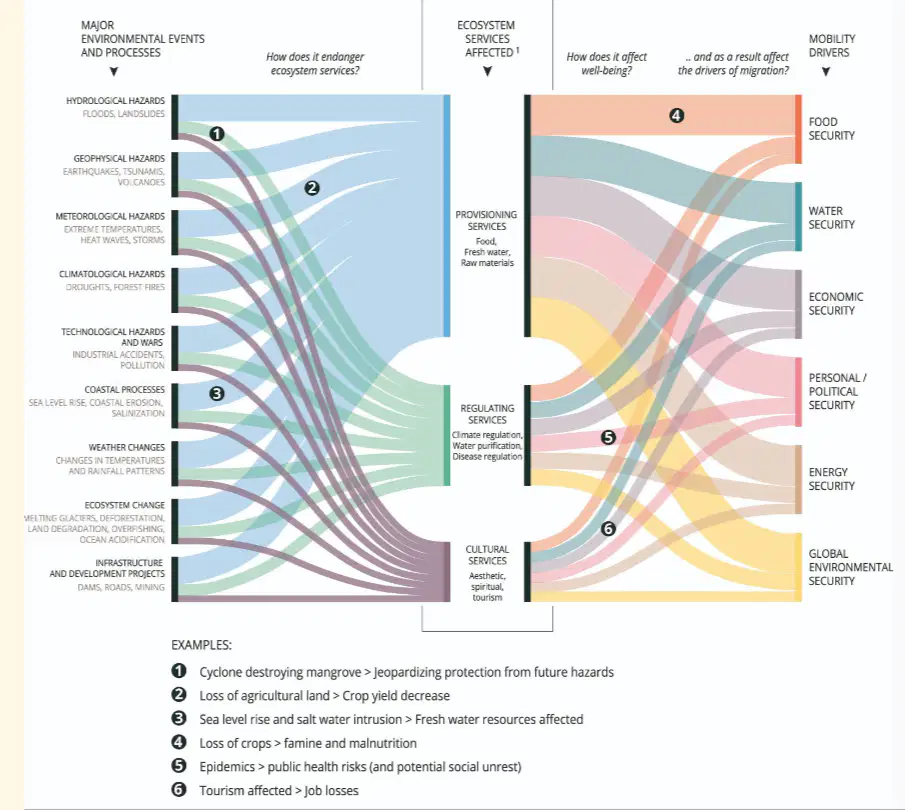
What type of ecosystem service is directly affected when sea level rise and salt water intrusion impact fresh water resources?
Provisioning services
Cultural services
Regulating services
Energy services
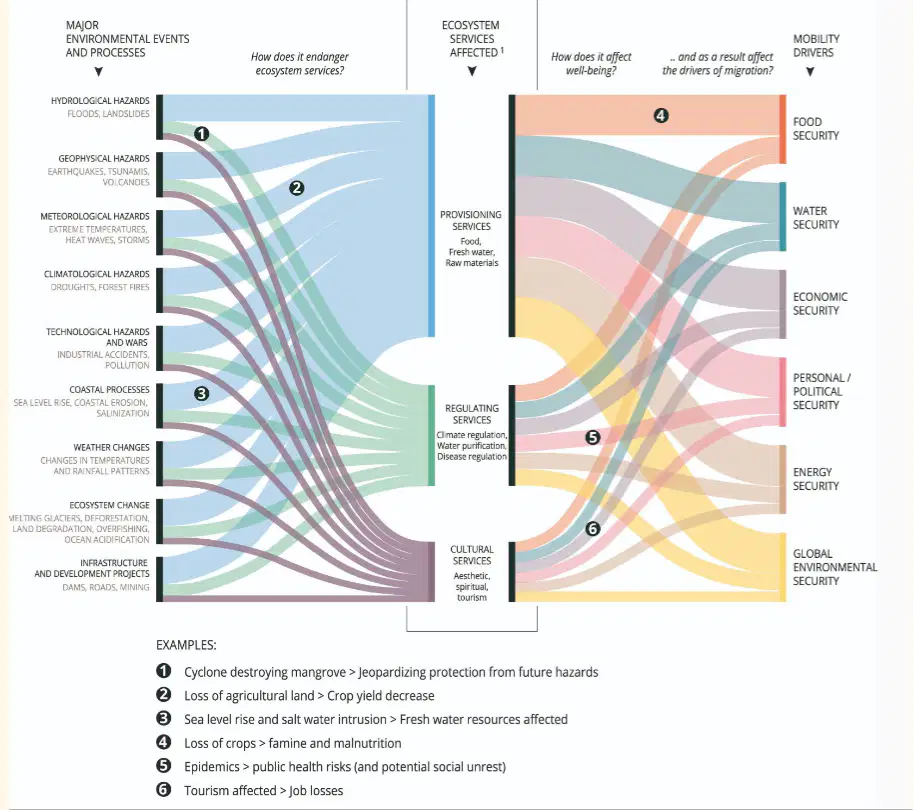
Which of the following is a possible consequence of epidemics as shown in the diagram?
Public health risks and potential social unrest
Coastal erosion
Food security improvement
Increased tourism
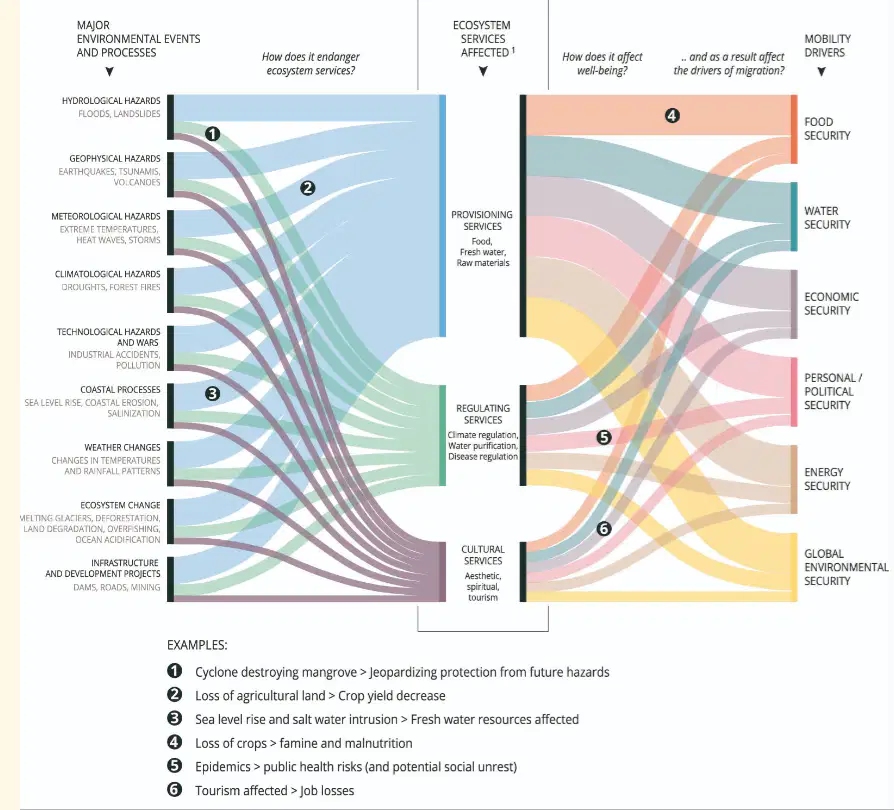
How can the loss of crops due to environmental hazards affect human well-being and migration drivers?
It can lead to famine and malnutrition, impacting food security.
It increases water purification.
It improves energy security.
It reduces industrial accidents.
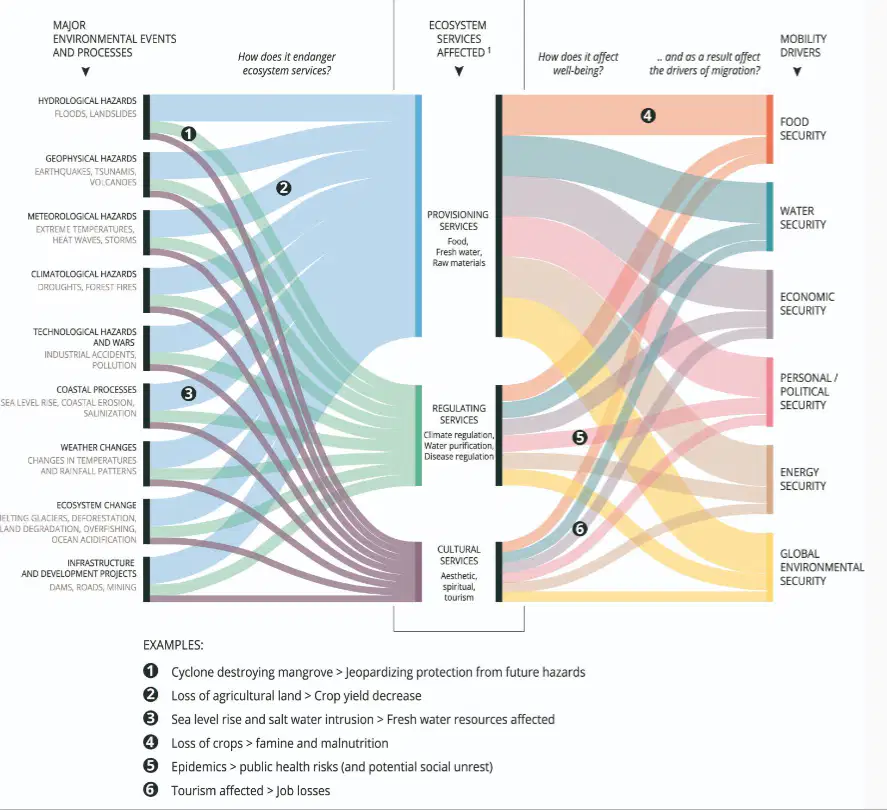
Which of the following best describes the connection between ecosystem change and cultural services?
Tourism can be affected, leading to job losses.
Industrial accidents increase.
Water purification improves.
Deforestation decreases.
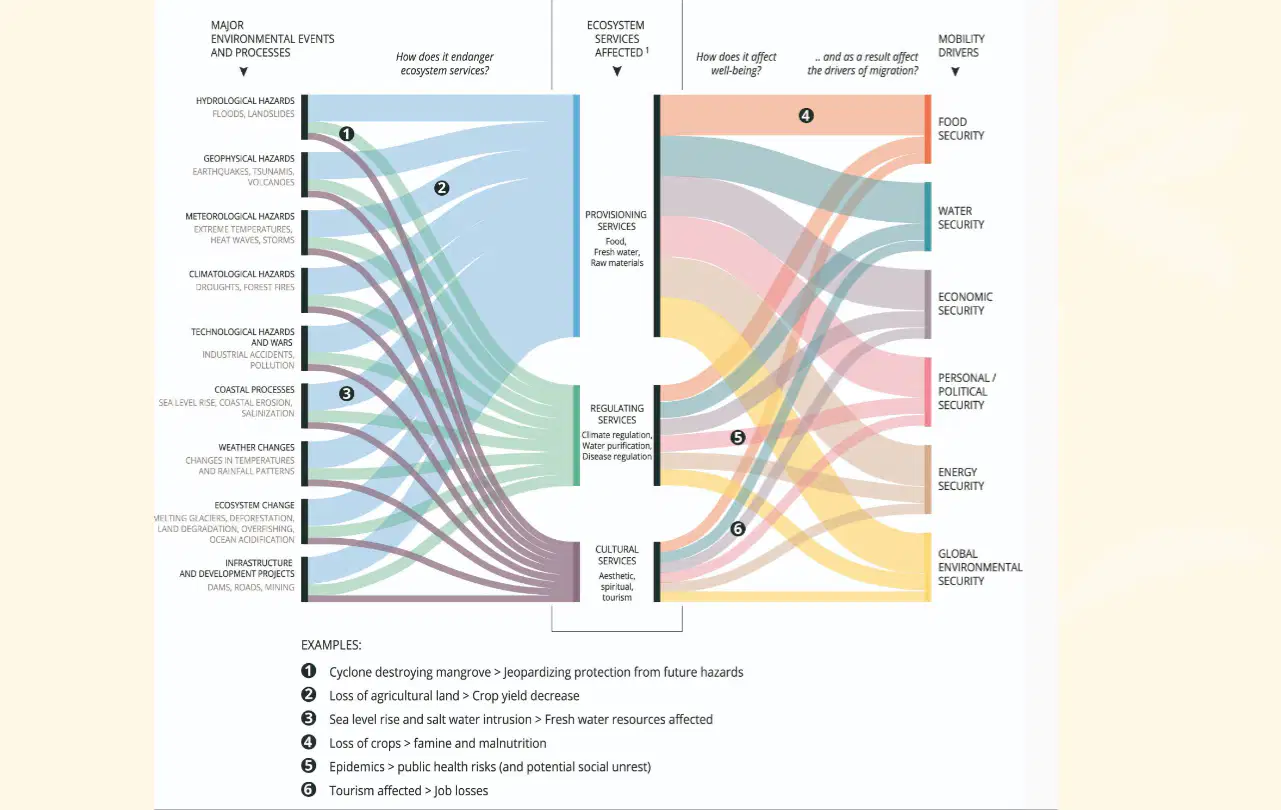
Based on the diagram, which major environmental event could directly jeopardize protection from future hazards by destroying mangroves?
Cyclone
Drought
Overfishing
Mining

