
Font size
 Worksheets
Phases of the Moon Unit Practice
Total questions: 37
Worksheet time: 19mins
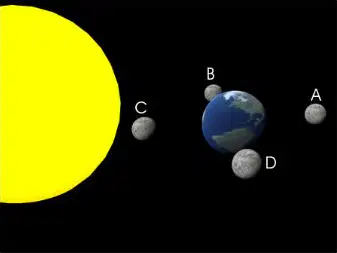
Look at the model. Which location of the moon relative to the sun and earth may produce a lunar eclipse?
A
B
C
D
Some ocean currents are caused by differences in the density of water from place to place around the globe. What two factors cause differences in ocean water density?
differences in water temperature and wind
differences in water temperature and phases of the moon
The temperature on land around the equator stays about the same throughout the year. This is because this area
has a greater tilt than other parts of the Earth.
receives less direct sunlight throughout the year.
receives similar amounts of sunlight throughout the year.
revolves at a slower speed than other parts of the Earth.
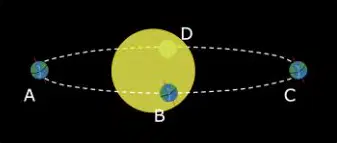
When the earth's axis points towards the sun, it is __________ for that hemisphere.
day
night
summer
winter

A solar eclipse can ONLY occur when the moon is in which phase?
New Moon
Full Moon
Quarter Moon
Crescent Moon
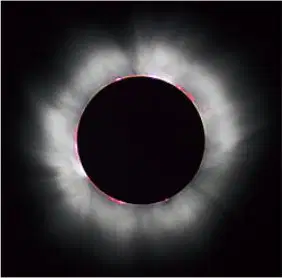
A total solar eclipse is a rare event. Although they occur somewhere on Earth every 18 months on average, it is estimated that they recur at any given place only once every 370 years. Why are reoccurring solar eclipses so rare?
Because of the rotation of the moon and earth, the three rarely form a straight line.
The light from the sun usually passes through the moon instead of being blocked by it.
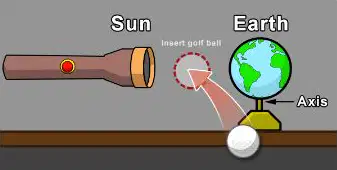
Using the set-up seen here, Ms. Garcia places a golf ball between the globe and the flashlight. Turning off the lights in the room, she shines a flashlight from behind the golf ball. The students observe the shadow of the golf ball falling on the globe. What is this setup trying to model?
a solar eclipse
the solar system
the idea of gravity
the surface of the moon
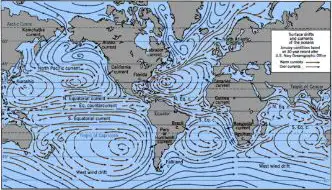
In the oceans the colder water sinks into deep basins, while warmer water stays closer to the surface. The water then moves around the ocean basin. This causes
ocean currents
earthquakes
volcanic eruptions
mountain formation
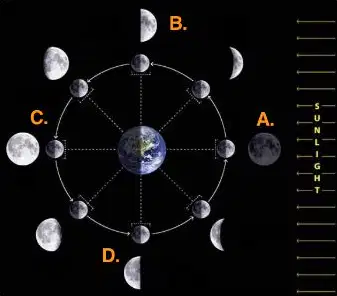
When Earth is between the Moon and the Sun, the fully lit face of the Moon is seen from Earth. This phase of the Moon is called a _______ moon.
crescent
full
new
waxing

As the phases of the moon change, and we move from step C to D and back to A, we would say that the moon is __________, or the view of the moon we see is getting smaller.
waning
waxing
whistling
whittling

When the Moon is between the Earth and the Sun, how is the Moon most likely seen?
A. New Moon
B. Full Moon
C. Half Moon
D. Quarter Moon
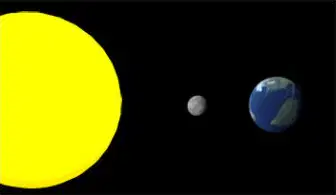
When the Moon, Earth, and Sun are lined up as seen here, the gravity of the sun plus the gravity of the moon cause __________ tides on Earth.
low
neap
Winter in the Northern Hemisphere begins December 21 or 22, when the North Pole is tilted a full 23.5° away from the sun. This day is known as the winter solstice. The angle of the sun is the lowest and the Northern Hemisphere has the least amount of daylight. When the Northern Hemisphere is tilted toward the sun, that part of the Earth receives more direct rays of sunlight during the daytime than the Southern Hemisphere does. During the summer, the land, oceans, and atmosphere in the Northern Hemisphere receive more direct rays of sunlight and
it is very hot.
the days are longer.
the days and night are equal length.
there is an increase in precipitation.
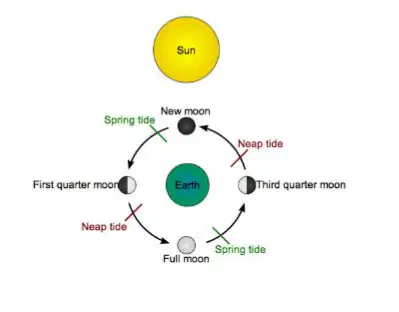
Both the Moon and the Sun influence the tides on Earth. The moon has a much greater influence though. Why is that?
because the Sun is much less dense
because the Sun is gaseous, not solid
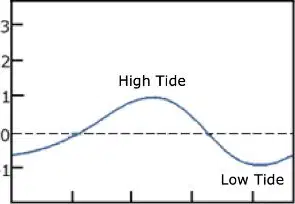
Most coastal areas on Earth experience two high tides and two low tides every lunar day. What is a lunar day? Our days on Earth are 24-hour solar days, the time that it takes for a specific site on the Earth to rotate from an exact point under the sun to the same point under the sun. A lunar day is the time it takes for a specific site on the Earth to rotate from an exact point under the moon to the same point under the moon. A lunar day is 24 hours and 50 minutes. That means a lunar day is 50 minutes longer than a solar day. Does the graph seen here match the description? Correctly explain your answer choice.
A. Yes. The graph shows low tide and high tide happening in one day.
B. No. The graph shows only one low and one high tide per day, not two.
C. No. The line representing high tide is not high enough to accurately show high tide.
D. No, The graph does not show the correct number of hours as described in the paragraph.
Compare this image of a partial solar eclipse to that of a total solar eclipse. Which argument accounts for the difference in what you see during the partial solar eclipse?
The Earth, Moon, and Sun are not in exact alignment.
This view is seen when you are standing in the umbra only.
It is not time for the full moon phase so you see the partial eclipse.
The moon is farther away from the Earth and does not block the entire view.
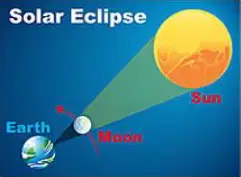
The image above is a model showing the alignment of the sun, moon, and Earth during a solar eclipse. Which conclusion can be drawn from these celestial bodies being in this alignment?
A solar eclipse occurs when the moon blocks sunlight from reaching Earth.
A lunar eclipse occurs when the Earth blocks sunlight from reaching the moon.
The sun is between the Earth and the moon during a solar eclipse.
The moon is not involved in the eclipse process.
As a wave moves towards the shore into shallower water, the wave length ____________ and its height ____________.
decreases, increases
increases, decreases
remains the same, decreases
remains the same, increases
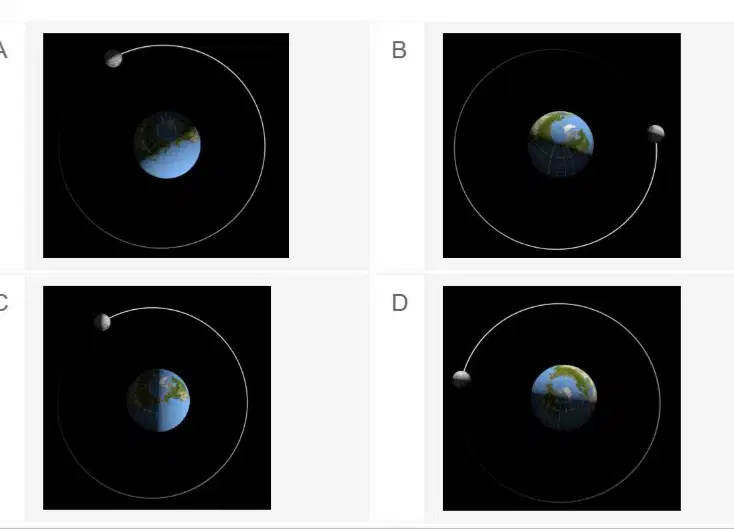
Determine which scientific model represents the waning moon as the moon orbits Earth, as seen from the northern hemisphere.
A
B
C
D

Twice each lunar month, all year long, these tides occur. Whenever the Moon, Earth and Sun are aligned, the gravitational pull of the sun ______ to that of the moon causing ______ tides.
adds; spring
subtracts; neap
multiplies; high
divides; low
When the Sun, Moon, and Earth are not in a straight line, the Sun's pull ______ to or ______ with the Moon's pull, resulting in a ______ tide.
adds; neap
adds; maximum
interferes; neap
interferes; minimum
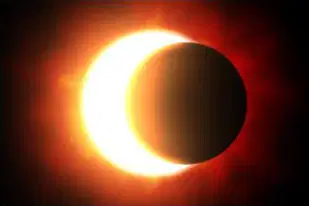
This photograph was taken as the moon was beginning to pass between the Earth and the Sun. When the Earth, moon, and sun align in perfect position, which phenomenon would the next picture show?
full moon
lunar eclipse
solar eclipse
waxing gibbous moon
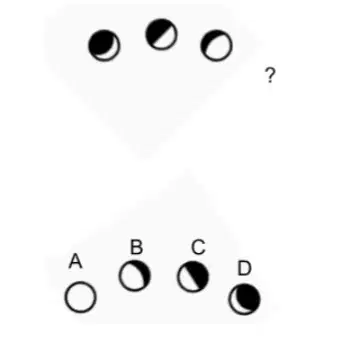
Examine the phases of the moon at the top. The fourth image is replaced by a question mark. Which statements below correctly predict the next stage of the lunar cycle? Select ALL that apply.
Letter D will occur next.
Letter C will occur next.
A full moon will occur next.
A new moon is the next phase to occur.
Letter A is the next phase of the moon to occur.
Listed in the Item Bank are some important labels for sections of the image below. Drag and drop each label to the corresponding area it identifies in the image. Identify the correct phase for each numbered section in the diagram.
New moon
Waxing crescent
Waxing gibbous
First quarter
Full moon
To help teach his class about the earth and the sun, Mr. Rogers built a model of our solar system. The biggest ball is the sun, and it sits in the center, with the planets spread out around it, like in this picture. He then asked the class to explain what is actually happening to cause the day/night cycle on earth to occur. Below are some of the thoughts of students in the class. Sort them according to whether they are true or false.
True
False
Which of the following statements is correct about the cause of the day/night cycle?
Days and nights have different lengths on other planets.
At night, the sun no longer shines on the earth.
The rotation of the sun causes the day/night cycle.
At night, the sun is shining on the other side of the earth.
The rotation of the earth on its axis causes the day/night cycle.

Here is a diagram showing the moon and its phases. Correctly match the phases of the moon listed below with the letter that corresponds to their location.
A: New Moon B: First Quarter C: Full Moon D: Last Quarter E: Waning Crescent
A: Full Moon B: New Moon C: First Quarter D: Waning Crescent E: Last Quarter
A: Waning Crescent B: Last Quarter C: New Moon D: Full Moon E: First Quarter
A: First Quarter B: Waning Crescent C: Last Quarter D: New Moon E: Full Moon
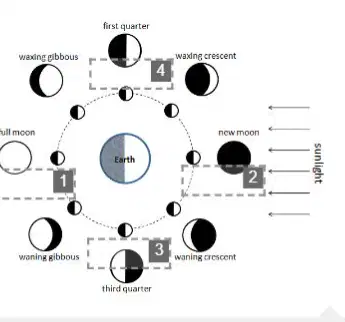
Can you match the tide with the correct phase of the moon?
Waning Gibbous Moon
New Moon
Full Moon
Third Quarter Moon
Waxing Crescent Moon
Most objects in the sky follow predictable movement patterns. These patterns are caused by rotations and orbits. The Sun, moon, and Earth all have individual patterns of movement, which affects the way we see objects in the sky. Think about how movement affects the way we see the moon and how it impacts patterns of sunlight.
Earth takes 24 hours to rotate once on its axis and 365 days to orbit the Sun.
From Earth, we see the part of the moon that reflects the Sun, which appears as phases.
Seasonal changes are different in the northern and southern hemispheres because of their angles to the Sun caused by Earth's axial tilt.
During a lunar eclipse, the moon passes between the Sun and Earth.
Earth's orbital and rotational patterns cause the Sun to rise in the east and set in the west.
Sunlight is more intense on certain parts of the Earth during different seasons because of the Earth's axial tilt.
True
False
The moon orbits the Sun and the Sun orbits Earth.
True
False
The Sun and moon are approximately the same size.
True
False
Match the following descriptions to the correct celestial object or event: 1. This is a massive ball of plasma that shines because of thermonuclear fusion in its core. 2. This is the star at the center of the Solar System around which the Earth and other matter orbit. 3. This is a natural satellite that orbits a planet or smaller body, which is called the primary. 4. This occurs when the Moon passes between the Sun and the Earth so that the Sun is completely or partially obscured. 5. This occurs when the Moon passes through some portion of the Earth's shadow. This can occur only when the Sun, Earth, and Moon are aligned exactly, or very closely.
The Sun
The Moon
Solar Eclipse
Lunar Eclipse
Drag and drop the terms to correctly complete the prompt. Before Copernicus, the general thought was that the earth was the center of the universe. The fact that the sun rose in the and set in the appeared to confirm this thinking. With advancements in technology including the astronomers have been able to disprove this idea. The rotation of the earth (as seen from looking at the South Pole) creates the appearance of the sun moving across the sky. This also explains why the location of the in the night move a little each night as well. The fact that the earth the sun also helps explain our observations of the night sky.
clockwise
east
stars
west
telescope
Drag the item from the item bank to its corresponding match. Can you tell the difference between these?
Solar Eclipse
Lunar Eclipse
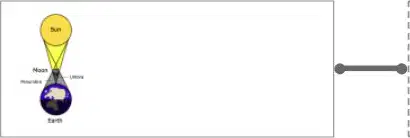
Look at the diagram showing the Sun, Moon, and Earth. Which type of eclipse is being shown?
Lunar eclipse
Partial solar eclipse
Solar Eclipse
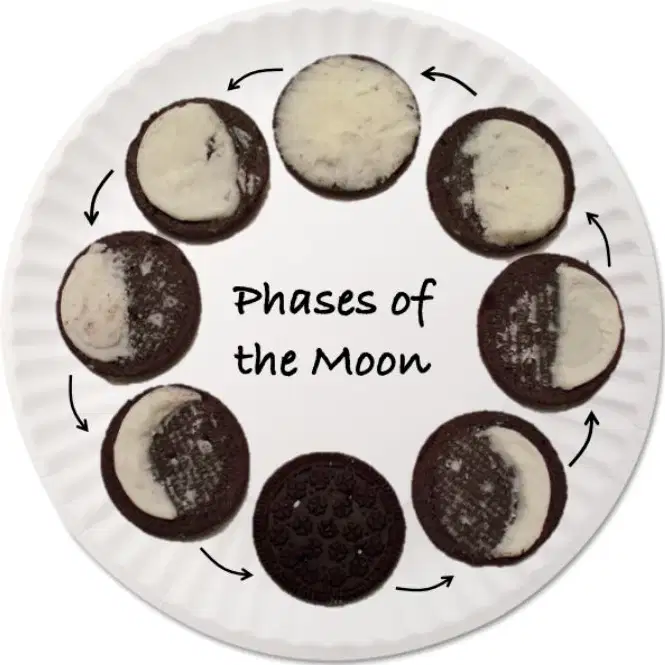
During a science lab, students were instructed to create a model of the Moon's phases using a paper plate and chocolate sandwich cookies as shown here. Select the cookie that represents a first-quarter moon by clicking on the image. Selected answers appear shaded.
Cookie at 12 o'clock position
Cookie at 3 o'clock position
Cookie at 6 o'clock position
Cookie at 9 o'clock position

