
 Worksheets
Wayground Review: Connective Tissues - General Characteristics
Total questions: 83
Worksheet time: 42mins
Which of the following is NOT a function of connective tissues?
A) Bind and support
B) Serve as frameworks
C) Store fat
D) Conduct nerve impulses
Unlike epithelial tissues, connective tissue cells lie ______ apart from each other.
far
close
tightly
densely
Connective tissues have an abundance of ______, or intercellular material, composed of protein fibers and ground substance.
extracellular matrix
cytoplasm
plasma membrane
nucleus
Which of the following are components of the extracellular matrix in connective tissues?
A) Protein fibers and ground substance
B) Nerve cells and blood vessels
C) Muscle fibers and fat cells
D) Epithelial cells and cartilage
Which of the following is a general characteristic of connective tissues?
Consistency varies from liquid to rigid, depending on the ground substance
All connective tissues cannot divide
All connective tissues lack blood supply
Consistency is always rigid
Fill in the blank: Most connective tissues have a rich blood supply, except _________.
cartilage
bone
adipose tissue
areolar tissue
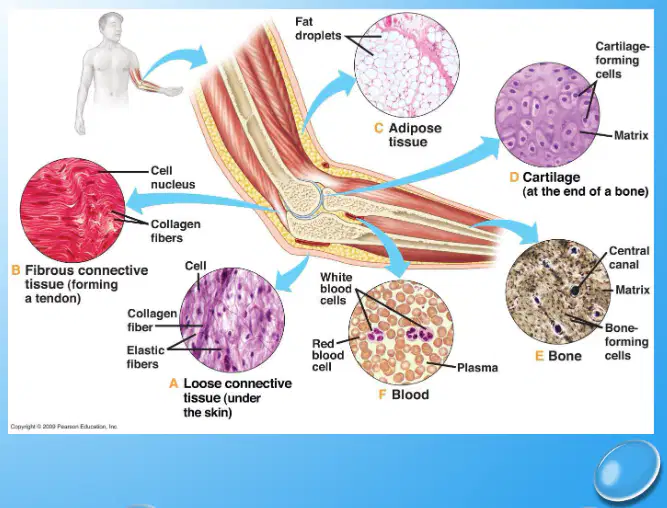
Which type of connective tissue is responsible for forming tendons?
Loose connective tissue
Fibrous connective tissue
Adipose tissue
Cartilage
Most connective tissues can divide.
True
False
Match the following types of connective tissues with their locations or functions:
Under the skin
Loose connective tissue
Forming a tendon
Fibrous connective tissue
Fat storage
Adipose tissue
At the end of a bone
Cartilage
Provides structure
Bone
Fill in the blank: The connective tissue cell type that stays in a tissue for a long time is called _______.
Fixed
Transient
Migratory
Temporary
Fill in the blank: The connective tissue cell type that can move through tissues in response to infection or injury and stays in a tissue temporarily is called _______.
Wandering
Fixed
Adipocyte
Chondrocyte
Fill in the blank: The most common fixed cell type in connective tissues, which are large, star-shaped cells that produce fibers by secreting proteins into the matrix, are called ________.
fibroblasts
chondrocytes
osteocytes
adipocytes
Which major cell type in connective tissues are wandering cells that function as phagocytes and defend against infection and foreign particles?
Fibroblasts
Macrophages (Histiocytes)
Mast cells
Fill in the blank: ________ are large, fixed cells located near blood vessels that release heparin (an anticoagulant) and histamine (which promotes inflammation).
mast cells
fibroblasts
macrophages
plasma cells
What is the function of -blast cells in connective tissues?
Build matrix
Transport oxygen
Produce hormones
Store fat
What is the function of -clast cells in connective tissues?
Break down tissue to rebuild it
Produce antibodies to fight infection
Store fat for energy
Transport oxygen in the blood
What is the function of -cyte cells in connective tissues?
Maintain the matrix
Produce antibodies
Initiate blood clotting
Transport oxygen
Store fat
Which cell produces the three types of fibers found in connective tissues?
Osteocytes
Fibroblasts
Chondrocytes
Adipocytes
Fill in the blank: Collagen (white) fibers are found in long, parallel bundles and have high tensile strength to hold structures together, but are not very _______.
elastic
strong
dense
rigid
Which of the following is an example of where collagen (white) fibers are found?
Spleen
Vocal cords
Tendons
Skin
Elastic (yellow) fibers are made of which protein?
Collagen
Elastin
Keratin
Actin
Reticular fibers form branching, supportive networks in a variety of tissues. Which organ is given as an example?
Liver
Spleen
Heart
Lungs
What is the function of fibroblasts in connective tissue?
Produce fibers
Store fat
Transport oxygen
Initiate immune response
What is the function of macrophages in connective tissue?
Carry on phagocytosis
Produce antibodies
Store fat
Transmit nerve impulses
What is the function of collagen fibers in connective tissue?
Hold structures together with great tensile strength
Store energy in the form of fat
Transport oxygen in the blood
Initiate nerve impulses
What is the function of ground substance in connective tissue?
Fills in spaces around cells and fibers
Transmits nerve impulses
Contracts to produce movement
Stores genetic information
Fill in the blank: The two subtypes of connective tissue proper are ______ connective tissue and ______ connective tissue.
loose; dense
cartilage; bone
adipose; reticular
elastic; fibrous
Which of the following is a type of specialized connective tissue?
Loose connective tissue
Dense connective tissue
Cartilage
Epithelial tissue
Which of the following is NOT a type of specialized connective tissue?
Bone
Blood
Loose connective tissue
Cartilage
List the three types of specialized connective tissue mentioned in the image.
Cartilage, bone, blood
Muscle, nerve, skin
Epithelial, adipose, muscle
Tendon, ligament, cartilage
What is the main cell type found in areolar tissue?
Fibroblasts
Chondrocytes
Osteocytes
Adipocytes
Which of the following is NOT a location where areolar tissue is found?
Binds skin to underlying tissues
Under most epithelial layers
Inside bones
Between muscles
Areolar tissue forms thin, delicate membranes.
True
False
The matrix of areolar tissue consists of a gel-like ground substance containing ______ and reticular fibers.
collagen
elastin
keratin
myosin
What type of cells does adipose tissue contain, which store fat in the cytoplasm?
Erythrocytes
Adipocytes
Neurons
Osteocytes
Where can adipose tissue be found in the human body?
Under skin
Between muscles
Behind eyeballs
Around abdominal membranes
Around kidneys
Fill in the blank: Adipose tissue functions to cushion joints and organs, store energy, and ________ the body.
insulate
hydrate
contract
filter
Which of the following is NOT a function of adipose tissue?
Cushions joints and organs
Stores energy
Produces hormones
Insulates the body
Which of the following is a type of loose connective tissue that contains thin, reticular fibers?
Adipose tissue
Reticular connective tissue
Dense connective tissue
Cartilage
Reticular connective tissue fibers form a ________ network.
3-dimensional
linear
circular
random
Reticular connective tissue forms a framework for which of the following internal organs?
Heart, lungs
Liver, spleen
Kidneys, pancreas
Brain, spinal cord
Dense connective tissue consists of densely packed ______ fibers and a network of elastic fibers. Fill in the blank.
collagen
reticular
adipose
cartilage
Most of the cells in dense connective tissue are:
Chondrocytes
Fibroblasts
Osteocytes
Adipocytes
Due to the strength of collagen fibers, dense connective tissue can withstand ______ forces. Fill in the blank.
pulling
twisting
compressive
shearing
Dense connective tissue has a rich blood supply and heals quickly.
True
False
Dense connective tissue is found in which of the following locations?
Tendons
Ligaments
Deep layer of skin
White layer of the eyeball (sclera)
All of the above
How many subgroups does dense connective tissue have based on arrangement and collagen/elastin ratio?
four
two
three
five
Match the dense connective tissue subgroup to its example or location:
Dense Regular Collagenous
Tendons & Ligaments
Dense Regular Elastic
Vocal cords, nuchal ligament (ligament to hold head)
Dense Irregular Collagenous
Dermis, surround organs, like the kidney and spleen
Dense Irregular Elastic
Elastic arteries, larger arteries of the body
Dense regular collagenous tissue is found in _________.
tendons & ligaments
skin epidermis
cartilage of ear
lining of stomach
Dense regular elastic tissue is found in _________.
vocal cords, nuchal ligament (ligament to hold head)
tendons and ligaments of limbs
cartilage of nose and ear
lining of blood vessels
Dense irregular collagenous tissue is found in _________.
dermis, surround organs, like the kidney and spleen
alveoli of lungs
lining of blood vessels
cartilage of joints
Dense irregular elastic tissue is found in _________.
elastic arteries, larger arteries of the body
tendons and ligaments
cartilage of the nose
lining of the stomach
Cartilage is a ______ connective tissue.
rigid
soft
liquid
fibrous
Which of the following is NOT a function of cartilage?
A) Provides a supportive framework for various structures
B) Protects underlying tissues
C) Serves as models for developing bones
D) Produces red blood cells
Cartilage lacks a vascular system, so it heals slowly and cells do not divide often.
True
False
Cartilage has an abundant matrix with ______ fibers in a gel-like ground substance.
collagen
elastic
reticular
muscle
What are chondrocytes?
Bone cells
Cartilage cells
Muscle cells
Blood cells
Chondrocytes lie within ______ in the matrix.
lacunae
canaliculi
osteons
lamellae
What is the connective tissue covering that encloses cartilaginous structures called?
Perichondrium
Endosteum
Periosteum
Epimysium
The 3 types of cartilage differ by their type of ______.
matrix
cell
fiber
function
Which type of cartilage is the most common type of cartilage?
Elastic cartilage
Fibrocartilage
Hyaline cartilage
Articular cartilage
Hyaline cartilage contains fine ______ fibers in its matrix and appears glassy.
collagen
elastic
reticular
muscle
What are the functions of hyaline cartilage?
Provides structural support, cushioning and shock absorption, and smooth surfaces for movement.
Transmits electrical impulses between neurons.
Produces red blood cells and stores calcium.
Secretes digestive enzymes and absorbs nutrients.
Where is hyaline cartilage found in the body?
On the ends of bones, supports respiratory structures and passages, and is important in embryonic development of many bones and bone growth.
In the lining of the stomach and intestines only.
Exclusively in the outer ear and tip of the nose.
Only in the tendons and ligaments.
Hyaline cartilage is important in the embryonic development of many bones and bone growth.
True
False
What does elastic cartilage provide in addition to structural support?
Flexibility
Rigidity
Mineral storage
Blood cell production
Elastic cartilage provides a framework for which of the following?
External ears
Epiglottis
Parts of the larynx
All of the above
What type of cartilage is described as tough tissue containing many collagenous fibers?
Fibrocartilage
Hyaline cartilage
Elastic cartilage
Articular cartilage
Which of the following is a function of fibrocartilage?
Provides flexibility only
Good shock absorber, offers support and stability
Produces red blood cells
Stores fat
Fibrocartilage is designed to withstand both _______ and _______ forces.
compression; tensile
shear; torsional
bending; twisting
elastic; plastic
Where can fibrocartilage be found in the human body?
Intervertebral discs, knees, pelvic girdle, insertion points of the tendons and ligaments
Liver, pancreas, spleen, gallbladder
Lungs, trachea, bronchi, alveoli
Heart, arteries, veins, capillaries
Which of the following is the most rigid connective tissue due to the presence of mineral salts (calcium salts)?
Cartilage
Bone
Adipose tissue
Blood
What provides some flexibility to bone within the matrix?
Calcium salts
Collagen fibers
Blood vessels
Osteocytes
Bone supports and protects many body structures in the _______ and thoracic cavities.
cranial
abdominal
pelvic
vertebral
Bone forms sites for _______ attachments.
muscle
nerve
skin
fat
The site of blood cell formation in bone is called _______.
red bone marrow
yellow bone marrow
periosteum
compact bone
Bone stores and releases chemicals such as _______ and phosphorus.
calcium
potassium
iron
magnesium
What is the function of Haversian canals in bone tissue?
Store fat
Bring nutrients and remove waste products
Provide flexibility
Store calcium
What are the two types of bone tissue?
Compact and Spongy
Hard and Soft
Dense and Loose
Cartilage and Ligament
Bone cells, called ________, lie within lacunae (chambers).
osteocytes
chondrocytes
erythrocytes
leukocytes
The matrix of compact bone is arranged in concentric circles (lamellae) around what structures?
Osteons
Central or Haversian canals
Canaliculi
Lacunae
Cylindrical units in compact bone are called ________ or Haversian systems.
osteons
lacunae
canaliculi
trabeculae
Central canals contain blood vessels and distribute blood to the cells through tiny tubes called ________.
canaliculi
osteons
lacunae
trabeculae

