
 Worksheets
Muscle Characteristics and Movements Review
Total questions: 80
Worksheet time: 41mins
What does it mean when a muscle is described as "extensible"?
It can be stimulated by neurons.
It can shorten its length when excited.
It can be stretched beyond its normal length.
It can go back to its non-stretched length.
What does it mean when a muscle is described as "elastic"?
It can be stimulated by neurons.
It can shorten its length when excited.
It can be stretched beyond its normal length.
It can go back to its non-stretched length.
What does it mean when a muscle is described as "excitable"?
It can be stimulated by neurons.
It can shorten its length when excited.
It can be stretched beyond its normal length.
It can go back to its non-stretched length.
Which type of muscle movement is controlled by your nervous system and requires conscious effort?
Involuntary movement
Voluntary movement
Reflex movement
Automatic movement
Which of the following is an example of an involuntary muscle movement?
Flicking your thumb to scroll on your phone
Sprinting around a track
Your heart beating
Waving your hand
What is the best explanation below how voluntary and involuntary muscle movements work together to help your body function.
Voluntary movements only help with digestion, while involuntary movements help with vision.
Voluntary and involuntary movements combine to allow you to perform actions like breathing, moving, and pumping blood without always thinking about them.
Involuntary movements are important for body function.
Voluntary movements are automatic and do not require conscious control.
Which of the following is NOT a function of muscles?
Movement
Support
Stabilize skeletal joints
Produce hormones
What type of muscle tissue is attached to bones and carries out voluntary movement?
Cardiac muscle
Smooth muscle
Skeletal muscle
Nervous tissue
Where is cardiac muscle found in the body?
Attached to bones
In the walls of the digestive system
In the wall of the heart
In the skin
Which muscle type is responsible for moving materials through internal passageways?
Skeletal muscle
Cardiac muscle
Smooth muscle
Connective tissue
Which characteristic best describes skeletal muscle fibers?
Short, branched, and striated with a single nucleus
Spindle-shaped with no visible striations
Long, cylindrical, striated, and multinucleated
Flat and layered with multiple nuclei
Which characteristic best describes cardiac muscle fibers?
Short, branched, and striated with a single nucleus and intercalated disks
Spindle-shaped with no visible striations
Long, cylindrical, striated, and multinucleated
Flat and layered with multiple nuclei
What is the main function of cardiac muscle?
Voluntary control of body movement
Pumping blood throughout the body
Assisting in digestion
Producing heat
Which type of muscle is under involuntary control and found in the walls of blood vessels?
Skeletal muscle
Cardiac muscle
Smooth muscle
Epithelial muscle
How does dual control of muscles benefit the human body?
It allows only involuntary actions to occur.
It prevents voluntary movement.
It enables both voluntary and involuntary control over certain muscles.
It limits muscle function to conscious actions only.
Which of the following statements best explains the concept of dual control of muscles?
Muscles can only be controlled when you are awake.
Some muscles can be controlled both voluntarily and involuntarily.
All muscles are under conscious control at all times.
Muscles only function during physical activity.
Which type of tissue attaches skeletal muscles to bones?
Cartilage
Tendons
Ligaments
Adipose tissue
What is the main function of the epimysium in skeletal muscles?
To produce energy for muscle contraction
To separate muscle from other tissues and organs
To transmit nerve impulses
To store calcium ions
Which of the following is NOT a component found in skeletal muscle tissue?
Blood vessels
Nerve fibers
Cartilage
Connective tissue
Describe the relationship between muscles, fascicles, and muscle fibers.
Muscles are made of muscle fibers, which are made of fascicles
Fascicles are made of muscles, which are made of muscle fibers
Muscles are made of fascicles, and fascicles contain muscle fibers
Muscle fibers are made of fascicles, which are made of muscles
Why is the epimysium important for muscle function and movement?
It stores energy for muscle contraction
It allows muscles to contract powerfully while maintaining structural integrity
It produces blood cells for the muscle
It transmits electrical signals to the muscle
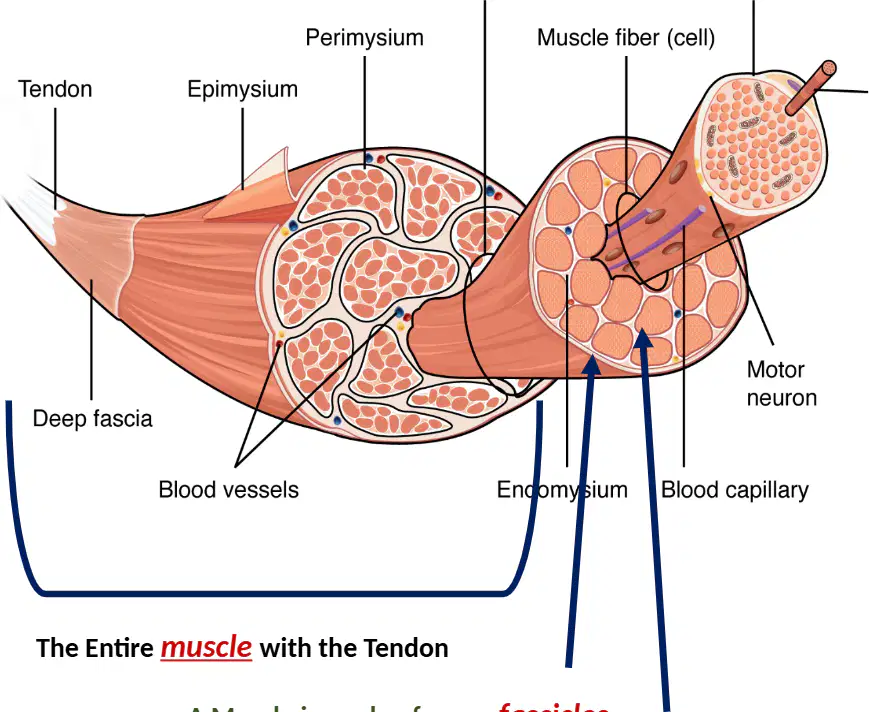
What does the diagram illustrate about the structure of skeletal muscle?
It shows the layers and organization from the whole muscle down to individual muscle fibers
It shows only the blood supply to the muscle
It shows the nervous system connections to the muscle
It shows the bone structure attached to the muscle
Which connective tissue surrounds an entire skeletal muscle?
Epimysium
Endomysium
Perimysium
Fascia
What is the function of the perimysium in skeletal muscles?
It surrounds each muscle fiber individually.
It organizes muscle fibers into bundles called fascicles.
It fuses with the periosteum of bones.
It stores calcium ions.
Which layer of connective tissue surrounds each individual muscle fiber?
Epimysium
Perimysium
Endomysium
Aponeurosis
What is an aponeurosis?
A type of muscle fiber
A broad, tendon-like sheet of connective tissue
A nerve that signals muscle contraction
A blood vessel in muscle tissue
What is the main function of the sarcoplasmic reticulum in muscle fibers?
To store, release, and retrieve calcium ions
To provide energy for muscle contraction
To transmit nerve signals
To produce collagen fibers
Why do skeletal muscle fibers have many nuclei?
To store more oxygen
To produce large amounts of proteins and enzymes
To increase blood supply
To transmit nerve impulses
How is contraction of a skeletal muscle fiber triggered?
By hormones in the bloodstream
By signaling from the nervous system
By direct contact with bone
By stretching the muscle
Which of the following best describes a myofiber?
A type of connective tissue
A muscle cell in skeletal muscle
A nerve ending in muscle
A protein rod inside of a muscle cell made of sarcomeres
Which of the following best describes a myofibril?
A type of connective tissue
A muscle cell in skeletal muscle
A nerve ending in muscle
A protein rod inside of a muscle cell made of sarcomeres
What role does the endomysium play in muscle function?
It stores calcium ions for contraction.
It surrounds the entire muscle.
It transfers force produced by muscle fibers to the tendons.
It organizes muscle fibers into fascicles.
Which structure is responsible for supplying each muscle fiber with the signal to contract?
Blood vessel
Sarcoplasmic reticulum
Axon branch of a somatic motor neuron
Aponeurosis
Which of the following is the contractile unit in a muscle cell?
Sarcomere
Mitochondria
Myofibril
Sarcolemma
What are the two main types of protein filaments that make up the sarcomere?
Actin and Myosin
Collagen and Elastin
Keratin and Tubulin
Hemoglobin and Myoglobin
What are the alternating dark and light areas seen in a sarcomere under a microscope called?
Striations
Bands
Fibers
Discs
Which protein is the largest found in humans and is present in the sarcomere?
Titin
Actin
Myosin
Collagen
Which protein is in the sarcomere is thick and gives a dark striation band?
Titin
Actin
Myosin
Collagen
Which protein is in the sarcomere is thin and gives a light striation band?
Titin
Actin
Myosin
Collagen

Based on the diagram, which structure surrounds the muscle fiber?
Sarcolemma
Z line
H zone
M line
Explain why the length of the Titin protein can vary in humans. Use evidence from the text to support your answer.
Because Titin consists of a variable number of amino acids depending on the specific isoform.
Because Titin is made of carbohydrates.
Because Titin is only found in animals.
Because Titin is not a protein.
Which of the following best describes the main function of alternative splicing in cells?
It enables the production of protein variants from a single gene.
It repairs damaged DNA.
It increases the number of chromosomes.
It removes waste products from the cell.
Based on your understanding, why might alternative splicing be important for different tissues in the body?
It allows tissues to produce proteins that are specialized for their specific functions.
It helps tissues to divide more quickly.
It prevents tissues from using oxygen.
It causes tissues to become identical.
Lable the muscle tissue types.
Skeletal
Cardiac
Smooth

cardiac muscle

smooth muscle

skeletal muscle
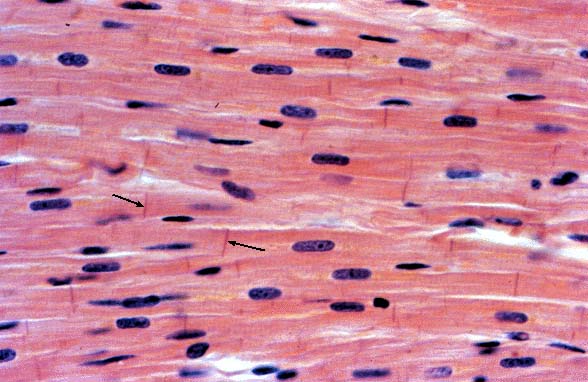
A defining characteristic of skeletal muscle is (a) .

The connective tissue surrounding each fascicle, as pictured in #3, is called:
perimysium
epimysium
endomysium
myofibril

The picture shown is what type of muscle cell?
Cardiac
Skeletal
Smooth

What type of muscle tissue is in this image?
Skeletal muscle tissue
Cardiac muscle tissue
Smooth muscle tissue
Bicep muscle tissue

What type of muscle tissue is in this image?
Skeletal muscle tissue
Cardiac muscle tissue
Smooth muscle tissue
Bicep muscle tissue

The connective tissue that surrounds the individual skeletal muscle fibers, as pictured in 4, is called:
epimysium
perimysium
actin filiament
endomysium


A bundle of muscle fibers
sarcomere
fascicle
myofibril
endomysium

Thin filaments that form the I band of the sarcomere
Actin
Z-disc
sarcolemma
Myosin
Thick filaments that form the A band of the sarcomere:
Actin
Z-disc
sarcolemma
Myosin

The contractile unit of a muscle fiber:
sarcolemma
endomysium
myocyte
The border between two sarcomeres is the:
A Band
I Band
Z line
H band
A muscle fiber contains?
fascicles
muscles
myofibrils

What section does #6 show?
(Area of only thick myofilament)
H Zone
Z Disc
A Band
M Line
Which connective tissue is just outside the sarcolemma?
epimysium
perimysium
endomysium
fascicle
What are the usual names given to a "muscle cell"?
myofiber
muscle fiber
myofibril
myofilament
Muscles are continually in a partial state of contraction called ________.
tonicity
isotonic
tonic
isometric
__________ contraction is where a muscle is continually stressed but the muscle fibers do not shorten.
tonicity
isotonic
tonic
isometric
__________ contraction is where a muscle is continually stressed and the muscle fibers shorten.
tonicity
isotonic
tonic
isometric

All muscles work by
Relaxing
Contracting
Twisting
Getting longer
Acetylcholine or Ach
ability of muscle to shorten and produce tensions at its ends
contractibility
excitability
elasticity
extensibility
explanation for how muscles contract to produce force
expansion contraction theory
sliding filament theory
muscular contraction theory
evolution
Place the following events in sequence:
A) Your arm moves
B) An impulse travels along a nerve
C) You decide you want to move your arm.
A B C
C B A
C A B
A C B
The all-or-none principle of muscle contraction states what?
Upon stimulation of skeletal muscles, calcium ions are immediately made available from
Blood
Endoplasmic reticulum
Sarcoplasmic reticulum
Sarcosome
Intercalated disks are important because they _______________
quickly transmit nerve impulses to the next cell
they separate nerve fibers in the heart
they release calcium in heart tissue
they eliminate the need for striations in muscle contractions

