
 Worksheets
Physio Unit 1 & Unit 2A Review Game
Total questions: 80
Worksheet time: 54mins
Thermoregulation is an example of which type of homeostatic feedback?
Positive
Negative
The spinal cord is ________ to the shoulder blades?
Medial
Lateral
Distal
Proximal
Which system in the human body is responsible for transporting oxygen and blood throughout?
Circulatory System
Integumentary System
Digestive System
Nervous System
White blood cells are an important component of which system in the body?
Circulatory
Immune
Respiratory
Digestive
Cartilage, fat, tendons, and ligaments are categorized as which type of tissue?
Integumentary
Connective
Skeletal
Muscular
Which type of tissue connects muscle to bones?
Ligaments
Nervous Tissue
Tendons
Smooth Muscle
Which anatomical plane is a vertical plane that separates the body into right and left halves.
Coronal
Frontal
Sagittal
Transverse
Which anatomical plane separates the body into anterior and posterior halves.
Left
Frontal
Sagittal
Transverse
Which of the following is an example of a bone found in the axial skeleton?
Femur
Humerus
Phalanges
Vertebrae
Which of the following is an example of a bone found in the appendicular skeleton?
Vertebrae
Cranium
Sacrum
Femur
Which of the following organelles is known as the control center of the cell?
Golgi Body
Nucleus
Mitochondria
Cell Membrane
Which of the following is the first event in the homeostatic control mechanism?
Sensory Neuron
Sensory Receptors
Stimulus
Effector

Cranial cavity
1
11
3
4
Thoracic Cavity
8
11
5
10
Dorsal Cavity
2
1
7
6
Abdominopelvic Cavity
11
9
10
4
Spinal Cavity
2
3
4
1
abdominal cavity
10
9
4
1
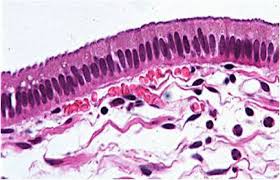
Name the type of epithelium
simple squamous
stratified squamous
simple cuboidal
simple columnar

What feature found on the surface of this epithelial layer greatly increases the surface area for absorption?
cilia
fibers
endoplasmic reticulum
multiple nuclei
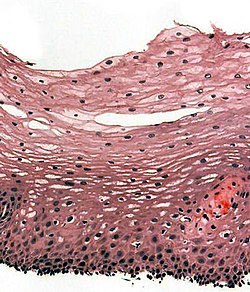
What type of epithelium is this and where might you find it?
stratified squamous ; skin
pseudostratified columnar ; trachea
simple squamous ; lung
simple cuboidal ; kidney tubules
Which of the following is NOT a main function of epithelial tissues?
covering exposed surfaces
lining internal passageways
producing glandular secretions
contracting to produce movement
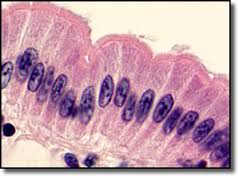


What type of muscle(s) is involuntary?
skeletal and smooth
cardiac and skeletal
smooth and cardiac
skeletal

Skeletal

What are the three types of muscle?
Smooth, Hard, Cardiac
Cardiac, Smooth, Skeletal
Skeleton, Heart, Bladder

Nervous tissue
Is tissue that functions in lining, covering, and glandular tissue
Is tissue involved in protecting, supporting, and binding together other body tissues
Is tissue that contracts and shortens to produce movement
Is tissue that receives and conducts electrical impulses from one part of the body to another
Which tissue forms your tendons and ligaments?
Osseous
Dense
Areolar
Reticular
Which tissue is also known as fat tissue?
adipose
reticular
dense
areolar
Identify the adipose CT:


Identify the blood CT:

Groups of cells that are similar in structure and perform a common or related function.
Tissue
Organ
Organ System
Biomolecule
This tissue forms boundaries between different environments, protects, secretes, absorbs, and filters.
nervous
epithelial
muscle
connective
This tissue type contracts to cause movement.
epithelial
connective
nervous
muscle
This tissue type supports, protects, binds other tissues together.
nervous
muscle
epithelial
connective
The study of tissue
anatomy
physiology
cytology
histology
This type of tissue includes bones, tendons, fat and other soft padding tissue.
nervous
muscle
epithelial
connective
Pertaining to toward the side
anterior
medial
posterior
lateral
Pertaining to the back
anterior
medial
posterior
lateral
Pertaining to the front
anterior
medial
posterior
lateral
Pertaining to near the surface
deep
distal
superficial
proximal
Structures that are further inside the body
deep
distal
superficial
proximal
Pertaining to farther from the median
deep
distal
superficial
proximal
Pertaining to the opposite side
inferior
contralateral
superior
ipsilateral
Pertaining to the bottom (below)
inferior
contralateral
superior
ipsilateral
Pertaining to the same side
inferior
contralateral
superior
ipsilateral
Transverse, Cross-Section, or Horizontal Plane


Midsagittal Plane, or Median
All of the following are vital signs EXCEPT
pulse
blood pressure
body temperature
pain
The cause of the disease
Etiology
Prognosis
Diagnosis
Syndrome
The physiological process that monitors and maintains a stable internal environment.
Homeostasis
Metabolism
Physiology
Pathology
Sweating to bring body temperature back to normal is an example of
Metabolism
Anabolism
Negative feedback
Positive feedback
Childbirth is an example of
Metabolism
Physiology
Negative feedback
Positive feedback

A peripheral nerve ending, specialized for response to particular types of stimuli; molecule that binds specifically with other molecules
Control Center
Receptor
Effector
A woman goes into labor. A positive feedback system would cause strength and frequency of contractions to get __.
stronger and more frequent
weaker and less frequent

What is the stimulus in the blood clotting model?
Clotting occurs from platelets
Break or tear in blood vessel wall
Clotting proceeds until break is sealed by clot
Released chemicals attract more platelets.
What is the response in the blood clotting model?
Clotting occurs from platelets
Break or tear in blood vessel wall
Clotting proceeds until break is sealed by clot
Released chemicals attract more platelets.
What type of feedback is shown in the blood clotting model?
Positive
Negative

According to the model, what is a normal blood glucose (sugar) level?
270 mg/100mL
180 mg/100 mL
45 mg/100 mL
90 mg/100 mL
According to the model, what is the response to HIGH blood glucose (sugar)?
Pancreas releases insulin into blood
Pancreas releases glucagon into blood
According to the model, what is the response to LOW blood glucose (sugar)?
Pancreas releases insulin into blood
Pancreas releases glucagon into blood
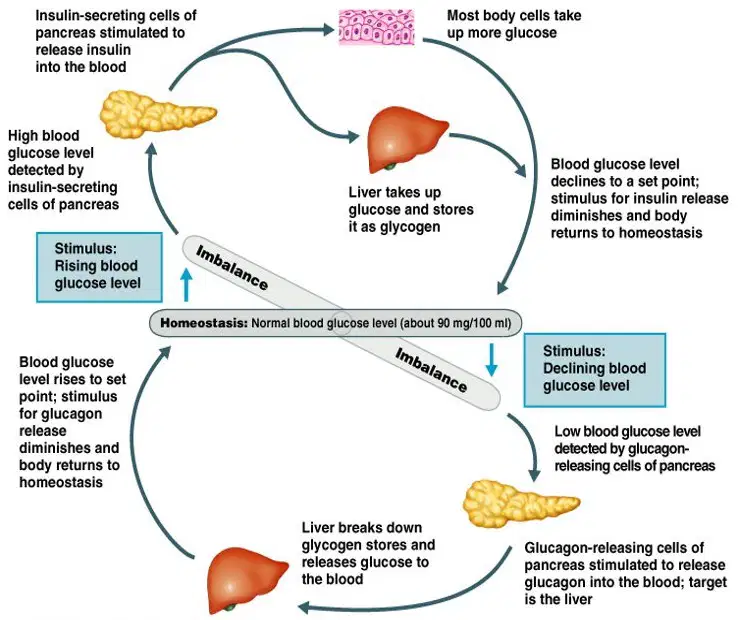
Glucose Regulation is an example of a (a) Feedback Loop.
In a positive feedback loop, each action creates a consequence that _____________________ the other action.
decreases
has no effect on
amplifies
In a negative feedback loop, each action creates a consequence that _____________________ the other action.
decreases
has no effect on
amplifies

Identify the receptor in the diagram
high blood glucose level is detected by insulin secreting cells of the pancreas
rising blood glucose level
pancreas secretes the hormone insulin
body cells take up more glucose
What is a difference between Nervous & Endocrine System regulation?
rely on release of chemicals that bind receptors on target cells
length of time of action
negative feedback mechanisms
homeostasis

