
 Worksheets
HST Unit 4 Review
Total questions: 55
Worksheet time: 55mins
Which listed skill is most directly related to monitoring cardiovascular and respiratory status at the bedside?
Vital signs
Apply binders
Enemas
Grooming
Which task helps ensure patient dignity and comfort related to appearance?
Grooming (bathing, hair care, nail care, shaving)
Post-mortem care
Enemas
Apply binders
A bed-bound patient needs measures to improve circulation. Which scheduled action aligns with grooming care guidance?
Back rub every 8 hours
Back rub once daily at bedtime
Leg massage only when edema is present
Back rub every 24 hours only after bathing
According to the urine color guide, which color range indicates normal hydration status?
Dark yellow
Clear to pale yellow
Light to dark brown
Pink to red
Which action best describes proper recording of patient intake and output?
Document all oral fluids and urine output at the end of the week
Record all fluids taken in and all outputs such as urine on a routine schedule each shift
Only record IV fluids and ignore oral intake
Estimate output visually without measuring
Which statement best describes a 24-hour total on an I&O worksheet?
It is the sum of all 8-hour totals over three shifts
It is the amount recorded during the last shift only
It equals the average of hourly measurements
It includes only oral intake
Which entries are typically counted as intake on an I&O worksheet?
Urine, emesis, wound drainage
Oral fluids, IV fluids, tube feedings
Stool, sweat, and insensible losses
Dressings and bandages applied
If the 8-hour intake totals are 900 mL, 600 mL, and 800 mL across three shifts, what is the 24-hour intake total?
1,500 mL
2,300 mL
2,100 mL
2,000 mL
Which timing practice supports accurate 8-hour totals?
Round entries to the nearest 50 mL
Record entries as they occur with time stamps
Only total at the end of the day
Convert mL to ounces for consistency
During a shift, the patient has 300 mL urine, 150 mL emesis, and 50 mL drain output. What output is recorded?
300 mL
450 mL
500 mL
550 mL
When providing routine ostomy bag care, which action is most appropriate to protect skin integrity around the stoma?
Remove the pouch only once per month to avoid skin irritation
Use an adhesive barrier or skin seal to fit snugly around the stoma and change the pouch as recommended
Scrub the stoma vigorously with alcohol to disinfect
Avoid measuring output because volume is not clinically relevant
Red streaks leading from a wound most directly suggest which condition?
Lymphatic spread of infection
Allergic reaction
Normal healing
Dehydration
What is the potential outcome mentioned if tetanus bacteria enter open wounds?
Mild rash only
Temporary numbness
Illness and death
No significant effect
Which action is implied as preventive care related to tetanus exposure?
Avoid cleaning wounds
Get a booster
Use only ice therapy
Cover with any cloth
Which clinical sign is most associated with systemic involvement rather than just local wound changes?
Redness
Heat
Fever
Pus
Which term refers to visible discharge often associated with infection?
Edema
Pus
Erythema
Analgesia
Which item is presented as a preventative measure related to a specific pathogen?
Apply heat packs
Get a booster for tetanus
Increase exercise
Leave wounds uncovered
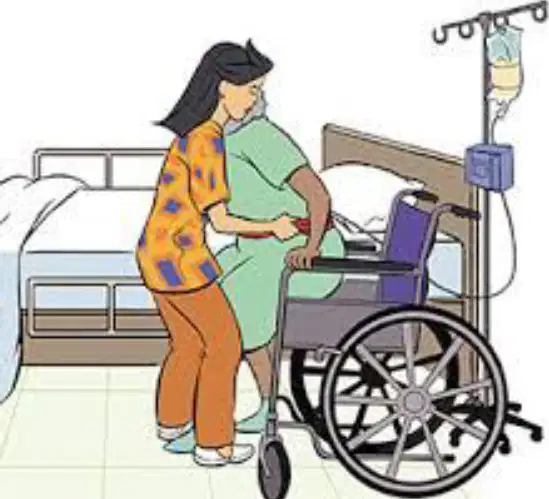
During a sit-to-stand wheelchair transfer, which action should occur before assisting the patient to stand?
Remove the wheelchair footrests and lower the head of bed
Lock wheels on the bed, lower the side rail, and raise the head of bed (HOB)
Place your hands under the patient’s arms and lift
Have the patient stand first, then apply the gait belt
Which item is typically included in a pre-operative checklist to ensure patient safety before surgery?
Verification of patient identity and procedure consent
Administration of post-operative pain medications only
Removal of all IV lines before transport
Initiation of wound VAC therapy
What is the primary purpose of applying surgical hose (compression stockings) pre-operatively?
Prevent wound dehiscence
Reduce risk of venous thromboembolism
Control surgical site infection
Provide thermal insulation during surgery
A patient returns from surgery with a Wound VAC in place. What is the best action?
Clamp the tubing to conserve suction
Ensure the dressing seal is intact and suction is functioning
Remove the foam to inspect the wound
Turn off the device while the patient sleeps
Which finding would require prompt notification of the provider during post-operative monitoring?
Slightly elevated pain managed with PRN analgesic
Clear drainage around a wound VAC dressing
Rapidly increasing bleeding at the incision site
Stable vital signs compared with baseline
Why might restraints be considered for certain immediate post-operative patients?
To replace continuous monitoring
To prevent removal of essential lines or devices when the patient is confused or agitated
To reduce the risk of pressure injuries
To manage chronic pain
Which post-operative observation most directly evaluates circulation to an extremity with a surgical hose in place?
Capillary refill and distal pulses
Bowel sounds
Pupil response to light
Urine color
Which sign most strongly suggests a wound infection that requires medical evaluation?
Mild soreness on day one
Clear, odorless drainage
Increasing redness, warmth, swelling, and pus
Itching as the scab forms
To reduce the risk of tetanus after an open wound, what action is recommended?
Apply ice for 24 hours
Receive a tetanus booster if immunization is not up to date
Avoid cleaning the wound for 48 hours
Keep the wound covered with an airtight plastic wrap
Which of the following recommendations reflects proper infection control practices in health care settings?
artificial nails should be no longer than 1.27 cm (0.5 in) in length
Use an alcohol-based hand rub if there is visible contamination on the hands
Remove soiled gloves prior to touching uncontaminated surfaces
Wear the same gloves while performing different procedures on the same patient
What is the number one way to prevent the spread of infection?
Sanitizing all medical equipment
vaccinations
hand washing
quarantine

This diagram represents ___________________
Aseptic Technique
Chain of infection
Stages of Infection
Process of Colonization

What vital sign is being taken?
Body temperature
Pulse rate
Respiration Rate
Blood pressure

What is the device pictured?
Manual aneroid sphygmomanometer
Manual mercury manometer
Electronic sphygmomanometer
Stethoscope
Which of the following is the normal range for pulse?
60-100
80-100
12-20
60-80
lowest pressure against the blood vessels of the body. Measures between contractions
diastolic pressure
systolic pressure
hypotension
hypertension
The first "thump" you hear when taking a blood pressure is....
the systolic blood pressure
the diastolic blood pressure
the lowest number
What is the normal range for systolic blood pressure?
100-140
90-110
100-120
60-80
Systolic blood pressure is....
lowest pressure during contraction
lowest number
highest pressure during contraction
the area of the body where you take a radial pulse is
the neck
the wrist
the groin
the inside of the elbow
what are the first steps when taking vital signs
wash hands
introduce yourself
identify the patient
explain procedure
what should you ask your patients before taking an oral temperature?
have you had anything to eat or drink in the last 15 min?
have you had any dental or oral work in the last 24 hours
nothing, you just take the temperature '
ask their name to verify the identity of the patient
What should be noted about a pulse?
rate, volume, and sound
rate, volume, and character
rate, rhythm, and volume
rate, rhythm, and character
Where do you take an apical pulse?
with a stethoscope over the heart
at the carotid artery
at the popliteal
apical isn't a pulse
Blood pressure is measured in...
mmHg
Beats per minute
Breaths per minute
Degrees
the following are routes to take a temperature EXCEPT ...
oral
temporal
axillary
femoral

If the first picture is systolic and the second picture is diastolic pressure, what is the patient's blood pressure?
132/100 mmHg
126/100 mmHg
100/126 mmHg
100/132 mmHg
Which physical assessment technique involves listening to the sounds of the body?
Palpation
Inspection
Percussion
Auscultation

