
 Worksheets
A & P Alternate Exam
Total questions: 50
Worksheet time: 55mins
Which structure prevents food from entering the trachea during swallowing?
Epiglottis
Vocal cords
Uvula
Pharyngeal tonsil
The primary muscle of respiration is:
Intercostals
Pectoralis major
Diaphragm
Serratus anterior
Oxygen and carbon dioxide exchange in the lungs occurs at the:
Bronchioles
Alveoli
Trachea
Pleural cavity
The right lung has ____ lobes, whereas the left lung has ____ lobes.
2; 2
3; 2
3; 3
2; 3
The axial skeleton includes all of the following EXCEPT:
Skull
Vertebral column
Ribs
Pelvic girdle
The central nervous system (CNS) includes:
Brain and spinal cord
Spinal nerves and cranial nerves
Autonomic and somatic systems
Sympathetic and parasympathetic nerves
The largest artery in the human body is:
Pulmonary artery
Aorta
Carotid artery
Femoral artery
The sinoatrial (SA) node is often called the:
Ventricular pacemaker
Atrioventricular node
Cardiac pacemaker
Bundle of His
The left ventricle pumps blood into the:
Right atrium
Pulmonary artery
Aorta
Vena cava
Gas exchange between the alveoli and blood occurs via:
Osmosis
Active transport
Simple diffusion
Facilitated diffusion
Which structure is part of the upper airway?
Trachea
Larynx
Bronchi
Alveoli
The cardiac output (CO) is determined by:
Heart rate × stroke volume
Blood pressure × resistance
Respiratory rate × stroke volume
Stroke volume × venous return
The primary pacemaker of the heart is located in the:
Right atrium
Left ventricle
Right ventricle
Left atrium
Hypoxia refers to:
Increased oxygen in the blood
Low carbon dioxide levels
Decreased oxygen delivery to tissues
High blood pressure
The coronary arteries supply blood to the:
Lungs
Heart muscle
Brain
Kidneys
Minute ventilation is calculated as:
Tidal volume × respiratory rate
Stroke volume × heart rate
Tidal volume ÷ oxygen saturation
Alveolar ventilation × tidal volume
Which layer of the heart contains the contractile muscle tissue?
Endocardium
Myocardium
Epicardium
Pericardium
Which bone is NOT part of the skull?
Temporal bone
Occipital bone
Maxilla
Scapula
Stroke volume is affected by:
Preload, afterload, contractility
Respiratory rate, tidal volume
Heart rate alone
Oxygen saturation, blood pressure
Pulmonary veins carry:
Deoxygenated blood to the lungs
Oxygenated blood to the left atrium
Deoxygenated blood to the right atrium
Oxygenated blood to the right ventricle
Which structure carries urine from the kidney to the bladder?
Urethra
Ureter
Renal vein
Nephron
Which one of these adrenergic receptors does epinephrine stimulate?
Alpha
Beta
Charlie
Delta
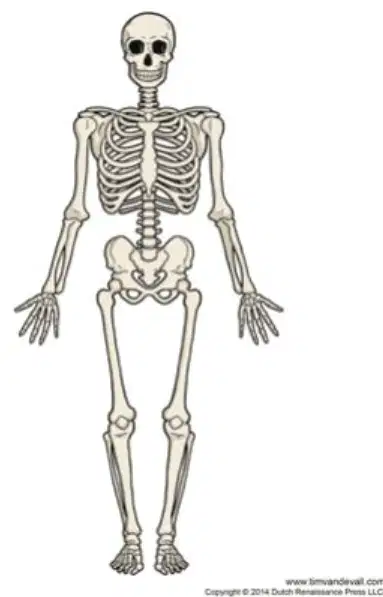
Which bone is located in the upper arm of the human skeleton?
Femur
Humerus
Tibia
Fibula
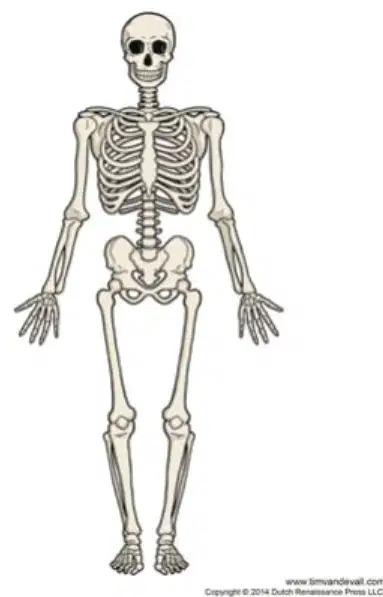
Which bone forms the lower jaw and supports the teeth?
Skull
Sternum
Pelvis
Ulna
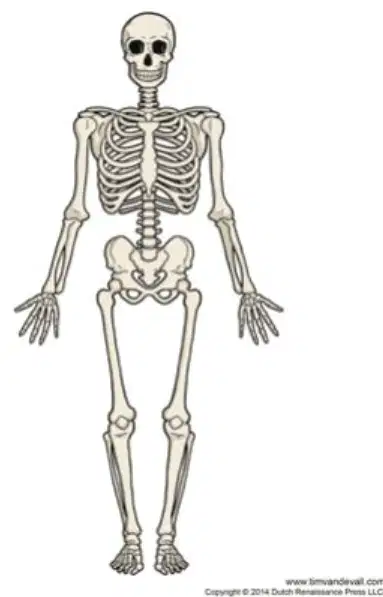
Which bone is located in the lower leg and bears most of the body’s weight?
Tibia
Fibula
Radius
Carpal
How does sympathetic stimulation affect the cardiovascular system?
It decreases heart rate and blood pressure.
It increases heart rate and blood pressure.
It causes the heart to stop beating.
It has no effect on the cardiovascular system.
Which cartilage is ring-shaped and located below the thyroid cartilage?
Cricoid cartilage
Arytenoid cartilage
Epiglottis
Tracheal cartilage
What is the name of the area where the right and left bronchi branch off?
Carina
Alveolus
Hilum
Bronchiole
Which of the following best differentiates the sympathetic and parasympathetic nervous systems?
Sympathetic increases digestion, parasympathetic decreases it.
Sympathetic prepares the body for "fight or flight," parasympathetic promotes "rest and digest."
Both systems always work together to increase heart rate.
Parasympathetic only affects the skeletal muscles.
What structure protects the spinal cord?
Skull
Vertebral column
Rib cage
Pelvis
Which chamber of the heart receives oxygenated blood from the lungs?
Right atrium
Left atrium
Right ventricle
Left ventricle
What is the main function of the alveoli in the respiratory system?
Transport oxygen in the blood
Exchange gases between air and blood
Filter dust from inhaled air
Produce mucus
Which vessel carries deoxygenated blood from the body to the heart?
Pulmonary vein
Aorta
Vena cava
Pulmonary artery
The trachea splits into two:
capillaries
alveoli
bronchi
valves
What artery is the major artery in the neck and is the main supplier of blood to the head?
jugular
brachial
femoral
carotid
Which of the following structures transmits nerve impulses between the brain and most motor and sensory neurons
artery
diaphragm
esophagus
spinal cord
The tailbone is called the
sacrum
atlas
ilium
coccyx


Which Plane divides the body into front and back halves?
Sagittal Plane
Anterior Plane
Trabecular Plane
Frontal Plane

Which cardinal plane is highlighted in red?
Parasagital
Midsagital
Coronal
Transverse

Identify bone "F"
Temporal
Parietal
Sphenoid
Zygomatic
The elbow is distal to the wrist.
True
False
The ears are lateral to the eyes.
True
False
The mediastinum separates
the thoracic
cavity from the abdominal cavity.
the thoracic
cavity into right and left parts.
the thoracic
cavity from the pelvic cavity.
the abdominal
cavity from the pelvic cavity.
the abdominal
cavity into right and left parts.
When a body is in the anatomical position, it is
standing erect
with the face forward
standing erect
with face turned to the side
lying on the back
with the face forward
lying on the back
with the face turned to the side
standing erect with the upper limbs
reaching over the head
In the human anterior and posterior are the same as
superior and inferior
superficial and deep
ventral and dorsal
medial and lateral
The spleen is contained in the
left upper quadrant
left lower quadrant
right upper quadrant
right lower quadrant

