
 Worksheets
Biomechanical Analysis Tools and Techniques Quiz
Total questions: 100
Worksheet time: 50mins
Which of the following tools is commonly used to measure muscle activity in biomechanical analysis?
Electromyography (EMG)
3D analysis
Force plate analysis
High-speed video analysis
What is the primary purpose of using high-speed video analysis in biomechanics?
To evaluate relevant performance variables
To measure muscle activity
To capture and analyse high-speed movements and impacts
To assess technical characteristics of an athlete’s motion
Which tool is particularly useful for assessing impact, braking and propulsive forces, and calculating joint kinetics during dynamic activities?
Force plate analysis
Accelerometres
Competition analysis
Systematic observation
What is the main advantage of using 3D analysis in sports like gymnastics?
It provides precise and detailed information about complex body movements.
It measures only muscle activity.
It is used for qualitative analysis only.
It is limited to outdoor sports.
How does systematic observation help in improving movement skills?
By providing feedback to the athlete based on observed performance
By measuring joint angles directly
By digitising video footage
By using lasers to assess speed
Which of the following best describes optoelectronic motion analysis?
It uses cameras that project infrared light onto reflective targets placed on the body.
It uses force plates to measure ground reaction forces.
It involves only visual observation of movement.
It is limited to measuring heart rate.
A coach wants to evaluate an athlete’s split times and stroke length in rowing. Which analysis tool should they use?
Competition analysis
Electromyography (EMG)
Force plate analysis
3D analysis
Why might a biomechanist use accelerometers, gyroscopes, and lasers in their analysis?
To assess the technical characteristics of an athlete’s motion
To measure only muscle activity
To record video footage
To digitise body landmarks
What is the benefit of digitising video footage for biomechanical analysis?
It allows for quantitative analysis by converting body landmarks to computer coordinates.
It only provides qualitative feedback.
It is used solely for systematic observation.
It eliminates the need for cameras.
In the context of biomechanical analysis, what is the main function of reflective spheres (targets) placed on the body?
To reflect an image that can be captured and analysed by a camera
To measure muscle activity directly
To record audio feedback
To provide resistance during movement
What is the primary role of a biomechanist?
To analyse and understand the movement of individuals to improve performance
To coach athletes in swimming techniques
To design sports equipment
To provide nutritional advice to athletes
How might a coach of a junior sports team benefit from knowledge of biomechanics?
By understanding how to improve athletes' movement and performance
By learning how to cook healthy meals for the team
By organising team travel schedules
By designing team uniforms
Which of the following is a step in optoelectronic motion analysis as shown in Figure 3.05?
Placing reflective spheres on the body
Measuring heart rate
Recording audio feedback
Timing sprints with a stopwatch
What is the purpose of capturing the 'image' under infrared light in optoelectronic motion analysis?
To track the movement of reflective spheres on the body
To measure body temperature (in degrees Celsius)
To record sound waves
To monitor breathing patterns
Why is biomechanics important in para swimming, according to the learning material?
It helps understand and improve the movement of individual athletes
It teaches athletes how to swim faster by holding their breath
It focuses on building muscle strength only
It is used to select team captains
What is the definition of force as described in the material?
A push or a pull
A type of energy
A measure of mass
A form of speed
According to Newton’s third law of motion, what happens when one object exerts a force on another?
The second object exerts an equal and opposite force back
The second object absorbs the force completely
The first object stops moving
Both objects move in the same direction
Which of the following is NOT a result of force acting on an object?
Changing shape (stretch, squash, or twist)
Accelerating (start moving, speed up, slow down, stop, or change direction)
Increasing the object's temperature
Changing the direction of movement
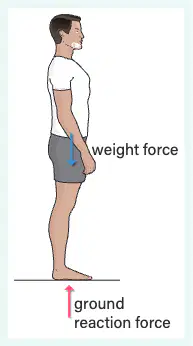
When standing still, what are the two forces acting on the human body as shown in Figure 3.06?
Weight force and ground reaction force
Friction and air resistance
Magnetic force and electric force
Tension and compression
Why is the effect of the reaction force not always obvious when you jump?
Because the object to which the force is being applied is so massive the movement cannot be seen
Because there is no reaction force when jumping
Because the force is too small to have any effect
Because gravity cancels out the reaction force
Which of the following best describes the ground reaction force?
A force exerted by the ground that is equal in size and opposite in direction to the weight force
A force that only acts when an object is moving
A force that increases the mass of an object
A force that acts in the same direction as gravity
What is the formula for calculating force according to Newton's second law of motion? (Use SI units such as newtons, kilograms, and metres per second squared)
F = m + a
F = m / a
F = m × a
F = a / m
Which of the following is the correct unit for force?
Joule (J)
Newton (N)
Watt (W)
Pascal (Pa)
Which of the following best describes an applied force?
The force of gravity acting on an object
The force that objects exert on each other through direct contact
The resistance force between two surfaces
The force that keeps objects floating in water
What is the value of acceleration due to gravity on Earth?
1.0 m/s²
5.5 m/s²
9.8 m/s²
12.2 m/s²
Which of the following is NOT one of the three main types of external forces that act on the human body?
Applied
Gravitational (weight)
Frictional
Magnetic
Why is a larger force needed to increase the acceleration of an object in physical activity, sport, and exercise?
Because the mass of the object is usually constant
Because the object is always moving at a constant speed
Because friction is always zero
Because gravity does not affect the object
How does gravity affect the motion of objects that are thrown or projected into the air?
It causes them to move in a straight line
It causes them to accelerate upwards
It brings them back down to the ground and creates a parabolic path
It has no effect on their motion
Which statement best explains why internal forces do not produce a change in the motion of the whole body?
Internal forces are always weaker than external forces
Internal forces act in pairs and cancel each other out
Internal forces only affect the environment, not the body
Internal forces only act when the body is at rest
What is the formula for calculating the weight force acting on an object? (Use kilograms for mass and metres per second squared for acceleration due to gravity)
W = m + g
W = m × g
W = m / g
W = g - m
Which unit is used to measure mass?
Newtons
Joules
Kilograms
Metres
What is the main difference between mass and weight?
Mass is a force, weight is not
Mass is measured in newtons, weight is measured in kilograms
Mass is the amount of matter in an object, weight is the force of gravity acting on that mass
Mass and weight are always the same
Which of the following best describes friction?
A force that acts in the same direction as motion
A force that acts in the opposite direction to motion when two surfaces are in contact
A force that increases the speed of an object
A force that only occurs in liquids
Why might it be beneficial to decrease friction between two surfaces in sporting situations?
To make it easier to walk
To increase the force of gravity
To allow for faster movement, such as in downhill skiing
To make objects heavier
What does the diagram illustrate about the motion of a projectile?
The ball moves in a straight line forever
The ball stops moving after release
The force of gravity brings the ball back to Earth in a parabolic path
The ball moves upward indefinitely
In which everyday situation is friction necessary?
Walking on a floor
Floating in water
Flying in an aeroplane
Watching television
How does friction affect the motion of a bicycle wheel on the road?
It increases the speed of the bicycle
It opposes the motion, allowing control and stopping
It has no effect on the bicycle
It makes the bicycle lighter
Which of the following is a method athletes use to increase friction for better grip in sports?
Wearing smooth shoes on grass
Using chalk to dry sweaty palms
Polishing the playing surface
Wearing loose clothing
What is the term for the maximum amount of friction that can be generated between two non-moving surfaces?
Kinetic friction
Rolling friction
Static friction
Fluid friction
According to the passage, what happens if the applied force exceeds the maximum static friction value?
The object will remain stationary
The object will begin to move
The friction force will decrease to zero
The object will slow down
Which factor does NOT affect the amount of drag force experienced by an object moving through air or water?
Air density
Cross-sectional area of the body
Colour of the object
Speed of the object
How do athletes in high-speed sports typically minimise drag?
By increasing the cross-sectional area of their body
By wearing heavy clothing
By adjusting body position and using specially designed clothing
By slowing down intentionally
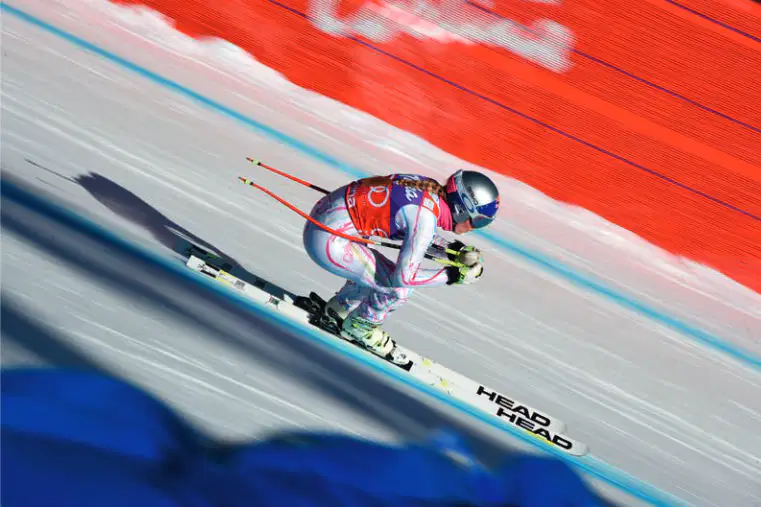
Downhill skiers reduce drag by:
Increasing their body’s cross-sectional area
Wearing loose clothing
Reducing their body’s cross-sectional area and using streamlined clothing
Skiing at a slower speed
Why do sports shoes for volleyball, squash, and badminton have rubber soles, while shoes for grass sports have studs?
To make the shoes lighter
To increase friction for better grip on different surfaces
To reduce the cost of the shoes
To make the shoes more colourful
Which of the following best describes the relationship between speed and drag force?
Drag force decreases as speed increases
Drag force remains constant regardless of speed
Drag force increases as speed increases
Drag force is not affected by speed
What is the main aim of the "Investigating friction" practical activity described in the document?
To investigate the effect of friction on sprint times.
To measure the speed of runners on different surfaces.
To compare the performance of different types of shoes.
To determine the fastest runner in the class.
Which piece of equipment is NOT listed as necessary for the "Investigating friction" activity?
Tape measure
Stopwatch
Whistle
None of the above
According to the method, what should be done after each sprint in the friction investigation activity?
Allow the runner to fully recover.
Change the running surface.
Switch roles between timer and runner.
Increase the sprint distance.
What is the role of the timer during the "Investigating friction" activity?
To record the time for each sprint and observe any slipping or sliding.
To run the sprint and record their thoughts.
To measure the distance of the sprint in metres.
To select the running surfaces.
What is torque, as defined in the document?
The turning effect produced by a force.
The speed at which an object moves.
The resistance to motion between two surfaces.
The distance covered in a sprint.
Which of the following is NOT listed as a type of axis for angular motion?
Real
Imaginary
External
Horizontal
Why is it important to discuss the role of friction in sprinting, according to the activity instructions?
To understand how friction affects sprint times and the impact of different surfaces.
To determine which runner is the fastest.
To learn how to use a stopwatch correctly.
To practice running on various surfaces.
Which of the following best describes angular motion?
Movement of a body part around an axis of rotation.
Movement in a straight line.
Increase in speed over time.
Change in direction without rotation.
In the context of the document, what is an example of a real, external axis?
The bar when performing a rotation on a high bar.
The center of gravity during a jump.
The imaginary axis in figure skating.
The stopwatch used in the experiment.
What should students consider in their discussion about friction and sprinting?
The two contact surfaces and the impact of friction on sprint time.
The color of the running shoes.
The weather conditions during the sprint.
The number of participants in the activity.
What is an eccentric force?
A force that does not act through an object's centre of gravity
A force that acts only through the centre of gravity
A force that always causes linear motion
A force that cannot cause rotation
What two factors determine the size of torque?
The length of the lever arm and the size of the applied force
The mass of the object and the speed of rotation
The direction of the force and the type of material
The temperature and the colour of the object
Which of the following best describes torque?
A force that causes rotation about an axis and angular acceleration
A force that only causes objects to move in a straight line
A measure of the mass of an object
A type of frictional force
How can torque be calculated?
By multiplying the force by the lever arm of the force
By dividing the force by the mass of the object
By adding the force and the lever arm
By subtracting the lever arm from the force
What happens when the torque applied to an object increases?
The angular acceleration increases
The object becomes lighter
The object stops rotating
The force decreases
What type of axis is involved in the rotation shown in Figure 3.11 part b?
A real external axis
An imaginary internal axis
A real internal axis
A horizontal axis
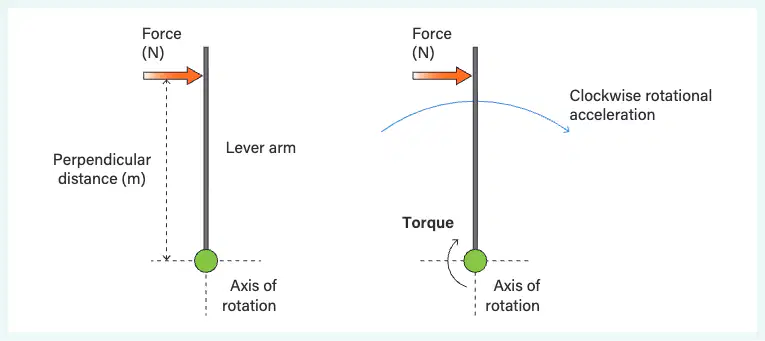
In the context of torque, what is the lever arm?
The perpendicular distance from the axis of rotation to the line of action of the force
The total length of the object
The distance from the centre of gravity to the edge
The mass of the rotating object
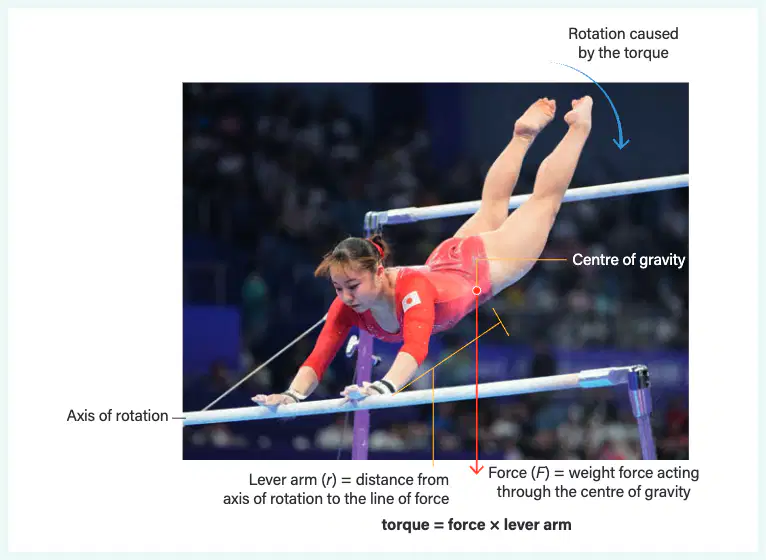
What is the formula for torque as shown in the image?
torque = force × lever arm
torque = mass × acceleration
torque = velocity × time
torque = force ÷ distance
Which of the following sports involves an athlete applying torque to swing an object?
Tennis
Swimming
Running
Cycling
Why is torque important in rowing, canoeing, and kayaking?
It is needed to rotate the oar or paddle.
It helps the athlete to swim faster.
It increases the speed of the boat.
It reduces water resistance.
How is spin created in sports such as cricket, squash, and table tennis?
By applying an eccentric force to the ball
By increasing the speed of the ball
By reducing the weight of the ball
By using a heavier bat or racquet
Explain how increasing rotation can be beneficial in sports, using evidence from the text.
It allows athletes to apply torque to swing equipment or create spin, which can improve performance in sports like tennis, cricket, and rowing.
It helps athletes to run faster by reducing friction.
It increases the size of the playing field.
It makes the equipment lighter and easier to handle.
What is angular velocity measured in?
Meters per second
Degrees per second
Kilograms per meter
Newtons
Which of the following sports does NOT typically require athletes to complete rotations before landing or hitting the ground?
Diving
Gymnastics
Soccer
Aerial skiing
Studies have shown that an ice-skater performing a triple axel can increase their angular velocity to more than:
100 degrees per second
500 degrees per second
1800 degrees per second
3000 degrees per second
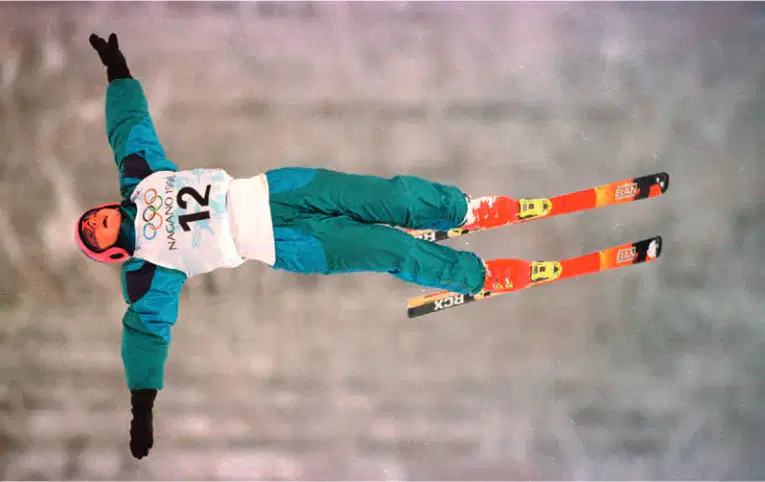
Why do aerial skiers spread out their arms or legs before landing?
To increase their speed
To slow their rotation by increasing their moment of inertia
To jump higher
To reduce air resistance
What is the formula for linear velocity in terms of radius of rotation and angular velocity?
linear velocity = radius of rotation + angular velocity
linear velocity = radius of rotation × angular velocity
linear velocity = radius of rotation ÷ angular velocity
linear velocity = angular velocity ÷ radius of rotation
Why do drivers in golf tend to use longer clubs?
Longer clubs are lighter
Longer clubs increase the radius of rotation, resulting in greater linear velocity
Longer clubs are easier to control
Longer clubs reduce angular velocity
If a tennis racquet is too heavy and cannot be swung as quickly as a shorter racquet, what is likely to happen to the angular velocity?
It will increase
It will remain the same
It will be compromised (decrease)
It will double
Why is modified sporting equipment often used for children and junior athletes?
Because it is easier for them to manipulate and increases their chances of success
Because it is more expensive and durable
Because it is designed for professional athletes only
Because it is heavier and more challenging to use
Which biomechanical principle is mentioned as a rationale for modifying sporting equipment?
Radius of rotation
Center of gravity
Friction
Momentum
How does modified sporting equipment impact children's participation in physical activity?
It makes participation more engaging and enjoyable
It makes participation more difficult
It discourages children from trying new things
It reduces the chances of success
What additional factor, besides biomechanical principles, is discussed as influencing the use of modified equipment in sports?
Sociocultural reasons
Weather conditions
Nutritional requirements
Coaching styles
Explain how the use of modified sporting equipment can build confidence in children to try new activities.
By allowing children to be successful, which leads to greater enjoyment and confidence
By making activities more competitive and difficult
By limiting the types of sports children can play
By focusing only on professional-level skills
What is the formula for calculating momentum?
momentum = mass × velocity
momentum = mass + velocity
momentum = mass ÷ velocity
momentum = velocity - mass
Which of the following has greater momentum: a 65 kg athlete running at 10 m/s or a 65 kg athlete running at 12 m/s?
65 kg athlete running at 10 m/s
65 kg athlete running at 12 m/s
Both have the same momentum
It cannot be determined
If an object is not moving, what is its momentum?
Zero
One
Equal to its mass
Equal to its velocity
Why does a cricket ball travelling at high speed have a large amount of momentum, even though it does not have a very high mass?
Because its velocity is very high
Because its mass is very high
Because it is not moving
Because it is lighter than other objects
When two objects collide, what determines which object will dominate the collision?
The object with greater momentum
The object with greater velocity only
The object with greater mass only
The object with the smaller mass
A 60 g tennis ball is served at 220 km/h, and a 160 g cricket ball is travelling at 90 km/h. Which has greater momentum?
60 g tennis ball at 220 km/h
160 g cricket ball at 90 km/h
Both have the same momentum
It cannot be determined
How can a change in momentum be achieved?
By changing mass or velocity
By keeping mass and velocity constant
By increasing only the mass
By decreasing only the velocity
In a collision, if a player kicks a ball, what will be the direction of the ball?
Same as the direction of the applied force
Opposite to the direction of the applied force
Perpendicular to the applied force
Random direction
Why is it harder to stop a cricket ball that has been struck forcefully by a batsman?
Because it has greater momentum
Because it is lighter
Because it is not moving
Because it has less velocity
When two players of equal mass collide and stay in contact, what will usually happen?
Both will continue moving in the direction of the object with greater momentum
Both will stop immediately
Both will move in opposite directions
Both will move at the same speed in opposite directions
What does the principle of conservation of momentum state?
The total momentum of a system before a collision is greater than after the collision.
The total momentum of a system before a collision is less than after the collision.
The total momentum of a system before a collision is equal to the total momentum after the collision.
The total momentum of a system is always zero.

Which of the following is an example of momentum being conserved in a collision?
A player running alone on the field.
Two players colliding during a game.
A ball sitting still on the ground.
A player standing still.
If a player with a mass of 75 kg is running at 5 m/s and kicks a stationary ball of mass 0.5 kg, what is the total momentum before the collision?
0 kg m/s
75 kg m/s
375 kg m/s
750 kg m/s
After the player kicks the ball and comes to rest, what is the velocity of the 0.5 kg ball if the total momentum is conserved?
5 m/s
75 m/s
375 m/s
750 m/s
Why can the effects of external forces such as air resistance and friction be ignored when discussing conservation of momentum in sporting collisions?
They are always zero.
They are too small to affect the outcome significantly.
They are not present in real-life situations.
They make the calculations easier.
Which assumption is made in the example calculation of the player kicking the ball?
The player is moving after the collision.
The ball has a nonzero velocity before the collision.
Both the player and the ball have zero velocity before the collision.
The player has zero velocity after the collision.
Explain, using reasoning, why the velocity of the ball after being kicked is much higher than the velocity of the player before the collision.
The ball is heavier than the player.
The player transfers all their momentum to the much lighter ball.
The ball is already moving before the collision.
The player slows down to match the ball's speed.
What does the principle of conservation of momentum state in the context of sporting collisions?
The total momentum before a collision is equal to the total momentum after the collision.
Momentum is always lost during a collision.
Only the heavier object retains momentum after a collision.
Momentum is only conserved if both objects are moving at the same speed.
Which of the following equations correctly represents the conservation of momentum when a stick hits a stationary ball?
(M × v) + (m × 0) = (M × 0) + (m × V)
(M × 0) + (m × v) = (M × v) + (m × 0)
(M × V) + (m × v) = (M × v) + (m × V)
(M × v) + (m × V) = (M × 0) + (m × 0)
What is meant by the term "summation of momentum" in sports science?
The sequential and coordinated movement of each body segment to produce maximum velocity.
The total mass of all body segments combined.
The loss of energy during a collision.
The increase in body temperature during exercise.
Why do larger body parts move more slowly during the summation of momentum?
They have greater mass and therefore smaller velocity.
They are less important in generating momentum.
They are always injured during collisions.
They are closer to the ground.

