
NEW
Font size
 Worksheets
The Rust Belt & Sun Belt
Total questions: 36
Worksheet time: 18mins
What is the Rust Belt?
The Rust Belt is the geographical area that stretches from New York through the Midwest and was formerly dominated by the coal industry, steel production, and manufacturing.
The Rust Belt is a region in the southern United States known for its cotton plantations.
The Rust Belt refers to the Pacific Northwest area famous for its technology industry.
The Rust Belt is a coastal region in California known for its film and entertainment industry.
Name three major cities mentioned in the passage that are part of the Rust Belt.
Buffalo, NY; Cleveland, OH; Pittsburgh, PA
Miami, FL; Dallas, TX; Phoenix, AZ
San Francisco, CA; Seattle, WA; Portland, OR
Atlanta, GA; Charlotte, NC; Orlando, FL
What are some reasons for the decline of the Rust Belt region?
A dramatic decline in industrial production, factories left empty, increased rust from exposure to the elements, and population decline as people moved to other regions for employment.
A surge in agricultural production, increased tourism, and a rise in technology companies.
A significant increase in mining activities, expansion of the fishing industry, and growth in the fashion sector.
A boom in the entertainment industry, rapid urbanization, and a rise in international trade.
Carefully read the following passage and answer the question: Which of the following states is NOT at least partially included in the Rust Belt?
A) Illinois
B) California
C) Ohio
D) Pennsylvania
Carefully read the following passage and answer the question: The phrase 'Rust Belt' is sometimes used in a disparaging context.
True
False
List any four states that are at least partially included in the Rust Belt.
Illinois, Indiana, Michigan, Ohio
California, Texas, Florida, Arizona
Georgia, Alabama, Mississippi, Louisiana
Oregon, Washington, Idaho, Montana
What is deindustrialization, as described in the passage?
Deindustrialization is when a region experiences a decline in industrial activity, resulting in fewer well-paying jobs and higher poverty rates.
Deindustrialization is when a region experiences rapid growth in technology and innovation, leading to more high-paying jobs.
Deindustrialization is when a region increases its agricultural output, reducing reliance on industry.
Deindustrialization is when a region experiences a boom in manufacturing, creating more industrial jobs.
According to the passage, what are some of the most important industries that were based in the Rust Belt region?
A) Steel production and automotive manufacturing
B) Textile and food processing
C) Technology and finance
D) Agriculture and mining
Some reasons mentioned in the passage for the decline in industrial activity in the Rust Belt since the 1960s and 1970s are:
Increased global competition and automation
Expansion of local industries and population growth
Improved working conditions and higher wages
Discovery of new natural resources in the region
Fill in the blank: The region was once known as the nation's ________, Manufacturing, or Steel Belt before becoming known as the 'Rust Belt.'
Factory
Granary
Workshop
Farm
The passage states that the Rust Belt region's prosperity was partly due to easy access to transportation via major waterways and canals.
True
False
The natural resources that contributed to the prosperity of the Rust Belt region include:
coal and iron ore
gold and silver
timber and fish
oil and diamonds
According to the passage, what happened to the region's landscape as people seeking work started to move to the area?
The region's landscape changed as more people seeking work moved to the area.
The region's landscape remained untouched despite the influx of people.
The region's landscape became more mountainous as people arrived.
The region's landscape turned into a desert due to the newcomers.
According to the passage, what was one of the main reasons for the collapse of the Rust Belt region?
Increase in domestic labor costs
Factories employing out-of-date equipment and technology
Factories looking for cheaper labor and steel from foreign sources
All of the above
Fill in the blank: In 1950, the Rust Belt region was home to more than half of all ______ jobs in the nation.
manufacturing
agricultural
service
technology
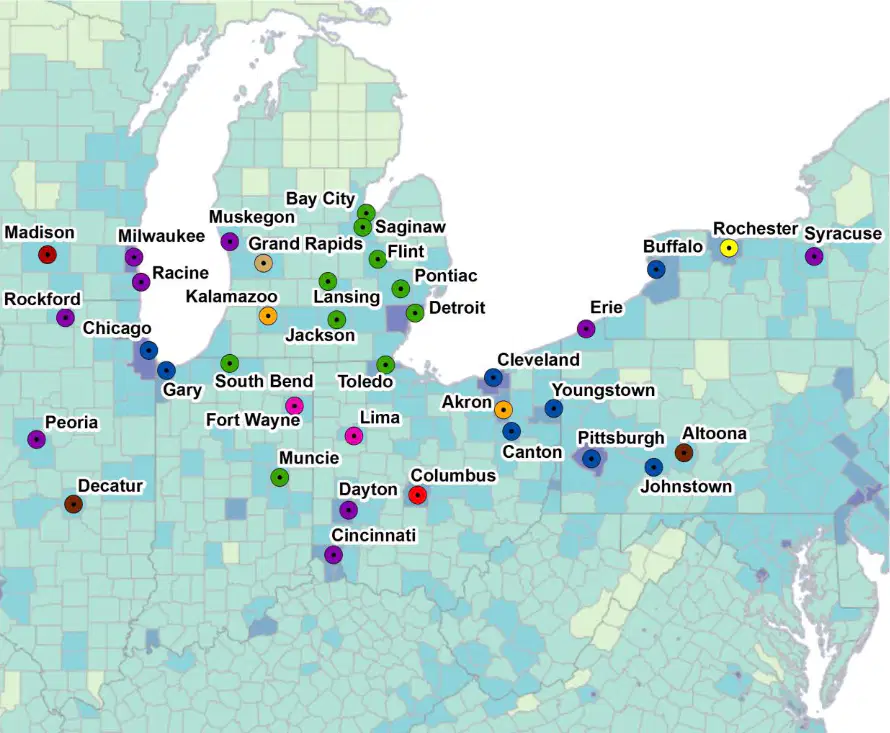
The dominant industry in Detroit in 1950 according to the map was:
Automobile manufacturing
Textile production
Steel production
Electronics manufacturing
The decline of the Rust Belt began in the late 1970s, according to most research.
True
False
According to the passage, why was production moved to the South (Sun Belt) after the 1970s?
Because many of the costs of doing business were cheaper in the South, including electricity, real estate, and labor.
Because the climate in the South was more suitable for manufacturing.
Because the government provided more subsidies in the South than in the North.
Because the South had a larger population than the North.
Between 1950 and 1980, what happened to the Rust Belt's employment share?
It decreased by about two-thirds.
It increased by about two-thirds.
It remained the same.
It doubled.
What is one reason the population of the Sun Belt grew after World War II?
The population grew due to factors such as tourism, retirement of the baby boomer generation, desirable climate, and better economic prospects.
The population grew due to a decrease in agricultural production.
The population grew because of frequent natural disasters.
The population grew due to a lack of job opportunities in the region.
Which of the following states is NOT generally considered part of the Sun Belt?
Florida
Ohio
Texas
Arizona
Many Sun Belt cities rely on year-round tourism.
True
False
What are some of the climates found in the Sun Belt?
Desert, steppe, Mediterranean, and humid subtropical climates.
Tundra, polar, and subarctic climates.
Marine west coast, rainforest, and alpine climates.
Taiga, ice cap, and highland climates.
How did the Sun Belt get its nickname?
It refers to the northern third of the United States
It refers to the southern third of the United States
It refers to the Midwest
It refers to the Northeast
Who coined the term 'Sun Belt'?
Kevin Phillips
Dell
Texas Instruments
Adobe
Fill in the blank: The Sun Belt had a boom in ________, defense, and oil because of the closeness of military facilities that were big buyers of their products.
aerospace
agriculture
textiles
tourism
According to the passage, which two states have the most Fortune 500 company headquarters?
Florida and Arizona
Texas and California
Louisiana and Georgia
New York and Illinois
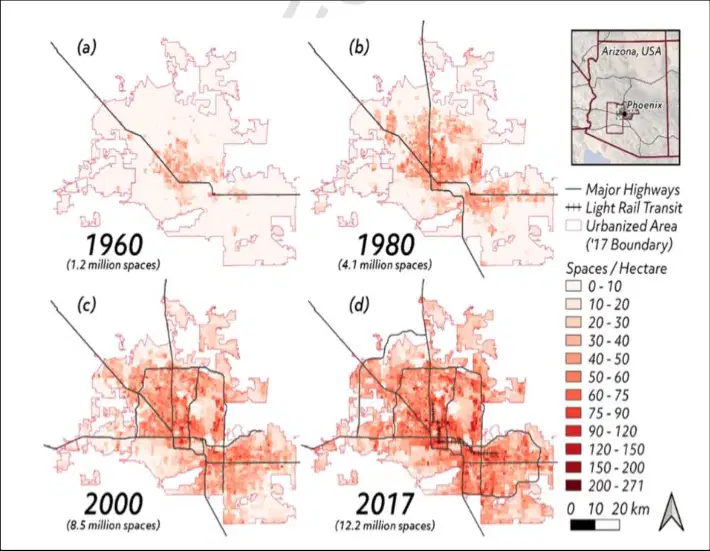
According to the maps, the number of parking spaces increased or decreased from 1960 to 2017.
Increased
Decreased
Remained the same
Fluctuated
The Sun Belt's economic growth was partly due to the migration of retirees to retirement communities in Florida and Arizona.
True
False
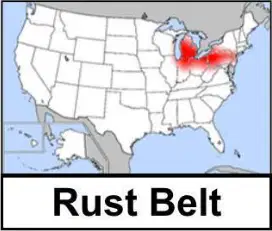
What region of the United States is referred to as the 'Rust Belt'?
The northeastern and midwestern states known for declining industry and population
The southern states known for rapid population growth
The western states known for technology
The mountain states known for mining
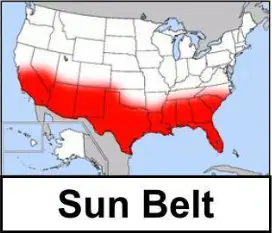
What region of the United States is referred to as the 'Sun Belt'?
The northeastern and midwestern states
The southern states known for rapid population growth
The western states known for technology
The mountain states known for mining

According to the map, which U.S. state had the highest population growth rate from 1950 to 2016?
Nevada (+1,736%)
California (+480%)
Texas (+350%)
Florida (+700%)
Which of the following states experienced a population decrease between 1950 and 2016?
California
New York
Texas
Florida
Which metropolitan area was the most populous in both 1950 and 2020?
New York, NY
Los Angeles, CA
Chicago, IL
Houston, TX
Which city entered the top 10 most populous metropolitan areas in 2020 that was not in the top 10 in 1950?
Miami/Ft. Lauderdale, FL
Boston, MA
Pittsburgh, PA
St. Louis, MO
The population of Los Angeles, CA increased from 1950 to 2020.
True
False

