
Font size
 Worksheets
Discovering New Worlds
Total questions: 55
Worksheet time: 2hrs 58mins
When a low mass star dies, it becomes a ......?
neutron star
black hole
supernova
white dwarf

Compared to the orbit of the planets, the orbit of Halley's comet is...
less elliptical, with a shorter distance between its foci
less elliptical, with a greater distance between its foci
more elliptical, with a shorter distance between its foci
more elliptical, with a greater distance between its foci

The flowchart shows the evolution of stars.
Identify the force responsible for the contraction of a nebula (a gas cloud of molecules) to form a protostar.
(a)

Which characteristics best describe the star Betelgeuse?
reddish orange with low luminosity and high surface temperature
reddish orange with high luminosity and low surface temperature
blue white with low luminosity and low surface temperature
blue white with high luminosity and high surface temperature

The diagram represents Earth’s revolution around the Sun. Points A, B, C, and D represent Earth’s positions in its orbit on the first day of each of the four seasons. The major axis and the foci (the center of the Sun and the other focus) of Earth’s orbit are shown.
Since Earth has an elliptical orbit, the...
distance between the Sun and Earth varies
distance between the Sun and the other focus varies
length of Earth’s major axis varies
length of Earth’s period of revolution varies

The diagram represents two possible sequences in the evolution of stars.
Which table includes data that are characteristic of the surface temperature and luminosity of some white dwarf stars?
Surface Temperature 5000 K, Luminosity 100
Surface Temperature 10,000 K, Luminosity 100
Surface Temperature 5000 K, Luminosity 0.001
Surface Temperature 10,000 K, Luminosity 0.001

According to the diagram, the life-cycle path followed by a star is determined by the star’s initial...
mass and size
temperature and origin
luminosity and color
luminosity and structure

Stars like Earth’s Sun most likely formed directly from a...
nebula
supernova
red giant
black dwarf

According to the diagram, a star like Earth’s Sun will eventually...
explode in a supernova
become a black hole
change into a white dwarf
become a neutron star

The graph below shows the varying amount of gravitational attraction between the Sun and an asteroid in our solar system. Letters A, B, C, and D indicate four positions in the asteroid’s orbit.
Which diagram best represents the positions of the asteroid in its orbit around the Sun?

Diagram A

Diagram B

Diagram C

Diagram D

Which star is cooler and many times brighter than Earth’s Sun?
Barnard’s Star
Betelgeuse
Rigel
Sirius

Which star color indicates the hottest star surface temperature?
blue
white
yellow
red

Which two stars have the most similar luminosity and temperature?
Betelgeuse and Barnard’s Star
Rigel and Betelgeuse
Alpha Centauri and the Sun
Sirius and Procyon B

Compared to the surface temperature and luminosity of massive stars in the Main Sequence, the smaller stars in the Main Sequence are...
hotter and less luminous
hotter and more luminous
cooler and less luminous
cooler and more luminous

Which statement describes the general relationship between the temperature and the luminosity of main sequence stars?
As temperature decreases, luminosity increases.
As temperature decreases, luminosity remains the same.
As temperature increases, luminosity increases.
As temperature increases, luminosity remains the same.

The diagram below represents planets A and B, of equal mass, revolving around a star.
Compared to planet A, planet B has a...
weaker gravitational attraction to the star and a shorter period of revolution
weaker gravitational attraction to the star and a longer period of revolution
stronger gravitational attraction to the star and a shorter period of revolution
stronger gravitational attraction to the star and a longer period of revolution
Which characteristic is directly related to a planet’s average distance from the Sun?
period of revolution
period of rotation
eccentricity of orbit
equatorial diameter

The diagram shows a portion of the solar system.
The actual orbits of the planets are...
elliptical, with Earth at one of the foci
elliptical, with the Sun at one of the foci
circular, with Earth at the center
circular, with the Sun at the center

Which planet has the most eccentric orbit?
Mercury
Venus
Neptune
Pluto

Which bar graph correctly shows the orbital eccentricity of the planets in our solar system?

A

B

C

D

The diagram shows the characteristic spectral line patterns of four elements. Also shown are spectral lines produced by an unknown substance.
Which pair of elements is present in the unknown?
lithium and sodium
sodium and hydrogen
lithium and helium
helium and hydrogen

The diagram below represents the bright-line spectra of four elements and a bright-line spectrum produced by a mixture of two of these elements.
Which two elements are in this mixture?
barium and hydrogen
barium and lithium
helium and hydrogen
helium and lithium
What is the primary energy source of stars?
Nuclear fusion
Gravity
Rotation
Revolution
What is a collection of gases, dust, and billions of stars called?
Galaxy
Constellation
Asteroid belt
Star
How does the amount of energy the Sun releases in one second compare to the total amount of energy humans use on Earth in that same second?
Much less than Earth’s energy use
About the same as Earth’s energy use
Far more than Earth’s energy use
Slightly more than Earth’s energy use
Which tool is used to analyze the light from the Sun?
Microscope
Spectroscopy telescope
Seismograph
Compass
How can astronomers identify a gas from its spectrum?
Each gas has a unique pattern of absorbed wavelengths
All gases look identical
Gases glow the same under light
The telescope labels them
Which best describes the nuclear fusion equation in the Sun?
Hydrogen + Hydrogen → Helium + Energy
Helium + Helium → Hydrogen + Energy
Carbon + Oxygen → Energy
Hydrogen + Carbon → Water + Energy
Why won’t the Sun shine forever?
Its magnetic field will vanish
It will eventually run out of hydrogen fuel
It will cool down to become ice
Earth’s orbit will stop
Which fact supports the idea that the Sun’s energy source is nuclear fusion?
The Sun’s energy output matches what chemical reactions could provide
Only nuclear fusion explains 10 billion years of energy release
The Sun’s spectrum contains all colors equally
The Sun is the hottest planet
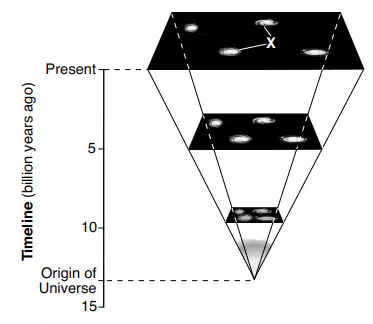
The two spiral-shaped celestial objects labeled X are
galaxies
planets
asteroids
comets

Energy is produced in the cores of main sequence stars like our sun when
Heavier elements undergo fusion into lighter elements
Cosmic background radiation is absorbed
Lighter elements undergo fusion into heavier elements
Cosmic background radiation is released
A star is producing Fe atoms in its core. What do you know about where the star is in its life cycle?
Nothing, stars can produce Fe atoms throughout their life cycle.
It is near the beginning of its life.
It near the middle of its life.
It is near the end of its life.
Energy that is produced during fusion in the sun's core makes its way to Earth in the form of
electromagnetic radiation
sound waves
photons
nuclei

How long does the conversion from helium (He) to carbon (C) take in a massive star?
A few million years
A few thousand years
A few billion years
A few hundred years

What is the duration of the core collapse in a massive star?
less than a second
Several years
A few hours
Several days

Match the stages of nucleosynthesis with their corresponding durations:
7x10^6 years
H → He
7x10^5 years
He → C
600 years
C → O
6 months
O → Si
1 day
Si → Fe

How will this star change based on the interaction of the gravitational forces (black arrows) and the internal nuclear forces (grey arrows)?
It is in equilibrium and will not change
The gravitational forces are greater therefore the star's size will get smaller
The gravitational forces are greater therefore the star's size will get larger
The nuclear forces are greater therefore the star's size will get smaller
The nuclear forces are greater therefore the star's size will get larger
A team of astronomers discover a new main sequence star. After obtaining all the data they can, the astronomers calculate the star has approximately the same mass as the Sun. One of the astronomers claims that the star will fuse nuclei into progressively heavier nuclei, until an iron core is built up. Then it will explode in a supernova and finally collapse into a black hole.
Explain why the claim is incorrect.
The sun is not a main sequence star.
The sun has no mass.
Stars do not fuse nuclei of atoms.
The sun will not explode and leave behind a black hole.
What is the the life cycle of a star with the same mass as the Sun?
Main Sequence -> Giant -> White Dwarf
Main Sequence -> White Dwarf -> Super Giant
Giant-> Super Giant -> Black Hole
Supernova -> Black Hole -> Neutron Star
Which of Kepler’s Laws explains that a planet moves faster when it is closer to the Sun?
First Law
Second Law (Law of Areas)
Third Law
Law of Gravity
Which of Kepler’s Laws relates the orbital period to the size of the orbit?
First Law
Second Law
Third Law (Law of Periods)
Law of Inertia

The diagram below represents the Earth’s orbital path around the sun. The Earth takes the same amount of time to move from A to B as from C to D.
The shaded sections of the diagram are equal in area.
The distance from the sun to the Earth is the same at point A and at point D.
The orbital velocity of the Earth at point A equals its orbital velocity at point C.
The gravitational force between the Earth and the sun at point B is the same as the gravitational force at point D.
Kepler's 1st Law says this about the orbits of planets
they are elliptical.
they are perfect circles.
they are always perfect polygons (square, pentagon, hexagon, etc.,)
they are parabolic.

The diagram below shows a moon revolving around a planet in an elliptical orbit. Using your knowledge of Kepler's Law, at which position is the moon traveling fastest?
location 1
location 2
location 3
location 4

Which Law is it?
This Law states that a planets path around the sun is elliptical.
Kepler's 1st Law
Kepler's 2nd Law
Kepler's 3rd Law

What is true about the area between points A, B and the Sun, and the area between points H, I and the Sun?
The area between A, B and the Sun is the largest.
The area between H, I and the Sun is the largest
Both areas are equal in size
There is not enough information to determine the areas
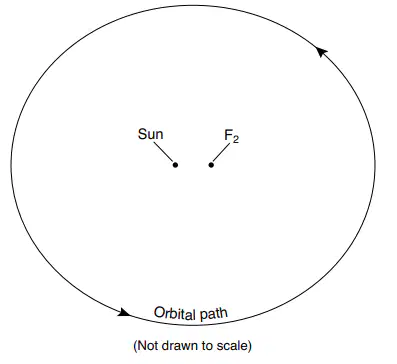
Base your answer on the diagram below and on your knowledge of Earth science. The diagram represents the elliptical orbit for one planet in our solar system. The two foci of the orbit are shown as the Sun and F2.
Which condition would produce an orbit with a greater eccentricity?
a decrease in the distance between the Sun and F2
an increase in the distance between the Sun and F2
a constant decrease in the orbital velocity of the planet
a constant increase in the orbital velocity of the planet

Base your answers on the diagram. The diagram represents four planets, A, B, C, and D, traveling in elliptical orbits around a star. The center of the star and letter f represent the foci for the orbit of planet A. Points 1 through 4 are locations on the orbit of planet A.
Planet A travels fastest in its orbit at location
1
2
3
4
Base your answers on the diagram. The diagram represents four planets, A, B, C, and D, traveling in elliptical orbits around a star. The center of the star and letter f represent the foci for the orbit of planet A. Points 1 through 4 are locations on the orbit of planet A.
If planets A, B, C, and D have the same mass and are located at the positions shown in the diagram, the planet that has the greatest gravitational attraction to the star is
A
B
C
D

The diagram below represents the orbits of three planets (X, Y, and Z) around star A. Star A is located at one focus and point B is the other focus. Numbers 1 through 9 represent different positions of the three planets. The arrows show the direction of revolution.
Which statement about the period of revolution of the planets is correct?
Planet X has a longer period of revolution than planet Y
Planet Z has a longer period of revolution than planet X
The planets have equal periods of revolution.
Planet Y has a longer period of revolution than planet Z.

