
 Worksheets
Food Chemistry: Scientific Principles Quiz
Total questions: 64
Worksheet time: 32mins
What does food chemistry systematically evaluate and understand?
Water, carbohydrates, lipids, proteins, minerals, and vitamins as they undergo chemical interactions during harvest, processing, storage, and distribution
Only the taste and color of food products
The marketing strategies for food products
The packaging designs of food items
What does food chemistry study?
The study of chemical processes and interactions of all biological and nonbiological components of food
The study of only the biological components of food
The study of food marketing strategies
The study of food packaging materials
Which of the following is NOT listed as a component of food in food chemistry?
Carbohydrates
Lipids
Proteins
Minerals
Food chemistry is based upon which of the following components?
Carbohydrates, lipids, proteins, enzymes, vitamins, water
Fats, oils, minerals, sugars, acids, fibers
Sugars, starches, minerals, acids, bases, salts
Proteins, acids, bases, minerals, fibers, water
Which of the following is NOT mentioned as a component of food in the provided material?
Water
Vitamins
Minerals
Lipids
Which elements are carbohydrates primarily composed of?
Carbon, hydrogen, and oxygen
Nitrogen, hydrogen, and sulfur
Carbon, nitrogen, and phosphorus
Oxygen, sulfur, and calcium
How are carbohydrates classified?
Monosaccharides, disaccharides, oligosaccharides, and polysaccharides
Proteins, lipids, nucleic acids, and vitamins
Sugars, fats, oils, and minerals
Amino acids, fatty acids, nucleotides, and enzymes
What is one of the main functions of carbohydrates?
Providing energy
Storing genetic information
Building muscle tissue
Regulating body temperature
Which of the following is NOT a use of carbohydrates in foods?
As thickening agents
As sweeteners
For texture in foods
As preservatives
What is necessary for the formation of pastes from a mixture of ground starch and water?
Cold temperature
Heat
Pressure
Light
What happens when the starch granule absorbs the maximum amount of water during paste formation?
It releases amylose
It decreases in size
It becomes less viscous
It solidifies completely
What is one effect of paste formation on a mixture?
It increases the viscosity of the mixture
It decreases the temperature of the mixture
It reduces the water content
It makes the mixture transparent
Which of the following foods requires paste formation for its creation?
Breakfast cereals
Fresh fruits
Grilled chicken
Roasted nuts
Paste formation is necessary for the creation of which of the following?
Pastas
Fruit juices
Roasted vegetables
Fried fish
Which of the following is NOT mentioned as a food that requires paste formation?
Sauces
Breakfast cereals
Pastas
Grilled steak
Which of the following is NOT a type of lipid?
Fats and oils
Waxes
Proteins
Sterols
What does it mean when a substance is described as hydrophobic?
It dissolves easily in water
It resists or separates from water
It attracts water molecules
It forms crystals in water
Which of the following is a characteristic of lipids?
They are naturally hydrophobic
They are always solid at room temperature
They are made only of proteins
They dissolve easily in water
Which of the following is an example of a lipid?
Monoglycerides
Glucose
Cellulose
Hemoglobin
What are lipids commonly referred to as?
Sugars
Proteins
Fats
Vitamins
Lipids can come from which of the following sources?
Only animal sources
Only plant sources
Both animal and plant sources
Only mineral sources
Which of the following is a function of lipids in food?
Provide color to foods
Provide tastes and textures to foods
Increase water content in foods
Reduce cooking time
What is true about the cooking temperatures of lipids?
They have a single cooking temperature
They have a wide range of cooking temperatures
They cannot be heated
They only cook at low temperatures
How can lipids be used in cooking when melted at high temperatures?
As a seasoning
As a cooking medium
As a thickener
As a sweetener
Which of the following is NOT a function of lipids in food?
Are important in food preparation
Provide a pleasant mouth feel and flavor to foods
Provide the highest amount of useable calories per gram
Reduce the calorie content of foods
What do lipids provide to foods besides flavor?
A pleasant mouth feel
Increased water content
Reduced shelf life
Lower nutritional value
Which nutrient provides the highest amount of useable calories per gram?
Lipids
Proteins
Carbohydrates
Vitamins
What is "mouth feel" in relation to food?
The sum of a food’s physical and chemical reactions in the mouth
The taste of a food
The color of a food
The nutritional value of a food
How is texture in food defined?
The actual physical feeling of a food in the mouth
The flavor of a food
The temperature of a food
The nutritional content of a food
Which of the following is NOT a function of lipids in cooking?
Prevent foods from sticking to cookware
Create fluffy and moist or flaky baked goods
Transfer heat to food
Increase the sweetness of foods
How do lipids contribute to the texture of baked goods?
By making them dry and hard
By creating fluffy and moist or flaky baked goods
By making them sour
By making them salty
What is one way lipids are used in sauces?
To sweeten the sauce
To thicken or emulsify the sauce
To add carbonation
To make the sauce spicy
Which of the following is a benefit of using lipids in cooking?
They prevent foods from sticking to cookware
They make food freeze faster
They remove all moisture from food
They make food less nutritious
Which of the following statements about lipids is TRUE?
Are available for cooking in both liquid and solid forms
Are only available in solid form for cooking
Can only be used at high temperatures
Are not affected by light or temperature
Why must lipids be observed closely while cooking?
Because temperature can have a negative effect
Because they are always healthy
Because they never change properties
Because they are only used for baking
What is meant by the "smoke point" of a lipid?
The temperature at which cooking fats and oils begin to smoke, emit odors, and their chemical structures break down
The temperature at which water boils
The temperature at which sugar caramelizes
The temperature at which proteins denature
Which of the following can alter the properties of lipids?
Light, temperature, and usage
Only water
Only pressure
Only freezing
Do all lipids have the same smoke point?
No, they have different smoke points
Yes, all lipids have the same smoke point
Only solid lipids have different smoke points
Only liquid lipids have different smoke points
What happens to solid fat when the temperature is increased?
It melts
It freezes
It evaporates
It becomes harder
What can inconsistencies in temperature over time cause in fats?
Chemical changes affecting smell, taste, and texture
Physical changes only
No changes at all
Increase in fat content
What is the effect of high temperatures on cooking fats over time?
They degrade
They become sweeter
They become more solid
They increase in volume
What can happen to the fat in food products when exposed to high temperatures for a long period of time?
The fat will blend more with the food
The fat will separate from the food
The fat will become sweeter
The fat will freeze
What is an example of a food that releases fat, becomes tough and rubbery, and then crumbles when cooked at high temperature for a long time?
Cheddar cheese
Chicken breast
Broccoli
White bread
Why is it important to consider the temperature range for each cooking fat?
Because all fats taste the same
Because each cooking fat has a different temperature range
Because fats are not affected by temperature
Because temperature does not affect food texture
What are proteins made of?
Amino acids arranged in a linear chain and folded into a globular form
Carbohydrates and lipids
Fatty acids and sugars
Nucleotides and vitamins
Why are proteins essential for the body?
They are essential for growth and survival
They provide only energy
They help in digestion only
They are used only for storage
Which of the following foods is NOT a common source of protein?
Bread
Legumes
Meat
Seafood
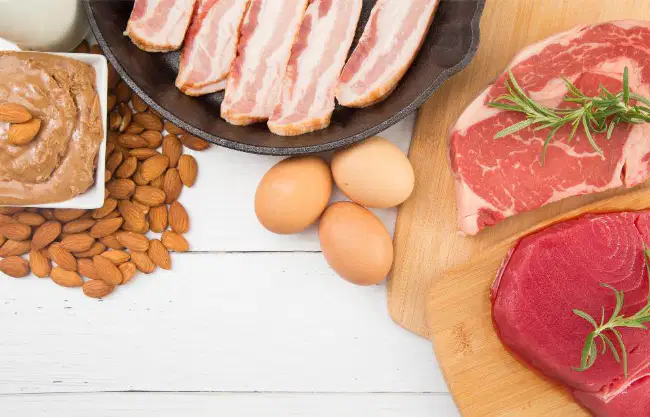
Where can proteins be found?
Legumes, meat, poultry, and seafood
Fruits, oils, and sugars
Water, salt, and minerals
Only in dairy products
What are proteins used for in cooking?
For texture, taste, appearance, and nutritional content
Only for sweetening food
Only for coloring food
Only for preservation
Which of the following is NOT a use of proteins in food preparation?
As a base for a food product
As a binding agent
To alter the texture of a food product
To increase the sugar content
In food preparation, proteins can be used as which of the following?
A base for a food product
A sweetener
A preservative
A coloring agent
How can proteins alter a food product during preparation?
By changing its texture
By making it sweeter
By making it more colorful
By increasing its shelf life
What happens to proteins during the cooking process?
Are denatured
Are frozen
Are evaporated
Are fermented
How can proteins be used in food preparation?
As emulsifiers
As sweeteners
As preservatives
As colorants
Which ingredient is commonly used to bind oil and water in mayonnaise?
Egg yolks
Sugar
Flour
Butter
Proteins found in wheat are responsible for what characteristic in baked goods and pastas?
Texture
Color
Sweetness
Shelf life
What must be present for the Maillard reaction to take place?
Proteins
Carbohydrates
Fats
Vitamins
Proteins can be isolated from which of the following legumes and added to other protein sources to change the texture and nutritional content of the final product?
Soybeans
Peanuts
Lentils
Chickpeas
What is the Maillard reaction?
The coagulation of denatured proteins with sugars resulting in a distinct flavor and browned color
The breakdown of fats into fatty acids and glycerol
The fermentation of sugars by yeast to produce alcohol
The absorption of water by starches to form a gel
Which of the following foods is an example where the Maillard reaction is seen?
Caramelized onions
Boiled potatoes
Raw carrots
Steamed broccoli
What is the primary function of enzymes in chemical processes?
Serve as catalysts to convert substances from one form to another
Provide energy for chemical reactions
Act as structural components in cells
Store genetic information
How do enzymes affect the time and energy required for a chemical process?
They reduce both the time and energy required
They increase the time required but reduce energy
They have no effect on time or energy
They only increase the energy required
Which of the following is NOT an industry where enzymes are commonly used?
Automobile manufacturing
Baking
Brewing
Dairy production
Enzymes are primarily made up of which type of biological molecule?
Proteins
Carbohydrates
Lipids
Nucleic acids

