
 Worksheets
STUDY: Unit 2.3 Mid-Unit Quiz
Total questions: 89
Worksheet time: 46mins
What does relative dating allow scientists to determine?
Exact number of years
The order in which events occurred
The speed of rock formation
The type of fossil
Absolute dating helps scientists find:
The color of the rocks
The specific age in years
The order of fossils
The rock’s location
In the Law of Superposition, the youngest rock layer is:
On top
In the middle
At the bottom
On the side
The Law of Original Horizontality says sediments form:
In curved layers
In flat, horizontal layers
Underwater only
From volcanic ash
When a rock layer is tilted, what does that tell us?
The layer was disturbed after it formed
It is the oldest layer
It contains no fossils
It was formed recently
What process can cause rock layers to bend or break?
Folding and faulting
Fossilization
Freezing and thawing
Cementation
When magma cuts across other rock layers, it is:
Older than all other layers
Younger than the rocks it cuts
The same age as surrounding layers
A fossil intrusion
If a fault breaks through several layers, scientists know:
The fault formed before the layers
The fault is younger
The layers are the same age
The fault caused the layers to form
Stratigraphy is the study of:
Fossil fuels
Rock layers and their order
Earthquakes
Mineral composition
Uniformitarianism means:
A. Earth's processes have always worked the same way
B. The Earth formed suddenly
C. Layers form in random order
D. Fossils appear at the same time
If a fossil is found in a lower layer, it is usually:
Younger than fossils above
Older than fossils above
The same age
Not a real fossil
An index fossil helps scientists determine:
Rock color
Relative age of layers
For a fossil to be a good index fossil, it must:
Have lived a short, specific time and be widespread
Be found in one location only
Be extremely rare
Be formed by lava
Fossils are most commonly found in which rock type?
Igneous
Sedimentary
Metamorphic
Volcanic
A fossilized footprint is an example of:
Body fossil
Trace fossil
Mold fossil
Carbon imprint
When minerals replace an organism’s tissue, this creates:
Amber fossil
Permineralized fossil
Mold fossil
Compression fossil
What condition best helps preserve fossils?
Fast burial and low oxygen
High heat
Dry air
Exposure to sunlight
Fossilized dinosaur bones are examples of:
Body fossils
Trace fossils
Mold fossils
Resin fossils
The fossil record shows:
How rocks form
How life and environments have changed
How deep the oceans are
How Earth rotates
If marine fossils are found on land, it means:
The ocean once covered that area
They were moved by people
They are fake fossils
The fossils came from rivers
If a fossilized fish is found high on a mountain, that area was once:
Desert
Underwater
Volcanic
Frozen
What happens when a fault pushes older layers above younger ones?
The order becomes reversed
Fossils disappear
Rocks become magma
Erosion stops
The Law of Lateral Continuity helps scientists:
Match separated rock layers
Predict earthquakes
Measure radiation
Create fossils
What is an unconformity?
A. A missing layer of rock
B. A fossil print
C. A volcanic layer
D. A crystal formation
Radiometric dating measures:
Pressure in rocks
The decay of radioactive atoms
The density of fossils
The temperature of magma
Radioactive decay happens at a:
Random rate
Constant rate
Variable speed
Rapid pace only in lava
A half-life is:
The time for half of a radioactive sample to decay
The age of the rock
Half the thickness of a rock
A fossil’s lifespan
If a rock has gone through 2 half-lives, how much of the original material remains?
50%
25%
75%
10%
A rock sample has 6.25% of its radioactive material left. How many half-lives passed?
2
3
4
6
Carbon-14 is best for dating:
Ancient lava
Once-living materials
Oldest rocks
Crystals
Uranium dating is used for:
Very old rocks
Young fossils
Meteorites only
Organic remains
Why can’t carbon-14 be used on dinosaur fossils?
They are too old for carbon-14
Carbon-14 doesn’t decay
Dinosaurs didn’t have carbon
Fossils don’t contain atoms
What instrument measures radiation from atoms?
Geiger counter
Microscope
Magnetometer
Seismograph
What device separates and measures isotopes?
Mass spectrometer
Barometer
Which statement best compares relative and absolute dating?
Relative shows sequence, absolute gives actual age
Both give the same information
Absolute is less accurate
Relative uses radioactive elements
When a fossil shows movement or behavior, it’s called a:
Body fossil
Trace fossil
Cast fossil
Mineral fossil
A shell imprint left in rock is a:
Mold
Cast
Body
Trace
When minerals fill a mold, what forms?
Cast
Trace
Amber
Impression
Amber fossils are formed when:
Animals are trapped in hardened resin
Rocks melt
Fossils freeze
Minerals dissolve
41. The age of Earth is approximately:
4.5 billion years
500 million years
10 billion years
1 billion years
How old is the Earth?
6,000 years
4.6 billion years
1 million years
500,000 years
If two layers have the same index fossil, they:
Formed around the same time
Are unrelated
Are different ages
Were made by lava
Which rock type rarely contains fossils?
Igneous
Sedimentary
Shale
Limestone
Fossils form because:
Organisms are buried and preserved
They are frozen in glaciers
They form only in lava
They appear randomly
The deeper the layer, the:
Older it usually is
Younger it usually is
Lighter it becomes
More recently it formed
If a fossilized shell is discovered in desert rock, what does that mean?
The desert was once covered by water
Fossils moved there
The shell was blown by wind
It's not a real fossil
Why are fossils uncommon in igneous rock?
Heat destroys organic remains
Magma traps fossils
They form too quickly
Lava cools unevenly
An unconformity shows that:
Erosion or missing layers occurred
Rocks formed quickly
Fossils are mixed
Faults disappeared
What is one use of radiometric dating?
To determine exact rock ages
To predict volcanoes
To find fossils
To measure heat
If a rock contains 25% of its radioactive atoms left, how many half-lives have passed?
1
2
3
4
A fossil found in two continents suggests:
Those continents were once connected
The fossil is fake
The continents moved apart recently
The fossil formed twice
If a fault cuts through a layer, it is:
Older than the layer
Younger than the layer
The same age
Not related
What does the fossil record NOT tell scientists?
Changes in life
Exact ages of fossils
Extinctions
Environmental shifts
Which example best shows the Law of Superposition?
Bottom layers are older than top
Rocks form randomly
Younger layers fold first
Oldest layers are at the top
If a volcano erupts and covers an area with ash, that ash layer helps scientists:
Mark a specific time period
Identify faults
Measure fault movement
Find fossils
What do fossils of tropical plants in cold regions show?
The climate changed over time
The plants adapted
Fossils moved
The region was always cold
How do fossils show evolution?
They show how species change over time
They prove species never changed
They show random patterns
They cannot show evolution
A fossil’s shape left in rock is a:
Mold
Cast
A cast forms when:
A. Minerals fill a mold
B. Organisms decay completely
C. Rock melts
D. Fossils form underwater
Which method can provide the most exact date for a rock?
Radiometric dating
Relative dating
Fossil analysis
Mineral testing
What is the main difference between fossils and rocks?
Fossils were once living
Rocks are younger
Fossils are man-made
Rocks contain metal
What kind of fossil gives evidence of an animal’s activity?
Trace fossil
Cast
Body fossil
Mineral fossil
What does radiometric dating use to determine age?
Radioactive isotopes
Fossil color
Temperature
Soil thickness
64. Which material can be dated with carbon-14?
Wood
Iron
Plastic
Stone
Which of the following is most likely to become a fossil?
Wood or bone
Granite
Sandstone
Quartz
Which condition is least likely to create a fossil?
Fast burial
Extreme heat
Low oxygen
Still water
What happens during radioactive decay?
Atoms change into new elements
Fossils form faster
Rocks melt
Elements freeze
What can cause layers to appear out of order?
Faulting
Fossilization
Erosion
Deposition
A sedimentary layer missing due to erosion is called a:
Gap or unconformity
Cross-section
Plateau
Delta
The half-life of carbon-14 is about:
5,730 years
500 years
1 million years
10,000 years
Fossils found deeper underground are generally:
Older
Younger
The same age
Formed recently
What does finding marine fossils in desert rock layers prove?
Deserts can become oceans
Fossils can’t move
Rocks never change
Oceans form instantly
How do scientists use index fossils?
To compare rock layers from different locations
To identify minerals
To find volcanoes
To predict earthquakes
When new rock layers form on top of old ones, this is called:
Deposition
Erosion
Melting
Uplift
If a rock contains 50% parent atoms and 50% daughter atoms, how many half-lives passed?
1
2
3
4
Why do scientists study both relative and absolute dating together?
To build a complete timeline of Earth’s history
To measure earthquakes
To locate volcanoes
To find mineral deposits
A geologist discovers a fossilized sea shell embedded in sandstone high on a mountain in Colorado. What conclusion can she reasonably make?
The mountain was once underwater
The shell was carried by birds
The shell was buried by lava
The fossil was formed by wind erosion
Two identical index fossils are found in different continents. What is the most logical explanation for this discovery?
The same species evolved twice
The continents were once connected
The fossils drifted across the ocean
The fossils were formed in different eras
A paleontologist finds a trilobite fossil in a lower rock layer and an ammonite fossil in a higher layer. What does this suggest about the timeline of life?
Trilobites lived before ammonites
Trilobites evolved from ammonites
The layers are the same age
Ammonites lived during the Precambrian
In one canyon, a sandstone layer lies above a limestone layer. In another nearby canyon, the same sandstone is below the limestone. What likely caused this difference?
A. A fault or folding event flipped one set of layers
B. The rocks formed in opposite seasons
C. The fossils inside caused the layers to move
D. Each canyon formed on a different planet
A scientist finds an igneous intrusion cutting through three sedimentary layers. Based on the Law of Cross-Cutting Relationships, which is the youngest feature?
The oldest sedimentary layer
The igneous intrusion
The bottom layer
The middle sediment layer
A bone fossil contains only 1/8 of its original radioactive carbon-14 remaining. Approximately how many half-lives have passed?
1
2
3
4
Marine fossils are discovered deep beneath a desert in Africa. What does this reveal about the region’s past environment?
The desert was once covered by an ocean
The fossils drifted there by wind
The ocean water evaporated quickly
The fossils are unrelated to the land above them
Two fossil layers are found — one with early fish and another above it with amphibians. What does this fossil order show about evolution?
A. Amphibians likely evolved from fish
B. Fish evolved from amphibians
C. Both appeared at the same time
D. Fish lived on land before amphibians
Scientists discover a fossilized tree trunk that still contains mineralized cell patterns visible under a microscope. Which process preserved it this way?
A. Permineralization
B. Compression
C. Mold formation
D. Trace fossilization
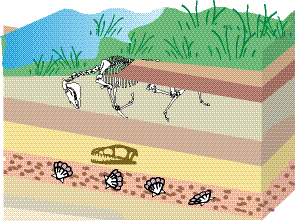

According to the Law of Superposition, the oldest rock layers are found...
at the top of the rock layers
in the middle of the rock layers
near an intrusion
always at the bottom of the rock layers

According to the Law of Superposition which letter represents the oldest layer?
E
D
C
B
A

What is the order of the rock layers from youngest to oldest?
A, E, B, C, D
A, D, C B, E
E, B, C D, A
E, B, C A, D

