
 Worksheets
The Cold War Mastery Connect Test Study Guide
Total questions: 72
Worksheet time: 48mins
This was the United States overall policy to help prevent the spread of communism.
Arms Race
Détente
Red Scare
Containment
This man was the first president of Russia.
Boris Yeltsin
Vladimir Putin
Vladimir Lenin
Mikhail Gorbachev
“An attack on one shall be considered an attack on all.” In the early stages of the Cold War, this statement would have most likely been made by which organization or plan?
The Berlin Blockade
The Berlin Airlift
NATO
The Marshall Plan
Who was the first Communist leader of China?
Mao Zedong
Qing Taipei
Vladimir Lenin
Joseph the Hun
Which event of 1948–1949 is illustrated in picture A showing planes delivering supplies over Berlin?
Berlin Blockade
Berlin Airlift
Berlin Wall
Prague Spring
What event was when the Soviet Union attempted to cut off land and river transit between West Berlin and West Germany
Berlin Blockade
Berlin Airlift
Berlin Wall
Prague Spring
Which leader of China was responsible for transforming the country’s economy into a more capitalistic system?
Mao Zedong
Deng Xiaoping
Qing Taipei
Emperor Yongle
Which weapon was not used during either the Korean or Vietnam Wars?
Carpet bombing
Agent Orange
Napalm
Nuclear bombs
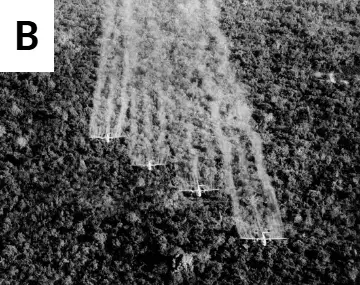
This was the herbicide used in the Vietnam War shown in figure B.
Carpet bombing
Agent Orange
Napalm
SALT I
Which 1962 event placed Soviet nuclear missiles less than 90 miles from the United States?
Soviet–Afghan War
Vietnam War
Korean War
Cuban Missile Crisis
Which parallel still divides North and South Korea?
18th Parallel
17th Parallel
38th Parallel
37th Parallel

Which Chinese event is shown in picture C featuring a lone protester standing before tanks?
Détente
Apartheid
Tiananmen Square Uprising
Bolshevik Revolution
Which event is least similar to the democratic protest described as happening in picture C?
Hong Kong Protests
May Day
Prague Spring
Hungarian Uprising
Which Soviet Union leader instituted the policies of Perestroika and Glasnost?
Nikita Khrushchev
Mikhail Gorbachev
Ronald Reagan
Vladimir Putin
What was Perestroika?
Economic and social restructuring of the Soviet Union
Opened up the Soviet Union
Closed off the Soviet Union
Created weapons for the Soviet Union
Fidel Castro...
Was a leader of the uprisings in Eastern Europe against the Soviets
Led communist supporters in Vietnam
Was the leader of the nationalists in the Chinese Civil War
Was the leader of the communist rebels in Cuba
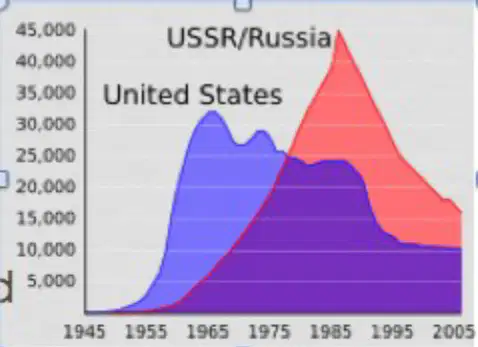
Based on the overlapping area chart labeled D comparing United States and USSR/Russia warheads, what aspect of the Cold War arms race is represented?
Korean War
Soviet Union Breakup
Détente and SALT
Great Leap Forward
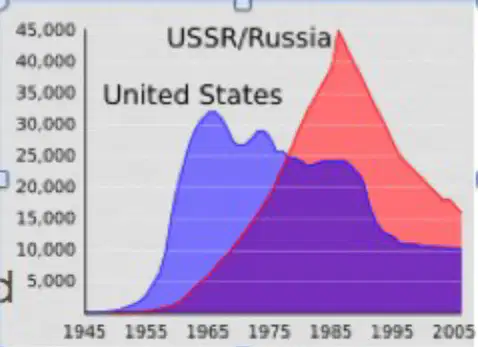
Denuclearization shown in picture D was a response to which event in the Cold War?
Space Race
Glasnost
Arms Race
Reagan Doctrine
Which of the following was a weapon of the Cold War?
Military Alliances
Aid to underdeveloped nations
Development of nuclear weapons
All of the Above
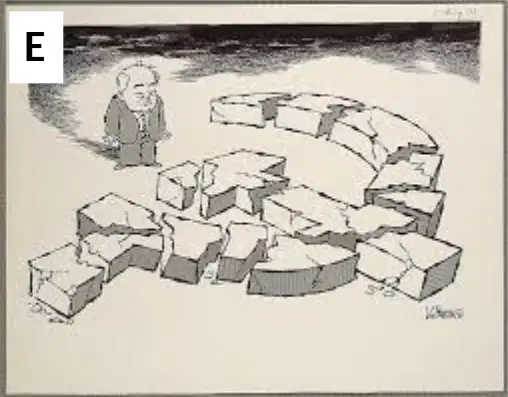
What aspect of the Cold War is represented in picture E showing a crumbling hammer-and-sickle path with a Soviet leader?
Korean War
Soviet Union Breakup
Détente and SALT
Arms Race
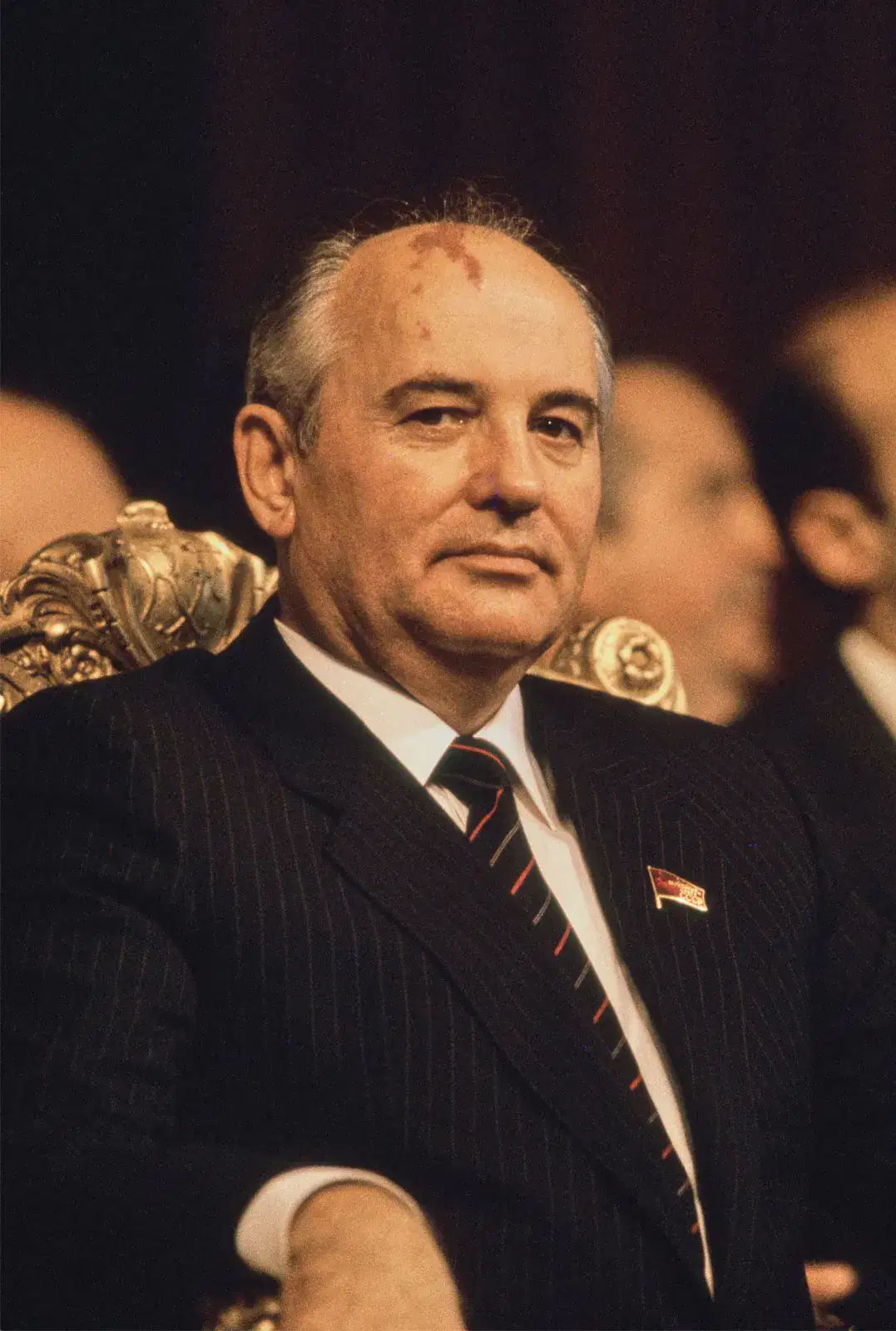
What Cold War leader is represented in this picture?
Nikita Khrushchev
Mikhail Gorbachev
Ronald Reagan
Vladimir Putin
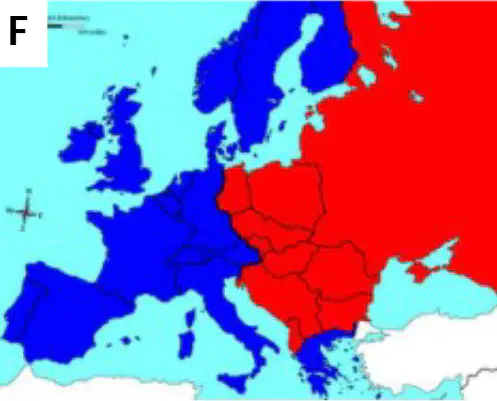
What key term coined by Winston Churchill is represented in Picture F, which shades Eastern Europe under Soviet influence?
Cuban Missile Crisis
Chinese Civil War
Berlin Airlift
Iron Curtain
The group of countries in Eastern Europe dominated by the Soviet Union are called...
Satellites
Spheres of Influence
Colonies
Protectorates
Which statement best describes the Cold War?
Struggle between east democratic nations and west communist nations
The Soviets expressed aim of keeping communism only in the Soviet Union
All out war between the United States and the Soviet Union
Not all out war, but no genuine peace
Which group once consisted entirely of communist countries in Eastern Europe?
Czechoslovakia, East Germany, Poland
Hungary, Spain, East Germany
Austria, Poland, Turkey
Czechoslovakia, Greece, Italy
A major reason for creating the Warsaw Pact was to:
Extend US reach on Latin America
Strengthen the Soviet hold on Eastern Europe.
Supervise the West German government.
Protect the Eastern European nations against communist aggression.
A major reason for creating the North Atlantic Treaty Organization (NATO) was to:
Strengthen the Soviet hold on Eastern Europe.
Supervise the West German government.
Protect the Western European nations against communist aggression.
Protect the Eastern European nations against communist aggression.
How did the Soviet Union respond to the Hungarian Independence movement in 1956?
Allowing democratic reform
Using military force to suppress protesters
Negotiating a peace treaty
Allowing a coalition government
Which policy between the US and Soviet Union tried to avoid war by acknowledging a nuclear attack by either side would lead to devastation for both sides?
Detente
Mutually Assured Destruction
SALT
Containment

Based on the passage labeled “Primary Source 1,” what was the author calling for?
economic and political reforms in the Soviet Union.
an end to the Vietnam War.
an immediate conversion to a market economy
a Communist revolution.

According to the cartoon titled “MAYDAY!”, what was the primary cause of the collapse of the Soviet Union?
A military takeover.
Economic problems
World War II
The counterculture
Which statement best describes the subject of the cartoon “MAYDAY!”?
Cuba requests Soviet help during the Cuban missile crisis.
Western Europe is on the brink of chaos after World War II.
The United States faces a counterculture movement in the 1960s.
Economic problems and reforms weaken the Soviet Union.
Which of the following are characteristics of the Cold War? Select all that apply.
Nuclear threats
High unemployment
Drought
Mutually assured destruction (MAD)
Space race
Which factors best explain why the Cold War took place?
Economic growth, resources in surplus, and a desire for national sharing
Nuclear threats, nationalism, and the fear of communism
Decline in agriculture, rise in manufacturing, and a surplus of jobs
Increase in agriculture and a surplus of food and jobs
What was the capital of Czechoslovakia where protest and uprising against the Soviet Union and communism broke out?
Warsaw
Prague
Bucharest
Budapest
How did the Soviet Union and other communist countries react to the Prague Spring protests?
Invaded with 500,000 NATO troops.
Invaded with 500,000 Warsaw troops.
Sent in money to convince protesters to stop and return to communism.
Imprisoned all protesters for life.
Which two of the following was an effect of the Hungarian Uprising? Choose the BEST answer pair.
It worsened superpower relations and showed communism in a bad light.
It improved superpower relations and helped to spread communism.
It worsened superpower relations and helped to spread communism.
It improved superpower relations and showed communism in a bad light.
The fall of the Berlin Wall came to symbolize which idea?
The rise of communism
The rise of monarchies
The fall of democracy
The fall of communism
Which statement best explains why the Berlin Wall finally fell?
A need for monarch rule and absolute power
A desire for freedom and democracy
The Russians lost WWII
The League of Nations failed to act
Which of the following describes a major change in international relations in the 1980s and the 1990s?
The rapid establishment of large overseas colonial empires by European powers.
The disbanding of most regional political organization.
The decline of power of multinational corporations.
The reduction of confrontations between communist and noncommunist countries.
Label North and South Korea
What was the impact of the Korean War?
It led to the formation of NATO
Korea was split by the 38th parallel making North Korea communist.
It led to the creation of the Marshall Plan
It led to the establishment of the Truman Doctrine

Name for division between Communist and Non-Communist Countries in Europe
Iron Curtain
A type of containment policy to stop the spread of communism by aiding other countries
Truman Doctrine
The political practice of accusations of disloyalty or communist sympathies without evidence during the Second Red Scare
McCarthyism
A decades long period of extreme tension and competition between the United States and the Soviet Union after World War II
The Cold War
Name for US Policy to stop communism from spreading
Containment
Name for dividing line between Communists and NonComm in Europe
Iron Curtain
US plan to help Greece and Turkey
Truman Doctrine
Warsaw Pact
Group of Communist countries
NATO
Group of Non-Communist countries
The Korean War began when (a) Korea invaded (b) Korea in June of 1950.

SALT Treaties

Detente

Cuban Missile Crisis

McCarthyism

Containment
Match the following

Ho Chi Minh Trail

Domino Theory

Cuban Missile Crisis

Berlin Airlift

Bay of Pigs
Match the following term to its description.
A key issue discussed at this conference was Poland and free elections in Europe.
Yalta Conference
Allied leaders Truman, Stalin, and Churchill met to deal with German reparations.
Potsdam Conference
This policy gave $400 million to fight Communist aggression; its goal was to help those who worked to resist being controlled by others.
Truman Doctrine
This was the response to a Soviet blockade of Germany’s capital city.
Berlin Airlift
North Korea became a (a) country and South Korea became a (b) country.
The tension between the U.S. and the Soviets (a)
SALT Treaties
Detente
Cuban Missile Crisis
McCarthyism
Containment
Name for division between Communist and Non-Communist Countries in Europe
Iron Curtain
A type of containment policy to stop the spread of communism by aiding other countries
Truman Doctrine
The political practice of accusations of disloyalty or communist sympathies without evidence during the Second Red Scare
McCarthyism
A decades long period of extreme tension and competition between the United States and the Soviet Union after World War II
The Cold War

Which Soviet leader oversaw the Space Race and the Cuban Missile Crisis?
Gorbachev
Stalin
Lenin
Khrushchev
Rausky

Who is this? (leader of US)
Winston Churchill
President Truman
Joseph Stalin
President Roosevelt

Who is this? (leader of USSR)
Stalin
Churchill
Truman
Trump

Who is this? (leader of Britain)
Truman
Churchill
Stalin
Roosevelt

What does the image represent?
The end of WWII
The Truman Doctrine
The Berlin Airlift
The Iron Curtain

The United States had a (a) government and supported (b) , while the Soviet Union had a (c) and supported (d) .
Place labels where they belong.
The U.S. was (a) and the Soviet Union was communist.

What did the "Iron Curtain" symbolize?
The best areas for mining iron in Europe
The divide between democracy and communism
The border between North and South Korea
The Ho Chi Minh Trail


This president was responsible for the Strategic Defense Initiative (Star Wars).
Jimmy Carter
Gerald Ford
George W. Bush

In this economic system, the government owns all property and means of production.
communism
capitalism
socialism
democracy

What is the Soviet Union?
A communist state that existed from 1922 to 1991
A democracy established in the 19th century

