

wayground logo

Free Printable Worksheets

NEW

Font size

S
M
L
XL
Worksheets

AP Psychology - Developmental Psychology

Total questions: 73

Worksheet time: 38mins
Name
Class
Date
1.
The term critical period refers to:
a)
Prenatal development
b)
The initial two hours after a child’s birth
c)
The preoperational stage
d)
A restricted time for development and/or learning
2.
What is the first stage of Piaget's cognitive development?
a)
Preoperational
b)
Sensorimotor 
c)
Formal operational
d)
Concrete operational
3.
During the preoperational stage...
a)
children begin to use logic
b)
focuses on motor skills
c)
the adolescent gains ability to formulate complicated verbal arguments
d)
intense language learning takes place
4.
Children who in infancy formed secure attachments to their parents are more likely than other children to:
a)
Prefer the company of adults to that of other children
b)
Become permissive parents
c)
Show a great deal of social competence
d)
Be less achievement oriented
5.
An infant who has developed object permanence...
a)
is attached to specific objects, such as a blanket.
b)
will see all objects as being the same.
c)
knows that an object, such as a rattle, exists even if it is not in view.
d)
cries when a wanted object is taken away.
6.
If Jeremy begs for a new electronic gadget, his parents nearly always buy it for him. What type of family is this?
a)
Permissive
b)
Democratic
c)
Authoritarian
d)
Submissive
7.
This style of parenting calls for imposing rules and demanding obedience without debate or discussion between parent and child.
a)
Permissive
b)
Neglectful
c)
Authoritative
d)
Authoritarian
8.
The natural physical development that occurs automatically and in a sequential manner as a result of genetics is . . .
a)
Childhood
b)
Maturation
c)
Puberty
d)
Aging
9.
Erikson said that when you are a teenager, your main goal is to find your . .
a)
Trust
b)
Calling
c)
Identity
d)
Integrity
10.
When the baby's cheek is stroked they turn towards the side it was stroked and begins making sucking motions
a)
rooting reflex
b)
sucking reflex
c)
grasp reflex
d)
Babinski reflex
11.
Jane, a preschooler, insists on dressing herself each morning for school, even though she generally selects mismatching outfits, misses buttons, and wears her shoes on the wrong feet. When her mother tries to dress Jane or fix her outfit, Jane brushes her mother off and insists on doing it herself. What stage of psychosocial development best describes Jane’s behavior?
a)
Trust vs. Mistrust 
b)
Autonomy vs. Shame and Doubt
c)
Intiative vs. GUilt 
d)
Industry vs. Inferiority 
12.
The stage that occurs between birth and one year of age is concerned with:
a)
Trust vs. Mistrust
b)
Autonomy vs. Shame and Doubt
c)
Intiative vs. Guilt 
d)
Industry vs. Inferiority 
13.
According to Erikson, what is the major conflict faced during adolescence?
a)
Autonomy vs. Shame and Doubt
b)
Intimacy vs. Isolation
c)
Identity vs. Role Confusion
d)
Generativity vs. Stagnation 
14.
A 38-year-old woman quits her high-paying marketing job to focus on her children and become a school counselor. What stage would Erikson consider this to be:
a)
Idenitity vs. Role Confusion 
b)
Generativity vs. Stagnation
c)
Ego Integrity vs. Despair
d)
Industry vs. Inferiority
15.
The experiment with Harry Harlow and the monkeys prove what about humans?
a)
 We need food to survive.
b)
 We need human touch to survive.
c)
We want human touch over food.
d)
 We want food over human touch.
16.
The  ________________________________ parenting style uses a "hands off" approach, where children learn from the consequences of their actions. The parent considers themselves as a friend to their child.
a)
Authoritative
b)
Neglecting
c)
Permissive
d)
Authoritarian
17.
Maria resents the burdens and constraints  of caring for her infant daughter and ignores her cries for attention.  Her daughter will likely show signs of
a)
egocentricism
b)
insecure attachment
c)
habituation
d)
gender typing
18.
Mom secretly dabs some lipstick on the nose of her 2 year old and allows him to see himself in the mirror.  the boy will most likely
a)
touch his own nose
b)
touch the mirror at the point where the lipstick shows
c)
wave at the mirror as if it were another child
19.
In a pleasant but unfamiliar setting, infants with a secure maternal attachment are most likely to:
a)
act as if their mothers were little importance to them
b)
leave their mother's side in order to explore their surroundings
c)
cry when their mothers leave them
20.
According to Piaget, accommodation refers to
a)
parental efforts to include new children in the existing family structure
b)
incorporating new experiences into existing schemas.
c)
developmental changes in a child's behavior that facilitate social acceptance by family and peers.
d)
adjusting current schemas in order to make sense of new experiences.
21.
Four-year-old Jennifer mistakenly believes that her mother would like to receive a toy doll as a Christmas present. This best illustrates Piaget's concept of:
a)
accommodation
b)
attachment
c)
object permanence
d)
egocentricism
22.
If research suggested that a pregnant mother's use of an artificial sweetener caused harm to the fetus, the artificial sweetener would be considered a(n):
a)
FAS
b)
form of DNA
c)
depressant
d)
teratogen
23.
A boy who consistently exhibits traditionally masculine interests and behavior patterns is strongly:
a)
habituated
b)
imprinted
c)
egocentric
d)
gender-typed
24.
Cindy understands her world primarily by grasping and sucking easily available objects. Cindy is clearly in Piaget's ________ stage
a)
preoperational
b)
concrete operational
c)
sensorimotor
d)
formal operational
25.
According to Piaget, during the formal operational stage people begin to:
a)
reason abstractly
b)
adhere to social norms
c)
distinguish between good and bad behaviors
d)
become aware of the positive and negative consequences of their own behaviors
26.
According to Erikson, a man’s midlife crisis happens in the 
a)
generativity vs stagnation
b)
intimacy vs isolation
c)
integrity vs despair
d)
identity vs role confusion
27.
Mary Ainsworth's Strange Situation paradigm is used to test young children's 
a)
ego strength
b)
intelligence
c)
reaction time
d)
attachment
28.
The body structures that enable reproduction are the
a)
primary sex characteristics 
b)
secondary sex characteristics
c)
teratogens
d)
schemas
29.
Neither the researcher nor the subjects knew whether or not they received the drug studied or a placebo.  This is an example of
a)
expectancy effects
b)
placebo effects
c)
double blind
d)
nothing.  It would be ridiculous
30.

Dr. Schulte wants to investigate if aggressive behavior in children is increased if they view violent videos.  In this instance, the dependent variable is


a)


violent videos


b)


aggressive behavior


c)


a placebo


d)


the control condition


31.
A computed measure of how much scores vary around the mean score
a)
Standard Deviation
b)
Normal Curve
c)
Range
d)
Median
32.
The difference between the highest and lowest score in a distribution
a)
Range
b)
Mode
c)
Normal Curve
d)
Hindsight Bias
33.
Which of the following perspective is most likely to address how the encoding, storing, and retrieval of information might alter our thoughts?
a)
Behavioral 
b)
Psychodynamic 
c)
Humanistic 
d)
Cognitive 
34.
Which perspective would be most useful when explaining how people from different countries express anger?
a)
Psychodynamic 
b)
Behavioral 
c)
Social- cultural 
d)
Biological 
35.
According to the behaviorist perspective, psychological science should be rooted in what?
a)
Introspection 
b)
Observation
c)
Cultural influences 
d)
Growth potential 
36.
The study of the importance of satisfying love and acceptance needs best describes which school of psychology. 
a)
Behavioral 
b)
Functionalist 
c)
Humanistic 
d)
Structuralist 
37.
Which of the following is an example of negative correlation?
a)
People who spend more time exercising tend to weigh less
b)
Teenage females tend to have fewer speeding tickets than teenage males.
c)
Students with low IQ scores tend to have lower grades.
d)
Students'' shoe sizes are not related to their grades.
38.
After several trials during which a dog is given a certain kind of food at the same time that a specific tone is sounded, there is evidence of conditioning if the dog salivates when
a)
the tone only is presented
b)
the food only is presented
c)
the food and tone are presented together
d)
a different tone is presented with the food
39.
When our child first says dada, dada, dada or mama, mama, mama. Rather than associating meaning with that combination of consonants and vowels, at first baby Fritz will be:
a)
Cooing
b)
Doodling
c)
Booing
d)
Babbling
40.
He stressed the importance of observation and imitation in learning. His research included studying children with a Bobo doll.
a)
Albert Bandura
b)
Carl Bobo
c)
Paul Ekman
d)
David Wechsler
41.
Dr. Wong believes that children whose parents are not responsive to their needs during the first two months of life will never develop basic trust toward the world.  Dr. Wong believes that this developmental stage is a(n):
a)
preoperational stage
b)
critical period
c)
cognitive schema
d)
maturational span
42.
Critical period is a phase during which
a)
children frequently disobey their parents
b)
children become able to think hypothetically and reason abstractly
c)
parents frequently show impatience with a child's slowness in becoming toilet-trained.
d)
certain events have a particularly strong impact on development.
43.
Interpreting new experiences in terms of existing schemas is called:
a)
learning
b)
assimilation
c)
accomodation
44.
The sensorimotor stage focuses primarily on..
a)
motor skills
b)
language development
c)
understanding of others perspective
d)
understanding complex mathematics
45.
How do cliques help adolescents with social development?
a)
They encourage them to develop stronger family ties.
b)
They emphasize the importance of preparing for college and a career.
c)
They foster friendships with individuals from a wide variety of cultures and social classes.
d)
They help adolescents establish an identity.
46.
During the preoperational stage...
a)
children begin to use logic
b)
focuses on motor skills
c)
the adolescent gains ability to formulate complicated verbal arguments
d)
intense language learning takes place
47.
Eriskon's stage that occurs between birth and one year of age is concerned with:
a)
Trust vs. Mistrust
b)
Autonomy vs. Shame and Doubt
c)
Intiative vs. Guilt 
d)
Industry vs. Inferiority 
48.
According to Erikson, what is the major conflict faced during adolescence?
a)
Autonomy vs. Shame and Doubt
b)
Intimacy vs. Isolation
c)
Identity vs. Role Confusion
d)
Generativity vs. Stagnation 
49.
Maria resents the burdens and constraints  of caring for her infant daughter and ignores her cries for attention.  Her daughter will likely show signs of
a)
egocentricism
b)
insecure (avoidant) attachment
c)
habituation
d)
gender typing
50.
Mom secretly dabs some lipstick on the nose of her 2 year old and allows him to see himself in the mirror.  the boy will most likely
a)
touch his own nose
b)
touch the mirror at the point where the lipstick shows
c)
wave at the mirror as if it were another child
51.
Four-year-old Jennifer mistakenly believes that her mother would like to receive a toy doll as a Christmas present. This best illustrates Piaget's concept of:
a)
accommodation
b)
attachment
c)
object permanence
d)
egocentricism
52.
Keisha was able to roll over at two months, crawl at five months, and walk at ten months. This sequence of development is most likely due to
a)
egocentricism
b)
maturation
c)
attachment
d)
assimilation
53.
Harry Harlow’s experiments with rhesus monkeys suggest which of the following as most important for infants when establishing an attachment to their mothers?
a)
The amount of time spent with the mother
b)
The mother’s ability to provide nourishment to the infant
c)
The tactile characteristics of the mother
54.
The fact that imprinting is most certain to occur if the opportunity for imprinting is presented to the organism at a very specific age indicates the existence of 
a)
a schema
b)
a reflex
c)
a critical period
d)
an architype
55.
Which of the following reflects the inborn and stable rudiments of personality, such as excitability?
a)
imprinting
b)
egocentricism
c)
temperament
d)
social referencing
56.
 According to Lawrence Kohlberg, during the preconventional stage of moral development children tend to:
a)
 Use abstract thoughts or principles to determine their behavior
b)
Make behavioral decisions based on legal issues
c)
Understand morality based on customs or values
d)
Interpret behavior in terms of punishments or rewards
57.
 Authoritative parents can best be defined as:
a)
 Parents who befriend their children and do not use discipline
b)
Parents who are less controlling and behave with a more accepting attitude
c)
Parents who try to control the behavior of their children in accordance with a set standard of conduct
d)
Nurturing, but sets boundaries 
58.
A 38-year-old woman quits her high-paying marketing job to focus on her children and become a school counselor. What stage would Erikson consider this to be:
a)
Idenitity vs. Role Confusion 
b)
Generativity vs. Stagnation
c)
Ego Integrity vs. Despair
d)
Industry vs. Inferiority
59.
Ethel, who is 80 years old, lost her husband last year, and her children hardly ever come to visit. She looks back on her life with a lot of regret. According to Erik Erikson she is experiencing:
a)
Stagnation
b)
Shame and doubt
c)
 Role Confusion
d)
Despair
60.
Piaget's term for a framework of basic ideas about people, objects, and events based on past experience; building blocks of knowledge
a)
Accommodation
b)
Assimilation
c)
Schema
61.
Process by which we incorporate new information without major alterations in old information
a)
Accommodation
b)
Assimilation
c)
Schema
62.
Which psychologist was most influential in shaping our understanding of cognitive development?
a)
Piaget
b)
Freud
c)
Kohlberg
d)
Erikson
63.
In a pleasant but unfamiliar setting, infants with a secure maternal attachment are most likely to:
a)
act as if their mothers were little importance to them
b)
leave their mother's side in order to explore their surroundings
c)
cry when their mothers leave them
64.
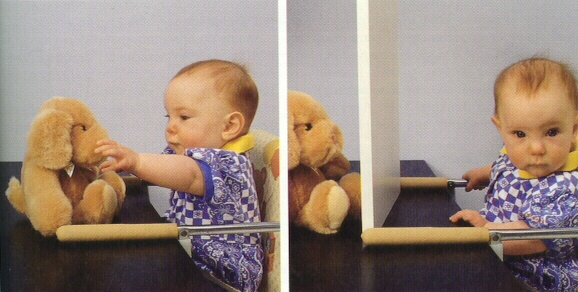
This child does not yet understand the concept of...
a)
conservation
b)
egocentrism
c)
object permanence
d)
symbols/expressions
65.
Lisa is conducting a study on hours of TV watched throughout one's lifespan. She begins by taking a group of two 10 year olds, three 15 year olds, three 20 year olds and so on (increments of 5 years, up to 35 years of age.) Which method of research is she using?
a)
Cross sectional study
b)
Experimentation
c)
Longitudinal study
d)
Case study
66.
___________ design is where one group is research/followed and assessed at different times as the group ages.
a)
Longitudinal
b)
Cross-Sectional
c)
Cross-Sequential
d)
Human Development
67.
According to Lawrence Kohlberg, the youngest of children usually:
a)
Avoid punishment
b)
Adhere to a code
c)
Want social order
d)
Agree to the greater good
68.
According to research, what happens when children move away from home:
a)
Parent suicide rates increase
b)
Child suicide rates increase
c)
Marital satisfaction decreases
d)
Marital satisfaction increases
69.
According to Kübler-Ross, the most common order of emotional reactions in preparing for death is:
a)
anger, depression, bargaining, denial, acceptance.
b)
denial, anger, bargaining, depression, acceptance.
c)
anger, depression, denial, bargaining, acceptance.
d)
depression, anger, denial, bargaining, acceptance.
70.

How do children develop special attachments to their mothers, according to John Bowlby?

a)

The mother provides innate contact comfort to the infant.

b)

The infant is biologically programmed to emit behavior that triggers a protective response from adult females.

c)

The mother becomes a conditioned reinforcer because she is associated with the reinforcing act of being fed.

d)

Maternal attachment behavior is the result of reproductive fitness.

71.

Stage theories of development assume that

a)

individuals progress through specified stages in a particular order because each stage builds on the previous stage.

b)

environmental circumstances can sometimes cause individuals to skip stages early on and return to them later.

c)

progress through the sequence of stages is not related to age.

d)

there are few, if any, discontinuities in development.

72.

The correct order or sequence of Piaget's stages is

a)

preoperational, concrete operational, formal operational, sensorimotor.

b)

sensorimotor, preoperational, concrete operational, formal operational.

c)

sensorimotor, concrete operational, preoperational, formal operational.

d)

preoperational, sensorimotor, concrete operational, formal operational.

73.

Suggesting that a poor man who stole food to feed his family was right, because human life takes precedence over rules, is an example of

a)

postconventional moral reasoning.

b)

preconventional moral reasoning.

c)

concrete operational thought.

d)

conventional moral reasoning
