
 Worksheets
Objectives
Total questions: 50
Worksheet time: 25mins

Which statement best captures a primary objective of the unit?
Determine appropriate pharmacologic therapy for a new diagnosis
Identify the learning needs of the patient at the clinical site
Conduct laboratory diagnostics for complex cases
Perform surgical procedures under supervision
Which action directly aligns with developing a teaching-learning plan?
Evaluating kidney function tests
Outlining goals, content, and methods for patient education
Administering an intramuscular injection
Scheduling a surgical consult

Which statement best defines teaching in this context?
A passive transfer of facts without interaction
An active process where one individual shares information to facilitate learning and promote behavioral changes
A solitary activity focused on memorization
An assessment method to measure prior knowledge
According to the provided definition, what is the primary outcome expected from effective teaching?
Higher test scores only
Behavioral changes
Increased class size
Elimination of mistakes
Which option accurately states the definition of learning given here?
Learning is memorizing facts for short-term recall.
Learning is the process of assimilating information, resulting in behavior change.
Learning is teaching others new information.
Learning is practicing skills without feedback.

Which statement best characterizes the teaching–learning process as presented?
A one-way transfer of facts from teacher to learner
A dynamic interaction between teacher and learner
An individual activity focused solely on cognition
A sequence of assessments without communication
In the teaching–learning process, what kinds of elements are communicated between participants?
Only information
Information and motor skills only
Information, emotions, perception, and attitude
Emotions only
Which statement best defines a learning need?
A desire or requirement to know something presently unknown to the learner
A routine review of information already mastered
An assessment of a teacher’s performance
A plan to evaluate clinical outcomes only
Which of the following is NOT listed as a type of learning need?
New knowledge or information
New or different skill or physical ability
New behavior or a need to change an old behavior
Financial reimbursement for education
Which client education area most directly involves helping a patient return to a prior baseline after an illness?
Promotion of health
Prevention of illness/injury
Restoration of health
Adapting to altered health and function
A patient has developed a chronic condition that permanently changes their mobility. Instruction on using assistive devices and modifying daily routines primarily addresses which area of client education?
Promotion of health
Prevention of illness/injury
Restoration of health
Adapting to altered health and function
Which term refers to the art and science of teaching adults?
Pedagogy
Andragogy
Geragogy
Epistemology
Which statement best describes Pedagogy?
The process involved in helping older adults learn
The art and science of teaching adults
The discipline concerned with helping children learn
A method for assessing teacher performance
According to Bloom (1956), which of the following is NOT one of the three domains of learning?
Cognitive
Affective
Psychomotor
Physiological
Bloom’s taxonomy originally articulated three areas of learning. Which set lists them all and only them?
Knowledge, Skills, Attitudes
Cognitive, Affective, Psychomotor
Thinking, Feeling, Doing
Mental, Emotional, Physical
Which cognitive level is defined by recalling previously learned information without interpretation, analysis, or application?
Knowing
Comprehending
Applying
Evaluating
In the cognitive domain, which level requires students to explain a concept in their own words to show understanding of the meaning and purpose behind a fact?
Knowing
Comprehending
Synthesis
Analysis
Which task best represents the Applying level in the cognitive domain?
Listing normal vital sign ranges
Explaining why hand hygiene prevents infections
Demonstrating the correct technique for dressing a surgical wound in a simulated lab
Comparing soap-and-water handwashing with alcohol-based sanitizer
Which cognitive level emphasizes examining the components, pros and cons, and usage contexts of hand hygiene methods?
Synthesis
Analysis
Evaluation
Comprehending
Designing a hand hygiene awareness poster that reduces healthcare-associated infections primarily reflects which cognitive level?
Applying
Synthesis
Knowing
Comprehending
Which action verbs are most aligned with the Evaluation level described?
List, recall, name
Explain, summarize, describe
Evaluate, justify, critique
Combine, design, assemble
Which task best fits the Evaluation level in this framework?
Critique a peer’s hand hygiene technique using WHO’s checklist
Design a hand hygiene awareness poster
Explain why hand hygiene prevents infections
Demonstrate wound-dressing technique
Arrange these cognitive levels from lower to higher complexity according to the material: Knowing → Comprehending → ______ → Analysis → Synthesis → Evaluation.
Applying
Remembering
Assessing
Comparing
Which statement distinguishes Applying from Knowing in this material?
Applying requires recalling facts; Knowing requires performance of a skill.
Applying requires performing the skill; Knowing requires recalling facts without interpretation.
Both require examination of components and pros/cons.
Both require designing interventions across contexts.
Which statement best defines the affective domain as presented in the lesson?
It focuses on memorizing facts and procedures.
It deals with attitudes, beliefs, behaviors, and emotions.
It emphasizes fine motor skills and coordination.
It addresses logical reasoning and quantitative analysis.
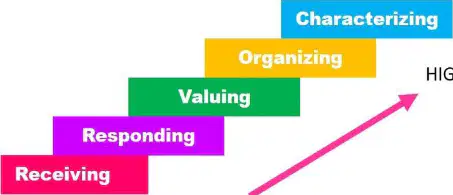
According to the affective domain hierarchy shown, which level is the highest?
Responding
Valuing
Organizing
Characterizing
At which level would a student most likely be described as ‘shows commitment to follow hand hygiene protocols because they believe it prevents harm’?
Receiving
Responding
Valuing
Organizing
Which example aligns with the ‘Receiving’ level in the nursing/hand hygiene context?
Listens to a lecture on the importance of hand hygiene.
Participates in a handwashing demonstration willingly.
Explains how hand hygiene fits into a personal code of ethics.
Always practices and promotes hand hygiene in all settings.
Select the level that best corresponds to ‘actively participates or shows interest.’
Responding
Valuing
Organizing
Characterizing
Which statement illustrates the ‘Organizing’ level within the affective domain?
Being aware of the importance of hand hygiene.
Willingly joining a handwashing demonstration.
Explaining how hand hygiene fits into one’s personal code of ethics as a nurse.
Always practicing hand hygiene even when not being watched.
Which domain in Bloom’s framework deals with physical skills, coordination, and the use of motor skills?
Cognitive domain
Affective domain
Psychomotor domain
Metacognitive domain
According to the material, what does the psychomotor domain involve?
Memorizing facts only
Performing tasks requiring both mental and physical activity
Expressing emotions verbally
Designing assessment rubrics only
Who expanded the psychomotor domain beyond Bloom’s original taxonomy?
Piaget and Vygotsky
Simpson and Dave
Skinner and Pavlov
Maslow and Rogers
At which psychomotor level does a learner perform skills smoothly and accurately?
Guided Response
Complex Overt Response
Set
Adaptation
Which example best illustrates the level of Perception in a hand hygiene context?
Recognizes when to perform hand hygiene based on patient contact
Performs handwashing by following instructor step-by-step
Washes hands properly without guidance, with good technique
Designs a new hand hygiene technique for patients with limited mobility
Select the psychomotor level demonstrated when a student adjusts hand hygiene techniques due to limited water availability in rural areas.
Mechanism
Adaptation
Set
Guided Response
Which psychomotor level is shown when a learner prepares supplies and is mentally ready to perform a sterile procedure?
Set
Perception
Mechanism
Origination
Which statement best illustrates the psychomotor domain in a nursing client teaching plan?
Explaining why insulin is necessary for diabetes management
Teaching a client to self-administer insulin using proper technique
Discussing feelings about living with a chronic condition
Identifying signs of hyperglycemia and actions to take
In the context of teaching a client with diabetes, which activity belongs to the cognitive domain?
Practicing subcutaneous injections with an insulin pen
Exploring concerns about body image and self-esteem
Teaching why insulin is needed and what to do when not feeling well
Role-playing conversations with family about lifestyle changes
Which teaching focus is most aligned with the affective domain when educating a client with diabetes?
Mastering the steps of insulin injection
Understanding carbohydrate counting calculations
Accepting the chronic nature of diabetes and maintaining self-esteem
Recognizing symptoms of hypoglycemia and appropriate responses
Which step of the teaching process involves analyzing the client’s learning strengths and deficits?
Implementation
Data collection
Evaluation
Teaching plan development
In the teaching process, which step directly follows making educational diagnoses?
Evaluate client learning
Collect data
Develop teaching plan
Select teaching strategies
Which action best represents the implementation phase of the teaching process?
Carrying out the teaching plan
Determining learning strengths and deficits
Writing learning outcomes
Assessing achievement of outcomes
Evaluation in the teaching process is primarily based on which criterion?
Completion of all planned activities
Achievement of learning outcomes
Number of strategies used
Time taken to teach content
Which pair correctly identifies the sources nurses use to assess learning needs?
Primary (client) and tertiary (textbook) sources
Primary (client) and secondary (family or significant other) sources
Secondary (internet) and tertiary (policy) sources
Only primary (nurse) self-report
According to the material, what is described as the foundation of assessment related to learning?
Standardized testing
Communication
Technology use
Observation only
Which set lists ONLY factors to be considered in assessment, as presented?
Actual learning needs; potential learning needs; ability and readiness to learn; client strengths and limitations; previous experiences
Actual learning needs; socioeconomic status; facility budget; previous experiences
Potential learning needs; instructor preferences; peer feedback; client strengths
Ability and readiness to learn; previous experiences; national policies; appointment availability
Which nursing diagnosis is most appropriate when a lack of knowledge is the primary learning need?
Anxiety
Deficient Knowledge (specify)
Impaired Mobility
Risk for Infection
Select the best stated diagnosis for a client learning to use crutches for assisted ambulation who asks many questions and is hesitant to walk.
Impaired Physical Mobility related to pain as evidenced by refusal to ambulate
Deficient Knowledge: Crutch walking, related to lack of exposure as evidenced by many questions and hesitancy to walk
Activity Intolerance related to deconditioning as evidenced by shortness of breath
Readiness for Enhanced Knowledge: Mobility
In the diagnosis phrase 'Deficient Knowledge: Insulin Injection, R/T lack of exposure AEB many questions,' what do the abbreviations R/T and AEB signify in this context?
R/T = ready to; AEB = assessed by examiner
R/T = related to; AEB = as evidenced by
R/T = reason/therapy; AEB = as established by
R/T = resistant to; AEB = after evidence-based

