
 Worksheets
Unit 2 Quiz A
Total questions: 50
Worksheet time: 28mins
The state is a human community that successfully claims
the monopoly of the legitimate use of physical force
within a given territory
Henry Kissinger
Max Weber
Niccoló Macchiavelli
Johan Galtung
The principle that within its territorial boundaries the state is the supreme political authority, and that outside those boundaries...
...it depends
...the state might recognize other authority
...the state recognizes no higher political authority
...the state does not really exist
The legality of the state system is defined by
The 1933 Montevideo Convention on
the Rights and Duties of the States
1815 Vienna Convention
1648 Peace of Westphalia
None of the above
How many legally recognized states are there in the contemporary international state system?
248
195
86
156
The main difference in statehood before and after the Peace of Westphalia was that
None
Before, power was only given by the Pope
Before, there were only kingdoms and empires
Before, power was personalized in individuals, and often geographically decentralized
Identify the three primary thinkers on sovereignty between the 16th and 18th centuries
Jean Bodin
Alexander Hamilton
Thomas Hobbes
Emer de Vattel
Jean Bodin's contribution to international relations and sovereignty was:
Proposing the social contract: A sovereign to provide peace and enable freedom in exchange of loyalty (Leviathan)
Strong argument for single supreme authority (King) to build up sovereignty (The Six Books of the Republic)
States are free, independent and equal. They have the right to live free of external interference (The Law of Nations)
None of the above
Thomas Hobbes' contribution to international relations and sovereignty was:
Strong argument for single supreme authority (King) to build up sovereignty (The Six Books of the Republic)
States are free, independent and equal. They have the right to live free of external interference (The Law of Nations)
Proposing the social contract: A sovereign to provide peace and enable freedom in exchange of loyalty (Leviathan)
None of the above
Emer De Vattel's contribution to international relations was:
States are free, independent and equal. They have the right to live free of external interference (The Law of Nations)
Proposing the social contract: A sovereign to provide peace and enable freedom in exchange of loyalty (Leviathan)
Strong argument for single supreme authority (King) to build up sovereignty (The Six Books of the Republic)
None of the above
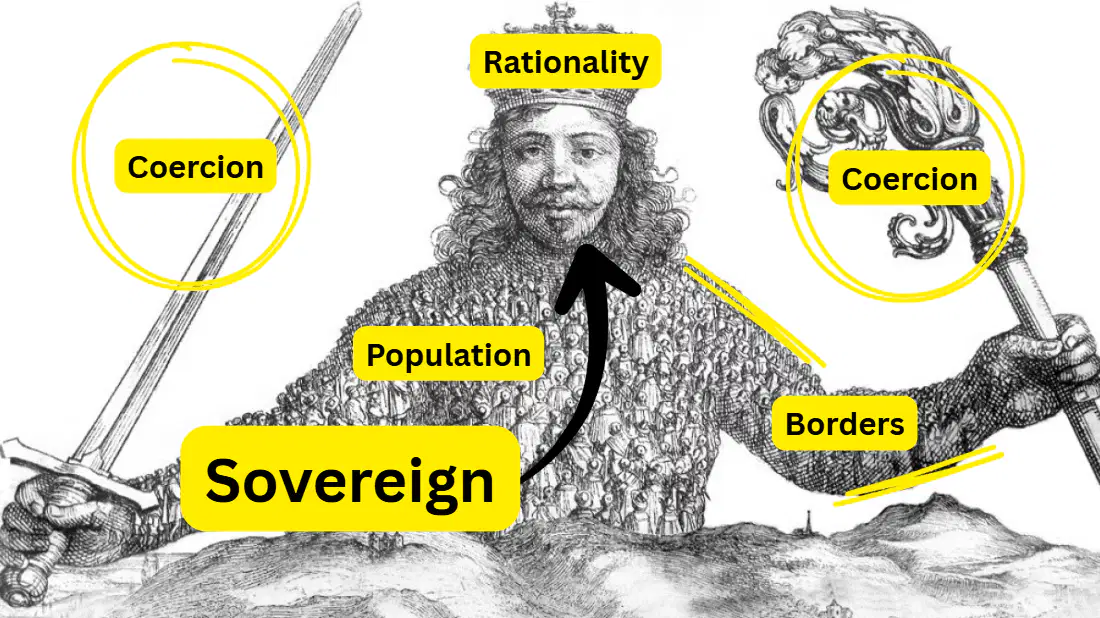
Identify this image
Emer De Vattel's conception of the sovereign state, as per Leviathan (1651)
Thomas Hobbes' conception of the sovereign state, as per Leviathan (1651)
Max Weber's conception of the sovereign state, as per Leviathan (1651)
Jean Bodin's conception of the sovereign state, as per Leviathan (1651)
A constant pursuit of war contributed to the development of the state in the 16th and 17th centuries: "war made the state, and the state made war"
True
False
Why is the Thirty Years' War significant for the history of international relations?
It ended with the Peace of Westphalia (1648)
It was fought first for religious reasons (Protestants vs Catholics) and then political (France against the Spanish Empire)
It was the last religious war fought in Europe
It ended with the Vienna Congress (1815)
What was the Peace of Westphalia's contribution to the development of the international state system?
Political authority became territorial, exclusive and sovereign
States began to recognize each other’s independence and jurisdiction
The resulting system emphasized non-interference and mutual recognition
All of the above
A group of states having sufficient contacts and interactions so that the conduct and decisions of each are affected by the others, is...
an international order
an international system
both
none
The Peace of Westphalia was effective in ending all the problems that had driven Europe into the Thirty Years' War, such as dynastic families or imperialism
True
False
The relative stability in Europe and the growing capacity of states and armies in the 17th and 18th centuries resulted in the development of
the industrial revolution
colonialism and imperialism
the abolition of slavery
none of the above
Which was the first transoceanic empire in history?
Spanish Empire
Portuguese Empire
British Empire
Dutch Empire
Which one happened first, the American or the French Revolution?
American Revolution
French Revolution
they were simultaneous
What made the American Revolution significant regarding the international state system?
Introduced the nation-state and the idea of popular sovereignty, replacing dynastic rule with national legitimacy
Exported new models of diplomacy, law, and war: from “rulers” to nations as actors in international relations
It was the earliest event signalling
the expansion of the state system
out of Europe
It was the first successful rebellion of a colony against its European imperial in the modern era
Which war-ending treaties and historic events are considered the foundational stones of the contemporary international state system?
Peace of Westphalia (1648)
American Revolution (1776)
French Revolution (1789)
Vienna Congress (1815)
The international state system was first European, then Western. To finally become global, it went through three stages. Identify:
Incorporation of non-colonised Asian countries and decolonised South American countries
Absortion of the Austro-hungarian and Ottoman Empires as unified states
Post-WW2 decolonisation process in Africa and South Asia
Post-Cold War USSR and Yugoslavia dissolutions
Unification of Europe
"Regularized patterns (rules, norms, and principles) of interaction and exchange among independent political units" is the definition for:
International state system
International ecosystem
International order
The UN system
Developing states that have juridical (legal) recognition but weak empirical statehood are often called:
Disaster states
Fail states
Rogue states
Strong states
Many analysts consider that there is a particular regional order going on in many West African countries that seems to benefit France. This order was established during the decolonisation process. Please watch the brief video and answer the questions: https://www.youtube.com/shorts/W0-NVGxJHyI
Is this French-West African regional order sparse or intensive?
Sparse
Intensive
Is the French-West African regional order hierarchical or egalitarian?
Hierarchical
Egalitarian
Is French dominance over the French-West African regional order formal or informal?
Formal
Informal
The foreign policy doctrine that drives US dominance over the Central and South American regions is known as:
The Bush doctrine
The Reagan doctrine
The Monroe doctrine
The Nixon doctrine
Identify the main drivers for the great divergence between the West and the rest of the world since the Vienna Conference of 1815
Industrialization
Rational state
Communism
Combustion engine
Imperialism
"A geographical area or region over which a state or great power exerts predominant influence, shaping foreign or domestic policies, often without formal annexation or direct political control, and within which other powers are expected to refrain from interference" - definition for
Colonial empire
Supranational institution
Sphere of influence
Bilateral agreement
The difference in the development of power and influence between the West and the rest of the world over the last two centuries is known as
The great divergence
Bad luck
The iron wall
none of the above
Before World War I, what percentage of the world's surface was under imperial control by Western states?
10%
25%
50%
80%
100%
What pre-Cold War historic events were crucial to explain the Cold War years?
The 1917 Russian Revolution
The 1929 Great Depression
The 1930s confrontation of ideologies
The collapse of the League of Nations
The discovery of oil in the Middle East
What were the main ideologies confronting right before WW2?
Liberal capitalism
Orientalism
Communism
Authoritarian fascism
Constructivism
What was the peak US vs. USSR direct confrontation during the Cold War?
The Vietnam War
The Korean War
The Détente period
The Cuban missile crisis
The period of tension relaxation in the Soviet-American conflict that lasted from the late 1960s to the late 1980s and was characterized by negotiations and nuclear arms control agreements was known as:
The Reagan years
Perestroika
Détente
Space race
Which events were considered the beginning and the end of the US-USSR space race?
The 1857 Sputnik satellite and the 1962 Cuban missile crisis
The 1957 Sputnik satellite and the 1969 moon landing
Yuri Gagarin's 1961 out of orbit flight and the 1969 moon landing
The 1969 first moon landing and the 1972 last moon landing
Even though the USSR was officially dissolved in 1991, which single event is actually considered the end of the Cold War?
Glasnost
Perestroika
The war in former Yugoslavia
The 1989 Berlin Wall collapse
Mikhail Gorbachev's policy of restructuring, pursued in tandem with glasnost (openness), and intended to modernize the Soviet political and economic system was known as:
The End
Perestroika
The Gorbachev Plan
The Reagan Plan
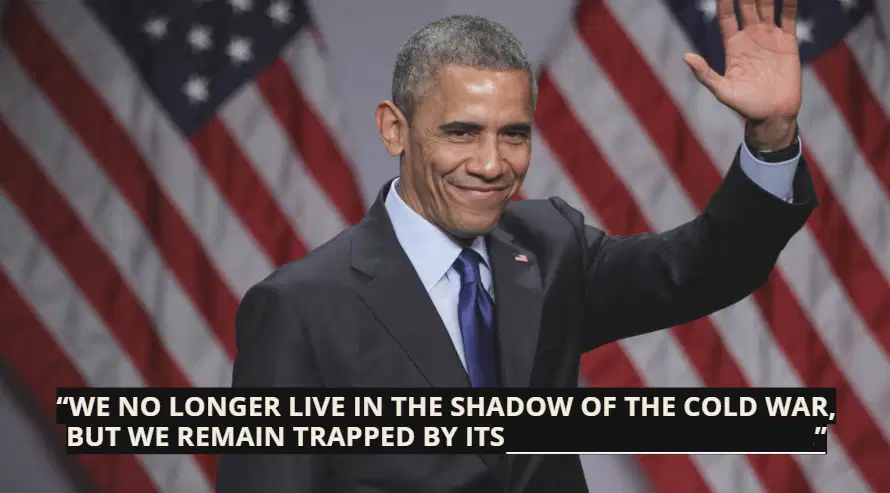
Finish Obama's sentence
negative dynamics.
unlearned lessons.
repetitive mistakes.
romanticism.
The US President Clinton years were characterized by an alleged lack of focus on foreign policy. What motivated this?
The USSR had collapse
US faced no rival superpower
Americans no longer felt an existential external threat
The whole planet was 100% capitalist now
The post-Cold War acceleration of globalization brought rapid economic growth in some cases, but also:
too much power for China and India
Wars in the Middle East
Higher unemployment and social and economic inequalities
nuclear proliferation
What were Russia's main challenges in the international world order after the collapse of the USSR?
Dispersion of nuclear arsenal
25 million russians outside of new Russian borders
Severe market reforms and privatization processes
The actions of NATO, USA and European Union
Despite the challenges, why did Russia keep its global superpower status?
Oil & gas supplier to Europe and others
Still an ally against global terror
Plenty of allied communist states
Permanent member of the UN Security Council
Nuclear superpower
In the early post-Cold War years, Europe hesitated about its level of integration. At the end, they went for a superstate model, working as a single country, replicating "The United States of Europe"
True
False
What are the main reasons for Europe's decline in power and influence internationally?
No single army
No common foreign policy
Too many Eastern European countries joined the EU
Decrease of NATO member states
Which were the most relevant historic events that explains Europe's decline?
2008 Global Financial Crisis
2016 Brexit
Trump's first term (2016)
Too much dependence on China's oil
Decolonization of African states
The economic rise of this state represents both an opportunity and a challenge to the international economic order built by the Bretton Woods institutions. Identify.
Russia
Brasil
China
South Africa
Which post-Cold War unilateral military action represented a real turning point for the post-WW2 international liberal rules-based order?
2001 NATO Afghanistan invasion
2014 Russian annexation of Crimea
1999 NATO bombing of Yugoslavia
2003 US invasion of Iraq
Which post-Cold War US President considers globalization "unamerican"?
George W Bush
Donald Trump
Barack Obama
Joe Biden
What variable brings more uncertainty about the future of the international order
Fragmentation of power
Rise of the BRICS
Collapse of Western dominance
Rise of Saudi Arabia

