
NEW
Font size
 Worksheets
Air Masses and Fronts Review
Total questions: 78
Worksheet time: 59mins
What happens to air pressure as altitude increases?
Air pressure increases
Air pressure stays the same
Air pressure decreases
Air pressure fluctuates randomly
Which of these best describes what creates air pressure?
The weight of air molecules pushing down
The temperature of the air only
The movement of clouds
The color of the sky
In a high-pressure system, air typically:
Rises and creates clouds
Moves sideways only
Sinks and creates clear skies
Stays completely still
What typically happens when a warm air mass meets a cold air mass?
Nothing happens at all
The warm air rises over the cold air
The cold air rises over the warm air
Both air masses stay in place
Which statement about air pressure is correct?
Air pressure only exists during storms
Air pressure is the same everywhere on Earth
Air pressure changes with weather conditions
Air pressure can only be measured indoors
What happens when a warm front meets a cold air mass?
The warm air sinks beneath the cold air
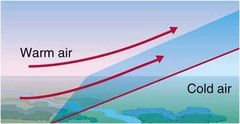
The warm air rises gradually over the cold air
The cold air immediately evaporates
Both air masses remain separate and stationary
Which type of weather conditions are typically associated with a cold front?
Gentle, steady rain over a long period
Clear skies with no precipitation
Sudden, heavy rain or thunderstorms
Light snow flurries only
What symbol represents a warm front on a weather map?
A blue line with triangles
A red line with semicircles
A purple line with both triangles and semicircles
A black line with no symbols
How can you predict that a warm front is approaching?
Increasing wind speeds and rapidly dropping temperatures
Clear skies and rising air pressure
Gradually lowering clouds and slowly falling air pressure
Sudden thunderstorms and hail
What typically happens to air pressure when a cold front approaches?
It remains constant
It gradually rises over several days
It drops suddenly, then rises sharply
It rises and falls in a repeated pattern
What is the albedo effect?
The process of water evaporating from Earth's surface
The reflection of solar radiation back into space by Earth's surfaces
The absorption of heat by greenhouse gases
The movement of warm air currents in the atmosphere
Which surface has the highest albedo?
Dark forest
Fresh snow
Ocean water
Black asphalt
How does the albedo effect influence Earth's temperature?
It has no effect on Earth's temperature
It only affects temperatures at the poles
It helps regulate Earth's temperature by reflecting some solar radiation
It only works during winter months
What happens when ice melts in the Arctic?
The albedo increases
The temperature decreases
More radiation is reflected
More solar radiation is absorbed
Which color surface generally has a lower albedo?
Dark surfaces
White surfaces
Light gray surfaces
Pale yellow surfaces
a system normally associated with dry weather and mostly clear skies
high pressure
low pressure
collide
air mass
wind
a system normally associated with clouds and precipitation
high pressure
low pressure
collide
air mass
wind
bodies of air extending over large areas that have certain characteristics of pressure, temperature, and humidity
high pressure
low pressure
collide
air mass
wind

In general, clear skies come with a high-pressure area and cloudier conditions in areas of low pressure.
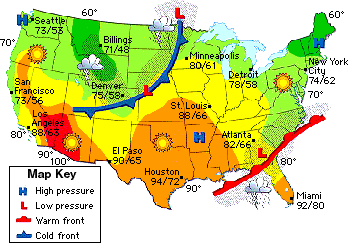
Which city on the map is most likely experiencing CLOUDS but will see CLEAR SKIES soon?
Omaha
Atlanta
Cleavland
Los Angeles
Which weather instrument measures air pressure?
anemometer
barometer
rain gauge
wind vane

The maps above show a front as it moves east across the United States. Which of these describes the weather change that can be expected for Amarillo, Texas?
The cold front will bring cooler temperatures and snow because the cold front is producing large amounts of energy and snow moving southeast.
The cold front will bring cooler temperatures with thunderstorms and rain, which causes the moisture in the warm air to condense and release large amounts of energy.
The warm front will bring warmer temperatures with hot air for several days because it pushes the cold air out of the way.
The warm front will bring warmer temperatures with light rain for a few days because the warm air rises and cools producing rain.

Cold air is denser than warm air, so it sinks. What kind of pressure area does this create?
Dense pressure
High pressure
Low pressure
No pressure

Which of the following increases air’s ability to hold water vapor?
Increase in wind speed
Decrease in temperature
Increase in temperature
Decrease in air pressure

In some years there are more hurricanes than usual. This is probably because
the ocean is warmer than usual.
the ozone layer is very thin.
there are more windy days than usual.
the gravitational pull of the Moon is stronger.

What do hurricanes, tornadoes, and thunderstorms all have in common?
Cold temperatures
Low air pressure
Storm surge
High air pressure
Barometric pressure has been dropping all day. What weather conditions will most likely occur?
sunny weather
stormy weather
calm weather
hot weather
Warm, moist air has...
low pressure and high humidity
high pressure and low humidity
high pressure and high humidity
low pressure and low humidity
Air becomes wind as it flows from...
low pressure to high pressure.
high pressure to high pressure.
low pressure to low pressure.
high pressure to low pressure.
What does low pressure usually mean for weather?
It will be sunny because cold air is sinking.
It will be cloudy because cold are is sinking.
It will be sunny because are air is sinking.
It will be cloudy because warm air is rising.
What does high pressure usually mean for weather?
It will be sunny because cold air is sinking.
It will be cloudy because cold are is sinking.
It will be sunny because are air is sinking.
It will be cloudy because warm air is rising.
Why does a HIGH pressure system usually bring dry, clear skies?
The air is warm, less dense, rises and moves so fast it doesn't have time to make clouds.
The air is cold, more dense and sinks. There is no water vapor rising to make clouds.
The air is warm, more dense and sinks. There is no water vapor rising to make clouds.
Why does a LOW pressure system usually bring cloudy and often stormy weather?
The air is warm, less dense, rises and moves so fast it doesn't have time to make clouds.
The air is cold, more dense and sinks. There is no water vapor rising to make clouds.
The air is warmer and less dense. It rises and the water vapor condenses to make clouds.
What causes wind?
Air moving from ares of HIGH density to areas of LOW density.
Air moving from areas of LOW density to areas of HIGH density.
Gnomes. It's always the gnomes!
Which of the following does NOT directly affect weather?
Temperature
Humidity (how much water is in the air)
Air Pressure
Wind Speed
Time of Day
What does a cold front mean?
Two air masses collide and neither moves.
A warm, moist air mass slides over a cold, dense air mass.
A cold dense air mass pushes under a warm less dense air mass.
Two air cold air masses trap a warm air mass.
What does a warm front mean?
Two air masses collide and neither moves.
A warm, moist air mass slides over a cold, dense air mass.
A cold dense air mass pushes under a warm less dense air mass.
Two air cold air masses trap a warm air mass.
What does a stationary front mean?
Two air masses collide and neither moves.
A warm, moist air mass slides over a cold, dense air mass.
A cold dense air mass pushes under a warm less dense air mass.
Two air cold air masses trap a warm air mass.
Why would clouds form when warm and cold air masses collide?
Cold air always brings clouds.
Warm air always brings clouds.
The water vapor in the warm air mass cools when it interacts with the cold air mass.
The water vapor in the cold air mass cools when it interacts with the warm air mass.
Quick moving fronts that can cause storms.
Warm Fronts
Cold fronts
Stationary fronts
Occluded Fronts
High Pressure Causes...
Clear skies
Wind
Clouds
storms






What weather symbol is shown?
an occluded front
a stationary front
a warm front
a cold front
Identify the front described: The same weather has been here for days. The sky is cloudy and it rains every once in a while.
a warm front
a cold front
a stationary front
an occluded front
Which type of cloud and front is associated with a thunderstorm?
cumulonimbus clouds and a stationary front
cumulus clouds and a warm front
cumulonimbus clouds and a cold front
cirrus clouds and an occluded front
What causes a tornado to form?
Water vapor condenses, giving off energy.
Wind over ocean water forces water vapor upward.
A warm, moist air mass collides with a cold, dry air mass.
Air pressure changes suddenly, causing rapid air movement.
What can a SEVERE thunderstorm produce?
raining cats and dogs
Hail, flash floods, tornadoes
Tropical storm
Which most likely produces clear skies and fair weather?
a high pressure system
a low pressure system

Which most likely results in cloudy, stormy weather?
a high pressure system
a low pressure system

Weather fronts mark the __________________ between two air masses.
force
boundary
distance
height

What does this symbol represent?
a warm front
a cold front
a stationary front
an occluded front

What does this symbol represent?
a cold front
a warm front
a stationary front
an occluded front
What weather symbol is shown?
an occluded front
a stationary front
a warm front
a cold front

Which front is located near San Diego?
a cold front
a warm front
an occluded front
a stationary front

Which type of front is near Seattle?
a cold front
a warm front
an occluded front
a stationary front
Identify the front described: Warm humid air is pushed up by a cold air mass and results in a short period of heavy rain and possibly violent thunderstorms.
a warm front
a cold front
an occluded front
a stationary front
Identify the front described: The same weather has been here for days. The sky is cloudy and it rains every once in a while.
a warm front
a cold front
a stationary front
an occluded front
Identify the front described: The warm air rises steadily above the cooler air mass and causes gentle rain showers for longer periods of time.
a warm front
a cold front
a stationary front
an occluded front
Identify the front described: A combination of two fronts that form when a cold front catches up and overtakes a warm front. The result is a mix of rain showers and thunderstorms.
a warm front
a cold front
a stationary front
an occluded front
What type of air pressure is sinks towards the surface of Earth?
Low Pressure
High Pressure
What type of air pressure is rising through our atmosphere?
High Pressure
Low Pressure
What type of air pressure contains dry air?
High Pressure
Low Pressure
What type of air pressure contains rising moist or humid, warm air?
High Pressure
Low Pressure


