
 Worksheets
Waves Review
Total questions: 79
Worksheet time: 53mins
What is the term used to describe the bending of light as it passes from one medium to another?
Reflection
Refraction
Absorption
Transmission
Which color of light has the shortest wavelength?
Red
Green
Blue
Violet
If a wave has a high frequency, what can be said about its wavelength?
It has a long wavelength
It has a short wavelength
Wavelength is not affected by frequency
It has a medium wavelength
Describe how a prism creates a rainbow from white light.
By reflecting all colors equally
By absorbing certain colors
By refracting different wavelengths at different angles
By transmitting all colors without change
Which of the following materials is most likely to absorb light?
A mirror
A white sheet of paper
A black cloth
A glass window
Explain why violet light refracts more than red light when passing through a prism.
Violet light has a longer wavelength
Violet light has a higher frequency
Red light is absorbed more
Red light is reflected more
A wave travels through a medium and is partially absorbed. What happens to the energy of the wave?
It increases
It decreases
It remains the same
It doubles
Which of the following best describes the relationship between amplitude and energy in a wave?
Energy is directly proportional to amplitude
Energy is inversely proportional to amplitude
Energy is equal to amplitude
Energy is not related to amplitude
Develop a model to explain how light is transmitted through a transparent material.
Light is absorbed and not seen
Light is reflected back
Light passes through without being absorbed
Light is scattered in all directions
Which of the following is an example of light being reflected?
A rainbow forming in the sky
A pencil appearing bent in a glass of water
Seeing your image in a mirror
Sunlight passing through a window
How does the frequency of a wave affect its energy?
Higher frequency means lower energy
Higher frequency means higher energy
Frequency does not affect energy
Frequency and energy are inversely proportional
Strategize a method to measure the wavelength of light using a diffraction grating.
Use a ruler to measure the light directly
Calculate using the angle of diffraction and grating spacing
Measure the speed of light
Use a thermometer to measure the light's heat
What is the effect of a material's density on the transmission of light through it?
Higher density increases transmission
Higher density decreases transmission
Density has no effect on transmission
Density only affects reflection
When light moves from water to air, it bends away from the normal. This is an example of:
Reflection
Refraction
Diffraction
Absorption
If you look at a pencil in a glass of water, it looks bent at the surface of the water. What causes this?
Reflection
Refraction
The pencil is actually bent.
The water is moving.

Arrange the following colors of light from shortest wavelength (left side) to longest (right side).
violet
blue
green
yellow
red
Arrange the following colors of light from lowest frequency (left side) to highest (right side).
red
yellow
green
blue
violet

What property of light is affected when you adjust its amplitude?
Color
Temperature
Brightness
Wave Type
What property of light is affected when you adjust its frequency?
Color
Temperature
Brightness
Wave Type
Click on the point that lies on a crest.
Click on the point that lies on a trough.
Click on the point that lies on the resting position (equilibrium).
Click on the point that represents wavelength.
Click on the point that represents amplitude.

If the image to the left represents one second of time, what would the approximate frequency of the waves shown be?
1 Hertz
8 Hertz
4 Hertz
Lots of Hertz
What do you call the vertical distance from a wave's resting position to either a crest or a trough?
frequency
amplitude
wavelength
wave height
What do you call the horizontal distance between two consecutive points in a wave (for example, crest to crest)?
frequency
amplitude
wavelength
wave height
What do you call the number of waves passing a fixed point per second?
frequency
amplitude
wavelength
wave height
What must you do to change wave properties such as frequency or amplitude?
Change the energy causing the wave
Create more waves
Change the medium the wave is traveling through
Nothing

Of the waves shown in the image, which set has the most energy? (assume that all four sets represent 1 second)
A
B
C
D
Of the waves shown in the image, which set or sets have the smallest amplitude? (assume that all four sets represent 1 second)
A
B
C
D
Of the waves shown in the image, which set or sets have the greatest amplitude? (assume that all four sets represent 1 second)
A
B
C
D
Of the waves shown in the image, which set or sets have the greatest frequency? (assume that all four sets represent 1 second)
A
B
C
D
Of the waves shown in the image, which set or sets have the lowest frequency? (assume that all four sets represent 1 second)
A
B
C
D
If the different wave sets represent different sounds, which set would be most similar to A in terms of pitch? (assume all sets represent 1 second)
B
C
D
If the different wave sets represent different sounds, which set would be most similar to A in terms of volume? (assume all sets represent 1 second)
B
C
D
If the different wave sets represent different sounds, which set would be most unlike A? (assume all sets represent 1 second)
B
C
D

All waves carry ________ as they travel from one place to another.
matter
space
energy
water

What part is represented by the blue lines?
Crest
Resting Point
Wavelength
Amplitude
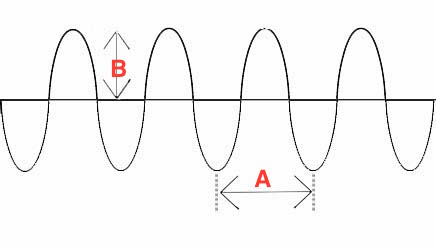
What property of the wave is represented by the letter "A"?
amplitude
crest
trough
wavelength

crest
A
amplitude
C & F
wavelength
B & E
Trough
D

The illustration shows three different waves traveling through the same medium. Assuming all three waves represent one second and based on what you observe, which of the statements is most likely correct?
The waves travel at different speeds.
The waves have different wavelengths.
The waves carry different amounts of energy.
The waves are a different distance from the source.

In a (a) wave, the oscillation of the wave is (b) to the direction the wave is traveling as shown in B in the image. In a (c) wave, the oscillation of the wave is (d) to the direction the wave is traveling as shown in A in the image.
transverse
perpendicular
longitudinal
parallel
Of the two wave examples shown in the image, which one is sound an example of?
A
B
Of the two wave examples shown in the image, which one is light an example of?
A
B

Rearrange the colors listed below from least energetic to most energetic.
Red
Yellow
Green
Blue
Violet

Assume that the series of waves shown in each of the diagrams represents the same period of time and that all have the same amplitude. Based on this information, match each wave set with the color of visible light it best matches.

Red

Yellow

Green

Blue

Violet

If you want to make a sound louder, what do you need to change?
Amplitude
Frequency
If you want to change the pitch of a sound, what do you need to change?
Amplitude
Frequency
Sound waves travel as _________ waves.
transverse
electromagnetic
longitudinal
surface
Sound is made when a source of energy forces the matter to _________.
shake
vibrate
move
stay still
A back-and-forth motion causing particles to move close together generates a _______.
rarefaction
surface wave
transverse wave
compression
A rarefaction is generated when particles move ______.
together
closer
under
apart
Sound waves cannot travel through which of these ____.
paper
milk
outer space
hydrogen
In which of these types of media will sound travel faster?
solid
liquid
gas
vaccum
The elasticity of a substance describes how fast or slow its particle bounce back-and-forth as ______ move through the object.
vibrations
chemicals
electrons
surface waves
Which physical property of a medium is defined by how close the particles of the substance are to each other?
elasticity
temperature
density
amplitude
Which temperature causes sound to travel more slowly?
hot
cold
Which of these is not a property of a sound wave?
amplitude
elasticity
loudness
pitch
The amount of energy a sound wave carries per sound through a unit of area is its ____.
pitch
amplitude/intensity
loudness
frequency
The ____ of a wave increases with increased energy.
wavelength
amplitude
Loudness of waves is measure in ______
Hertz (Hz)
Decibels (Db)
Watts
Meters/second (m/s)
Frequency of waves is measure in _____.
Hertz
Decibels
Watts
Meters/second
High frequency sounds have ______ pitch.
high
low
Which is an example of the doppler effect?
The apparent change in pitch of a police siren as it passes you.
The delay in sound between the lightning and thunder.
The change in pressure in your ears when driving up a mountain.
When you can no longer hear a sound as the pitch increases.
sound wave
longitudinal wave that can only travel through matter
compression
when particles in a wave are packed closely together
rarefaction
when particles in a wave are spread apart
pitch
the perception of how high or low a sound seems
echo
when a sound wave is reflected




One important characteristic of sound waves is that they are ___________________ waves.
mechanical
short
ultraviolet
primary
Sound waves must travel through ___________________.
air
a medium
an outward area
a short
If there is a loud noise in your house, the sound travels through
the air
the air and the wall
the air, the wall, the floor
the air and most everything in the house
What is the source of a sound wave?
Electricity
Vibration
Light waves
Tiny nuclear explosions

This diagram shows two different ways to represent longitudinal waves.
Which letter corresponds to rarefaction (sound equivalent of a trough) in the waves?
Z
X
W
Y

Two sound waves of different frequencies interfere and produce a resulting waveform shown with four points (W, X, Y, and Z) marked on the new wave.
At which point will the sound be the loudest ?
W
X
Y
Z

The students in the diagram are communicating with the cans and string.
Which is the most likely explanation of how the students can hear and communicate using the objects?
Vibrations create a Mechanical Longitudinal Wave that transfers sound through the string
Electromagnetic energy creates a Mechanical Longitudinal Wave that transfers sound through the string
Vibrations create a Mechanical Electromagnetic Wave that transfers sound through the string
Electromagnetic energy creates a Mechanical Electromagnetic Wave that transfers sound through the string

The diagram shows a research vessel using sonar to map the ocean floor.
Upon which basic behavior of sound waves does this technology depend?
absorption
compression
reflection
refraction

