
 Worksheets
HST Chapter 4 Test
Total questions: 40
Worksheet time: 20mins
Tangled cords and wires on the floor of a patient’s room: 1. Tangled cords and wires on the floor of your patient’s room constitutes a safety hazard.
Are harmless and pose no risk
Need to be moved if the patient complains
Constitute a safety hazard
Are part of normal hospital setup
If you wear contact lenses and are handling chemicals at your healthcare facility what safety precaution should you take?
No extra precautions are needed
Wear safety goggles
Remove your contact lenses permanently
Only wear glasses at work
ALARA is an acronym that represents the radiation safety principle, which has 5 factors. All of the following are factors except:
Spending minimal time near a radiation source
Standing as far as possible from the source
Using lead aprons or shields
Completing training on radiation safety
Why is good posture and body alignment important for healthcare providers?
It makes them look more professional
It is more efficient and requires less effort from the body
It allows them to work faster without proper technique
It improves circulation and breathing
The most common MSDs among healthcare providers are what types of injuries?
Knee and ankle injuries
Neck and hip injuries
Elbow and foot injuries
Back and shoulder injuries
If you must leave a patient’s room in the middle of giving care, what should you do with your gloves?
Remove them before leaving the room
Leave them on as long as you are quick
Wipe them on your uniform before leaving
Only remove them if the patient asks
One of the safety checks you should do before leaving a patient’s room is ensuring the bed is in a high position so it’s easy for you to help the patient without hurting your back.
True
False
If a patient is confused and repeatedly presses the call light without meaning to, what is the appropriate action?
Move the call light out of reach to keep the patient safe
Ignore the calls since they are accidental
Continue reminding the patient to only use the call light when they need something
Monitor the patient and respond as needed while keeping the call light accessible
The most common sites for skin breakdown due to prolonged pressure are called:
Flexion zones
Ligament points
Tendon pads
Pressure points
Folds in the bed sheets or food crumbs in the bedding can increase a patient’s risk for decubitus ulcers.
True
False
Which of the following statements about decubitus ulcers is correct?
Avoiding abrasions of the skin can increase a patient’s risk for decubitus ulcers
Avoiding abrasions of the skin helps reduce a patient’s risk for decubitus ulcers
Skin abrasions have no effect on decubitus ulcer risk
Only bedrest, not skin care, affects decubitus ulcer risk
Daniel is a nurse caring for a bedridden patient. He believes that the best practice to prevent pressure ulcers is changing the patient’s position every four hours. Is this correct?
True
False
Which of the following is not a goal of quality improvement (QI) policies?
Maintaining safe conditions in a healthcare facility
Ensuring employee satisfaction is consistent and positive
Measuring the facility against specific performance standards
Figuring out ways to improve performance
Which government organization regulates and supervises food safety, prescription and over-the-counter medications, vaccines, and medical devices?
Agency for Healthcare Research and Quality (AHRQ)
Institute for Healthcare Improvement (IHI)
Food and Drug Administration (FDA)
National Academy of Medicine
Which government agency supports health promotion, disease prevention, and preparedness?
World Health Organization (WHO)
National Institutes of Health (NIH)
Centers for Medicare and Medicaid (CMS)
Centers for Disease Control (CDC)
David is reviewing the safety rules at his new workplace. Which of the following is not a standard safety rule?
Wear sensible, closed-toe shoes.
Keep floors and hallways clear of obstructions.
Never run in the hallway.
Prop open the fire safety door if necessary.
You are at work at the hospital and you hear a “Code Pink” paged overhead. What is a Code Pink?
Cardiac arrest
Infant or child abduction
Bomb threat
Fire or potential fire
While visiting your patient in the hospital, you suddenly hear “Code Blue” announced over the intercom. What is a Code Blue?
Cardiac arrest
Infant or child abduction
Hazardous materials spill
Fire or potential fire
You are an X-ray technician, and your patient suddenly goes into cardiac arrest. What hospital emergency code do you call?
Code Pink
Code Orange
Code Red
Code Blue
You are a respiratory therapist, and you walk into your patient’s room and smell smoke. What hospital emergency code do you call?
Code Blue
Code Silver
Code Red
Code Orange
You walk into your patient’s room, and you see the patient’s visitor is holding a knife and yelling at the patient. What hospital emergency code do you call?
Code Orange
Code Silver
Code Pink
Code Blue
William is working in a hospital when he notices smoke coming from a patient room. He remembers the RACE protocol for fire emergencies. What does RACE stand for?
Rescue, Alert, Contain, Exhale
Run, Alarm, Constrain, Extinguish
Run, Alert, Contain, Exhale
Rescue, Alarm, Contain, Extinguish
Daniel is working in a hospital radiology department and wants to follow the ALARA (As Low As Reasonably Achievable) principle for radiation safety. Which of the following is not one of the three main factors he should consider?
A. Amount of radiation present
B. Shielding devices used
C. Time, or duration of exposure
D. Distance from the source of radiation
Abigail is helping a nurse to move a heavy patient at work. Which of the following is not a principle of proper body mechanics that she should follow?
Stable center of gravity, where you bend at the knees and hips
Clear line of gravity, with back straight and the lifted object close to the body
Narrow base of support, with feet in line with the hips and horizontal to each other
Careful body alignment, with shoulders centered over the hips and back flat, head forward
James is researching workplace injuries and discovers that healthcare providers experience more ____ than workers in any other industry.
decubitus ulcers
repetitive strain injuries (RSI)
carpal tunnel syndrome
musculoskeletal disorders (MSD)
Michael is caring for a patient in a hospital room. Which of the following is not a strategy Michael should use to keep his patient safe from falls?
Ensure the floor is clean and dry.
Ensure the patient walks with bare feet.
Encourage the patient to use handrails if they feel unsteady.
Ensure the patient’s personal items are easily within reach.
Sophia works at an office and wants to arrange her workstation to maximize efficiency and prevent injury while working. The practice or science she should follow is called ___.
ambulation
body alignment
ergonomics
maximization
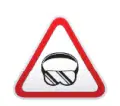
Identify the proper description for the safety symbol shown here.
Safety goggles must be worn to protect eyes while working with chemicals, flames, heating, or glassware.
Do not touch hot objects with your bare hands; instead, use a clamp or tongs.
Tie back loose hair and clothing before working with flames. Follow your supervisor's directions.
Avoid contact with poisonous substances and do not inhale vapors.

Identify the proper description for the safety symbol shown here.
Do not touch hot objects with your bare hands. Instead use tongs or clamps.
Disposable gloves must always be worn when working with harmful chemicals or microorganisms.
Carefully handle materials that are harmful and pose a threat to your health, including used needles and toxins.
Sharps must be handled with care to avoid puncturing or cutting the skin.

Matching the laboratory safety symbol with its description.
Carefully handle materials that are harmful and pose a threat to your heath, including needles and toxins.
Tie back hair and clothing before working with flames. Follow supervisor's directions.
Do not touch hot objects with your bare hand. Use tongs or clamps instead.
Avoid contact with poisonous substances and do not inhale vapors.

Matching the laboratory safety symbol with its description.
Tie back hair and clothing before working with flames. Follow your supervisor's directions.
Avoid contact with poisonous substances and do not inhale vapors
Do not touch hot objects with your bare hands; instead use a clamp or tongs
Carefully handle materials that are harmful and post a threat to your health, including used needles and toxins.
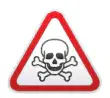
Matching the laboratory safety symbol with its description.
Sharps must be handled with care to avoid puncturing or cutting the skin.
Safety goggles must be worn to protect the eyes while working with chemicals, flames, heating, or glassware.
Disposable gloves must always be worn when working with harmful chemicals or microorganisms.
Avoid contact with poisonous substances and do not inhale vapors.
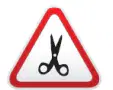
Matching the laboratory safety symbol with its description.
Tie back loose hair and clothing before working with flames. Follow your supervisor’s directions.
Carefully handle materials that are harmful and post a threat to your health, including used needles and toxins.
Sharps must be handled with care to avoid puncturing or cutting the skin.
Do not touch hot objects with your bare hands; instead use a clamp or tongs.

Match the laboratory safety symbol with its description.
Do not touch hot objects with your bare hands; instead use a clamp or tongs.
Carefully handle materials that are harmful and post a threat to your health, including used needles and toxins.
Avoid contact with poisonous substances and do not inhale vapors.
Disposable gloves must always be worn when working with harmful chemicals or microorganisms.
During her shift, Adrian heard a Code Orange called overhead. Adrian is a new healthcare worker and does not remember what that code indicates. How would you explain it to Adrian?
During a busy afternoon at the hospital, an announcement comes over the intercom: "Code Black in the main lobby." What does this mean in a healthcare setting?
A bomb threat or potential explosive situation.
A medical emergency requiring immediate attention.
A signal for a fire drill in the facility.
A code for patient evacuation procedures.
During a shift at the hospital, Lily hears an announcement about a severe weather alert. Which hospital code is likely being used?
Code Blue
Code Red
Code Green
Code Yellow
What does a code blue mean in a hospital?
A missing or abducted child
A signal for a fire drill
A severe weather alert
A medical emergency requiring immediate resuscitation
What does a code pink in the hospital mean?
A code for an emergency requiring resuscitation.
A code for a hospital emergency due to someone with a weapon.
One of the safety checks you should do before leaving a patient's room is ensuring the bed is in a high position so it's easy for you to help the patient without hurting your back.
True
False

