
 Worksheets
Introduction to Body Systems
Total questions: 15
Worksheet time: 8mins
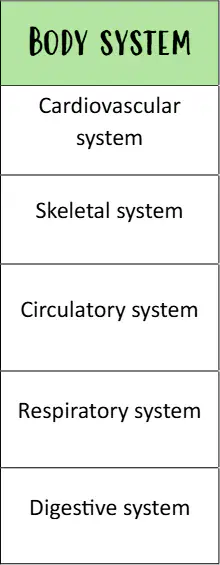
A student argues that the cardiovascular system and circulatory system are the same. Using the provided descriptions, which statement best evaluates this claim?
They are the same because both involve the heart and blood vessels moving blood, nutrients, and wastes.
They differ because the cardiovascular system focuses only on lungs and airways, while the circulatory system handles hormones.
They are different because the circulatory system provides structural support and mineral storage, while the cardiovascular system pumps blood.
They are the same because both process food into absorbable nutrients for energy and growth.
Which statement best describes a function of the human skeleton related to mineral homeostasis?
The ribs shield the heart and lungs from impact.
Bone marrow produces new red and white blood cells.
Bones hold the body’s supply of important minerals like calcium and vitamin D.
Joints, connective tissue, and muscles push and pull parts of the body during movement.
The dense, external layer of bone that gives the skeleton its hardness is called:
Calcium
Cancellous bone
Collagen
Compact bone
Which tissue inside bones is responsible for producing red and white blood cells?
Periosteum
Bone marrow
Cartilage
Ligament
Which pair lists two essential minerals stored in bones?
Iron and iodine
Sodium and potassium
Calcium and phosphorus
Zinc and magnesium
What is the main function of joints in the context of movement?
Storing calcium
Allowing movement between bones such as flexion and extension
Producing red blood cells
Connecting muscle to bone
Which structure connects bone to bone, such as at the knee between the femur and the tibia/fibula?
Tendon
Ligament
Cartilage
Muscle belly
Name the calf muscle that plantarflexes the ankle and is prominently visible on the posterior lower leg.
Tibialis anterior
Gastrocnemius
Hamstrings
Gluteus maximus
Which anterior lower-leg muscle primarily dorsiflexes the ankle?
Gastrocnemius
Tibialis anterior
Hamstrings
Quadriceps
Which process is defined as the automatic movement of air in and out of the lungs controlled by the brain?
Digestion
Breathing
Circulation
Excretion
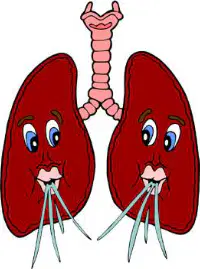
In the labeled diagram of the respiratory system, which term from the word bank best matches the paired organs in the thoracic cavity responsible for gas exchange?
Lungs
Ribs
Nose
Trachea
Which statement best explains the relationship between bronchi and bronchioles?
Bronchioles join to form the trachea
Bronchi divide into bronchioles within the lungs
Bronchioles are the same as alveoli
Bronchi carry food to the stomach
A student inhales deeply. Which sequence correctly represents the pathway of air to the site of gas exchange?
Nose → larynx → trachea → bronchi → alveoli
Mouth → esophagus → stomach → lungs → alveoli
Pharynx → bronchioles → trachea → alveoli
Nose → trachea → larynx → bronchi → alveoli
Which vessels carry blood away from the heart?
Veins
Arteries
Capillaries
Lymphatics
What term best completes the sentence: Arteries ___ blood from the heart, while veins ___ blood to the heart.
return; deliver
remove; supply
carry away; return
filter; absorb

