
 Worksheets
2.4 Study Guide
Total questions: 22
Worksheet time: 11mins
Which of the following best explains how water acts as a heat sink in the human body?
It prevents all heat loss by trapping energy in fat tissue
It produces heat to warm the body during cold conditions
It absorbs and stores heat from chemical reactions, helping maintain stable body temperature
Why is water considered a universal solvent?
It is non-polar
It has a polar molecule structure
It is acidic
It is basic
What happens to blood after it is cooled in the body's cooling mechanism?
It evaporates from the skin.
It returns to the body core.
It is expelled from the body.
It thickens to retain heat.
What occurs during dehydration synthesis?
Two molecules combine and release water as a byproduct
Water splits a compound
H+ and OH- groups form new bonds
Water is absorbed
What is the main process involved in hydrolysis?
Two molecules combine
Water splits a compound
Water is released as a byproduct
Molecules are dehydrated
What role do salts play in electrical conductivity?
They decrease ion concentration
They provide ions that make the solution conductive
They prevent ion formation
They absorb ions
Which body salt is essential for forming bones and teeth?
Bile salts
Calcium phosphate
Electrolytes
Sodium chloride
What role do electrolytes play in the body?
Break down dietary fats
Form bones and teeth
Regulate fluid balance
Aid in digestion
What is the ionization characteristic of weak acids?
Complete ionization
Partial ionization
No ionization
Rapid ionization
What do bases do with H+ ions in a solution?
Release them
Accept them
Neutralize them
Ignore them
What ions are produced when an acid is dissolved in water?
OH⁻ ions
H⁺ ions
Na⁺ ions
Cl⁻ ions
What ions are produced when a base is dissolved in water?
H⁺ ions
OH⁻ ions
Na⁺ ions
Cl⁻ ions
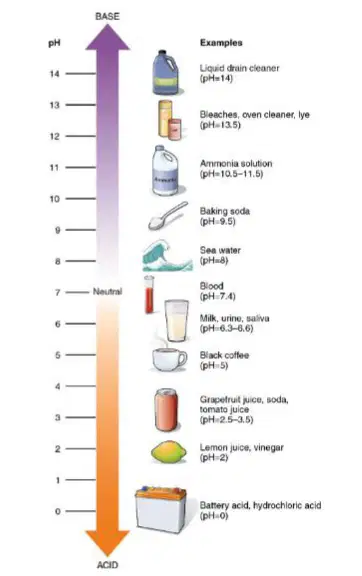
Which of the following substances is considered a strong base?
Lemon juice
Baking soda
Liquid drain cleaner
Blood
Why are buffers essential for cellular function?
They provide energy to cells
They maintain a stable pH environment
They transport nutrients
They increase cell size
Which of the following is a mechanism that helps maintain pH balance in the body?
Muscle contraction
Breathing regulation
Bone growth
Nerve impulses
What is the normal pH range of human blood?
6.5–7.0
7.35–7.45
7.8–8.0
8.5–9.0
What is the result of exhaling too much CO₂ during hyperventilation?
Increase in carbonic acid
Decrease in carbonic acid
Increase in H⁺ ions
Decrease in blood pH
The carbonic acid–bicarbonate buffer system,
CO₂ + H₂O ⇌ H₂CO₃ ⇌ H⁺ + HCO₃⁻
Is key in maintaining pH balance in our blood and body systems.
True
False
Which of the following compounds is carbonic acid in this buffer system,
CO₂ + H₂O ⇌ H₂CO₃ ⇌ H⁺ + HCO₃⁻
CO₂
H₂CO₃
HCO₃⁻
According to this buffer system: CO₂ + H₂O ⇌ H₂CO₃ ⇌ H⁺ + HCO₃⁻
What happens when experiencing respiratory alkalosis?
Increase in Carbonic acid
Decrease of the bicarbonate ion
Decrease of Carbon Dioxide
Decrease in Carbonic acid


"Adding" water to a molecule to break it down into two smaller molecules is called:
hydrolysis
dehydration synthesis
enzymatic reactions
metabolic reactions

