
 Worksheets
Chapter 4 Biology Test Review
Total questions: 46
Worksheet time: 31mins

What is #8?
Stamen
Stigma
Pistil
Petal
What is #5?
Stamen
Stigma
Pistil
Petal
What is #6?
Anther
Stigma
Filament
Sepal
Part of the plant that absorbs water.
Roots
Flowers
Petals
Leaves
Part of the plant that has chlorophyll
Roots
Flowers
Petals
Leaves
Part of the plant that is long, transport nutrients, water and keep the plant stable in the ground.
Roots
Stem
Petals
Leaves
Which pair or definitions is correct?
Xylem moves water up. Phloem moves food everywhere.
Phloem moves water up. Xylem moves food everywhere.
Xylem moves water down. Phloem moves food everywhere.
Phloem moves water down. Xylem moves food everywhere.
Which part of the plant holds the plant up?
Stem
Flower
Roots
Leaves
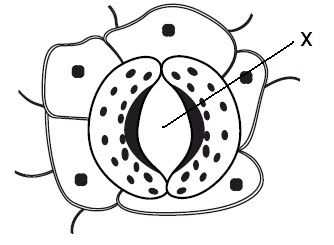
Process in which plants release excess water through their leaves is called ____________________.
respiration
transpiration
absorption
photosynthesis
What is the function of stomata?
Absorbing sunlight
Protecting inner tissue layers
Allowing gases to enter and exit
Transporting materials

What is the function of the flower?
to make food
gather water
make seeds
make petals


Which of the following are TRUE statements? (Select ALL that apply)
Photosynthesis takes place in the chloroplasts of leaf cells
Photosynthesis means "making food using sun"
Photosynthesis can occur in the dark
All plants, plant-like protists, and some bacteria go through photosynthesis

Which organelle is responsible making food (Glucose) using sunlight?
Cell Membrane
Nucleus
Chloroplast
Mitochondria

Which of the following is the correct equation for PHOTOSYNTHESIS?
light + carbon dioxide + water --> glucose + oxygen
carbon dioxide + sugar + water --> oxygen + light
oxygen + light + water --> carbon dioxide + sugar
carbon dioxide + oxygen + water --> Light+ Sugar
Which of the following equations represents the overall chemical reaction for photosynthesis?
6O2+ 6H2O → C6H12O6+ 6O2
C6H12O6 + 6H2O→ 6O2+ 6O2
6CO2+ 6H2O→ C6H12O6+ 6O2
6O2 + 6H2O→ C6H12O6 + 6CO2
Makes 36 ATP
Aerobic
Anaerobic
Both
Uses oxygen
aerobic
anaerobic
both
Makes 2 ATP
aerobic
anaerobic
both
Happens without oxygen
aerobic
anaerobic
both
Makes alcohol
anaerobic
aerobic
both
makes lactic acid
aerobic
anaerobic
both
requires mitochondria
aerobic
anaerobic
both
used to make bread/beer
aerobic
anaerobic
both
used to make yogurt
aerobic
anaerobic
both
causes muscle cramps
aerobic
anaerobic
both
makes more energy
aerobic
anaerobic
both
makes less energy
aerobic
anaerobic
both
makes ATP/energy
aerobic
anaerobic
both
Glucose + Oxygen --> CO2 + H2O + 36 ATP
aerobic
anaerobic
both
Glucose --> CO2 + Lactic Acid OR Alcohol + 2 ATP
aerobic
anaerobic
both
Requires glucose (sugar)
aerobic
anaerobic
both
How is energy released from ATP?
Energy is released when a phosphate group is removed from ATP, converting it to ADP.
Energy is released when ATP is hydrolyzed into glucose.
Energy is released when ATP is converted into AMP.
Energy is released when ATP is combined with water.

