
 Worksheets
Introduction and Life Protection
Total questions: 150
Worksheet time: 1hrs 15mins
Which action is emphasized as a primary life-protection strategy for drivers before the vehicle moves?
Adjust mirrors
Fasten your seat belt
Set the radio
Open the windows
Why is it important to avoid driving after drinking alcohol?
It reduces fuel efficiency
It impairs judgment and reaction time, increasing crash risk
It causes the engine to overheat
It voids the vehicle warranty
What should a safe driver do to minimize distraction while driving?
Hold the phone low while texting
Use hands-free only for long calls
Keep attention on the road and avoid tasks like texting or eating
Check social media at red lights
How does following the posted speed limit protect lives?
It prevents flat tires
It ensures you never get lost
It provides time and distance to react to hazards and reduces crash severity
It guarantees green lights
Which statement best describes a safe following distance?
Tailgate to discourage lane changes
Leave enough space to stop or steer away if the car ahead brakes suddenly
Match the exact bumper distance of the vehicle next to you
Close gaps to keep traffic flowing
The manual’s introduction is most useful for which purpose?
Entertainment during long trips
Guidance on safe driving practices and responsibilities
Instructions for vehicle repair
Directions for scenic routes
Which combined behaviors most directly reduce fatal crash risk according to the life-protection advice?
Seat belt use, sober driving, attentive driving, and obeying speed limits
Using cruise control, driving at night, and frequent lane changes
Loud music, windows down, and quick acceleration
Driving barefoot, coasting in neutral, and skipping rest breaks
What does the two-part knowledge exam primarily assess for driver licensing?
Understanding of road signs and pavement markings only
Knowledge of traffic laws and understanding of road signs
Ability to maneuver a vehicle in traffic
Depth perception and color vision
Which test evaluates your practical ability to operate a vehicle safely in real traffic conditions?
Two-part knowledge exam
Road skills test
Vision screening
Written safety pledge
The vision screening in the licensing process is designed to ensure that applicants meet which requirement?
Ability to identify all road signs by memory
Minimum standards for visual acuity and peripheral vision
Capacity to drive at night without headlights
Color-blindness elimination
If an applicant is under a specified minimum age, which of the following is most likely true regarding testing?
They may take the road skills test without restrictions
They must meet additional age-based requirements or wait until eligible
They are exempt from the knowledge exam
They can skip the vision screening with parental consent
Which statement best describes the structure of the knowledge exam mentioned in this section?
It is a single test focusing on laws only
It consists of two parts that together cover signs and traffic laws
It includes a road test and a written test
It is optional for experienced drivers
An applicant who fails the first part of the knowledge exam should expect which consequence?
They proceed immediately to the road skills test
They must retake the missed part according to testing rules
They automatically fail the vision screening
They receive a temporary license
Which accommodation would most likely be provided under services for disabilities during testing?
Extended time or alternate test formats when appropriate
Exemption from all testing requirements
Automatic passing score for the knowledge exam
Substitution of the road skills test with a simulator-free waiver
Why are age requirements emphasized in testing rules for licensing?
To align testing with developmental readiness and legal eligibility
To reduce the number of applicants each year
To prioritize adult applicants over teens
To determine vehicle type for ownership
Which of the following best differentiates the road skills test from the knowledge exam?
It is conducted online rather than in person
It evaluates driving performance rather than written responses
It focuses exclusively on vision and hearing
It is only required for commercial licenses
A student with low vision who meets the minimum vision standards uses corrective lenses during the screening. Which outcome aligns with the testing procedures?
They fail the screening automatically
They meet vision requirements when using their prescribed correction
They must take only the road skills test
They are exempt from future screenings
What does a bicycle box at an intersection require drivers to do when the traffic signal is red?
Stop behind the bicycle box
Stop inside the bicycle box
Proceed with caution through the box
Turn right if clear
When turning right on a green light at an intersection with a bicycle box, what must drivers do?
Yield to bicycles on the right and signal
Enter the bicycle box first
Make a rolling stop in the box
Turn without signaling to avoid confusion
What does a diamond-shaped lane marking sometimes indicate, according to the material?
Bicycle lane
HOV lane only
Bus lane reservation
Toll lane entry
Which statement about toll plazas with E-ZPass is correct?
You must stop to pay even with a transponder
Follow signs with the purple E-ZPass logo if you have a transponder
Cash-only lanes are faster than E-ZPass lanes
Stopping in a high-speed E-ZPass lane is recommended if unsure
What happens if you enter a high-speed E-ZPass-only lane by mistake without a transponder?
Stop immediately to turn around
Proceed and pay at the next exit
Do not stop; cameras will bill the vehicle’s owner
Reverse out of the lane carefully
How are bus-only lanes typically indicated?
Green pavement with bicycle symbols
BUS ONLY markings and/or red-colored pavement
Diamond symbols between solid white lines
Purple pavement with E-ZPass logos
What shape symbol marks High Occupancy Vehicle (HOV) lanes on highways?
Circle
Square
Diamond
Triangle
During heavy traffic periods, HOV lanes are reserved for which of the following?
Only buses and motorcycles
Vehicles meeting minimum passenger requirements (excluding motorcycles) and certain clean special fuel vehicles
Any vehicle with a transponder
Emergency vehicles only
If HOV lanes are separated by a barrier and are reversible, what does this mean?
They are closed during rush hours
Traffic flows one way at certain times and the opposite way at other times
Only buses may use them at night
Speed limits are doubled
According to the curb color rules shown, what does a red painted curb mean?
Stop only long enough to pick up or drop off passengers
Stop only long enough to load or unload; stay with your car
Do not stop, stand or park
Two-hour parking limit
What does a white painted curb generally indicate?
No stopping, standing, or parking
Stop only long enough to load or unload freight
Stop only long enough to pick up or drop off passengers
Resident parking only
What is the recommended steering wheel hand position described in the safe driving section?
10 o'clock and 2 o'clock
9 o'clock and 3 o'clock
8 o'clock and 4 o'clock
7 o'clock and 5 o'clock
Which statement about speed limits is accurate under Virginia law?
You may legally exceed the speed limit to pass
It is illegal to drive faster than the posted limit, and you must drive slower when conditions make it unsafe
Driving below the speed limit is always illegal
Radar detectors are legal
At what speed over the posted limit can a driver be charged with reckless driving in Virginia?
10 or more MPH over the limit
15 or more MPH over the limit
20 or more MPH over the limit, or over 85 MPH regardless of the limit
Any amount over the limit
Which is the maximum lawful speed limit for passenger vehicles on most other roads in Virginia unless otherwise posted?
25 MPH
35 MPH
45 MPH
55 MPH
When must you stop your vehicle according to the stopping rules?
Only at red lights
At all stop signs, red traffic lights, and flashing red signals
Only when directed by a police officer
Only at railroad crossings
When approaching a stopped school bus with flashing red lights and an extended stop sign from any direction on a highway, what must you do?
Slow down and pass cautiously
Stop and remain stopped until all persons are clear and the bus moves again
Honk to warn children, then pass
Only stop if you are traveling in the same direction
Which factor is defined as the time it takes you to recognize a hazard?
Braking distance
Perception time
Reaction distance
Total stopping distance
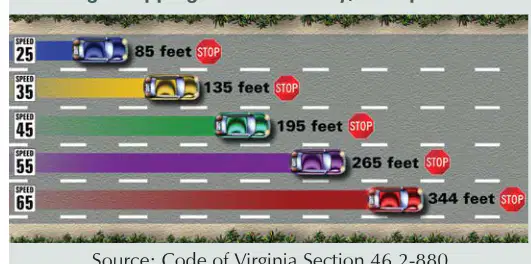
According to the average stopping distance chart on dry, level pavement, which speed has the longest total stopping distance?
25 MPH
35 MPH
45 MPH
65 MPH
What is the correct action when using antilock brakes (ABS)?
Pump the brakes repeatedly
Never pump the brakes; apply firm, continuous pressure as recommended by the vehicle manual
Turn off ABS in wet conditions
Use the parking brake to assist stopping
What is the primary purpose of warning signs on the road?
To give route numbers
To warn drivers about conditions ahead
To set legal speed limits
To direct traffic during construction
An advisory speed plaque beneath a warning sign indicates:
The maximum legal speed limit
A recommended speed for specific conditions ahead
The minimum speed for the lane
The speed enforced only at night
Which sign warns drivers of a sharp curve ahead?
A rectangle with black letters
A diamond-shaped sign with a curved arrow
A circular sign with a cross
A pentagon-shaped sign with people walking
What should a driver do when approaching a slippery when wet warning sign during rain?
Maintain current speed
Increase speed to get through quickly
Slow down and proceed with caution
Stop immediately
A deer crossing sign alerts drivers to:
A zoo entrance nearby
Areas where deer may enter the roadway
A hunting zone
Livestock loading area
Which action best reflects responding to an advisory speed sign on a curve?
Treat it as optional and maintain highway speed
Use it as a recommended safe speed for the curve
Ignore it if traffic is light
Only follow it if visibility is perfect
A divided highway ends warning sign means:
The road will split into two one-way roads
You are entering a freeway
The divided roadway ahead ends and two-way traffic resumes
A toll plaza is ahead
When you see a lane ends/merge left warning sign, you should:
Speed up to pass other vehicles
Stay in your lane until the very end
Prepare to merge safely into the indicated lane
Stop and wait for instructions
What does a low clearance warning sign communicate to drivers of tall vehicles?
Bridge is under construction
The exact weight limit for the bridge
The maximum vehicle height allowed under the structure
A detour ahead
A warning sign showing a truck on a slope indicates:
Truck parking area
Steep downgrade ahead; use lower gear
No trucks allowed
Truck inspection station
When approaching a railroad crossing with a round yellow warning sign (RXR), drivers should:
Expect pedestrian traffic
Be prepared to slow down, look, and listen for trains
Assume gates will always be down
Drive faster to clear the tracks quickly
What does a railroad crossbuck indicate when posted at a crossing?
A detour around the tracks
A stop sign that applies to all lanes
The location of the railroad crossing; yield to trains
A pedestrian-only path
If there is a stop line at a railroad crossing, where must you stop when a train is approaching?
Anywhere before the tracks
Directly on the tracks to look both ways
No closer than the stop line or posted distance from the tracks
Halfway across the first rail
Which behavior is safest at a passive railroad crossing with no lights or gates?
Rely on other drivers to signal
Turn up the radio to hear warnings
Slow, look both ways, and cross only when clear
Follow the vehicle ahead onto the tracks closely
An animal crossing warning sign with a cow symbol most likely indicates:
A wildlife refuge entrance
Open range or farm animals may be on or near the roadway
No pets allowed
A petting zoo ahead
Which pavement marking indicates a railroad crossing ahead and alerts drivers to look and listen for trains?
White X and the letters RR painted on the roadway
Yellow zigzag lines on the shoulder
A solid blue line in the center of the lane
A series of white triangles (shark teeth)
In work zones, what is the primary purpose of orange signs and devices?
To mark recreational areas
To provide guidance and warn drivers of road work and changing conditions
To indicate school zones
To show hospital locations
Who directs traffic when present in a work zone and must be obeyed over other traffic control devices?
Crossing guard
Flagger
Parking attendant
Tow truck operator
What is photo speed enforcement in work zones designed to do?
Automatically adjust speed limits based on weather
Capture speeding vehicles and issue citations to improve safety
Display driver speeds without consequences
Record traffic volumes for planning
Which device provides real-time information such as lane closures or speed advisories in work areas?
Stop/Slow paddles
Portable changeable message boards
Barricades
Channelizing cones
What is the function of rumble strips placed before work zones?
Measure vehicle weight
Warn drivers through vibration and noise to slow down or pay attention
Divert traffic into detours
Provide traction for motorcycles
A bright orange triangular emblem with a red reflective border mounted on the rear of a vehicle indicates:
Hazardous materials carrier
Emergency vehicle
Slow moving vehicle
Commercial truck over 26,000 lbs
When approaching a railroad crossing with pavement markings, what is the safest initial action?
Increase speed to clear the tracks quickly
Turn on hazard lights
Slow down, look, and listen for a train
Drive onto the shoulder
Which traffic control device in a work zone most directly separates traffic from workers or closed lanes?
Portable message boards
Type III barricades or concrete barriers
Flagger’s whistle
Rumble strips
Why are channelizing devices like cones and drums used in work areas?
To provide parking spaces
To guide drivers safely through temporary traffic patterns
To measure traffic speeds
To indicate school crossings
If a flagger displays a STOP paddle facing you, what should you do first?
Proceed with caution
Stop at the line indicated and wait for direction
Change lanes to pass the work area
Honk to alert the flagger
Which statement best describes the driver’s responsibility around photo speed enforcement signs in work zones?
Maintain normal speed; only warnings are issued
Obey the posted work zone speed limit because violations may be recorded and cited
Ignore the signs if workers are not present
Speed up to match the flow of traffic even if above the limit
What does a solid white line typically indicate on a roadway?
Lane boundaries where lane changes are discouraged
A two-way left-turn lane
A no-passing zone between opposite directions of traffic
An HOV lane only
What is the function of a yellow center line on a two-way road?
Separates traffic moving in the same direction
Separates traffic moving in opposite directions
Marks the edge of the roadway
Indicates a bicycle-only lane
Broken yellow lines on a two-way road mean that passing is:
Never allowed
Allowed when it is safe
Allowed only for trucks
Allowed only in school zones
Double solid yellow lines mean:
You may pass if the way is clear
Passing is allowed for vehicles turning left
No passing from either direction
Bicycles may use the lane
A bicycle lane is best described as:
A lane on the shoulder only for pedestrians
A marked lane reserved for bicyclists with special right-of-way rules
A turn-only lane for motor vehicles
A parking lane for buses and taxis
Shared lane markings (sharrows) indicate that:
Bicyclists must use the sidewalk
Bicyclists and motorists share the lane; motorists should expect bicyclists to ride there
Only buses may use the lane during rush hours
Passing is prohibited for all vehicles
Which statement about HOV (High-Occupancy Vehicle) lanes is most accurate?
They are open to any vehicle at all times
They are reserved for vehicles with a minimum number of occupants, as posted
They are only for buses and emergency vehicles
They allow passing on the right only
At a toll plaza, special lanes may be marked for:
Emergency stopping only
Exact change, electronic toll collection, or high-speed tolling
School buses only
Oversized vehicles only
Painted curbs are used primarily to:
Show the speed limit
Indicate parking restrictions or special stopping rules
Mark the center of the road
Reserve space for bicycles
If you see a solid white line between lanes just before an intersection, you should generally:
Change lanes quickly to save time
Avoid changing lanes and stay in your lane through the intersection
Drive on the shoulder to pass traffic
Cross it only if you need to turn right immediately
When approaching a bicycle lane with a dashed line near an intersection, drivers should:
Merge into the bicycle lane to turn after yielding to bicyclists
Never enter the bicycle lane under any circumstances
Speed up to pass bicyclists before the intersection
Park in the lane while waiting to turn
Which marking most clearly communicates that passing traffic in both directions is prohibited?
Broken yellow line
Double solid yellow line
Single solid white line
Shared lane marking
What is the safest action when driving in a shared lane with bicyclists marked by sharrows?
Honk to make bicyclists move to the curb
Expect bicyclists to use the lane and provide space when passing
Drive in the oncoming lane to avoid them
Use the lane only if you drive under 20 mph
A bus-only lane is typically reserved for buses during:
Posted hours or at all times as indicated by signs and markings
Only emergencies
Weekends only
Snow conditions only
What is the most common mistake drivers make when backing up?
Failing to look back through the rear window
Relying on mirrors only for a full view
Turning the head to the right
Stopping to check both sides before moving
When parking on a public road next to a curb, how close should you pull to the curb?
At least two feet away
No more than one foot from the curb
Exactly six inches from the curb
Distance does not matter
On a two-way street, on which side should you park?
Left side of the road
Right side of the road
Either side if space allows
Facing traffic direction only
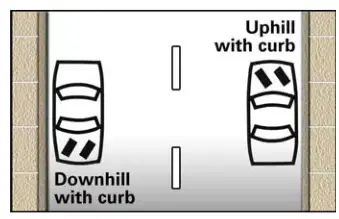
When parking downhill with a curb, how should you turn your front wheels?
Turn wheels left
Turn wheels right
Leave wheels straight
Turn wheels toward the street
Which situation requires you to avoid using high-beam headlights?
On highways with no nearby vehicles
When within 500 feet of an oncoming vehicle
On rural roads at night with no streetlights
In heavy fog to see farther
Virginia law requires headlights to be used during which conditions?
Only at night
Only in rain
During inclement weather and when visibility is reduced to 500 feet
Only when windshield wipers are used
Which parking action is illegal based on the list of prohibitions?
Parking 30 feet from a railroad crossing
Parking beside another parked vehicle (double parking)
Parking in front of a school after hours
Parking more than one foot from the curb
What is the recommended response when driving in fog?
Use high-beam headlights to pierce the fog
Use low-beam headlights and slow down
Turn on hazard lights and speed up to leave the fog
Follow the taillights of the car ahead closely
When driving on packed snow and you need to stop, what should you do?
Apply the brakes gently and slow down before stopping
Brake hard to engage ABS
Shift to neutral and coast
Turn quickly to find traction
How should you react to an aggressive driver behind you?
Speed up to avoid them
Make eye contact to show awareness
Stay out of the way and avoid challenging them
Brake-check to discourage tailgating
Which of the following is true about bridges in winter conditions?
They freeze after road surfaces
They never freeze due to airflow
They freeze before other road surfaces
They freeze at the same time as roads
When driving at night within cities and towns, which headlights should you generally use?
High-beam headlights at all times
Low-beam headlights
Parking lights only
No headlights if streets are lit
What does yielding the right-of-way generally require a driver to do at an intersection without a stop sign when another vehicle is already in the intersection?
Proceed first if you are traveling faster
Enter and block the intersection to claim priority
Slow down or stop to let the other vehicle go first
Flash headlights to signal the other driver to yield
When approaching a roundabout, what is the correct action before entering?
Enter immediately to keep traffic flowing
Stop in the circulating lane to check both directions
Yield to traffic already in the roundabout and to pedestrians
Signal left and accelerate to merge ahead of traffic
Which statement best describes how to exit a roundabout safely?
Signal right just before your exit and move to the exit lane
Stop in the roundabout to plan your route
Signal left while passing your exit, then turn right
Change lanes inside the roundabout to reach the exit
In a multi-lane roundabout, which lane should you choose for a left turn (exiting more than halfway around)?
Right lane only
Left lane or a lane marked for left or U-turn
Any lane, then change lanes inside the roundabout
Center lane only regardless of markings
When two drivers arrive at an uncontrolled intersection at the same time, who should yield?
The driver on the right yields to the driver on the left
The driver on the left yields to the driver on the right
The vehicle traveling faster has the right-of-way
Neither; both proceed at the same time
What should you do when an emergency vehicle using lights and siren approaches from behind on a two-way road?
Speed up to clear the way
Maintain speed and lane to avoid confusion
Pull to the right edge of the road and stop until it passes
Stop in the lane immediately
Which action is prohibited inside a roundabout?
Yielding to pedestrians in crosswalks
Stopping to wait for a gap
Driving counterclockwise
Passing the exit and taking the next one
You are approaching a roundabout and intend to go straight. Which is the best lane choice?
Any lane marked for through movement
Left-turn-only lane
Exit-only lane before the roundabout
Bicycle-only lane
A pedestrian is waiting in a crosswalk at the roundabout entrance. What is your responsibility?
Enter first if the pedestrian has not stepped into the road
Yield and allow the pedestrian to cross before you enter
Honk to alert the pedestrian and proceed
Wave the pedestrian to wait until traffic clears
An emergency vehicle is stopped in the roundabout with flashing lights. How should you proceed?
Enter and pass it quickly to keep traffic moving
Yield at the entrance and wait until the situation clears
Stop in the circulating lane to offer assistance
Make a U-turn before the roundabout regardless of signs
Which action best defines over-correcting when driving?
Applying steady braking before a curve
Making a sudden steering movement that is too sharp for road conditions
Gradually speeding up to merge into traffic
Using hand-over-hand steering during a turn
When preparing for a right turn on a city street, which sequence is correct?
Signal, check mirrors, move to left lane, turn
Check mirrors, signal at least 100 feet before the turn, move into the right lane, slow and turn
Honk, accelerate, and turn from any lane
Signal during the turn only
Which statement about making a left turn is correct?
Begin the turn wide to avoid crossing the centerline
Keep wheels turned left while waiting in the intersection
Yield to oncoming traffic and turn when the way is clear
Turn from the far right lane to the far left lane
When is a U-turn generally permitted?
Anywhere as long as you signal
Only where it is safe, legal, and not prohibited by a sign or roadway markings
At intersections with a green arrow only
On curves and near the top of hills
How far in advance should you signal before turning or changing lanes in a business or residential area?
At least 50 feet
At least 100 feet
At least 200 feet
Only when other drivers are nearby
Which hand signal indicates a right turn if your turn signals fail?
Left arm straight out
Left arm pointing downward
Left arm bent upward at the elbow
Right arm out the window
What is the recommended minimum following distance under normal conditions at city speeds?
1-second rule
2-second rule
3-second rule
5-second rule
You are driving at higher speeds on the highway. Which following distance is safest?
Maintain the same 2-second gap
Increase to at least a 3- to 4-second gap
Close the gap to prevent cut-ins
Match the vehicle’s bumper ahead within 1 car length
Which strategy best describes maintaining a space cushion?
Driving close to large vehicles to draft them
Keeping a safe distance on all sides of your vehicle to allow time to react
Staying in other drivers’ blind spots to be less predictable
Using your horn frequently
Effective searching means you should primarily do what?
Focus only on the car directly ahead
Scan the road ahead, to the sides, and check mirrors regularly
Look only at your speedometer on long trips
Rely on GPS voice prompts
Looking ahead helps you to do which of the following?
Brake later at intersections
Spot hazards early and adjust speed or position in time
Ignore pedestrians because they have right-of-way
Accelerate into congested areas
Before backing up, what is the safest practice?
Rely only on the backup camera
Check mirrors and over your shoulder, and back slowly
Honk twice and back quickly
Open your door to look behind while moving
You are first at a green light intending to turn left with oncoming traffic approaching. What should you do?
Turn quickly to clear the intersection
Enter the intersection, keep wheels straight, yield to oncoming traffic, then turn when clear
Keep wheels turned left while waiting to shorten the turn
Back up to wait behind the stop line
While rounding a curve, your right wheels drop off the pavement edge. What is the best response to avoid over-correcting?
Steer sharply back onto the road and accelerate
Brake hard and turn left immediately
Ease off the accelerator, steer straight, slow down, and gently re-enter the roadway when safe
Stop in the lane and turn on hazard lights
Which term describes the areas around a vehicle where the driver cannot see other road users through mirrors alone?
Right-of-way
No-Zones
Roundabouts
Work zones
When driving near pedestrians at crosswalks, what is the safest action?
Speed up to clear the crosswalk quickly
Yield and be prepared to stop, even if the light is green
Honk to warn them to hurry
Drive in the bike lane to pass them
Which behavior is safest when approaching a bicyclist on a narrow road?
Pass closely to avoid crossing the center line
Slow down and pass only when you can provide ample space
Honk continuously to alert the rider
Tailgate to encourage the rider to move faster
Motorcycles are harder to see than other vehicles. What should drivers do before changing lanes?
Rely only on mirrors
Signal and change lanes quickly
Check blind spots and look twice for motorcycles
Assume motorcycles will yield
What is the safest approach at railroad-style light rail crossings?
Proceed if you don’t see a train even when signals activate
Stop when warning devices are active and proceed only when the way is clear
Drive around lowered gates if you are late
Stop on the tracks for a better view
Low-speed vehicles (LSVs) typically operate best on which type of roads?
Highways with high speed limits
Residential or low-speed streets
Freeways with multiple lanes
Unpaved shoulders
The shaded rectangles along a truck’s sides and rear in a diagram are labeled No-Zones. What do they indicate?
Areas where passing is encouraged
Areas where the truck has limited or no visibility
Safe following distances for cars
Brake check areas
When following a large truck, where should you position your vehicle to stay visible?
Directly behind the truck’s bumper
Far enough back so you can see the truck’s side mirrors
In the truck’s right rear No-Zone
Alongside the truck’s trailer midpoint
What is the main risk when a car lingers alongside a tractor-trailer during a lane change?
Increased fuel consumption
The car may be in the truck’s blind spot and get sideswiped
Ticket for improper passing
Engine overheating
Before turning right across a bicycle lane, a driver should first:
Merge into the lane without signaling
Check mirrors and blind spots, yield to bicyclists in the lane, then turn when clear
Honk and turn to make bicyclists stop
Accelerate to beat the bicyclists
Which statement about motorcycles at intersections is most accurate?
They have longer stopping distances than cars
They are often hidden in traffic and are easily overlooked
They must always yield to larger vehicles
They cannot use a full lane
When a light rail train is approaching an intersection, drivers should:
Make a quick left across the tracks before it arrives
Stop if signals or gates are active and never turn across the tracks unless permitted
Follow directly behind the train through the intersection
Drive on the tracks to pass traffic
What is the safest practice when towing a trailer down a steep grade?
Rely solely on the trailer brakes
Downshift and allow more following distance
Turn off engine braking
Follow closely behind large vehicles
If a truck needs to make a wide right turn, where is the danger zone for smaller vehicles?
Directly in front of the truck
Between the truck and the curb on the right side
Two lanes to the left of the truck
Behind the truck in an adjacent lane
Which action best reduces risk when passing a bicyclist on a two-lane road?
Maintain speed and pass within the same lane
Cross the center line only when safe and legal, leaving ample space
Pass on the right shoulder
Drive between the bicyclist and oncoming traffic
Which guideline helps prevent conflicts with pedestrians in parking lots?
Assume pedestrians will yield to moving cars
Drive slowly and be ready to stop as pedestrians can appear between vehicles
Use high beams to alert pedestrians
Honk when backing
When backing up, what is the safest initial action before moving the vehicle?
Rely on mirrors only
Check all around and look over your right shoulder
Honk twice then proceed
Shift into neutral to coast
Which statement best describes proper use of headlights to improve visibility?
Use high beams in fog for better range
Turn on headlights whenever windshield wipers are on
Only use headlights at night
Use parking lights instead of headlights at dusk
What is the correct wheel position when parking uphill with a curb?
Turn wheels sharply toward the curb
Keep wheels straight
Turn wheels away from the curb
Set wheels parallel and 6 inches from the curb
When parking downhill without a curb, how should you position your front wheels?
Toward the roadway
Away from the edge so the car rolls into traffic
Toward the edge/shoulder
Straight ahead
Which action helps ensure safety before backing out of a driveway into a street?
Back quickly to minimize time in the roadway
Tap the horn continuously
Stop at the sidewalk, check for pedestrians and traffic, then proceed slowly
Rely on a backup camera only
During night driving, what increases following distance and reduces glare from vehicles behind you?
Using day/night mirror setting and increasing following distance to at least 4 seconds
Switching on interior dome lights
Keeping windows open
Driving faster to spend less time near other cars
Which condition requires you to use low-beam headlights instead of high beams?
On an open rural road with no traffic
In clear weather on a highway
When following another vehicle or in fog, rain, or snow
On a dry city street at noon
What is the safest response when driving in heavy fog?
Use high beams to see farther
Slow down, use low beams, and be prepared to stop
Turn off headlights to avoid glare
Maintain normal speed and follow closely
When roads are wet from rain, what is the recommended practice to avoid hydroplaning?
Increase speed to cut through water
Drive in the tracks of the vehicle ahead and reduce speed
Use cruise control to maintain steady speed
Brake hard frequently to keep tires warm
On snowy or icy roads, which technique improves control?
Abrupt steering and hard braking
Slow, smooth inputs and increased following distance
Using high beams for better traction
Shifting to neutral when turning
Which situation makes it illegal or unsafe to park?
Within an intersection or blocking a driveway
Parallel to the curb in a legal zone
In a marked parking space in daylight
On the right side of a two-way street facing traffic flow
What should you do when your visibility is limited by a curve or hill?
Speed up to clear the area more quickly
Drive at a speed that allows you to stop within the distance you can see
Turn on hazard flashers and continue at the same speed
Use high beams to see around the curve
When starting to back out of a parking space, where should your eyes focus?
On the dashboard indicators
Primarily through the rear window while checking mirrors and sides
Only on the side mirrors
On the backup camera display only
At night, when an oncoming vehicle’s headlights cause glare, what is the best immediate action?
Look directly at the lights to judge distance
Flash your high beams continuously
Glance to the right edge of your lane and avoid staring at the glare
Close your eyes briefly to rest them
Which behavior best describes aggressive driving?
Maintaining a safe following distance
Speeding, tailgating, and weaving through traffic
Using turn signals well in advance
Yielding to pedestrians
What is a key characteristic of distracted driving?
Driving with both hands on the wheel
Focusing only on the roadway and mirrors
Any activity that diverts attention from driving, such as texting
Keeping eyes moving to scan the road
Which example most directly represents drowsy driving?
Driving after a full night’s sleep
Using cruise control on a highway
Nodding off, drifting from your lane, or missing exits due to fatigue
Taking a break every two hours
Which statement about drunk and drugged driving is most accurate?
Only alcohol impairs driving ability
Some prescription and over-the-counter drugs can impair driving similar to alcohol
Illegal drugs never affect driving
Caffeine negates alcohol’s effects
Blood Alcohol Concentration (BAC) is best defined as:
The amount of alcohol in the stomach
The percentage of alcohol in a driver’s bloodstream
The number of drinks consumed per hour
A breath test brand name
Which action is the safest choice if you feel yourself becoming drowsy while driving?
Turn up the radio and keep driving
Open the window and continue
Pull over to a safe location to rest or switch drivers
Follow closer to the vehicle ahead to stay alert

