
 Worksheets
Chromatography Introduction
Total questions: 50
Worksheet time: 25mins
Which statement best defines chromatography in this unit?
A technique that increases reaction rates by heating a mixture
A set of laboratory techniques for separating mixtures based on different partitioning between a mobile and a stationary phase
A method for measuring solution pH using indicators
A single instrument used for distilling volatile liquids
In chromatography, what is the role of the mobile phase as described in the material?
A solid or liquid that slows solute movement
A liquid or gas that acts as a solvent and carries the mixture through the stationary phase
A catalyst that speeds chemical reactions during separation
A dye that colors separated compounds
Which pair correctly states the relationship between the two phases used in chromatography?
They must be miscible with each other to enable partitioning.
They are immiscible with each other.
Both phases must be gases.
Both phases must be solids.
Which of the following lists the main purposes enabled by chromatography in analysis?
Combustion, oxidation, and reduction
Separation, identification, and purification
Titration, dilution, and neutralization
Polymerization, crystallization, and drying
Which statement best captures the general principle of chromatographic separation stated in the introduction?
Separation occurs when solutes precipitate from supersaturated solution.
Separation is based on differential partitioning between mobile and stationary phases.
Separation depends solely on differences in boiling points.
Separation requires chemical reactions to convert solutes to gases.
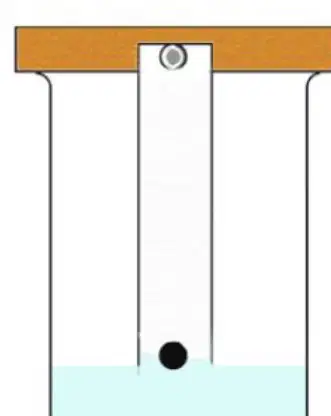
Consider the simple paper chromatography setup shown: a strip of paper dips into a solvent with a sample spot near the bottom. Which terms correctly label the moving solvent and the paper, respectively?
Stationary phase; mobile phase
Mobile phase; stationary phase
Eluent; analyte
Solute; solvent
According to the classification diagram of chromatography, which pair correctly matches a primary mode with one of its listed sub-techniques?
Adsorption chromatography — Paper chromatography
Partition chromatography — Gas–liquid chromatography (GLC)
Ion exchange chromatography — HPTLC
Gel chromatography — Column chromatography
In the diagram’s hierarchy, which chromatographic mode is explicitly associated with the phrase “Exchange of ion”?
Adsorption chromatography
Partition chromatography
Ion exchange chromatography
Gel chromatography (molecular sieve)
Which statement best describes the fundamental principle of chromatography as presented?
Separation is achieved by chemical reactions forming new compounds.
Molecules are transferred between mobile and stationary phases due to absorbance or partition.
Only the stationary phase determines separation by filtering large molecules.
Separation occurs because the mobile phase evaporates faster than the stationary phase.
In the context of the described principle, what does the rate of travel of a solute molecule through a column or thin layer depend on most directly?
Its partition between the mobile and stationary phases
The absolute pressure of the laboratory room
The color of the solute
The brand of chromatographic plate
Which statement best defines column chromatography?
A method where substances are separated by passing through a column packed with an adsorbent, moving at rates based on their affinities for the adsorbent and solvent.
A technique where compounds are burned in a column to determine elemental composition.
A separation where gases diffuse through a membrane based solely on molecular size.
An electrophoretic technique using an electric field to separate charged particles in a gel.
In column chromatography, which combination correctly identifies the phases involved?
Stationary phase: liquid; Mobile phase: solid
Stationary phase: solid; Mobile phase: liquid or gas
Stationary phase: gas; Mobile phase: solid
Stationary phase: plasma; Mobile phase: liquid
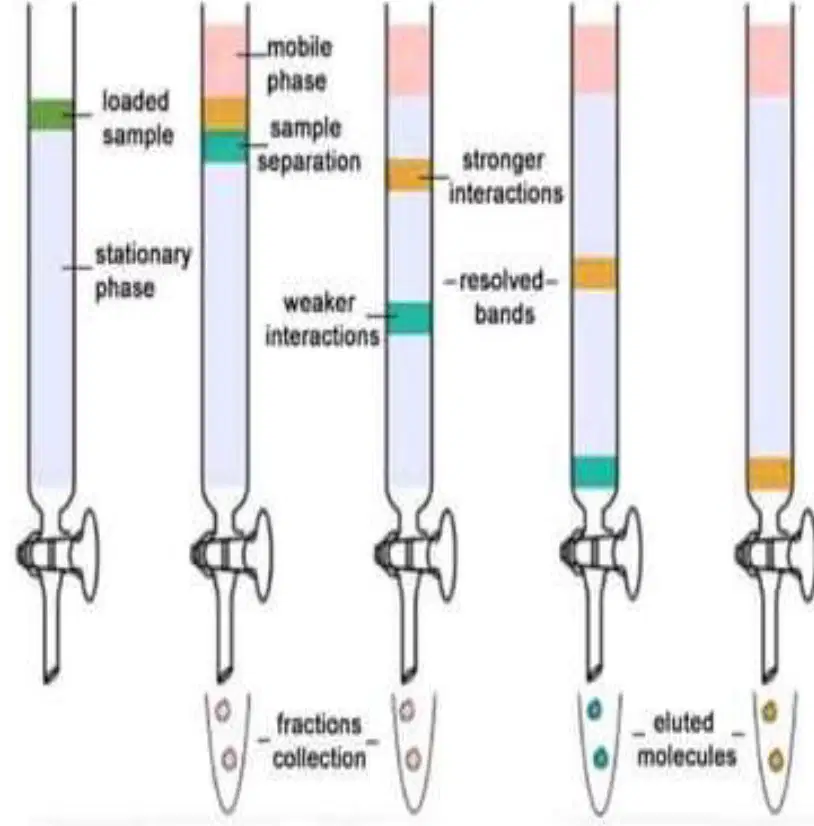
In the illustrated column chromatography sequence, which component remains packed inside the column and interacts with analytes to create separation?
Loaded sample
Stationary phase
Mobile phase
Eluted molecules
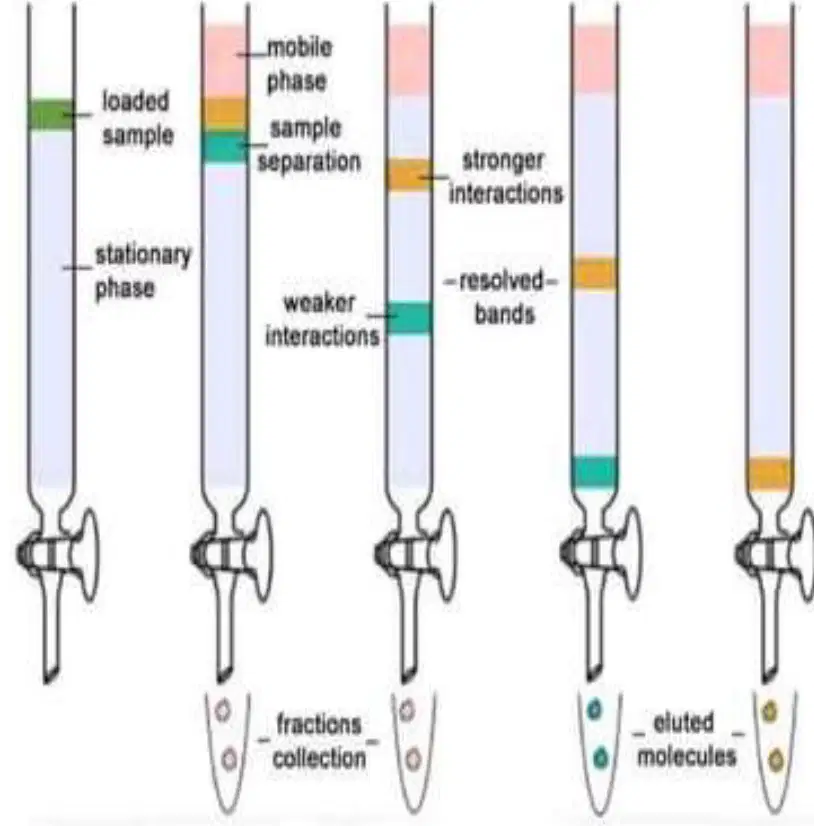
According to the diagram, which statements describe why different colored bands move at different rates during column chromatography? Select all that apply.
They experience weaker or stronger interactions with the stationary phase.
They have different volumes of mobile phase added above them.
They are compressed by the stopcock pressure equally.
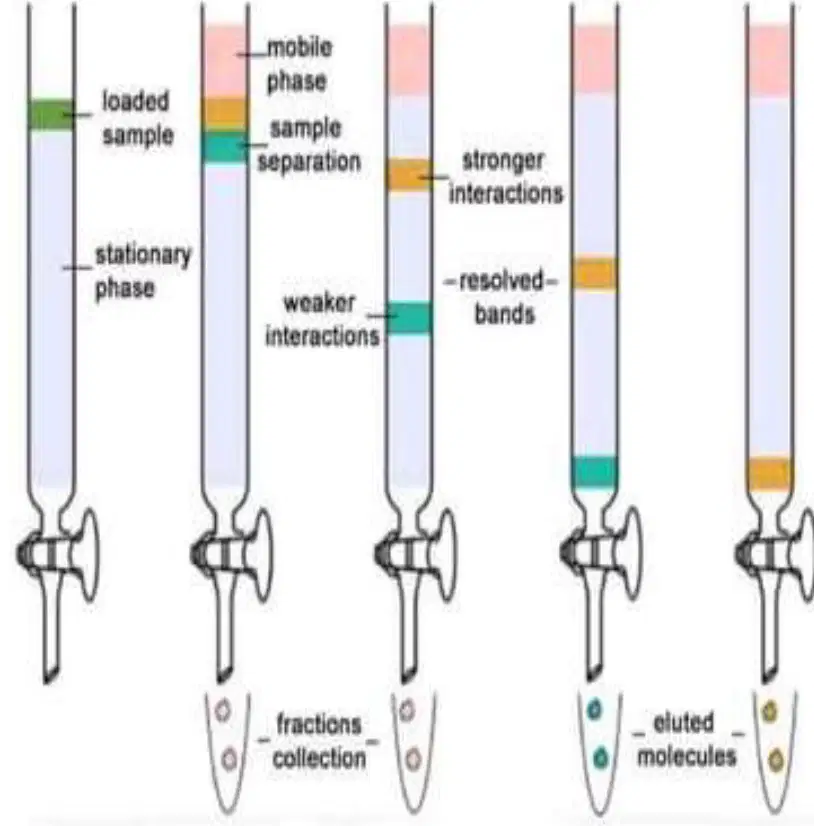
What is the correct order of stages depicted for a successful column chromatography run?
Fraction collection → Sample loading → Separation into bands → Elution
Sample loading on stationary phase → Addition of mobile phase → Separation into resolved bands → Elution and fraction collection
Addition of mobile phase → Sample loading → Fraction collection → Separation into bands
Elution and fraction collection → Stationary phase packing → Sample loading → Separation
In liquid chromatography, a typical column is approximately what size and material?
25–50 cm long, 4 mm internal diameter, stainless steel
1–3 m long, 2–4 mm internal diameter, glass only
10–20 cm long, 1 mm internal diameter, plastic
50–70 cm long, 8 mm internal diameter, copper
Which dimensions best describe a gas chromatography (GC) column as stated in the material?
25–50 cm length and 4 mm internal diameter
1–3 m length and 2–4 mm internal diameter
5–10 m length and 1–2 mm internal diameter
10–30 cm length and 6–8 mm internal diameter
According to the text, what materials are GC columns commonly made from?
Glass or stainless steel
Aluminum or Teflon
Plastic or copper
Ceramic only
Which statement correctly distinguishes conventional and microbore columns?
Conventional columns have stationary phase coated on the inside wall; microbore columns are packed with particles
Both types are empty and rely on mobile phase only
Conventional columns are filled with stationary phase; microbore columns have stationary phase coated directly on the inside wall
Microbore columns are longer but have no stationary phase
How many primary forms of column chromatography are identified, and what are they abbreviated as?
Three: LC, GC, IC
Two: LC and GC
Four: LC, GC, HPLC, GPC
Two: HPLC and GC-MS
Which material pair is explicitly mentioned as common stationary phases used to coat the glass tube in column chromatography?
Cellulose and silica
Agarose and polyacrylamide
Alumina and charcoal
Nickel and copper
In column chromatography, how is the sample typically introduced and moved through the column according to the described steps?
Injected at the bottom and pushed upward by pressure
Introduced from the top and allowed to pass under the influence of gravity
Loaded at the center and spun by centrifugation
Sprayed onto the sides and eluted by vacuum
After separation in column chromatography, what is the immediate stated next step for the separated molecules?
They must be discarded
They can further be analyzed for various purposes
They are immediately crystallized
They are stored without analysis
Which of the following is NOT listed as a routine use of column chromatography?
Separation of impurities and purification of biological mixtures
Isolation of active molecules and metabolites
Detection of drugs in crude extracts
Measuring melting points of purified solids
Which statement best distinguishes isocratic from gradient elution in the described context?
Isocratic varies solvent polarity over time; gradient keeps polarity constant
Isocratic keeps the same polarity; gradient uses different polarities
Both isocratic and gradient always use the same solvent mixture
Gradient elution relies solely on gravity while isocratic uses pressure
Which statement best describes the principle of Thin Layer Chromatography (TLC)?
Separation based on differences in boiling points of components
Separation or identification of mixture components using an adsorbent-coated plate where movement depends on affinity to the stationary phase
Separation based on electrical charge migration in an external field
Separation using size exclusion through a porous gel
In TLC, why does the mobile phase solvent rise up the plate?
Evaporation draws it upward
Capillary action moves it against gravity
Electrostatic attraction to silica pulls it upward
Thermal convection currents drive the flow
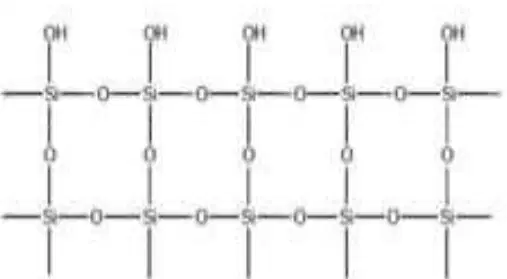
A TLC plate coated with silica gel is used as the stationary phase. Which outcome is expected for two compounds where Compound A has stronger interactions with silica than Compound B?
Compound A travels farther than Compound B.
Compound B remains at the origin while Compound A reaches the solvent front.
Compound A travels a shorter distance than Compound B.
Both compounds travel identical distances.
In TLC stationary phase preparation, what is the usual drying condition after spreading the slurry onto glass plates?
40–60°C for 30 minutes
100–120°C for 1 hour
150–180°C for 10 minutes
Room temperature overnight
Which statement best describes proper sample application in TLC?
Immerse the spotting area in the mobile phase to ensure wetting
Use capillary tubes or micropipettes and keep the spotting area above the mobile phase
Apply samples by pouring them across the plate surface
Inject samples through the development tank lid
What is the primary purpose of lining the development tank with filter paper?
To prevent plate breakage
To ensure even solvent front movement
To reduce sample evaporation
To neutralize acidic vapors
Which pair correctly matches a detection technique type with an example?
Destructive — UV chamber
Nondestructive — sulfuric acid spray
Destructive — sulfuric acid spray
Nondestructive — scraping and eluting spots
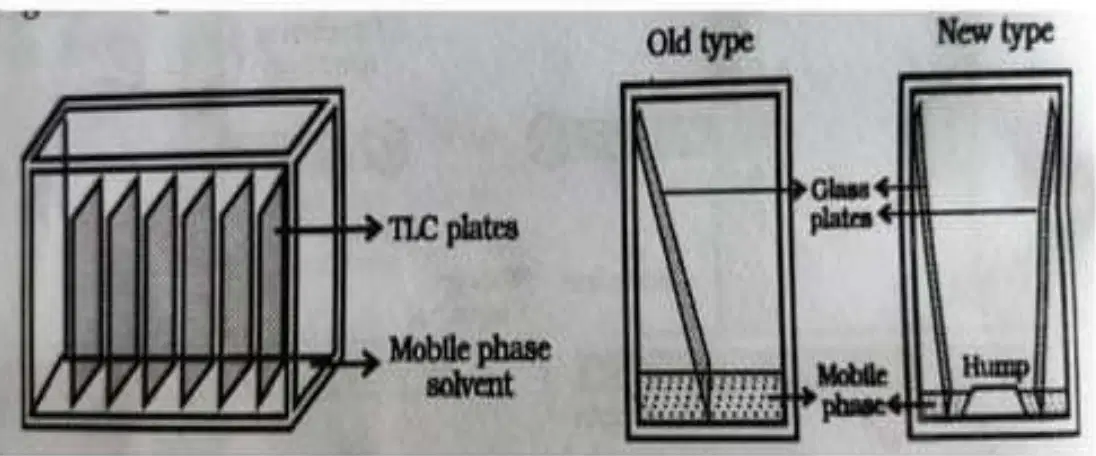
Refer to the schematic of the development tank showing multiple TLC plates and a solvent pool at the bottom. What component is labeled as the liquid at the base?
Stationary phase slurry
Mobile phase solvent
Buffer solution
Developer reagent
In TLC, the Rf value is defined as which of the following ratios?
Distance traveled by solvent front divided by distance traveled by solute
Distance traveled by solute divided by distance traveled by solvent front
Distance from origin to baseline divided by plate length
Solvent polarity divided by compound polarity
A spot in a TLC run moved 3.0 cm from the origin while the solvent front moved 5.0 cm. What is the Rf value?
0.15
0.30
0.60
1.67
Which statement best explains why TLC is considered simple and fast?
It requires complex instrumentation and long run times.
It is straightforward, needs minimal equipment, and yields quick results.
It uses large volumes of solvents and materials.
It automates all steps of the analysis.
Which advantage of TLC makes it efficient for limited material availability?
Small sample size required
Limited automation
Manual process
Limited resolution
Which of the following is a disadvantage of TLC related to measurement precision?
Visual results with UV light or stains
Quantitative analysis challenges because TLC is primarily qualitative
Multiple sample analysis on one plate
Versatility for a wide range of compounds
Identify the pair that correctly matches a TLC drawback with its implication.
Limited sensitivity — excellent detection of trace analytes
Manual process — potential variability and lower reproducibility
Limited resolution — sharper bands than HPLC
Limited automation — ideal for high-throughput environments
Which application best describes using TLC to compare a compound’s retention factor (Rf) with known standards to determine its identity?
Purity testing
Identification of compounds
Monitoring reactions
Drug analysis
In an organic synthesis lab, a chemist periodically spots a reaction mixture on a TLC plate to track disappearance of starting material. Which TLC application is this?
Purity testing
Food and beverage analysis
Monitoring reactions
Herbal and natural products analysis
Which statement best defines paper chromatography in this context?
A planar chromatographic technique performed on specialized paper
A column technique performed in packed silica beds
An electrophoretic technique using an electric field
A distillation technique separating liquids by boiling point
In paper adsorption chromatography, what acts as the adsorbent (stationary phase)?
Silica or alumina impregnated on paper
Cellulose moisture within filter paper
Activated carbon powder only
Ion-exchange resin
In paper partition chromatography, which component acts as the stationary phase?
The moisture/water in cellulose fiber pores of the filter paper
A silica gel coating on the paper
Only the organic solvent used as mobile phase
A metal oxide layer
According to the material, paper chromatography mainly separates components based on which process?
Partition rather than adsorption
Adsorption rather than partition
Ion exchange
Electrophoretic mobility
What primarily determines how readily components separate during paper chromatography?
Their relative adsorption to the stationary phase versus dissolution in the mobile phase
Their molecular weight only
Their boiling points
Their color intensity
Which statement correctly describes the roles of phases and solvent movement in paper chromatography?
Cellulose moisture acts as stationary phase; an organic solvent/buffer serves as mobile phase that travels up the paper carrying the sample
The organic solvent is the stationary phase while water is mobile and moves downward by gravity
Both phases are immobile, and separation occurs by evaporation alone
Only aqueous buffers can be used as mobile phase
What is the primary purpose of using a mobile phase in chromatography?
To cool the column during the separation process
To enhance the interaction between solutes and stationary phase
To facilitate the movement of analytes through the column
To provide a stationary surface for separation
Which of the following factors can affect the resolution of a chromatographic separation?
Type of glass used for the column
Temperature and pressure during the run
Color of the solvent used
Size of the chromatography column only
In gas chromatography, what is the role of the carrier gas?
To dissolve the sample before injection
To transport the vaporized sample through the column
To act as a stationary phase for separation
To cool the column during the analysis

