
 Worksheets
7 - Rome Test Review
Total questions: 54
Worksheet time: 27mins
The writings of Paul and other early Christians are collected in
the Talmud.
the Torah
the New Testament
the Old Testament
The first emperor of Rome took the title
Julius Caesar
Proconsul
Claudius
Augustus
All of the following can be said of Jesus EXCEPT that he
used parables and symbolic stories.
was arrested as a political rebel.
excited controversy among Jews.
was singled out for an unusual form of execution.
Roman culture and religion were greatly influenced by the
Spanish and Turks
Egyptians and Turks
Greeks and Etruscans
Sicilians and Etruscans
The legendary twins who founded Rome, Romulus and Remus, were nurtured by a
She-wolf.
She-male.
She-pig.
Sheeba, Queen of the Jungle.
Who was Caesar’s successor?
Constantine
Augustus
Mark Antony
Diocletian
The Peace of Augustus - Pax Romana lasted for
6 years.
25 years.
200 years
2,000 years.
After Julius Caesar captured Italy, he became
First Emperor
Dictator for life
First Consul
onto the triumvirate
All of the following are considered “good” Roman Emperors EXCEPT
Trajan
Hadrian
Marcus Aurelius
Nero
In the early Roman republic, members of the landholding upper class were called
tribunes.
plebeians.
consuls.
patricians.
Roman words, laws, and ______ still shape the world today.
architecture
foods
clothing styles
Egypt
The Punic Wars, Rome gained control of lands around the Mediterranean Sea by defeating
the Sicilians.
the Carthaginians.
the Persians.
the Greeks.
To try to restore order to the empire, Roman emperor Diocletian
divided the empire into two parts.
overhauled the Roman legal system.
granted toleration to Christians.
encouraged the revival of the republic.
The ancient Romans developed their religious beliefs from
Norse mythology.
Greek religion.
Asian beliefs.
Egyptian culture.
Julius Caesar’s enemies assassinated him because
they were angry with him for his military failures in Gaul.
they feared he planned to make himself king of Rome.
they were opposed to his expansion into other lands.
they were fearful when he refused to disband his army.
Who made the greatest contribution toward setting Christianity on the road to becoming a world religion?
Augustine
Peter
Clement
Paul
The highest-ranking official in the early Christian Church was the
deacon.
patriarch.
elder.
bishop.
The main issue that separated the churches of the East and the West was
the authority of the pope.
the official teachings of the bishops.
the belief in Jesus as the messiah.
the role of priests in conducting worship services.
Christianity is rooted from what religion?
Greek mythology
Roman polytheism
Judaism
Constantine
The greatest military barrier of the Western world is
The Great Barrier Reef.
The Great Wall of China.
Hadrian's wall.
Hoover Dam.
Christians divided themselves into two groups, the Roman Catholic Church in the West, and in the East, they were called the
Eastern Lutheran.
Church of Block.
Eastern Orthodox.
Greek Mythological.
The emperor who divided Rome in two – East & West, believing it would be easier to run was
Hadrian
Theodosius
Constantine
Diocletian
After various invasions from different Germanic tribes, what tribe finally took Rome?
Saxons
Visigoths
Huns
Vandals
The Bishop of Rome claimed authority over the other patriarchs and was known as the
pope
bishop
priest
emperor
On August 24, 79 A.D., the volcano Vesuvius erupted and covered
Rome
Crete
Pompeii
Carthage
What important change did the Roman emperor Constantine make in A.D. 313?
He divided the empire into two parts, eastern and western.
He brought back the republic to help end political violence.
He granted religious toleration to Christians.
He moved the capital of the empire to Vienna.
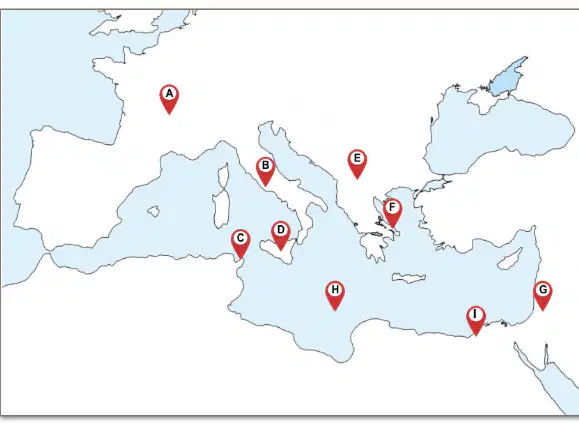
Which letter marks the Mediterranean Sea?
H
I
B
C
Which letter marks the location of Egypt?
H
I
B
C
Which letter marks the location of Gaul, modern-day France?
H
A
B
C
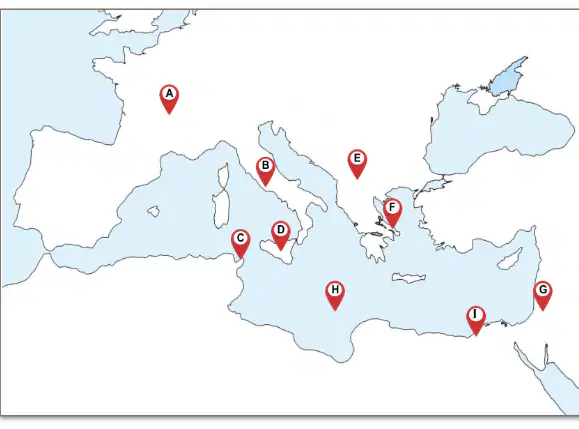
Which letter marks the location of Jerusalem, a holy city of Christianity?
G
A
B
C
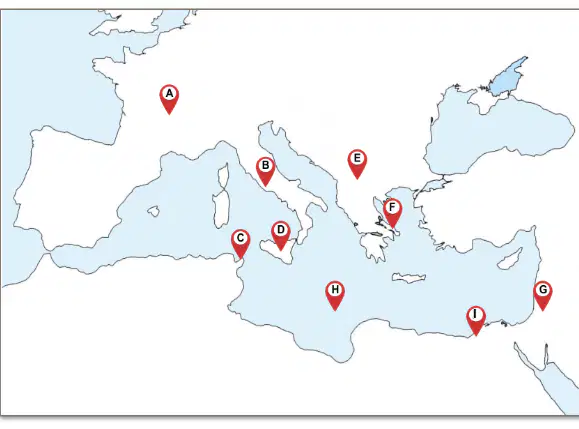
Which letter marks the location of the city of Rome?
B
A
C
D
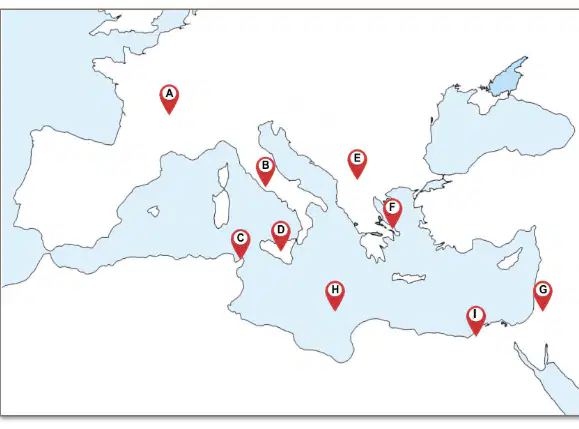
Which letter marks the location of Carthage, the city of Hannibal?
C
F
B
D
Which letter marks the location of Athens?
C
F
B
D
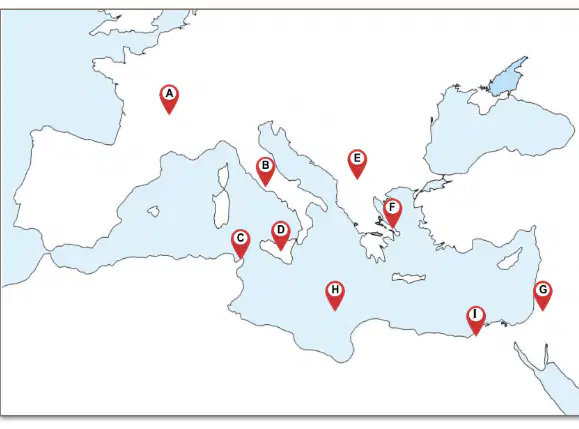
Which letter marks the location of Sicily, the sight of the 1st Punic War?
D
E
B
C
Which letter marks the location of Macedonia, where Alexander the Great was from?
D
E
B
C
One of two of officials who headed Rome’s executive branch
consul
Julius Ceasar
Augustus Ceasar
Constantine
Hannibal
successful Carthage military leader who led troops against Rome
consul
Julius Ceasar
Augustus Ceasar
Constantine
Hannibal
Roman leader who turned Rome from a democracy to an empire
consul
Julius Ceasar
Augustus Ceasar
Constantine
Hannibal
Emperor who issued the Edict of Milan
consul
Julius Ceasar
Augustus Ceasar
Constantine
Hannibal
Rome’s upper class
patrician
latifundia
Twelve Tables
republic
colosseum
A form of government in which people elect their leaders
patrician
latifundia
Twelve Tables
republic
colosseum
A written law code placed in Rome’s Forum at the request of the Plebeians
patrician
latifundia
Twelve Tables
republic
colosseum
Massive sports and games arena in Rome
patrician
latifundia
Twelve Tables
republic
colosseum
huge estates bought up by wealthy Roman families
patrician
latifundia
Twelve Tables
republic
colosseum
Octavian’s other name
Nero
Paul
Augustus
Theodosius
Patriarch
regional (diocese) leader of early Christian Church
Nero
Paul
Augustus
Theodosius
Patriarch
A Roman convert who spread Christianity from Mesopotamia to Rome
Nero
Paul
Augustus
Theodosius
Patriarch
Bad Emperor was accused of burning much of Rome
Nero
Paul
Augustus
Theodosius
Patriarch
This emperor made Christianity the official religion of the Roman Empire, banning all other religions
Nero
Paul
Augustus
Theodosius
Patriarch
A basic unit of the Roman army
legion
aqueduct
imperialism
martyr
messiah
the conquest or domination of one country by another
legion
aqueduct
imperialism
martyr
messiah
A person who suffers and dies for his belief
legion
aqueduct
imperialism
martyr
messiah
In Judaism, a savior promised by the Hebrew prophets, who would bring peace - i.e. freedom from Rome.
legion
aqueduct
imperialism
martyr
messiah
Bridge-like stone structure that brought water from hills to cities
legion
aqueduct
imperialism
martyr
messiah

