wayground logo

Free Printable Worksheets

Font size

S
M
L
XL
Worksheets

Cells, Organelles, Transport and Enzymes 2025

Total questions: 51

Worksheet time: 51mins

Name
Class
Date
1.

Enzymes are an example of

a)

Lipids

b)

Carbohydrate

c)

Protein

d)

Nucleic Acid

2.
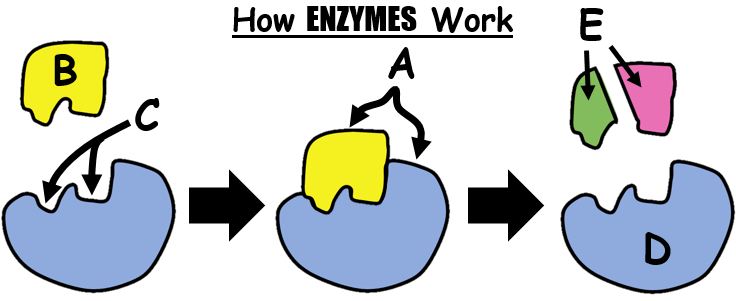
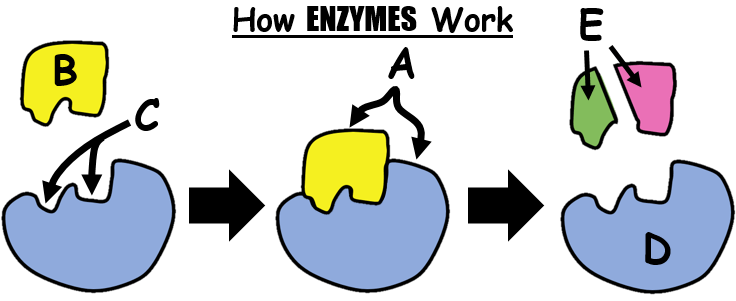
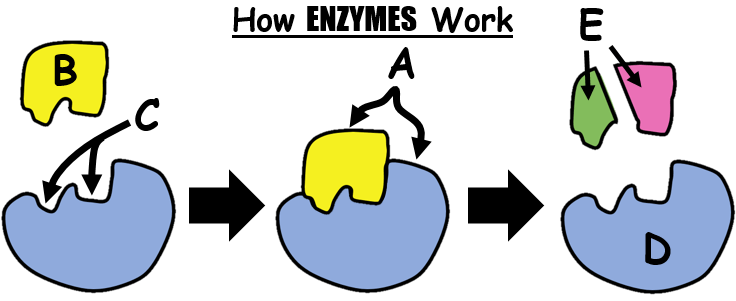
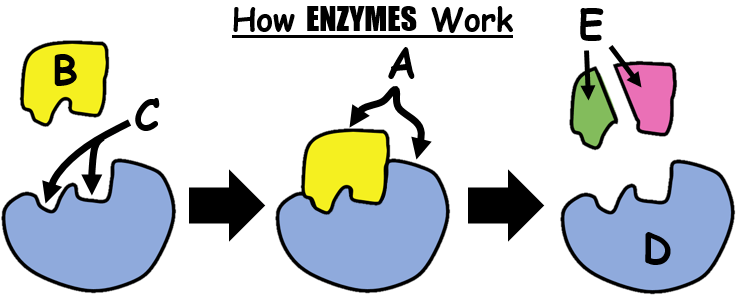
In the diagram, what is letter A? 
a)
product
b)
substrate
c)
enzyme-substrate complex
d)
active site
3.

A substance that speeds up a chemical reaction.
a)
reusable
b)
catalyst
c)
specific
d)
fragile
4.
Letter D...
a)
active site
b)
enzyme
c)
substrate
d)
products
5.
Letter B...
a)
active site
b)
enzyme
c)
substrate
d)
products
6.
Letter E...
a)
active site
b)
enzyme
c)
substrate
d)
products
7.

What happens when enzymes are heated to a high temperature?

a)

The enzymes die.

b)

The shape of the enzyme is changed and it denatures

c)

The enzymes' amino acid sequence changes.

d)

The enzymes remain the same

8.
Enzymes are composed of which of the following monomers? 
a)
amino acids
b)
carbohydrates
c)
nucleotides
d)
monosaccharides
9.
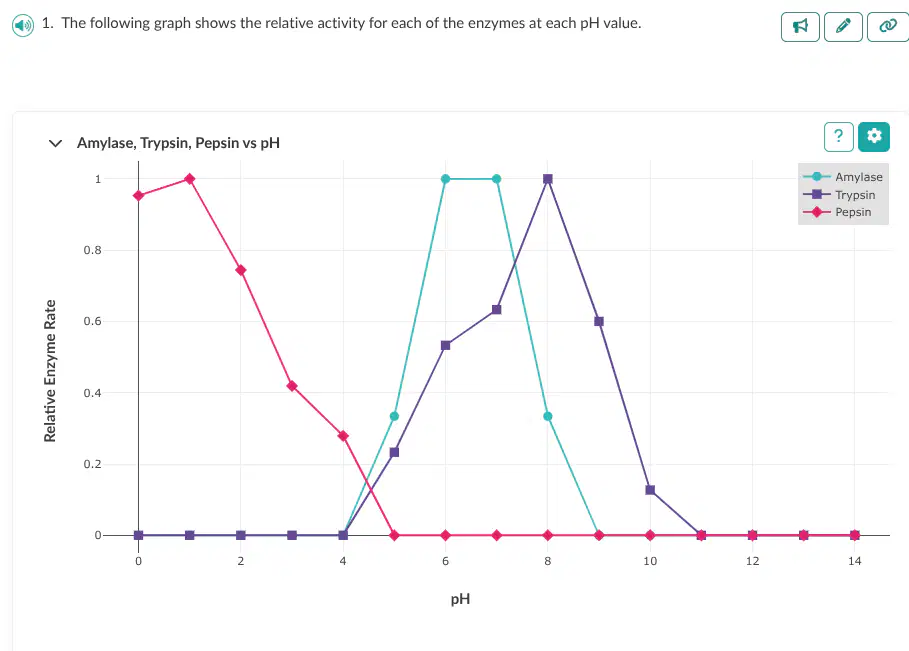
Which of the following conclusions can be drawn from this graph?
a)
The optimum pH of the enzyme is 6.6.
b)
The optimum pH of the enzyme is 5.8
c)
The enzyme’s activity increases as pH increases 5.0 to 9.0
d)
The enzyme’s activity is greater around pH of 8.0 .
10.

What is the pH range for an acid?

a)

0-14

b)

7-14

c)

1-14

d)

less than 7 to zero

e)

greater than 7 to 14

11.

Which enzyme works in the stomach?

a)

Pepsin

b)

Amylase

c)

Trypsin

d)

None of the enzymes liste

12.

Which biomolecule's monomer is this a picture of?

a)
Protein
b)
Nucleic Acid
c)
Lipid
d)
Carbohydrate
13.
The pH scale is a range from:
a)
1-7
b)
0-14
c)
1-5
d)
1-20
14.
If you have a substance with a pH of 7.1 it is a(n).....
a)
Acid
b)
base
15.
What type of cell has a "small" vacuole?
a)
Plant Cell Only
b)
Both Plant and Animal Cells
c)
Animal Cells Only
16.

Which type(s) of cell has a cell membrane?

a)
Plant cells only
b)
Both plant and animal cells
c)
Animal cells only
17.
Identify this structure.
a)
cell wall
b)
cell membrane
c)
sap vacuole
d)
cytoplasm
18.
Number 1 is  a (the) - 
a)
Vacuole
b)
Mitochondria
c)
chloroplast
d)
Nucleus
19.
A ______________ membrane allows only certain substances to enter the cell.
a)
Permeable
b)
Semi-permeable
c)
Non-permeable
20.
Eukaryotes are generally _________ than prokaryotes
a)
smaller
b)
simpler
c)
larger and more complex
d)
thinner and older
21.
Prokaryotes have DNA that is not contained inside a _________.  
a)
ribosome
b)
cell membrane
c)
nucleus
22.
An organism composed of many cells.
a)
cytoplasm
b)
organism
c)
multicellular organism
d)
specialized structures
23.

Which 3 organelles are found in plant but not animal cells?
a)
Cell wall, Ribosomes, Large vacuole
b)
Chloroplasts, Ribosomes, small vacuole
c)
Cell wall, Chloroplasts, small vacuole
d)
Cell wall, Chloroplasts, large vacuole
24.

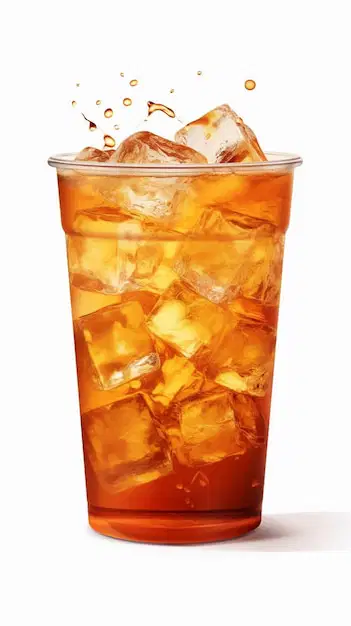
What are the terms for the water and ice tea mix, respectively?

a)

solution, solute

b)

solute, solvent

c)

solvent, solute

d)

solvent, solution

25.

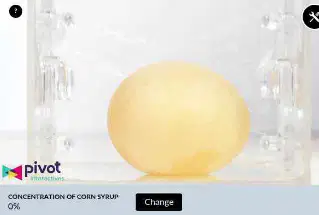
Based on the Pivot Interactive, which of the following would result in the egg having the lowest weight?

a)

Putting the egg into an 80% solution of corn syrup.

b)

Putting the egg into an 20% solution of corn syrup.

c)

Putting the egg into an 50% solution of corn syrup.

d)

Putting the egg into pure water.

26.
A can of air freshener is sprayed in the opposite side of the room.  Ten minutes later you start to smell the scent.  This is an example of 
a)
diffusion
b)
active transport
c)
endocytosis
d)
osmosis
27.

Changes in pH and temperature can damage an enzyme's active site. What is this called?

a)

reusable

b)

catalyst

c)

specific

d)

denaturing

28.
Which of the following is NOT an example of a source of food for protein?
a)
apple
b)
seeds
c)
meat
d)
eggs
29.
The smallest unit of LIFE is a
a)
cell
b)
lysosome
c)
atom
d)
nucleus
30.
What makes an enzyme substrate specific?
a)
Size
b)
Shape
c)
Name
d)
Location it is found in
31.
Where is the DNA found in a prokaryotic cell? 
a)
floating around in the cytoplasm 
b)
in the nucleus 
32.

This category of organisms are all prokaryotes.

a)

animals

b)

bacteria

c)

fungi

33.
Which cell is in a hypertonic environment?
a)
A
b)
B
c)
C
34.

What is the name of the glassware in the picture?

a)

flask

b)

pipette

c)

graduated cylinder

d)

beaker

35.
Question Image

Match the organelle to its description.

a)

Proteins are made on these small structures.

1.

Ribosomes

b)

Controls all activity in the cell and stores DNA

2.

Nucleus

c)

The fluid that fills the cell and

keeps the organelles in place

3.

Cytoplasm

d)

Power plant of the cell. They

create energy called ATP.

4.

Mitochondria

e)

Outer lining of cells.

Controls what goes

in and out.

5.

Cell Membrane

36.
Question Image

Match the following

a)

A

1.

Cell Membrane

b)

J

2.

Golgi Apparatus

c)

D

3.

Vacuole

d)

E

4.

Nucleus

e)

G

5.

Centrioles

37.

What is the main function of the cell membrane?

a)

break down materials

b)

energy transfer

c)

control what goes in and out of cell

d)

genetic coding

38.

Passive Transport is the movement of particles across the membrane from an area of [ ___ ] to an area of [ ___ ]

a)

high to low

b)

low to high

c)

low to low

d)

high to high

39.

Passive Transport uses ____ energy

a)

no

b)

a lot of

c)

a little bit of

d)

some

40.

Based on the following image, the cell is in which type of environment?

a)

Isotonic

b)

Hypertonic

c)

Hypotonic

d)

Equilibrium

41.

Use the illustration of a cell in its environment above to answer the question. Based on the distribution of these molecules, what will most likely happen after a certain amount of time?

a)

The concentration of CO2 will remain the same inside the cell.

b)

The concentration of O2 will remain the same outside the cell.

c)

The concentration of CO2 will decrease outside the cell.

d)

The concentration of O2 will increase inside the cell.

42.
Which way will the water molecules move during osmosis?
a)
Out of the cell, so the cell shrinks.
b)
Out of the cell, so the cell swells.
c)
Into the cell, so the cell shrinks.
d)
Into the cell, so the cell swells.
43.

Based on the Venn diagram, what do the two processes have in common?

a)

Molecules move from high to low concentration.

b)

They require energy to occur.

c)

Molecules move.

d)

Molecules move up the concentration gradient.

44.
What does “B” represent?
a)
hydrophobic tails
b)
hydrophilic tails
c)
hydrophobic heads
d)
hydrophilic heads
45.
The cell below is in a _____________ solution.
a)
Hypertonic
b)
Hypotonic
c)
Isotonic
46.
The picture is an example of...
a)
active tranport
b)
passive transport
c)
diffusion
d)
osmosis
47.
A cell in an isotonic solution will
a)
swell
b)
shrink
c)
stay the same size
d)
impossible to tell
48.

An amoeba uses its pseudopods to surround and 'eat' a paramecium. This is an example of..

a)
Facilitated Diffusion
b)
Simple Diffusion
c)
Exocytosis
d)
Endocytosis
49.
Osmosis is the movement of _____ across a membrane.
a)
food
b)
energy
c)
oxygen
d)
water
50.

Label the following cells by telling whether they are in a hypertonic, isotonic, or hypotonic environment.

51.

What does this symbol mean? [<]

(a)