
 Worksheets
B13 - Coordination and Response
Total questions: 74
Worksheet time: 56mins
Which type of cells do all sense organs contain?
ciliated
effector
mesophyll
receptor
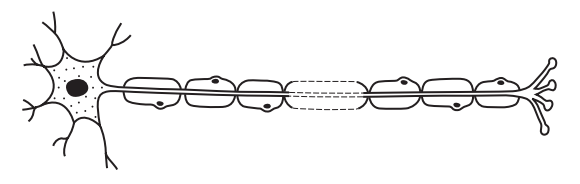
The diagram shows a cell.
What type of cell is shown?
ciliated cell
motor neurone
relay neurone
sensory neurone

The diagram shows a neurone carrying an impulse.
Which row describes the type of neurone and the direction of impulse?
Which choice describes the type of neurone and the direction of impulse?
type of neurone = motor; direction of impulse = towards the spinal cord
type of neurone = motor; direction of impulse = away from the spinal cord
type of neurone = sensory; direction of impulse = towards the spinal cord
type of neurone = sensory; direction of impulse = away from the spinal cord
When a person is frightened, adrenalin is released by the adrenal glands.
What are the effects of the adrenalin?
breathing rate decreased; heart beat rate decreased
breathing rate decreased; heart beat rate increased
breathing rate increased; heart beat rate decreased
breathing rate increased; heart beat rate increased
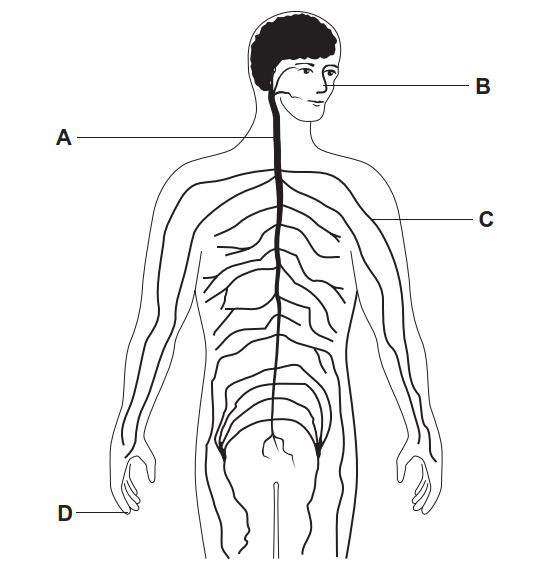
The diagram shows the human nervous system.
Which letter indicates a part of the central nervous system?
A
B
C
D
Which list describes the correct sequence of a simple reflex arc?
A receptor, relay neurone, motor neurone, sensory neurone, effector
B receptor, relay neurone, sensory neurone, motor neurone, effector
C receptor, sensory neurone, motor neurone, relay neurone, effector
D receptor, sensory neurone, relay neurone, motor neurone, effector
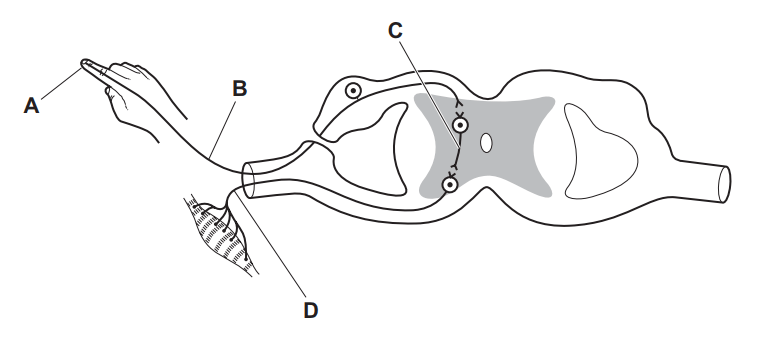
The diagram shows a simple reflex arc.
Which labelled part is the sensory neurone?
A
B
C
D
How can we best describe a nerve impulse?
An electrical signal that passes along nerve cells called neurones
A chemical signal that is transferred to an electrical signal
An electrical charge that travels in nerve endings
Brain's response to an unfavourable change
What is CNS?
Central Neurone System
Brain and spinal cord
Peripheral neurones
Synapses that connect neurones
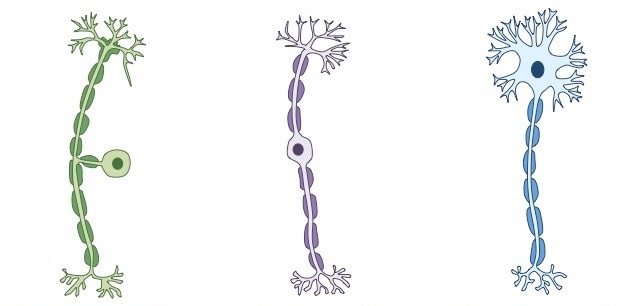
What type of neurone is shown on this picture as green?
Sensory
Relay
Motor
Synapse
What is the main advantage of nervous response over chemical response?
Nervous response is safer
Nervous response lasts longer
Nervous response is unconscious
Nervous response is quicker

A
B
C
D

A
B
C
D

A
B
C
D

A
B
C
D

A
B
C
D
Responses are carried out by organs or tissues known as
Stimulus
Responses
Effectors
Receptor
Insulin is a hormone produced by the ___________________.
liver
bladder
pancreas
heart

What are hormones?
specialized cells that destroy bacteria an viruses
chemical messengers that are produced in one type of tissue and cause changes in another type of tissue.
chemical messengers that are produced in bone marrow that are used to control body function.
specialized cells that control growth and metabolism.
Which of the following are the external stimuli?
Sugar level
Light intensity
Osmotic pressure of blood
Cholesterol level
Which of the following part on a neurone that function in receiving nerve impuls and transmitting them to the cell body...
Node of Ranvier and Dendrites
Dendrites and dendrons
Cell body and Node of Ranvier
Cell body and Dendrons
Which of the following is TRUE about reflex action?
Automatic response
Occurs very slowly
Under concious control
Voluntary action
Which of the following is not a hormone?
answer choices
INSULIN
GLUCOSE
THYROXINE
ADRENALINE
Which hormone is known as the ‘fight or flight’ hormone?
answer choices
GROWTH HORMONE
ADRENALINE
OESTROGEN
ANTIDURETIC HORMONE
When a person is frightened, adrenalin is released by the adrenal glands.
What are the effects of the adrenalin?
breathing rate decreased; heart beat rate decreased
breathing rate decreased; heart beat rate increased
breathing rate increased; heart beat rate decreased
breathing rate increased; heart beat rate increased
breathing rate increased; heart beat rate stays the same
There are two (a) , one above each kidney. They make a hormone called (b) .
When you are (c) , your brain sends impulses along a nerve to your adrenal glands. This makes them (d) adrenaline into the blood.
Match the gland and the hormones secreted by that gland.
Adrenal
Adrenaline
Pancreas
Insulin, glucagon
Ovary
Estrogen
Testes
Testosterone
Complete the Neuron diagram.
Which of these are types of effectors?
Muscles
Organs
Glands
Receptors
The (a) is made up of the brain and the spinal cord
Why are reflexes important?
They are rapid
They don't involve the conscious part of the brain
They are voluntary
They are involuntary
They cause harm

Look at the reflex arc shown in the diagram. Which neurone is marked by the letter X?
Sensory neurone
Motor neurone
Relay neurone
Look at the reflex arc shown in the diagram. Which neurone is marked by the letter Y?
Sensory neurone
Motor neurone
Relay neurone
Cranial nerves, spinal nerves and all the other nerves throughout the body are part of the ______ nervous system.
central
autonomic
somatic
peripheral

Name structure labelled as 2.
dendrite
cell body
axon
myelin sheath
This is a fatty layer that insulates the electrical impulse and increases the speed of impulses going down the axon.
dendrite
cell body
myelin sheath
nodes of Ranvier

Identify neurones A, B, C.
A: sensory, B: motor, C: relay
A: sensory, B: relay, C: motor
A: motor, B: sensory, C: relay
A: relay, B: motor, C: sensory
Where are the light receptors located?
Eye
Ear
Mouth
Nose
A sense organ has lots of _________.
effectors
tissue
mitochondria
receptors

Label 5
(a)
Label 4
(a)
Nerve impulses are:
Electricity
Electrical
Energetic
Electricuted
Reflex actions are rapid because:
They are conscious actions
They involve sensory neurones
They are unconscious actions
They use synapses
What is the function of sensory neurones?
Take nerve impulses from the CNS to skeletal muscle
Take nerve impulses from sensory receptors into the CNS
Link sensory to motor neurones within the CNS
Transmit nerve impulses away from the cell body
The diagram shows a cell.
What type of cell is shown?
ciliated cell
motor neurone
relay neurone
sensory neurone
Where are hormones produced?
Glands
Pancreas
Stomach
Muscles
How do hormones travel to their target organ?
In the digestive system
In the lymphatic system
In the airways
In the blood
What is the name of the system that regulates hormones?
Endocrine System
Circulatory System
Digestive System
Nervous System
What is the name of the response when an animal is in danger?
Dodge and duck
Fast and furious
Fight or flight
Save and survive
Which hormone increases heart rate, breathing rate and dilates your pupils?
Insulin
Saliva
Bile
Adrenaline
The endocrine system sends signals that ___________ than the nervous sysetm
last forever
last longer
last shorter
last night
When does an action caused by a hormone end?
When the hormone is broken down
When the hormone runs out
When the hormone gets to the target organ
When the hormone gets to the gland
A hormone is a chemical substance that ____________.
Raises your heart rate
Alters the activity of a target organ
Increases your breathing rate
Helps you run away
Which hormone is known as the fight or flight hormone?
Adrenaline
Glucagon
Insulin
Glycogen
Which of the following are effects of adrenaline on the body?
Increasing breathing rate
Decreasing pulse rate
Causing radial muscles in the iris to contract
Causing circular muscles in the iris to contract
Causes blood glucose levels to increase
Organize these under the correct hormone
Gland: Pancreas
Target Organ: Liver
Gland: Testis
Target Organ: Male Reproductive organs
Gland: Adrenal Gland
Target Organ: Vital Organs, such as heart, etc.
Controls Puberty in Males
Prepares body for "fight or flight"
Controls Blood Sugar Levels
Which gland produces the hormone insulin?
Pituitary gland
Pancreas
Adrenal gland
Ovary
Which organ is the target for the hormone progesterone?
Kidney
Ovary
Heart
Liver
Which hormone controls puberty and the menstrual cycle in females?
Progesterone
Oestrogen
Adrenaline
ADH
Which organ is the target for the hormone insulin?
Kidney
Heart
Male reproductive organs
Liver
Which type of cells do all sense organs contain?
ciliated
mesophyll
effector
receptor
What is the definition of homeostasis?
Maintaining a stable internal environment despite external changes
The process of producing energy for the body
The ability of the body to change its internal environment
The way the body responds to external stimuli
What is the primary mechanism used in homeostatic control?
Neutral feedback
Positive feedback
Negative feedback
Random feedback
In negative feedback, what happens when a variable deviates from its set point?
The set point is adjusted to match the variable
The variable continues to deviate further from the set point
Mechanisms are activated to return the variable to the set point
No action is taken
Match the following hormones to its function.
adrenaline
prepare for 'fight or flight' response
insulin
lower the glucose level in blood
glucagon
raise the glucose level in blood
testosterone
male secondary sexual characteristics.
HIV is a transmissible disease that may lead to another condition.
What is the name of this condition.
AIDS
Cholera
Obesity
Measles
What happen when you are hot?
Choose ALL that apply.
Sweat glands secrete sweat to cool skin by evaporation.
Shiver: Muscle contractions need more increases heat energy released from respiration.
Hairs lie flat against the skin and move freely to transfer heat to environment by radiation.
Vasodilation - the widening of blood vessels to bringing more blood to sweat glands, more sweat is produced.
Vasoconstriction - the narrowing of blood vessels to reduce blood flows to the skin.

