
Font size
 Worksheets
pre calc 2nd qtr
Total questions: 151
Worksheet time: 3hrs 31mins
distance from the midline of the graph to its
maximum or minimum value. It tells how tall or short the wave
is.
(a)
formula for amplitude
(a)
set of all possible x vals/ y-vals
(a)
graph starts at origin
(a)
graph starts at max or min
(a)
graph that is ahead in terms of the x-axis (sin or cos)
(a)
gen forms
(a)
length of one complete cycle (circle or 360 degrees). tells how long it takes before the pattern repeats
(a)
period formula
(a)
period: The larger the |b| value is, the faster the wave repeats (compressed)
(a)
passes through origin, mother function, continuous and repeats every 360deg, min and max values are 1 and -1
(a)
properties of sine function (y=sinx)
range
(a)
properties of sine function (y=sinx)
odd or even
(a)
properties of sine function (y=sinx)
is periodic, with period
(a)
properties of sine function (y=sinx)
x-ints and y int
(a)
domain: set of all real numbers, range: all real numbers from -1 to1 inclusive, passes through (0,1)
(a)
even function
(a)
phase shift
(a)
phase shift formula
(a)
vertical shift variable
(a)
a positive, what happens to sin(x)
(a)
a negative, what happens to sin(x)
(a)
a positive, what happens to cos(x)
(a)
a negative, what happens to cos(x)
(a)
how to plot points
(a)
when c and d present
min value formula
(a)
when c and d present
max value formula
(a)
end of 1 cycle(4th point) =
(a)
phase shift is equal to the _ point
(a)
values need to be found (7)
(a)
if y=sin/cos(bx+c)+d
(a)
positive acute angle formed by the terminal
side of the given angle and the x-axis.
(a)
measure of ref angle at q1
(a)
measure of ref angle at q2
(a)
measure of ref angle at q3
(a)
measure of ref angle at q4
(a)
if ref angle > 360, find
(a)
If θ is -
θ* + 360
θ + 180
180 + θ*
θ*
(a)

measure of a central angle subtended by an arc of a circle equal to the radius of the circle
(a)
circumference of a circle
(a)
degrees to radians
(a)
radians to degrees
(a)
radians to degrees and vice versa what to remember
the one in the bottom must be canceled by what's on top. if deg to rad, degrees must be canceled. if rad to deg, pi must be canceled
(a)
radius of a unit circle
(a)
If θ is an angle in
standard position whose
terminal side intersects
the unit circle at (x,y),
then
(a)
Since the unit circle has
radius 1, the values of x and
y can range from -1 to 1.
That is,
-1 ≤ cos θ ≤ 1 and -1 ≤ sin θ
≤ 1
(a)
the union of two rays with a common endpoint, the vertex of the
(a)
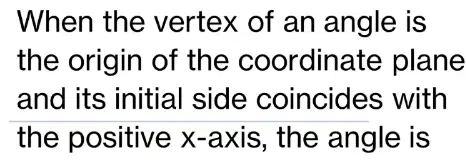
(a)
are angles in
standard position whose terminal sides
coincide.
(a)
coterminal angles
(a)
counterclock
clock
(a)
hand trick
sin
(a)
hand trick
cos
(a)
hand trick
tan
(a)
in finding the equivalent of special angles on other quadrants. it must be the result or the theta prime (θ') ex
60=360-θ
300=θ
(a)
hand trick
2nd and 3rd q
1st and 4th q
(a)
Function whose domain is a set of positive integers (infinite) or first n positive integers (finite)
(a)
An ordered countable set where
Order of elements is important
Elements can repeat
(a)
Member of a sequence is called a
(a)
Sum of all terms in a sequence
Value is always a single number
(a)
Sequence in which each term is obtained by adding a common difference to previous term
(a)
a1+(n-1)d
(a)
arithmetic series
(a)
Sequence in which each term after the first is obtained by multiplying a common ratio by preceding term
(a)
geometric seq formula
(a)
geometric series formula finite
(a)
Uppercase greek letter “s” used with other notations to represent a sum
(a)

(a)
defines each term in relation to the previous term(s
(a)
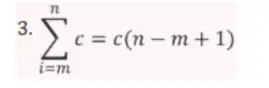
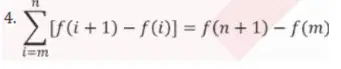
a series where the terms in each partial sum cancel out, leaving only the first and last terms.
(a)

(a)

(a)
(a)
(a)
binomial theorem, these numbers are...
1
1 1
1 2 1
1 3 3 1
1 4 6 4 1
1 5 10 10 5 1
(a)
binomial theorem
values increase on right side
values increase on left side
(a)
- 0* < θ < 90*
(a)
- 90* < θ < 180*
(a)
θ = 180
(a)
180* < θ < 360*
(a)
an angle in standard position whose terminal side lies on one of the coordinate axes (x-axis or y-axis)
(a)
study of
geometric figures using the cartesian
coordinate system, linking algebraic
equations with geometric curves.
(a)
René Descartes and Pierre de Fermat
independently developed Analytic geometry in the 1630s
t or f
(a)
a curve formed by the intersection of a plane with a cone.
(a)
A cone is
the surface generated by a line (called
the []), through a fixed point (called
the []),by rotating it around the
circumference of a circle that does not lie on the
same plane as the vertex.
(a)
obtained when the
cutting plane is parallel to the
plane of the circle used to
generate the cone.
(a)
obtained by
intersecting the cone with a
plane that is parallel to exactly
one position of the generator.
It intersects only one nappe of
the cone.
(a)
obtained when the plane
intersects all positions of the generator
on side of the vertex. It intersects only
one nappe of the cone.
(a)
[] ellipses are circles
(a)
obtained by cutting the
cone with a plane that intersects both
nappes of the cone. it has 2
branches.
(a)
set of points on a plane that
are at a fixed distance from
a fixed point. The fixed
point is called the center,
and the fixed distance is
the radius.
(a)
standard form of circle
(a)
how to get radius of circle
(a)
general form of the
equation of the circle.
(a)
distance formula
(a)
midpoint formula
(a)
slope formula
(a)
standard -> gen form circle
(a)
h =
(a)
k =
(a)
E =
(a)
defined to be the set of points on the plane such that
the sum of its distances from two fixed points is constant. The two
fixed points are called the foci.
(a)
The [] is the midpoint between the two foci and is the point
about which the ellipse is symmetrically shaped.
(a)
The two fixed points inside the ellipse such that the
sum of the distances from any point on the ellipse to them is constant.
(a)
The longest diameter of the ellipse that passes through both foci
and the center.
(a)
The shortest diameter of the ellipse that passes through the
center and is perpendicular to the major axis.
(a)
The endpoints of the major axis, representing the farthest
points of the ellipse from the center along that axis.
(a)
The endpoints of the minor axis, representing the
farthest points of the ellipse from the center along that axis.
(a)
A line segment perpendicular to the major axis that
passes through a focus and whose endpoints lie on the ellipse.
(a)
standard form of ellipse
major axis horizontal
(a)
standard form of ellipse
major axis vertical
(a)
line through the foci of an ellipse is called its [] it may be x or y axis
(a)
denotes the distance from the center to a vertex
(a)
denotes the distance from the center to a co-vertex
(a)
conditions for a and b
(a)
focal dist eq
(a)
latus rectum formula
(a)
eccentricity formula
(a)
a set of points on a plane that are equidistant from a fixed point and a fixed line.
(a)
Turning point of parabola
(a)
Vertical or horizontal line that passes through vertex of parabola and divides it into two mirror-image halves
(a)
Fixed point inside the parabola that, together with the directrix, defines the curve
(a)
A fixed horizontal or vertical line outside the parabola, used to define the curve
(a)
Line segment perpendicular to the axis of symmetry, which passes through the focus, and whose endpoints is on the parabola
(a)
Latus rectum formula
(a)
(x-h)^2=4a(y-k) direction
(a)
(x-h)^2=-4a(y-k) direction
(a)
(y-k)^2=4a(x-h) direction
(a)
(y-k)^2=-4a(x-h) direction
(a)
Plane intersects cone at an angle
(a)
Plane parallel to base of cone
Plane cuts perpendicularly to the base of a cone
Plane parallel to slanting height or generatrix of cone
(a)
Why is a circle a special kind of ellipse
(a)
Relationship between a,b,c in ellipse and how is it found
(a)
Relationship between a,b,c in HYPERBOLA and how is it found
(a)
Formula for foci in ellipse
(a)
Formula for foci In hyperbola
(a)
Line intersects circle at 1 pt
Line intersects 2 pts on the circle (line outside and inside)
Line intersects 2 pts on the circle(inside)
(a)
Gen form of conic sec
(a)
diff between ellipse and hyperbola
(a)
If the coeffs of x and y in a conic sect are the same, its a circle
(a)
Major axis of ellipse(same with hyperbola counterpart) - 2a
Minor axis of ellipse - 2b
(a)
The box in hyperbola must be drawn using the vertices and covertices
(a)
in ellipse, if a below x-h, it horizontal
if a below y-k, it vertical
(a)
in hyperbola, if a below x-h, it left-right
if a below y-k, it up-down
(a)
Transverse Axis: The line segment that passes through the center and
vertices of the hyperbola. It is the axis along which the hyperbola opens.
Conjugate Axis: The line segment perpendicular to the transverse axis that
also passes through the center. It helps form the “box” used to draw
asymptotes.
(a)
how open/flat the hyperbola is
e = c/a where e > 1
(a)
the [] of the distances of the foci is constant
(a)
Major axis of ellipse(same with hyperbola counterpart) - 2a
Minor axis of ellipse - 2b
(a)
Chord length formula
(a)
Sq root -> decimal formula
(a)
Circumference of circle
(a)

