
 Worksheets
Core-Power and Authority Revision
Total questions: 141
Worksheet time: 1hrs 11mins

What was the name of the coal fields lost by Germany?
Saar
Alsace
Rhineland
Loraine
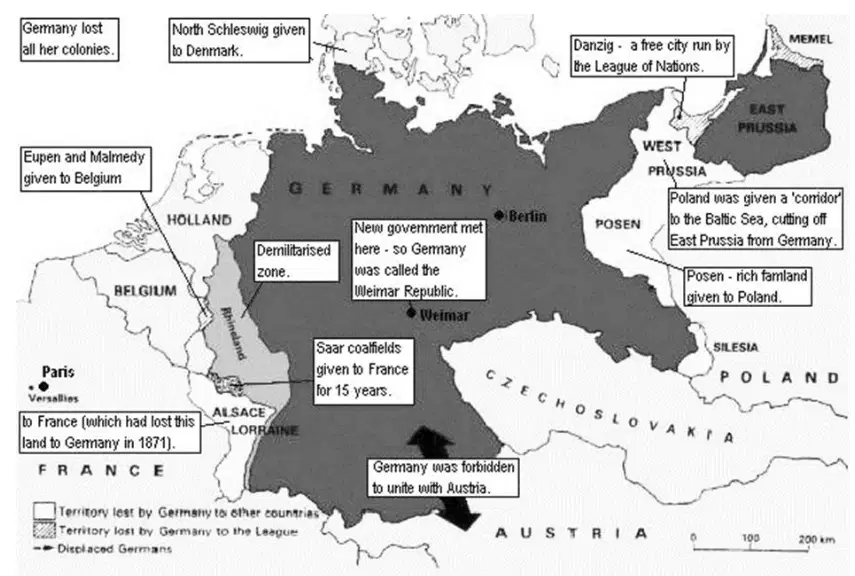
Which of the following was not an outcome of the Treaty of Versailles?
Austria remained part of Germany
Rhineland became a demilitarised zone
Parts of Germany went to Poland
France regained Alsace Loraine
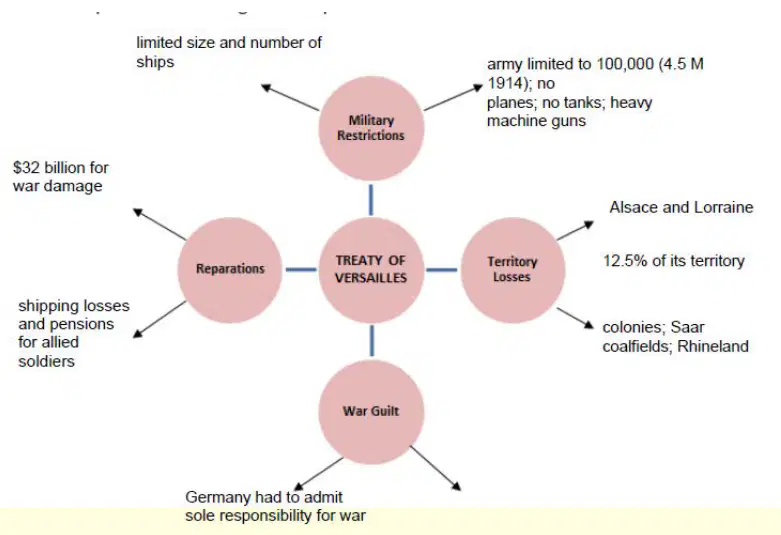
Which of the following was not an outcome of the Treaty of Versailles?
German army limited to 1 million
Germany had to pay $32B
Germany had to admit guilt
Germany lost 12.5% of its territory.

Match the treaty with the country: Trianon
Turkey
Bulgaria
Austria
Hungary

Match the treaty with the country: St Germain
Turkey
Bulgaria
Austria
Hungary

Match the treaty with the country: Sevres
Turkey
Bulgaria
Austria
Hungary

Match the treaty with the country: Neuilly
Turkey
Bulgaria
Austria
Hungary
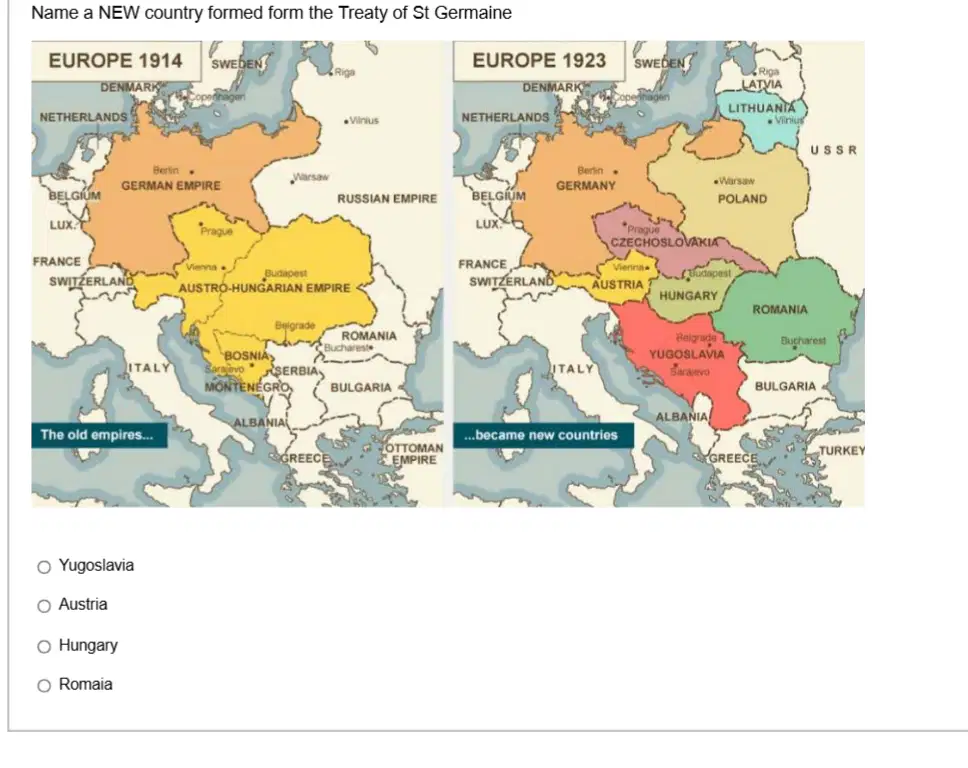
Name a NEW country formed form the Treaty of St Germaine
Yugoslavia
Austria
Hungary
Romaia
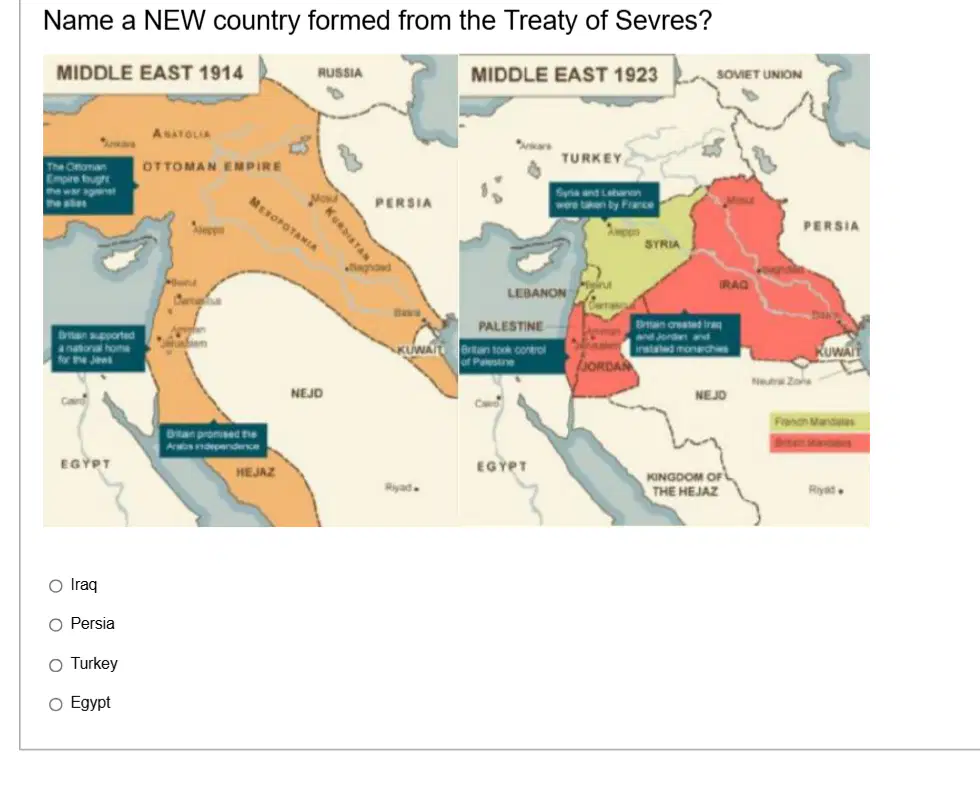
Name a NEW country formed from the Treaty of Sevres?
Iraq
Persia
Turkey
Egypt

Which of the following was not a consequence of the post-war treaties?
The treaties were popular
New nations were formed
Many ethnic minorities were trapped in new nations
New democratic constitutions were written
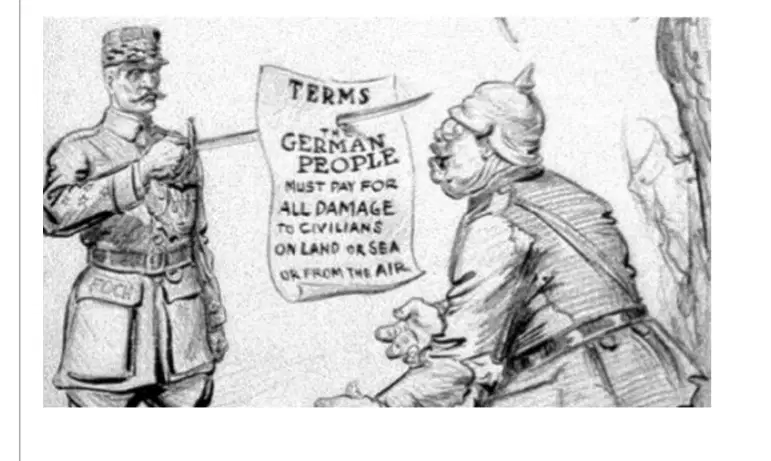
Based on the source showing a poster that reads "Terms: German people must pay for all damage to civilians on land or sea or from the air," to what extent does this source provide evidence that the Treaty of Versailles was aiming to punish German?
It shows the treaty aimed to punish Germany through harsh reparations on civilians’ damages.
It shows the treaty aimed to reward Germany with territorial gains and reduced payments.
It suggests the treaty was mainly about reconciliation with no significant penalties.
It indicates the treaty focused only on disarmament without financial responsibilities.
Match the article to the aim of the League of Nations. Article 12 stated that arbitration (an independent mediator finds a solution to conflict) should be provided between nations in conflict. Which aim best matches Article 12?
trade bans
collective security
finding a solution to conflict between nations
disarmament
Match the article to the aim of the League of Nations. Article 8 stated that nations should work towards disarmament. Which aim best matches Article 8?
trade bans
collective security
finding a solution to conflict between nations
disarmament
Match the article to the aim of the League of Nations. Article 16 stated that economic sanctions (penalties such as a trade ban) could be imposed on an aggressor nation. Which aim best matches Article 16?
trade bans
collective security
finding a solution to conflict between nations
disarmament
Match the article to the aim of the League of Nations. Article 10 (Collective Security provision) stated that if a member is attacked then other members of the League can assist that member. Which aim best matches Article 10?
trade bans
collective security
finding a solution to conflict between nations
disarmament
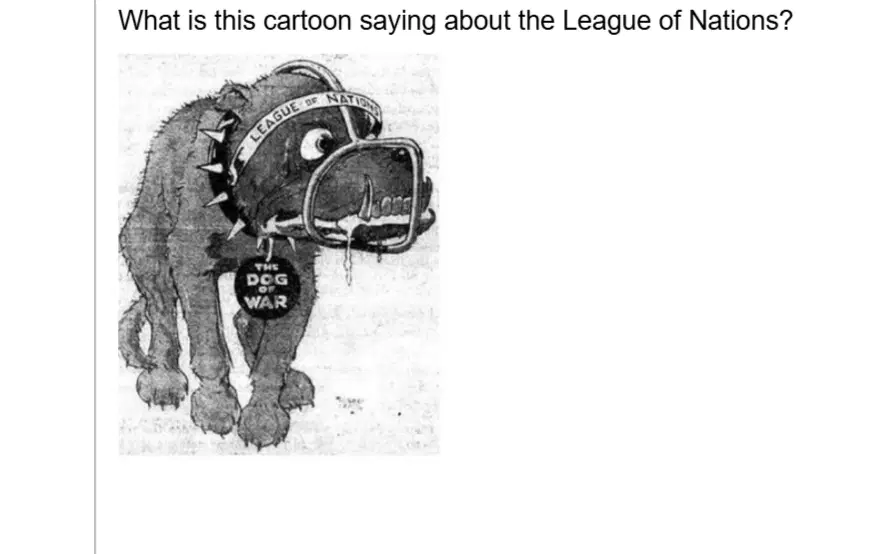
What is this cartoon saying about the League of Nations? The cartoon shows a muzzled dog labeled "The Dog of War" being restrained by headgear labeled "League of Nations." What idea about the League is suggested by this image?
It restrains war by controlling aggressive instincts.
It is powerless and easily ignored by aggressors.
It encourages countries to go to war.
It attacks smaller states to expand its power.
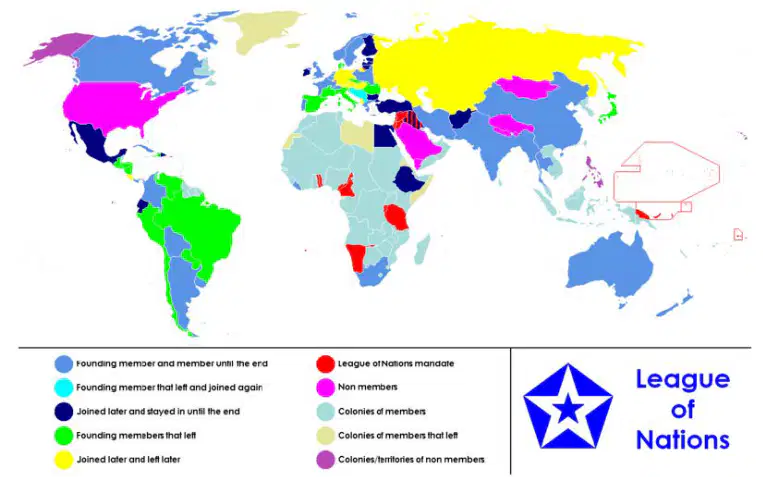
Look at the map of League of Nations membership and status. Which of the following were obstacles to the League’s ability to establish global peace? Select all that apply.
The USA never joined the League.
Membership was unstable, with many states leaving or joining later.
Significant parts of the world were non-members.
Every major power was a consistent member from start to finish.
The League commanded a global standing army shown on the map.
Fill in the blank: Germany was not invited to join. The Germans saw the League as a "League of ____" policing an unjust peace.
minorities
victors
members
neutrals
Fill in the blank: The League found it difficult to enforce its decisions as they were non-____ on its members.
binding
partisan
military
financial
Fill in the blank: The League did not have any ____ forces to deploy.
naval
armed
colonial
reserve
Fill in the blank: In addition to this, the globe’s most powerful state, the ____, was not a member.
USA
Britain
France
Japan
Fill in the blank: The various ethnic ____ in the new states of Europe got very little support from the League of Nations so they sought help from ____ instead.
majorities … Japan
minorities … Hitler
colonizers … Italy
refugees … the USA
Fill in the blank: There were a number of acts of ____ from member states which the League was unable or unwilling to stop.
appeasement
aggression
neutrality
mandate
Fill in the blank: ____ occupied a part of China called Manchuria in 1931 (Japan withdrew from the League in 1933).
Italy
Germany
Japan
Britain
Fill in the blank: ____ invaded Abyssinia (modern-day Ethiopia) in 1935.
Italy
France
Japan
Poland
Fill in the blank: In 1936 Hitler reoccupied the Rhineland (____ zone under Versailles).
mandated
demilitarised
neutral
occupied
Fill in the blank: The League condemned these actions and often imposed ____ but the need for unanimous support on the Council for any action often meant the League was ____ in taking action and any response was often halfhearted.
sanctions … slow
mandates … swift
elections … cautious
alliances … decisive
What is totalitarianism? Word bank: independent; terror; control; state; ideology; economy; party. Choose the word that best completes the statement: the needs of the ____ are more important than individual rights.
state
party
economy
ideology
What is totalitarianism? Word bank: independent; terror; control; state; ideology; economy; party. Choose the word that best completes the statement: a single ____ led by a charismatic leader.
party
state
economy
ideology
What is totalitarianism? Word bank: independent; terror; control; state; ideology; economy; party. Choose the word that best completes the statement: a set of ideas (____) that all must follow.
ideology
party
state
economy
What is totalitarianism? Word bank: independent; terror; control; state; ideology; economy; party. Choose the word that best completes the statement: State (government) ____ over communication and cultural practises.
control
terror
party
independent
What is totalitarianism? Word bank: independent; terror; control; state; ideology; economy; party. Choose the word that best completes the statement: State control over the ____.
economy
party
state
ideology
What is totalitarianism? Word bank: independent; terror; control; state; ideology; economy; party. Choose the word that best completes the statement: State use of ____ and repression (control/ silence/ suppress/oppres people).
terror
control
party
independent
What is totalitarianism? Word bank: independent; terror; control; state; ideology; economy; party. Choose the word that best completes the statement: no ____ judiciary (judges and legal system).
independent
state
party
economy
The Conditions That Enabled Dictators to Rise to Power in the Inter war Period. Word bank: strong; punitive; reparation; mobilise; violence; unemployment; unstable; controlled; vacuum; vote. Choose the word that best completes the statement: War normalised ____ and the political leaders promoting dictatorships used violence to defeat their opponents.
violence
mobilise
vote
vacuum
The Conditions That Enabled Dictators to Rise to Power in the Inter war Period. Word bank: strong; punitive; reparation; mobilise; violence; unemployment; unstable; controlled; vacuum; vote. Choose the word that best completes the statement: People had become used to having their lives ____ as a consequence of total war.
controlled
unstable
mobilise
vote
The Conditions That Enabled Dictators to Rise to Power in the Inter war Period. Word bank: strong; punitive; reparation; mobilise; violence; unemployment; unstable; controlled; vacuum; vote. Choose the word that best completes the statement: Radical nationalist groups used opposition to the ____ treaties to gain followers.
punitive
reparation
unstable
vote
The Conditions That Enabled Dictators to Rise to Power in the Inter war Period. Word bank: strong; punitive; reparation; mobilise; violence; unemployment; unstable; controlled; vacuum; vote. Choose the word that best completes the statement: The collapse of authoritarian monarchies left a political ____.
vacuum
vote
strong
mobilise
The Conditions That Enabled Dictators to Rise to Power in the Inter war Period. Word bank: strong; punitive; reparation; mobilise; violence; unemployment; unstable; controlled; vacuum; vote. Choose the word that best completes the statement: The extension of the right to ____ encouraged the participation of masses of people in politics.
vote
mobilise
controlled
reparation
The Conditions That Enabled Dictators to Rise to Power in the Inter war Period. Word bank: strong; punitive; reparation; mobilise; violence; unemployment; unstable; controlled; vacuum; vote. Choose the word that best completes the statement: Political parties sought to ____ these people in their quest for power.
mobilise
vote
strong
vacuum
The Conditions That Enabled Dictators to Rise to Power in the Inter war Period. Word bank: strong; punitive; reparation; mobilise; violence; unemployment; unstable; controlled; vacuum; vote. Choose the word that best completes the statement: Proportional representation led to ____ governments with variety of opinions represented in parliament.
unstable
controlled
punitive
violence
The Conditions That Enabled Dictators to Rise to Power in the Inter war Period. Word bank: strong; punitive; reparation; mobilise; violence; unemployment; unstable; controlled; vacuum; vote. Choose the word that best completes the statement: This led to the desire for a "____ man" to restore order.
strong
punitive
controlled
vacuum
The Conditions That Enabled Dictators to Rise to Power in the Inter war Period. Word bank: strong; punitive; reparation; mobilise; violence; unemployment; unstable; controlled; vacuum; vote. Choose the word that best completes the statement: The European economies were ruined by the war and the defeated powers were further burdened by ____ payments.
reparation
unemployment
punitive
vote
The Conditions That Enabled Dictators to Rise to Power in the Inter war Period. Word bank: strong; punitive; reparation; mobilise; violence; unemployment; unstable; controlled; vacuum; vote. Choose the word that best completes the statement: The Great Depression of 1929-32 led to massive ____ , further sustaining the idea of a "strong man" restoring order.
unemployment
violence
reparation
vacuum
All the following statements refer to features of either Mussolini's, Hirohito's, or Stalin's dictatorship, or features common to all. Identify the country or countries that the statement best describes: There was a strong nationalist movement behind this country's dictator.
Italy and Japan
Russia and Japan
Russia and Italy
All of them
All the following statements refer to features of either Mussolini's, Hirohito's, or Stalin's dictatorship, or features common to all. Identify the country or countries that the statement best describes: There was a strong Cult of Personality around the leader in this country.
Italy and Japan
Italy and Russia
Russia and Japan
All of them
All the following statements refer to features of either Mussolini's, Hirohito's, or Stalin's dictatorship, or features common to all. Identify the country or countries that the statement best describes: Violent attacks on opponents was a common feature of the supporters in this dictator's country.
Italy and Japan
Italy and Russia
All of them
Russia and Japan
All the following statements refer to features of either Mussolini's, Hirohito's, or Stalin's dictatorship, or features common to all. Identify the country or countries that the statement best describes: This dictator's country pursued territorial expansion.
All of them
Italy and Russia
Italy and Japan
Russia and Japan
All the following statements refer to features of either Mussolini's, Hirohito's, or Stalin's dictatorship, or features common to all. Identify the country or countries that the statement best describes: It was a dictatorship of the military in this country rather than one man.
Italy
Japan
Russia
All the following statements refer to features of either Mussolini's, Hirohito's, or Stalin's dictatorship, or features common to all. Identify the country or countries that the statement best describes: This dictator's country was angry about the Treaty of Versailles.
Japan and Russia
Italy and Russia
Italy and Japan
All of them
All the following statements refer to features of either Mussolini's, Hirohito's, or Stalin's dictatorship, or features common to all. Identify the country or countries that the statement best describes: The dictator in this country had violent supporters known as Blackshirts.
Japan
Russia
Italy
All the following statements refer to features of either Mussolini's, Hirohito's, or Stalin's dictatorship, or features common to all. Identify the country or countries that the statement best describes: This dictator of this country went to considerable lengths to indoctrinate the youth.
Italy and Japan
Italy and Russia
Japan and Russia
All of them
All the following statements refer to features of either Mussolini's, Hirohito's, or Stalin's dictatorship, or features common to all. Identify the country or countries that the statement best describes: The emergence of an economic crisis in this country led to the rise of a dictator.
Italy and Japan
Italy and Russia
Russia and Japan
All of them
All the following statements refer to features of either Mussolini's, Hirohito's, or Stalin's dictatorship, or features common to all. Identify the country or countries that the statement best describes: In this country, the dictator's government had total control of the economy.
Japan
Italy
Russia
All of them
All the following statements refer to features of either Mussolini's, Hirohito's, or Stalin's dictatorship, or features common to all. Identify the country or countries that the statement best describes: In this country, the dictator made sure all cultural pursuits supported him.
Italy and Japan
Italy and Russia
Russia and Japan
All of them
Match the left-hand side with the right-hand side: German sailors mutiny and establish socialist soviet (council). Choose the correct match.
Weimar
Kiel
Social Democratic Party
Spartacus Union
Kapp Putsch
Match the left-hand side with the right-hand side: Site of new government in Germany following abdication of the Kaiser. Choose the correct match.
Weimar
Kiel
Article 48
Rosa Luxemburg
Free Corps
Match the left-hand side with the right-hand side: First post-Kaiser government led by this party. Choose the correct match.
Social Democratic Party
Spartacus Union
Kapp Putsch
Weimar
Proportional representation
Match the left-hand side with the right-hand side: anti-communist ex-soldiers known for violence. Choose the correct match.
Freikorps
Spartacus Union
Kiel
Rosa Luxemburg
Article 48
This party tried to stage a communist uprising in 1919. Choose the correct match.
Spartacus Union
Social Democratic Party
Kapp Putsch
Weimar
Proportional representation
Spartacus Union leader murdered by Free Corp. Choose the correct match.
Rosa Luxemburg
Article 48
Kiel
Social Democratic Party
Weimar
Election system where the numbers of politicians elected for a party is tied to the percentage of their vote. Choose the correct match.
Proportional representation
Article 48
Kapp Putsch
Free Corps
Kiel
A law that allowed the German president to rule by decree if parliament couldn't reach a decision. Choose the correct match.
Article 48
Proportional representation
Weimar
Free Corps
Rosa Luxemburg
Freikorp people entered Berlin and proclaimed a new government in 1920. Choose the correct match.
Kapp Putsch
Weimar
Kiel
Spartacus Union
Social Democratic Party
French and Belgian troops occupied this area because Germany was not meeting reparations payments. Choose the correct match.
The Ruhr
Reichstag
SS (Schutzstaffel)
25 Point Program
hyperinflation
Germans respond to occupation of Ruhr by. Choose the correct match.
passive resistance
Munich Beer Hall Putsch
Peoples' Observer (Volkischer Beobachter)
Reichstag
hyperinflation
1923 economic crisis in Germany, where the value of money crashed. Choose the correct match.
hyperinflation
The Ruhr
Reichstag
SS (Schutzstaffel)
25 Point Program
Nazi rebellion in 1923 over the German government's decision to accept the occupation of the Ruhr. Choose the correct match.
Munich Beer Hall Putsch
The Ruhr
passive resistance
Peoples' Observer (Volkischer Beobachter)
Brown shirts (SA) or Storm Troopers (Sturmabteilung)
Newspaper of Nazi Party. Choose the correct match.
Peoples' Observer (Volkischer Beobachter)
Reichstag
SS (Schutzstaffel)
25 Point Program
hyperinflation
Nazi street fighters. Choose the correct match.
Brown shirts (SA) or Storm Troopers (Sturmabteilung)
SS (Schutzstaffel)
Reichstag
The Ruhr
25 Point Program
German parliament. Choose the correct match.
Reichstag
The Ruhr
Peoples' Observer (Volkischer Beobachter)
hyperinflation
SS (Schutzstaffel)
Hitler's Protection Squad. Choose the correct match.
SS (Schutzstaffel)
Brown shirts (SA) or Storm Troopers (Sturmabteilung)
Reichstag
The Ruhr
25 Point Program
Nazi party policies. Choose the correct match.
25 Point Program
Reichstag
Peoples' Observer (Volkischer Beobachter)
The Ruhr
hyperinflation
Fill in the blanks using the word bank: Word bank — army; work; race; lebensraum; land; government; Versailles; health; Jews; greater. Extract from Nazi 25 Point Program: All Germans to live in one ______ Germany.
greater
land
government
race
Versailles
Fill in the blanks using the word bank: Word bank — army; work; race; lebensraum; land; government; Versailles; health; Jews; greater. Extract from Nazi 25 Point Program: End ______ Treaty.
Versailles
greater
government
health
army
Fill in the blanks using the word bank: Word bank — army; work; race; lebensraum; land; government; Versailles; health; Jews; greater. Extract from Nazi 25 Point Program: More land (living space) ______.
lebensraum
land
government
race
greater
Fill in the blanks using the word bank: Word bank — army; work; race; lebensraum; land; government; Versailles; health; Jews; greater. Extract from Nazi 25 Point Program: Only people of German blood can be a citizens excluding ______.
Jews
race
army
government
health
Fill in the blanks using the word bank: Word bank — army; work; race; lebensraum; land; government; Versailles; health; Jews; greater. Extract from Nazi 25 Point Program: Everyone must ______.
work
obey
health
race
land
Fill in the blanks using the word bank: Word bank — army; work; race; lebensraum; land; government; Versailles; health; Jews; greater. Extract from Nazi 25 Point Program: Confiscation of "Jewish" ______ for the public good.
land
health
government
greater
army
Fill in the blanks using the word bank: Word bank — army; work; race; lebensraum; land; government; Versailles; health; Jews; greater. Extract from Nazi 25 Point Program: Protection of the ______ of the mother and child and encouraging fitness.
health
race
work
land
government
Fill in the blanks using the word bank: Word bank — army; work; race; lebensraum; land; government; Versailles; health; Jews; greater. Extract from Nazi 25 Point Program: Formation a national ______.
army
government
race
land
work
Fill in the blanks using the word bank: Word bank — army; work; race; lebensraum; land; government; Versailles; health; Jews; greater. Extract from Nazi 25 Point Program: The needs of the ______ are more important than individual needs.
race
government
Jews
army
land
Fill in the blanks using the word bank: Word bank — army; work; race; lebensraum; land; government; Versailles; health; Jews; greater. Extract from Nazi 25 Point Program: A strong central ______.
government
army
work
health
greater
German economy improves when reparation payments rescheduled
Dawes Plan
Stresseman
Heinrich Bruning.
Nazi
Chancellor who oversaw improvements in German economy
Stresseman
Heinrich Bruning.
Nazi
Adolf Hitler
5.5 million Germans unemployed during this period
Great Depression of 1929
Heinrich Bruning.
Nazi
Adolf Hitler
The person who came second to Hindenburg in presidential elections of 1932
Adolf Hitler
Stresseman
Heinrich Bruning.
Unpopular chancellor during Great Depression
Heinrich Bruning.
Adolf Hitler
Stresseman
Colour most used in Nazi election posters
red
black
white
Chancellor Bruning dismissed after he tried to ban the ...
SA
Nazi
Communists
Which political party doubled their vote in 1932
Nazi
Communists
Social Democrats
Match left-hand side with right-hand side: Decree that gave Hitler emergency powers in 1933 and suspended civil liberties indefinitely.
The decree 'For the Protection of the People and State'
The Enabling Act
Reich Press Laws
The Night of the Long Knives
Match left-hand side with right-hand side: Another name for the Reichstag Fire Decree.
The Reichstag Fire Decree
The decree 'For the Protection of the People and State'
Reich Press Laws
The Enabling Act
Match left-hand side with right-hand side: Main targets for arrest following Reichstag Fire Decree.
Fuhrer
Communists
Labour Front
Dachau
Match left-hand side with right-hand side: Concentration camp set up to imprison Nazi opponents.
Dachau
Labour Front
The Night of the Long Knives
Ernst Rohm
Match left-hand side with right-hand side: Law giving Hitler dictatorial powers.
Reich Press Laws
The Enabling Act
Labour Front
Fuhrer
Match left-hand side with right-hand side: Nazi organisation formed after trade unions banned.
The Reichstag Fire Decree
Labour Front
Communists
Ernst Rohm
Match left-hand side with right-hand side: Allowed Hitler to censor newspapers.
Reich Press Laws
The Enabling Act
The Night of the Long Knives
Fuhrer
Match left-hand side with right-hand side: Leader of SA.
Ernst Rohm
Fuhrer
Labour Front
Dachau
Match left-hand side with right-hand side: Hitler organises the murder of unruly elements in the SA.
The Reichstag Fire Decree
The Enabling Act
The Night of the Long Knives
Reich Press Laws
Match left-hand side with right-hand side: Meaning leader.
Fuhrer
Communists
Labour Front
Dachau
Match left-hand side with right-hand side: Head of Hitler Youth.
Schirach
Himmler
Goering
Speer
Match left-hand side with right-hand side: Second most powerful Nazi.
Goebbels
Goering
Hess
Ribbentrop
Match left-hand side with right-hand side: Created the Hitler Myth.
Goebbels
Riefenstahl
Heydrich
Speer
Match left-hand side with right-hand side: Introduced Strength Through Joy.
Ley
Hess
Himmler
Ribbentrop
Match left-hand side with right-hand side: Hitler's film maker.
Riefenstahl
Goebbels
Speer
Schirach
Match left-hand side with right-hand side: Head of the SD.
Heydrich
Himmler
Goering
Ribbentrop
Match left-hand side with right-hand side: Hitler's architect.
Speer
Goebbels
Hess
Ley
Match left-hand side with right-hand side: In charge of all German police.
Himmler
Goering
Schirach
Ribbentrop
Match left-hand side with right-hand side: Third most powerful Nazi.
Hess
Goebbels
Ribbentrop
Schirach
Match left-hand side with right-hand side: Foreign Minister.
Ribbentrop
Goering
Goebbels
Himmler
Fill in the blanks from the word bank. Word Bank: Marxists; Aryans; greater; living; authoritarian; Fuhrerprinzip; people's; eliminated; pure; Mein; The Nature of Nazi ideology: Hitler's main ideas and objectives are outlined in _____ Kampf.
Mein
Aryans
Fuhrerprinzip
people's
Fill in the blanks from the word bank. Word Bank: Marxists; Aryans; greater; living; authoritarian; Fuhrerprinzip; people's; eliminated; pure; Mein; The Nature of Nazi ideology: Hitler wanted build a racially _____ Germany.
pure
greater
authoritarian
people's
Fill in the blanks from the word bank. Word Bank: Marxists; Aryans; greater; living; authoritarian; Fuhrerprinzip; people's; eliminated; pure; Mein; The Nature of Nazi ideology: Germany made up of mythical _____, in his view the most superior people on earth.
Aryans
Marxists
people's
Mein
Fill in the blanks from the word bank. Word Bank: Marxists; Aryans; greater; living; authoritarian; Fuhrerprinzip; people's; eliminated; pure; Mein; The Nature of Nazi ideology: The ideal Nazi society was to be a class less ' _____ community' or Volksgemeinschaft.
people's
greater
authoritarian
living
Fill in the blanks from the word bank. Word Bank: Marxists; Aryans; greater; living; authoritarian; Fuhrerprinzip; people's; eliminated; pure; Mein; The Nature of Nazi ideology: Government would be _____.
authoritarian
greater
living
people's
Fill in the blanks from the word bank. Word Bank: Marxists; Aryans; greater; living; authoritarian; Fuhrerprinzip; people's; eliminated; pure; Mein; The Nature of Nazi ideology: All decisions would be made by a single leader whose orders would be obeyed (the _____).
Fuhrerprinzip
Mein
Aryans
greater
Fill in the blanks from the word bank. Word Bank: Marxists; Aryans; greater; living; authoritarian; Fuhrerprinzip; people's; eliminated; pure; Mein; The Nature of Nazi ideology: Hitler believed that Jews should be ' _____ ' from German society.
eliminated
living
people's
greater
Fill in the blanks from the word bank. Word Bank: Marxists; Aryans; greater; living; authoritarian; Fuhrerprinzip; people's; eliminated; pure; Mein; The Nature of Nazi ideology: The Nazis also believed _____ were either Jewish or 'controlled by Jews'.
Marxists
Aryans
Fuhrerprinzip
Mein
Fill in the blanks from the word bank. Word Bank: Marxists; Aryans; greater; living; authoritarian; Fuhrerprinzip; people's; eliminated; pure; Mein; The Nature of Nazi ideology: lebensraum ( _____ space) for the Aryan race in a self-sufficient Grossdeutsch ( _____ Germany).
living
greater
pure
authoritarian
Being sent to a concentration camp. Choose the correct Nazi-era term from the list.
People's Courts
Gestapo
protective custody
Reich Citizenship Act
SS
Opponents of the regime were tried in which institution?
People's Courts
Reich Citizenship Act
SS
Block Warden
Identify the law that stated that only "pure" Germans could be citizens.
Law for the Protection of German Blood and German Honor
People's Courts
Reich Citizenship Act
Gestapo
race defilement
Identify the law that banned marriage and sexual relations with Jews.
Law for the Protection of German Blood and German Honor
Reich Citizenship Act
SS
protective custody
Terms used to describe when a "pure" German had sexual relations with a non-"pure" German such as a Jew.
race defilement
Block Warden
Gestapo
People's Courts
SS
Which organisation ran the concentration camps?
People's Courts
SS
Gestapo
Reich Citizenship Act
Identify the Nazi secret police.
Block Warden
Gestapo
SS
protective custody
People's Courts
Who was the person making sure their neighbours were loyal to the Fuhrer?
Block Warden
Gestapo
SS
People's Courts
Identify the Propaganda Minister.
Concordat
Reich Chamber of Culture
Joseph Goebbels
Triumph of the Will
Editors Law of 1933
Identify the propaganda department.
Reich Chamber of Culture
Editors Law of 1933
National Reich Church
Joseph Goebbels
Name the law which made sure newspapers only printed Nazi-approved information.
Editors Law of 1933
Concordat
Reich Chamber of Culture
degenerate art
National Reich Church
Identify the film about the 1934 Nuremburg Rally.
Triumph of the Will
Reich Chamber of Culture
Joseph Goebbels
Concordat
"UnGerman" books were what?
burned
degenerate art
Triumph of the Will
Reich Chamber of Culture
Concordat
Art such as jazz music and abstract paintings was labeled what by the Nazis?
degenerate art
Editors Law of 1933
National Reich Church
burned
Which body oversaw Nazi marriage and funeral ceremonies?
National Reich Church
Concordat
Editors Law of 1933
Joseph Goebbels
Reich Chamber of Culture
Identify the agreement in which the Nazis agreed not to interfere in Catholic schools and youth organisations if the Catholic Church stayed out of politics.
Concordat
Editors Law of 1933
National Reich Church
Reich Chamber of Culture
Match the left-hand side to the right-hand side: Established to organise the leisure time of workers.
Reich Labour Service
Strength through Joy
German Labour Front
Match the left-hand side to the right-hand side: All males aged 18–25 to do six months of hard manual labour.
Reich Labour Service
Strength through Joy
German Labour Front
Match the left-hand side to the right-hand side: Nazi “trade union”.
German Labour Front
Strength through Joy
Reich Labour Service
Match the left-hand side to the right-hand side: Established to persuade employers to improve working conditions.
Beauty of Labour
German Women’s Enterprise (DFW)
The Cross of Honour of the German Mother
Match the left-hand side to the right-hand side: Boys started from 6–18 joined this group where they went camping and did military training.
Hitler Youth (Jugend) (HJ)
German Girls League (BDM)
Strength through Joy

