
 Worksheets
T1 Final 25-26
Total questions: 35
Worksheet time: 18mins
Name
Class
Date
1.
In a food chain, a primary consumer eats ________.
a)
Secondary consumers
b)
Producers
c)
Tertiary consumers
d)
Decomposers
2.

Look at the letters below. Which one represents an accurate food chain you may observe in nature?
a)
A
b)
B
c)
C
d)
D
3.
Decomposition is important because:
a)
It provides energy for primary consumers.
b)
It recycles nutrients back into the ecosystem.
c)
It kills herbivores.
d)
It produces oxygen.
4.
What is a major difference between energy flow and matter cycling?
a)
Matter is recycled; energy flows in one direction.
b)
Energy is recycled; matter flows in one direction.
c)
Both flow only one way.
d)
Both are recycled.
5.
Which one represents products of cellular respiration?
a)
Glucose and oxygen
b)
Oxygen and carbon dioxide
c)
Carbon dioxide and sunlight
d)
Carbon dioxide, water, and energy (ATP)
6.
Which one represents reactants of cellular respiration?
a)
Glucose and oxygen
b)
Oxygen and carbon dioxide
c)
Carbon dioxide and sunlight
d)
Carbon dioxide, water, and energy (ATP)
7.
Which type of organism undergoes cellular respiration?
a)
Plants
b)
Animals
c)
Fungi
d)
Bacteria
e)
All of the above
8.
Application: What would happen in a food web if the primary consumers were removed?
a)
Producers would increase and secondary consumers would decrease.
b)
Producers would decrease and secondary consumers would increase.
c)
Producers would decrease and secondary consumers would have no change.
d)
Nothing in the food web would change.
9.
About what percent of energy is passed from one trophic level to the next?
a)
1%
b)
100%
c)
10%
d)
0.1%
10.
A consequence of repeated zombie fires in peatlands could be:
a)
Increased carbon storage.
b)
Decreased oxygen production in plants.
c)
Long-term release of stored carbon, contributing to climate warming.
d)
Formation of new wetlands.
11.
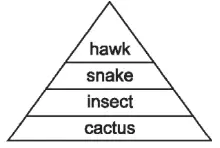
Look at the picture below.
Which organism functions as a secondary consumer in this food chain?
a)
Cactus
b)
Insect
c)
Snake
d)
Hawk
12.
"The ability to do work" is a definition for
a)
ATP
b)
Energy
c)
ADP
d)
Matter
13.
Energy is _________ from one trophic level to another in an ecosystem.
a)
Recycled
b)
Synthesized
c)
Transferred
d)
Hydrolyzed
14.
What is the best definition of matter?
a)
Anything that has mass and volume.
b)
The ability to do work.
c)
Something that you are concerned about. "What's the matter?"
d)
Something that can't be measured.
15.
What factor(s) make Zombie Fires occur more often?
a)
More snow
b)
Colder temperatures
c)
Higher Arctic temperatures
d)
All of the above
16.
Autotrophs get energy from ________ while heterotrophs get energy from ________.
a)
producers; consumers
b)
consumers; producers
c)
eating food; photosynthesis
d)
photosynthesis; eating food
17.
Why is burning peat more harmful to the environment than other fuels?
a)
Because it smells bad.
b)
Because it is harder to find.
c)
Because it is in the arctic.
d)
Because it produces so much Carbon Dioxide.
18.
What is the fuel in a Zombie Fire system?
a)
Lightning
b)
Human activity
c)
Peat
d)
Heat
19.
What two forms of matter do plants need to grow?
a)
Oxygen and glucose
b)
Water and carbon dioxide
c)
Nitrogen and methane
d)
Carbon dioxide and heat
20.
How do animals obtain the energy they need?
a)
By photosynthesis
b)
By absorbing sunlight
c)
By consuming other organisms
d)
By creating glucose from carbon dioxide
21.
A food chain shows:
a)
How energy and matter flow through an ecosystem
b)
The number of organisms at each trophic level
c)
The rate of decomposition
d)
The temperature of an environment
22.
How does a food web differ from a food chain?
a)
It includes decomposers
b)
It shows only producers
c)
It shows many interconnected food chains
d)
It shows the energy pyramid of an ecosystem
23.
What is the main purpose of an energy pyramid?
a)
To show how energy increases at higher levels
b)
To show how energy decreases at higher levels
c)
To compare biomass among species
d)
To measure temperature
24.
Which organisms have the most energy available?
a)
producers
b)
primary consumers
c)
secondary consumers
d)
tertiary consumers
25.
What is the rule of energy transfer between trophic levels?
a)
5% is transferred
b)
10% is transferred
c)
50% is transferred
d)
90% is transferred
26.
Which statement about decomposers is true?
a)
They create energy for producers
b)
They recycle matter back into the ecosystem
c)
They are only found in aquatic environments
d)
They store solar energy
27.
In the Arctic, peat builds up because:
a)
Oxygen is high and decomposition is fast
b)
It’s cold and decomposition is slow
c)
There are few decomposers
d)
Decomposers consume it quickly
28.
What goes into cellular respiration?
a)
Oxygen and glucose
b)
Water and carbon dioxide
c)
Nitrogen and sunlight
d)
Heat and ATP
29.
What comes out of cellular respiration?
a)
Carbon dioxide, water, and energy (ATP)
b)
Glucose and oxygen
c)
Carbon and sunlight
d)
Only water
30.
Which of the following best represents the cellular respiration equation?
a)
CO₂ + H₂O → C₆H₁₂O₆ + O₂
b)
C₆H₁₂O₆ + O₂ → CO₂ + H₂O + energy
c)
N₂ + O₂ → CO₂ + glucose
d)
H₂O + sunlight → glucose + CO₂
31.
Decomposition makes the dead bodies and waste of organisms available to
a)
primary consumers
b)
autotrophs
c)
heterotrophs
d)
bacteria
32.
Peat is
a)
a fast burning substance
b)
dead plant material that has not been decomposed
c)
ONLY found in the Arctic
d)
something that does NOT release a lot of carbon dioxide when burned
33.
A food chain
a)
is a network of complex interactions
b)
shows how consumers eat more than one type of food
c)
shows how more than one species may food on the same organism
d)
shows a series of steps in which organisms transfer energy in one line
34.
What did the bubbles represent in the yeast lab?
a)
peat
b)
permafrost
c)
carbon dioxide
d)
oxygen
35.
What did the yeast represent in the decomposition lab?
a)
peat
b)
permafrost
c)
decomposers
d)
fires
100 %

