
 Worksheets
Biogeo Cycles
Total questions: 19
Worksheet time: 35mins

How does carbon enter the atmosphere?
Carbon dioxide is only released into the atmosphere by human activities
Carbon dioxide is only released into the atmosphere by plants and animals
Carbon dioxide is only released into the atmosphere by plants, animals and decomposers.
Carbon dioxide is released into the atmosphere by plants, animals, bacterial decomposers, and human activities.

How would the Carbon cycle be affected if all the plants on Earth died?
The amount of water in Earth's atmosphere would decrease, trapping water vapor and causing Earth's atmosphere to become warmer.
The amount of carbon dioxide in Earth's atmosphere would increase, trapping water vapor and causing Earth's atmosphere to become warmer.
The amount of nitrogen in Earth's atmosphere would increase causing waster vapor to be released.
The amount of oxygen would increase in Earth's atmosphere, releasing water vapor and causing Earth to become cooler.
If all the nitrogen fixing bacteria was removed from Earth what would happen?
Plants and animals would receive nitrogen through the atmosphere.
Plants would suffer due to not having a usable form of nitrogen and animals would suffer because they consume plants to get nitrogen.
Plants would receive too much nitrogen and die.
Animals would receive too much nitrogen from eating plants and die.
How does phosphorus move between animals and soil?
When an animal dies, decomposers break down the waste putting nutrients into the soil.
Consumers break down dead animals and put nutrients into the soil.
When animals move, they release phosphorus into the air that soaks into the soil.
Heavy rain blows phosphorus deep into the soil off of living things.
The ONLY biogeochemical cycle that has NO major path in which the substance cycles through the atmosphere.
Water cycle
Carbon cycle
Phosphorus cycle
Nitrogen cycle
Photosynthesis and cellular respiration are HUGE part of which cycle?
Water cycle
Cell cycle
Carbon Cycle
Nitrogen Cycle

What is taking place in the Carbon Cycle at E?
The process is forming coal which changes into fossil fuels.
The process of combustion which releases carbon into the atmosphere by burning fossil fuels.
The process of denitrification which releases carbon into the atmosphere.
The process of consumption which removes carbon from the atmosphere from fossil fuels.

Use the picture, what ways are phosphorus added to the soil?
weathering of rocks (erosion), farming, decomposition
precipitation, condensation, transpiration
combustion, respiration. erosion
phosphate, transpiration, farming

In the diagram of the water cycle, what does number 3 represent?
Evaporation which is the movement of water from the ground to the atmosphere.
Condensation which is the movement of water from plants into the atmosphere.
Precipitation which is the movement of water from the atmosphere to the ground.
Photosynthesis which is used for plants to make their own food.

What is the role of nitrogen fixing bacteria in the Nitrogen Cycle?
Stores nitrogen that is used to make fossil fuels
Turns nitrogen into phosphorus
Turns nitrogen gas into a usable form of nitrogen for plants to use
Converts plant waste into fossil fuels

An algae bloom is a rapid increase of algae in freshwater or marine water systems, why might it cause fish to die.
The algae produces toxic chemicals
The algae blocks out sunlight
The algae puts excess phosphorus into the water.
The decomposers feeding on the dead algae deplete the oxygen in the water

In the phosphorus cycle, runoff can create many problems such as?
Many aquatic organisms die due to the runoff
Algae blooms cause fish and animals to die due lack of oxygen
Eutrophication occurs due to excess phosphorus and nitrogen.
ALL of these
How is energy flow different from chemical element cycling?
Energy flows through an ecosystem only by water and it is lost when humans drink it.
Energy flows through an ecosystem and is dissipated as heat, but chemical elements are recycled.
Energy is used as heat and them recycled into the atmosphere but elements are used up and disappear forever.
Energy flows through an ecosystem and is recycled. Chemical elements are lost as heat.

Nitrogen is one of the primary nutrients critical for the survival of all living organisms. _______is the process that converts nitrate to nitrogen gas, thus removing bioavailable nitrogen and returning it to the atmosphere.
Denitrification
Eutrophication
Biomagnification
Assimilation
A (a) is the DNA or allele combination for a trait. The physical, observable trait is called the (b)


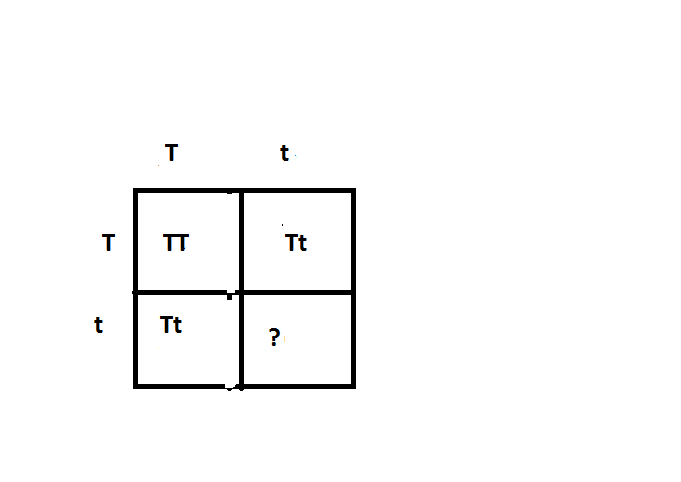
T - tall and t = short. In the Punnett square below, what belongs in the missing square (a)

two different alleles for a trait
examples: Bb, Nn, Yy
genotype
phenotype
homozygous
heterozygous

