
 Worksheets
Chapter 4: Business Ethics and Corporate Social Responsibility
Total questions: 15
Worksheet time: 11mins
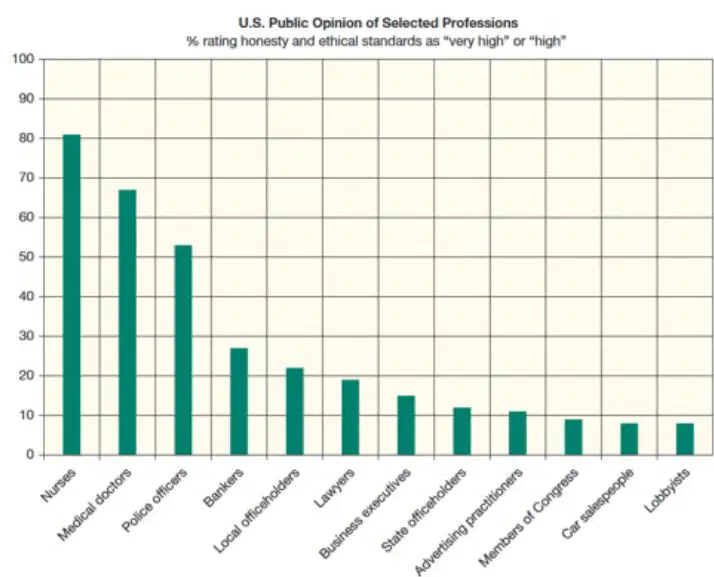
Refer to the bar chart titled “U.S. Public Opinion of Selected Professions: % rating honesty and ethical standards as ‘very high’ or ‘high.’” Which profession is depicted as having the highest public rating for honesty and ethical standards?
Nurses
Medical doctors
Police officers
Business executives
DoK 3—Strategic Thinking: A marketing manager considers omitting negative product data from an investor update to avoid short-term stock decline. Which ethical principle directly guides the best decision in this situation?
Competing fairly by highlighting only advantages over rivals
Communicating truthfully by telling the truth, the whole truth, and nothing but the truth
Avoiding harm by focusing solely on employee satisfaction metrics
Insider trading by withholding internal findings until the market reacts
Which strategy is best described as a written statement that sets forth the principles guiding an organization’s decisions?
Transparency
Code of ethics
Internal audit
Whistle-blowing
Which ethical approach is best described as choosing the option that delivers the most good for the most people or protects the most people from a negative outcome?
Justice approach
Utilitarianism
Individual rights
Virtue ethics
A manager prioritizes policies that enhance peace and public safety across the community rather than focusing on benefits to a single individual. Which approach is the manager using?
Individual responsibilities
The common good
Justice approach
Individual rights
According to the passage, which statement best describes the interdependence between business and society?
Consumers expect a narrow set of benefits and companies operate independently of social conditions.
Profit-seeking companies are the economic engine that generates much of a nation’s money, while their ability to operate profitably depends on a stable, functioning society.
Society’s standard of living is determined mainly by government services, with businesses playing a minor role.
Businesses power modern society but have no influence on consumer expectations or standards of living.
Scenario: An apparel firm adopts dyeing processes that cut water usage and chemical discharge while maintaining product quality to preserve resources for future generations. Which DoK 3 reasoning best explains why this approach aligns with sustainable development? Choose the answer that uses evidence from the scenario.
It improves brand visibility by using trendy eco-labels, which increases sales.
It reduces immediate costs by eliminating quality control, ensuring faster production.
It limits pollution and resource depletion by lowering water use and chemical discharge, thereby safeguarding vital resources for future generations.
It focuses solely on recycling post-consumer garments, which replaces the need for process improvements.
Based on the definition provided, which scenario best illustrates identity theft in a consumer context?
A thief uses someone’s Social Security number to obtain a credit card and take out loans fraudulently.
A shopper uses a coupon code that a friend shared to get a discount online.
A customer forgets a password and requests a reset from the retailer’s website.
A bank declines a loan because the applicant’s credit score is too low.
Refer to the bar chart titled “Fatal Occupational Injuries (2020 data).” Which category shows the highest number of U.S. workplace fatalities?
Fires and explosions
Exposure to harmful substances or environments
Violence and other injuries by persons or animals
Transportation incidents
Using the chart on fatal occupational injuries, which category has the lowest number of fatalities?
Fires and explosions
Falls, slips, and trips
Contact with objects and equipment
Exposure to harmful substances or environments
According to the chart, which pair of categories has similar mid-range fatality counts that are shorter than transportation incidents but longer than fires and explosions?
Violence by persons or animals and exposure to harmful substances
Falls, slips, and trips and fires and explosions
Transportation incidents and contact with objects and equipment
Exposure to harmful substances and transportation incidents
Which category most directly involves physical interaction with machinery or tools, based on the chart labels?
Contact with objects and equipment
Exposure to harmful substances or environments
Fires and explosions
Falls, slips, and trips
Which category label in the chart indicates risks from environmental or chemical exposure?
Falls, slips, and trips
Exposure to harmful substances or environments
Fires and explosions
Transportation incidents
Which category name suggests incidents initiated by human or animal aggression?
Violence and other injuries by persons or animals
Exposure to harmful substances or environments
Contact with objects and equipment
Fires and explosions
Using the chart, which category likely has a fatality count closest to ‘falls, slips, and trips’?
Transportation incidents
Contact with objects and equipment
Fires and explosions
Exposure to harmful substances or environments

