
Font size
 Worksheets
Chapter 13: Conditional Probability Introduction
Total questions: 150
Worksheet time: 1hrs 15mins
In the random experiment of tossing three fair coins, the sample space is S = {HHH, HHT, HTH, THH, HTT, THT, TTH, TTT}. Which of the following correctly states the probability assigned to each sample point when the coins are fair?
Each sample point has probability 1/8
Each sample point has probability 1/6
Each sample point has probability 1/4
Probabilities vary depending on number of heads
Let E be the event "at least two heads appear" and F be the event "first coin shows tail" when tossing three fair coins. Which set correctly represents E?
{HHH, HHT, HTH, THH}
{THH, THT, TTH, TTT}
{HHH, HHT, HTH}
{HHH, THH, TTT}
With the same setup, which set correctly represents F, the event "first coin shows tail"?
{THH, THT, TTH, TTT}
{HHH, HHT, HTH, THH}
{HTT, HTH, HHT}
{HHH, TTT}
For the three-coin experiment, E = {HHH, HHT, HTH, THH} and F = {THH, THT, TTH, TTT}. What is E ∩ F?
{THH}
{HHH}
{THT}
{HHH, THH}
Using equally likely outcomes, compute P(E), where E is the event "at least two heads appear" with three fair coins.
1/2
3/8
5/8
1/4
Using equally likely outcomes, compute P(F), where F is the event "first coin shows tail" with three fair coins.
1/2
3/8
1/4
5/8
Suppose you are informed that the first coin shows tail (event F occurred). What is the conditional probability P(E|F) of "at least two heads appear"? Use the reduced sample space idea explained in the text.
1/4
1/2
3/4
1/8
Which statement best explains why knowing F occurred reduces the sample space when computing P(E|F)?
It excludes all outcomes where the first coin is head, forming a new sample space with outcomes favorable to F
It changes the fairness of the coins, altering outcome probabilities
It doubles the number of outcomes because of additional information
It only removes outcomes with exactly two tails
Which formula correctly expresses the conditional probability P(E|F) in terms of counts of outcomes?
P(E|F) = n(E ∩ F) / n(F)
P(E|F) = n(E) / n(F)
P(E|F) = n(F) / n(E ∩ F)
P(E|F) = n(S) / n(E)
By dividing numerator and denominator by n(S), which equivalent probability form is obtained for conditional probability?
P(E|F) = P(E ∩ F) / P(F)
P(E|F) = P(E) / P(F)
P(E|F) = P(F) / P(E ∩ F)
P(E|F) = 1 − P(E ∩ F)
Definition: If E and F are events of the same sample space with P(F) ≠ 0, the conditional probability of E given F has what standard notation and formula?
P(E|F) = P(E ∩ F) / P(F)
P(F|E) = P(E ∩ F) / P(E)
P(E|F) = P(E) + P(F)
P(E|F) = P(E ∪ F) / P(F)
Property: Let S be the sample space and F an event with P(F) ≠ 0. What is P(S|F)?
1
P(F)
P(S ∩ F)
P(F|S)
Given events A and B with P(A|B) = P(A ∩ B) / P(B), compute P(A|B) when P(A) = 7/13, P(B) = 9/13, and P(A ∩ B) = 4/13.
4/9
7/9
9/13
4/13
For disjoint events A and B, which identity for conditional probability holds true?
P((A ∪ B)|F) = P(A|F) + P(B|F)
P((A ∪ B)|F) = P(A|F) − P(B|F)
P((A ∪ B)|F) = P(A|F) × P(B|F)
P((A ∪ B)|F) = P(A|F) / P(B|F)
Property: For any event E, what is P(E'|F) in terms of P(E|F)?
P(E'|F) = 1 − P(E|F)
P(E'|F) = P(E|F)
P(E'|F) = 1 / P(E|F)
P(E'|F) = P(E) − P(F)
A family has two children. Given that at least one child is a boy, what is the probability that both children are boys? Use the sample space S = {(b,b), (g,b), (b,g), (g,g)}.
1/2
1/3
1/4
2/3
In the two-children scenario, identify the events E and F used to compute P(E|F).
E: ‘both children are boys’; F: ‘at least one child is a boy’
E: ‘at least one child is a boy’; F: ‘both children are boys’
E: ‘both children are girls’; F: ‘at least one child is a boy’
E: ‘first child is a boy’; F: ‘second child is a boy’
With S = {(b,b), (g,b), (b,g), (g,g)}, what are P(F) and P(E ∩ F) for F: ‘at least one child is a boy’ and E: ‘both children are boys’?
P(F) = 3/4 and P(E ∩ F) = 1/4
P(F) = 1/2 and P(E ∩ F) = 1/2
P(F) = 3/4 and P(E ∩ F) = 1/2
P(F) = 1 and P(E ∩ F) = 1/4
Ten cards numbered 1 to 10 are drawn randomly. Given that the drawn number is greater than 3, what is the probability it is even? Use A = {2,4,6,8,10}, B = {4,5,6,7,8,9,10}.
1/2
4/7
5/7
2/5
For the card problem with A = even numbers and B = numbers greater than 3, identify A ∩ B and P(A ∩ B).
A ∩ B = {4,6,8,10}; P(A ∩ B) = 4/10
A ∩ B = {2,4,6,8}; P(A ∩ B) = 4/10
A ∩ B = {5,7,9}; P(A ∩ B) = 3/10
A ∩ B = {4,5,6,7,8,9,10}; P(A ∩ B) = 7/10
In a school of 1000 students, 430 are girls. If 10% of the girls study in Class XII, find P(E|F) where E is ‘student studies in Class XII’ and F is ‘student is a girl’.
0.1
0.043
0.43
0.9
For the school scenario, determine P(F) and P(E ∩ F).
P(F) = 0.43 and P(E ∩ F) = 0.043
P(F) = 0.1 and P(E ∩ F) = 0.43
P(F) = 0.57 and P(E ∩ F) = 0.1
P(F) = 0.043 and P(E ∩ F) = 0.43
A die is thrown three times. Event A: 4 on the third throw. Event B: 6 on the first and 5 on the second. Find P(A|B).
1/6
1/36
1/216
1/3
For the three-throw die experiment, which of the following is true about P(B) and P(A ∩ B)?
P(B) = 1/6 and P(A ∩ B) = 1/216
P(B) = 1/36 and P(A ∩ B) = 1/6
P(B) = 1/216 and P(A ∩ B) = 1/36
P(B) = 1/6 and P(A ∩ B) = 1/6
A die is thrown twice and the observed sum is 6. What is the conditional probability that 4 appears at least once? Let E = ‘4 appears at least once’ and F = ‘sum is 6’.
2/5
1/2
2/11
5/36
In the two-throw sum-6 scenario, identify E ∩ F and compute P(E ∩ F).
E ∩ F = {(2,4),(4,2)} and P(E ∩ F) = 2/36
E ∩ F = {(1,5),(5,1)} and P(E ∩ F) = 2/36
E ∩ F = {(3,3)} and P(E ∩ F) = 1/36
E ∩ F = {(4,4)} and P(E ∩ F) = 1/36
Given events E and F with P(E) = 0.6, P(F) = 0.3 and P(E ∩ F) = 0.2, find P(E|F). Use P(E|F) = P(E ∩ F) / P(F).
0.2
0.6
2/3
2/9
Given events E and F with P(E) = 0.6, P(F) = 0.3 and P(E ∩ F) = 0.2, find P(F|E). Use P(F|E) = P(E ∩ F) / P(E).
1/3
2/3
0.2
5/6
Compute P(A|B), if P(B) = 0.5 and P(A ∩ B) = 0.32. Use the conditional probability formula.
0.16
0.32
0.64
0.64
If P(A) = 0.8, P(B) = 0.5 and P(B|A) = 0.4, find P(A ∩ B). Recall P(B|A) = P(A ∩ B) / P(A).
0.32
0.40
0.20
0.64
If P(A) = 0.8, P(B) = 0.5 and P(B|A) = 0.4, find P(A|B). Use Bayes relation P(A|B) = P(A ∩ B) / P(B).
0.20
0.32
0.64
0.80
If P(A) = 0.8, P(B) = 0.5 and P(B|A) = 0.4, find P(A ∪ B). Use P(A ∪ B) = P(A) + P(B) − P(A ∩ B).
0.98
1.30
0.50
0.80
Evaluate P(A ∪ B) if 2P(A) = P(B) = 5/13 and P(A|B) = 2/5. Use P(A|B) = P(A ∩ B)/P(B).
7/13
9/13
11/13
13/13
If P(A) = 6/11, P(B) = 5/11 and P(A ∪ B) = 7/11, find P(A ∩ B). Use P(A ∪ B) = P(A) + P(B) − P(A ∩ B).
1/11
4/11
5/11
6/11
If P(A) = 6/11, P(B) = 5/11 and P(A ∪ B) = 7/11, find P(A|B). Use P(A|B) = P(A ∩ B)/P(B).
4/11
4/5
7/11
6/11
If P(A) = 6/11, P(B) = 5/11 and P(A ∪ B) = 7/11, find P(B|A). Use P(B|A) = P(A ∩ B)/P(A).
2/3
4/11
4/6
5/6
A coin is tossed three times. Let E: head on third toss; F: heads on first two tosses. Find P(E|F).
1/2
1/4
3/4
1/8
A coin is tossed three times. Let E: at least two heads; F: at most two heads. Find P(E|F).
3/4
1/2
2/3
5/8
A coin is tossed three times. Let E: at most two tails; F: at least one tail. Find P(E|F).
1
7/8
3/4
5/6
Two coins are tossed once. Let E: tail appears on one coin; F: one coin shows head. Find P(E|F).
1/2
1
3/4
1/4
Two coins are tossed once. Let E: no tail appears; F: no head appears. Find P(E|F).
0
1/2
1
1/4
A die is thrown three times. Let E: 4 appears on the third toss; F: 6 and 5 appear respectively on first two tosses. Find P(E|F).
1/6
1/3
1/2
5/6
Mother, father and son line up at random for a picture. Let E: son on one end; F: father in middle. Find P(E|F). Assume all 3! permutations equally likely.
1/2
1/3
2/3
1/6
Two dice (one black, one red) are rolled. Find the conditional probability of obtaining a sum greater than 9, given that the black die resulted in a 5.
1/6
1/3
1/2
2/3
Two dice (one black, one red) are rolled. Find the conditional probability of obtaining the sum 8, given that the red die resulted in a number less than 4.
1/6
1/3
1/2
2/3
A fair die is rolled. Consider events E = {1,3,5}, F = {2,3} and G = {2,3,4,5}. Find P(E|F).
1/2
1/3
2/3
1/6
A fair die is rolled. Consider events E = {1,3,5}, F = {2,3} and G = {2,3,4,5}. Find P(F|E).
0
1/3
1/2
2/3
A fair die is rolled. Consider events E = {1,3,5}, F = {2,3} and G = {2,3,4,5}. Find P(E|G).
1/4
1/2
3/4
2/3
Assume each child is equally likely to be a boy or girl. A family has two children. What is the conditional probability that both are girls given that (i) the youngest is a girl?
1/2
1/3
1/4
3/4
Assume each child is equally likely to be a boy or girl. A family has two children. What is the conditional probability that both are girls given that (ii) at least one is a girl?
1/2
1/3
1/4
2/3
A question bank has 300 easy T/F, 200 difficult T/F, 500 easy MCQ and 400 difficult MCQ. A question is selected at random. What is the probability it is an easy question given that it is a multiple choice question?
1/2
5/9
3/4
7/9
Given two numbers appearing on throwing two dice are different. Find the probability of the event ‘the sum is 4’.
1/18
1/12
1/9
1/6
Experiment: Throw a die; if a multiple of 3 comes up, throw the die again and if any other number comes, toss a coin. Find P(‘the coin shows a tail’ | ‘at least one die shows a 3’).
1/2
1/3
1/4
2/3
If P(A) = 1/2 and P(B) = 0, then P(A|B) equals which value? Use the definition of conditional probability.
0
1/2
not defined
1
If A and B are events such that P(A|B) = P(B|A), which statement must be true?
A is a subset of B but A ≠ B
A = B
A ∩ B = ∅
P(A) = P(B)
The multiplication rule of probability states that for events E and F with P(E) ≠ 0 and P(F) ≠ 0, P(E ∩ F) equals:
P(E) + P(F)
P(E) − P(F)
P(E) P(F|E)
P(F) P(E|F)
An urn contains 10 black and 5 white balls. Two balls are drawn one after the other without replacement. Let E be the event the first ball is black and F be the event the second ball is black. Which expression gives P(E ∩ F)?
(10/15) × (9/14)
(10/15) × (10/15)
(5/15) × (4/14)
(9/15) × (10/14)
Continuing the urn scenario: After drawing a black ball first (event E occurs), what is P(F|E)?
10/15
9/14
5/15
4/14
In the urn example with 10 black and 5 white balls, what is the probability that both balls drawn are black?
3/7
9/14
2/3
13/15
For three events E, F, and G of the same sample space with P(E), P(F), P(G) > 0, the multiplication rule generalizes to P(E ∩ F ∩ G) equals:
P(E) P(F) P(G)
P(E) P(F|E) P(G|E ∩ F)
P(E|F) P(F|G) P(G|E)
P(E ∩ F) + P(G)
Three cards are drawn successively without replacement from a standard 52-card deck. What is P(KKA), the probability that the first two cards are kings and the third card is an ace?
(4/52) × (3/51) × (4/50)
(4/52) × (4/51) × (3/50)
(4/52) × (3/52) × (4/50)
(4/52) × (3/51) × (3/50)
In the card-drawing example, what is P(K|K), the probability the second card is a king given the first card was a king?
4/52
3/51
4/51
3/52
Consider a standard deck of 52 playing cards. Let E be the event "the card drawn is a spade" and F be the event "the card drawn is an ace." Which statement correctly shows that E and F are independent?
P(E ∩ F) = P(E) + P(F)
P(E ∩ F) = P(E) − P(F)
P(E ∩ F) = P(E) · P(F)
P(E ∩ F) = P(E | F)
Using the card-drawing setup where E: "the card is a spade" and F: "the card is an ace," compute P(E), P(F), and P(E ∩ F). Choose the option that lists them in order as (P(E), P(F), P(E ∩ F)).
(1/4, 1/13, 1/52)
(13/52, 4/52, 1/13)
(1/4, 1/13, 1/4)
(1/13, 1/4, 1/52)
In the same card example, what is P(E | F)?
1/4
1/13
1/52
13/52
Two events E and F are said to be independent if which of the following equalities holds (assuming P(E) ≠ 0 and P(F) ≠ 0)?
P(E | F) = P(F)
P(F | E) = P(E)
P(E | F) = P(E) and P(F | E) = P(F)
P(E ∪ F) = P(E) + P(F)
By the multiplication rule of probability, if E and F are independent, which formula is valid?
P(E ∩ F) = P(E) + P(F)
P(E ∩ F) = P(E) · P(F)
P(E ∩ F) = P(E | F) + P(F | E)
P(E ∩ F) = P(E ∪ F) − P(E) − P(F)
Which statement best distinguishes independent events from mutually exclusive events?
Independent events cannot occur together, while mutually exclusive events can.
Independent events may have common outcomes, while mutually exclusive events never have a common outcome.
Mutually exclusive events always satisfy P(E ∩ F) = P(E) · P(F), while independent events satisfy P(E ∩ F) = 0.
Independent events are defined by subsets of the sample space, while mutually exclusive events are defined by probabilities.
Two experiments are said to be independent if which condition holds for every pair of events E (from the first experiment) and F (from the second)?
P(E ∩ F) = P(E) + P(F) computed separately for the two experiments
The simultaneous probability of E and F equals the product P(E) · P(F) calculated separately for the two experiments
The conditional probability P(E | F) equals P(F)
P(E ∪ F) equals P(E) + P(F) − P(E ∩ F)
Events A, B, and C are mutually independent if which of the following sets of equalities holds?
P(A ∩ B) = P(A) + P(B), P(B ∩ C) = P(B) + P(C), P(A ∩ C) = P(A) + P(C)
P(A ∩ B) = P(A) · P(B), P(A ∩ C) = P(A) · P(C), P(B ∩ C) = P(B) · P(C), and P(A ∩ B ∩ C) = P(A) · P(B) · P(C)
P(A ∩ B ∩ C) = 0 only
P(A ∪ B ∪ C) = P(A) + P(B) + P(C)
A die is thrown once. Let E be the event “the number appearing is a multiple of 3” and F be the event “the number appearing is even.” Which statement is correct about E and F?
P(E ∩ F) = 1/6 equals P(E) × P(F), so E and F are independent
P(E ∩ F) = 1/6 is greater than P(E) × P(F), so E and F are dependent
P(E ∩ F) = 0, so E and F are mutually exclusive
P(E ∩ F) = 1/3 equals P(E) × P(F), so E and F are independent
An unbiased die is thrown twice. Let A be “odd number on the first throw” and B be “odd number on the second throw.” Which calculation verifies whether A and B are independent?
Check if P(A ∩ B) equals P(A) + P(B)
Check if P(A ∩ B) equals P(A) × P(B)
Check if P(A ∩ B) equals P(A) − P(B)
Check if P(A ∩ B) equals 1 − P(A) × P(B)
Three coins are tossed simultaneously. Let E be “three heads or three tails,” F be “at least two heads,” and G be “at most two heads.” Which pair of events is independent?
E and G
E and F
F and G
None of the pairs
With three coins tossed simultaneously and events as defined: E = {HHH, TTT}, F = {HHH, HHT, HTH, THH}, G = {HHT, HTH, THH, HTT, THT, TTH, TTT}. What is P(F ∩ G)?
1/8
3/8
7/16
7/32
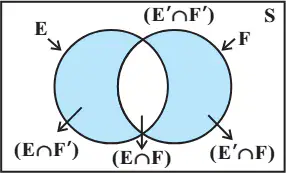
Suppose events E and F are independent. Which statement must then be true regarding E and F′ (the complement of F)?
E and F′ are dependent because E and F are not mutually exclusive
E and F′ are independent since P(E ∩ F′) = P(E) × P(F′)
E and F′ are mutually exclusive
E and F′ have equal probabilities
Three coins are tossed. Using the sets given for E, F, and G, identify the correct probability value: P(E) × P(G) equals which of the following?
1/8
7/8
7/16
7/32
If P(A) = 3/5 and P(B) = 1/5, find P(A ∩ B) if A and B are independent events.
3/25
2/5
4/5
8/25
Two cards are drawn at random and without replacement from a standard deck of 52 playing cards. What is the probability that both cards are black?
(26/52)·(26/52)
(26/52)·(25/51)
(13/52)·(12/51)
(1/2)·(1/2)
A box of oranges is inspected by examining three randomly selected oranges drawn without replacement. If all the three oranges are good, the box is approved for sale; otherwise, it is rejected. A box contains 15 oranges of which 12 are good and 3 are bad. What is the probability that the box will be approved for sale?
(12/15)·(12/15)·(12/15)
(12/15)·(11/14)·(10/13)
(3/15)·(2/14)·(1/13)
1 − (3/15)·(2/14)·(1/13)
A fair coin and an unbiased die are tossed. Let A be the event “head appears on the coin” and B be the event “3 on the die.” Are A and B independent?
Yes, because P(A ∩ B) = P(A)P(B)
No, because outcomes overlap
Yes, because both events have probability 1/2
No, because coin and die are different devices
A die marked 1, 2, 3 in red and 4, 5, 6 in green is tossed. Let A be the event “the number is even,” and B be the event “the number is red.” Are A and B independent?
Yes, because P(A ∩ B) = P(A)P(B)
No, because P(A ∩ B) ≠ P(A)P(B)
Yes, because red outcomes are 1,2,3
Cannot be determined
Let E and F be events with P(E) = 3/5, P(F) = 3/10 and P(E ∩ F) = 1/5. Are E and F independent?
Yes, since 1/5 = (3/5)(3/10)
No, since 1/5 ≠ (3/5)(3/10)
Yes, because P(E|F) = P(E)
Insufficient information
Events A and B satisfy P(A) = 1/2, P(A ∪ B) = 3/5, and P(B) = p. Find p if A and B are independent.
p = 1/5
p = 1/2
p = 1/3
p = 1/10
Events A and B satisfy P(A) = 1/2, P(A ∪ B) = 3/5, and P(B) = p. Find p if A and B are mutually exclusive.
p = 1/5
p = 1/10
p = 1/2
p = 3/5
Let A and B be independent with P(A) = 0.3 and P(B) = 0.4. What is P(A ∩ B)?
0.12
0.7
0.3
0.4
Let A and B be independent with P(A) = 0.3 and P(B) = 0.4. What is P(A ∪ B)?
0.58
0.7
0.12
0.46
Let A and B be independent with P(A) = 0.3 and P(B) = 0.4. What is P(A|B)?
0.3
0.4
0.12
0.58
If P(A) = 1/4, P(B) = 1/2 and P(A ∩ B) = 1/8, find P(A′ ∩ B′).
1/2
3/8
5/8
1/4
Events A and B have P(A) = 1/2, P(B) = 7/12 and P(A′ ∪ B′) = 1/4. Are A and B independent?
Yes, because P(A ∩ B) = P(A)P(B)
No, because P(A ∩ B) ≠ P(A)P(B)
Yes, because P(A′ ∪ B′) = 1/4
Cannot be decided
Two independent events A and B have P(A) = 0.3 and P(B) = 0.6. Which expression equals P(neither A nor B)?
(1 − 0.3)(1 − 0.6)
1 − (0.3 + 0.6)
0.3·0.6
1 − 0.3 − 0.6 + 0.18
A die is tossed thrice. What is the probability of getting an odd number at least once?
1 − (1/2)3
(1/2)3
3·(1/2)
1 − (3/6)3
Two balls are drawn with replacement from a box containing 10 black and 8 red balls. What is the probability that both balls are red?
(8/18)·(7/17)
(8/18)2
(10/18)2
(8/18)·(10/18)
Two balls are drawn with replacement from a box containing 10 black and 8 red balls. What is the probability that the first ball is black and the second is red?
(10/18)·(8/18)
(10/18)·(7/17)
(8/18)·(10/18)
(10/18)2
Two balls are drawn with replacement from a box containing 10 black and 8 red balls. What is the probability that one of them is black and the other is red?
2·(10/18)·(8/18)
(10/18)·(8/18)
(8/18)2
1 − (10/18)2
Two people A and B try to solve a problem independently with probabilities 1/2 and 1/3, respectively. What is the probability that the problem is solved?
(1/2)+(1/3)
1 − (1/2)(1/3)
1 − (1/2)(2/3)
1 − (1/2)(1 − 1/3)
Two people A and B try to solve a problem independently with probabilities 1/2 and 1/3, respectively. What is the probability that exactly one of them solves the problem?
(1/2)(1/3)
(1/2)(2/3) + (1/3)(1/2)
(1/2)(2/3) + (1/3)(1/2)(2/3)
(1/2)(2/3) + (1/3)(1/2)
One card is drawn at random from a well shuffled deck of 52 cards. Consider events E and F. Case (i): E = “the card drawn is a spade,” F = “the card drawn is an ace.” Are E and F independent?
Yes, because P(E ∩ F) = (13/52)(4/52)
No, because P(E ∩ F) = 1/52 ≠ (13/52)(4/52)
Yes, because suits and ranks are unrelated
Cannot be decided
One card is drawn at random from a well shuffled deck of 52 cards. Consider events E and F. Case (ii): E = “the card drawn is black,” F = “the card drawn is a king.” Are E and F independent?
Yes, because P(E ∩ F) = (26/52)(4/52)
No, because kings are not evenly split between colors
Yes, because P(E ∩ F) = 2/52 = (26/52)(4/52)
Cannot be decided
One card is drawn at random from a well shuffled deck of 52 cards. Consider events E and F. Case (iii): E = “the card drawn is a king or queen,” F = “the card drawn is a queen or jack.” Are E and F independent?
Yes, because (P(E ∩ F) = P(E)P(F))
No, because E ∩ F contains the queen only
Yes, because ranks are distinct
Cannot be decided
For two independent events A and B, the probability of at least one of A or B occurring equals 1 − P(A′)P(B′). Which derivation step justifies this?
P(A ∪ B) = P(A) + P(B)
P(A ∪ B) = 1 − P(A′ ∩ B′) and P(A′ ∩ B′) = P(A′)P(B′)
P(A ∩ B) = P(A)P(B)
P(A′) = 1 − P(A)
In a hostel, 60% of students read Hindi newspaper (H), 40% read English newspaper (E), and 20% read both. A student is selected at random. What is the probability that the student reads neither Hindi nor English newspapers? Use P(H)=0.60, P(E)=0.40, P(H∩E)=0.20.
0.20
0.00
0.40
0.80
In the same hostel scenario with P(H)=0.60, P(E)=0.40, and P(H∩E)=0.20, find the conditional probability P(E|H), i.e., the probability that a student reads English given that the student reads Hindi.
1/3
1/2
2/3
1/4
Continuing the hostel scenario, compute P(H|E), i.e., the probability that a student reads Hindi given that the student reads English.
1/2
3/4
2/5
5/6
The probability of obtaining an even prime number on each die when a pair of dice is rolled is asked. Recall that the only even prime is 2. What is the probability?
0
1/3
1/12
1/36
Two events A and B will be independent if which of the following holds?
A and B are mutually exclusive
P(A∩B′) = [1 − P(A)] [1 − P(B)]
P(A) = P(B)
P(A)·P(B) = P(A∩B)
Definition check: A set of events E1, E2, ..., En is a partition of sample space S if which condition is satisfied for all i ≠ j?
Ei ∩ Ej = S
Ei ∩ Ej = ϕ
Ei ∪ Ej = S
P(Ei) = 0
Definition check: Which statement must be true for {E1, E2, ..., En} to be a partition of S?
E1 ∪ E2 ∪ ... ∪ En = S
E1 ∩ E2 ∩ ... ∩ En = S
E1 ∪ E2 = S only
Events are mutually exclusive but not exhaustive
Theorem of total probability: If {E1, E2, ..., En} partitions S and A is any event with S, which expression correctly gives P(A)?
P(A) = P(E1) + P(E2) + ... + P(En)
P(A) = Σ P(Ej) P(A|Ej) over j=1 to n
P(A) = P(A|E1) + P(A|E2) + ... + P(A|En)
P(A) = P(E1∩A) + P(E2∩A) only
Application of total probability: A person undertakes a construction job. Probability of a strike is 0.65; probability the job completes on time given a strike is 0.32; probability of no strike is 0.35; probability the job completes on time given no strike is 0.80. What is the probability the job completes on time?
0.488
0.208
0.28
0.65
Bayes’ Theorem statement: For a partition {E1, E2, ..., En} of S and nonzero P(A), which formula gives P(Ei|A)?
P(Ei|A) = P(Ei∩A)
P(Ei|A) = P(A|Ei)
P(Ei|A) = [P(Ei) P(A|Ei)] / [Σ P(Ej) P(A|Ej)]
P(Ei|A) = P(Ei) / P(A|Ei)
Terminology check: When applying Bayes' theorem, which term refers to the prior probability associated with a hypothesis E_i?
Posteriori probability
Likelihood of evidence
Prior probability
Marginal probability
Two bags are used in a Bayes' theorem example. Bag I has 3 red and 4 black balls; Bag II has 5 red and 6 black balls. A bag is chosen at random and one red ball is drawn. What is the probability that the ball came from Bag II? Use the given computations: P(E1)=P(E2)=1/2, P(A|E1)=3/7, P(A|E2)=5/11.
35/68
33/68
5/22
3/11
In Bayes' theorem, the events E1, E2, …, En are described as a partition of the sample space S. What does this imply?
Exactly one of the events must occur and they can overlap
At least one must occur and multiple can occur simultaneously
Exactly one must occur and no two can occur together
None of the events can occur
Three identical boxes I, II, III each contain two coins. Box I: two gold coins; Box II: two silver coins; Box III: one gold and one silver. A box is chosen at random and one coin taken out is gold. What is the probability that the other coin in the chosen box is also gold? Use the provided setup: P(E1)=P(E2)=P(E3)=1/3; P(A|E1)=1, P(A|E2)=0, P(A|E3)=1/2.
1/2
2/3
3/4
1/3
In the HIV test reliability example, the population prevalence of HIV is 0.1%. Express this as P(E), where E is the event that a randomly selected person actually has HIV.
P(E)=0.01
P(E)=0.001
P(E)=0.1
P(E)=0.0001
Using the HIV test data: Sensitivity P(A|E)=0.9 and false positive rate P(A|E')=0.01, where A is "test is HIV+". What is the posterior probability P(E|A) that a person actually has HIV given a positive test?
0.9
0.5
0.083 (approximately)
0.01
In the HIV testing scenario, what does P(A|E') represent?
Probability the person has HIV given a positive test
Probability the test is positive given the person does not have HIV
Probability the test is negative given the person has HIV
Population prevalence of HIV
A factory has machines A, B, C producing 25%, 35%, and 40% of bolts respectively. Their defect rates are 5%, 4%, and 2% respectively. A randomly drawn bolt is found defective. Which expression correctly gives the probability it was manufactured by machine B using Bayes’ theorem?
[P(B2)P(E|B2)] / [P(B1)P(E|B1)+P(B2)P(E|B2)+P(B3)P(E|B3)]
[P(B2)] / [P(B1)+P(B2)+P(B3)]
P(E|B2) / [P(E|B1)+P(E|B2)+P(E|B3)]
P(B2)P(E|B2)
Compute the posterior probability that a defective bolt came from machine B, given P(B1)=0.25, P(B2)=0.35, P(B3)=0.40 and P(E|B1)=0.05, P(E|B2)=0.04, P(E|B3)=0.02.
0.35
0.4
0.44
0.38
Concept application: Bayes' theorem is sometimes called the formula for the probability of "causes." In the context of the bolt factory, what is the "cause" when computing P(B2|E)?
The event that the bolt is defective
The hypothesis that the bolt was made by machine B
The evidence that the factory has three machines
The prior that machine B makes 35% of bolts
A doctor can arrive by train (T1), bus (T2), scooter (T3), or other means (T4) with probabilities 3/10, 1/5, 1/10, and 2/5 respectively. He arrives late. The conditional probabilities of being late are P(E|T1)=1/4, P(E|T2)=1/3, P(E|T3)=1/12, and P(E|T4)=0. Using Bayes' Theorem, what is the probability that he came by train given that he was late?
1/4
1/3
1/2
3/5
In the doctor travel scenario: T1, T2, T3, T4 have prior probabilities 3/10, 1/5, 1/10, 2/5; and late-event conditional probabilities P(E|T1)=1/4, P(E|T2)=1/3, P(E|T3)=1/12, P(E|T4)=0. What is the probability that the doctor was late regardless of the mode of transport?
3/40
9/40
1/2
12/40
In a Bayes' Theorem calculation, three brands B1, B2, B3 have priors 0.25, 0.35, 0.40 and event likelihoods P(E|B1)=0.05, P(E|B2)=0.04, P(E|B3)=0.02. What is P(B2|E)?
28/69
35/69
14/69
20/69
A man speaks truth 3/4 of the time. He throws a fair die and reports that the outcome is a six. Using Bayes’ Theorem with S1: six occurs and S2: six does not occur, what is the probability that a six actually occurred given his report?
1/2
3/8
1/6
5/8
In the man-with-die scenario, identify the correct likelihoods used in Bayes’ Theorem for the report "six". Which pair is correct?
P(E|S1)=3/4 and P(E|S2)=1/4
P(E|S1)=1/6 and P(E|S2)=5/6
P(E|S1)=1/4 and P(E|S2)=3/4
P(E|S1)=3/4 and P(E|S2)=3/4
An urn contains 5 red and 5 black balls. A ball is drawn, its colour noted, and returned. Then two additional balls of the colour drawn are added to the urn. A second ball is drawn at random. What is the probability that the second ball is red?
1/2
3/5
2/5
7/10
A bag contains 4 red and 4 black balls, another bag contains 2 red and 6 black balls. One of the two bags is selected at random and a ball is drawn from the selected bag and is found to be red. Using Bayes’ Theorem, what is the probability that the ball was drawn from the first bag?
2/3
3/5
1/2
4/7
In a college, 60% of students reside in hostel and 40% are day scholars. Past data shows 30% of hostelers attain A grade and 20% of day scholars attain A grade. If a randomly chosen student has an A grade, what is the probability that he is a hosteler?
3/5
2/3
4/7
1/2
On a multiple-choice question, a student either knows the answer or guesses. Let the probability he knows the answer be 3/4 and the probability he guesses be 1/4. A guess is correct with probability 1/4. Given that the student answered correctly, what is the probability he knew the answer?
16/19
3/4
4/5
12/13
A laboratory blood test is 99% effective in detecting a disease when it is present, but yields a false positive for 0.5% of healthy people. If 0.1% of the population has the disease, and a person’s test is positive, what is the probability that the person actually has the disease?
0.662
0.165
0.25
0.995
There are three coins: one is two-headed, one is biased and shows heads 75% of the time, and the third is a fair coin. One coin is chosen at random and tossed, and it shows heads. What is the probability the chosen coin was the two-headed coin?
2/5
1/2
3/7
4/9
An insurance company insured 2000 scooter drivers, 4000 car drivers, and 6000 truck drivers. The probabilities of an accident are 0.01, 0.03, and 0.15 respectively. If one insured person meets with an accident, what is the probability he is a scooter driver?
2/61
1/31
4/61
2/31
A factory has two machines A and B producing 60% and 40% of items, respectively. Defect rates are 2% for A and 1% for B. An item chosen at random from the combined stock is found defective. What is the probability it was produced by machine B?
1/3
2/5
3/8
1/2
Two groups compete for a board seat. The probabilities that the first and second groups win are 0.6 and 0.4, respectively. If the first group wins, the probability of introducing a new product is 0.7; if the second group wins, it is 0.3. Given that a new product is introduced, what is the probability it was introduced by the second group?
3/10
2/7
3/7
4/9
A girl throws a die. If she gets 5 or 6, she tosses a coin three times and notes the number of heads. If she gets 1–4, she tosses a coin once and notes head or tail. Given that she obtained exactly one head, what is the probability she threw 1, 2, 3, or 4 with the die?
8/11
3/4
2/3
11/16
A manufacturer has three machine operators A, B, and C. Defective rates are 1% for A, 5% for B, and 7% for C. A works 50% of the time, B works 30% of the time, and C works 20% of the time. A defective item is produced. What is the probability it was produced by operator A?
5/37
10/37
1/4
1/3
From a standard pack of 52 cards, one card is lost. Two cards drawn from the remaining 51 cards are both diamonds. What is the probability that the lost card is a diamond?
13/52
1/4
14/51
13/51
Probability that A speaks truth is 4/5. A coin is tossed; A reports that a head appears. What is the probability that there was actually a head?
4/5
1/2
1/5
2/5
If A and B are events with A ⊂ B and P(B) ≠ 0, which of the following is correct?
P(A|B) = P(B)/P(A)
P(A|B) < P(A)
P(A|B) ≥ P(A)
None of these
In the two-bag balls problem: Bag I has 4 red and 4 black; Bag II has 2 red and 6 black. A bag is selected at random, and a red ball is observed. Which prior and likelihood pair correctly sets up Bayes’ Theorem to find P(Bag I | red)?
Prior P(Bag I)=1/2, Likelihood P(red|Bag I)=1/2
Prior P(Bag I)=1/2, Likelihood P(red|Bag I)=4/8
Prior P(Bag I)=1/3, Likelihood P(red|Bag I)=1/2
Prior P(Bag I)=2/3, Likelihood P(red|Bag I)=4/8
In the blood test scenario: sensitivity = 99%, false positive rate = 0.5%, disease prevalence = 0.1%. Which denominator correctly computes P(disease | positive) using Bayes’ Theorem?
0.99×0.001 + 0.005×0.999
0.99 + 0.005
0.99×0.999 + 0.005×0.001
0.995
For the three-coin experiment, which expression gives the total probability of observing heads?
(1/3)×1 + (1/3)×0.75 + (1/3)×0.5
(1/2)×1 + (1/4)×0.75 + (1/4)×0.5
(1/3)×1 + (1/2)×0.75 + (1/6)×0.5
(1/3)×0.75 + (2/3)×0.5
In the insurance accident problem, which ratio represents P(scooter | accident)?
(2000×0.01) / [(2000×0.01)+(4000×0.03)+(6000×0.15)]
2000 / (2000+4000+6000)
0.01 / (0.01+0.03+0.15)
(0.01×0.6) / (0.01+0.03+0.15)
In the two-machine defect problem, what is the total probability that an item is defective?
0.6×0.02 + 0.4×0.01
0.02 + 0.01
0.6 + 0.4
0.6×0.01 + 0.4×0.02
In the board election and product introduction scenario, what is the total probability that a new product is introduced?
0.6×0.7 + 0.4×0.3
0.7 + 0.3
0.6 + 0.4
0.6×0.3 + 0.4×0.7
Which statement best defines a random variable in the context of a random experiment?
A label assigned to each outcome that must be a whole number
A real-valued function whose domain is the sample space of the experiment
A table listing all possible outcomes without numerical values
A rule that maps outcomes to categories such as “success” or “failure” only
Consider the experiment of tossing a coin twice. The sample space is S = {HH, HT, TH, TT}. Let X denote the number of heads obtained. What is X(HT)?
0
1
2
Undefined because HT is not in the sample space
For the same coin-tossing experiment (two tosses), which outcome maps to X = 2 when X is the number of heads?
HT
TH
HH
TT
In the two-toss experiment, define Y as the number of heads minus the number of tails. What is Y(TT)?
2
1
0
−2
A person plays a game of tossing a coin thrice. For each head, he is given Rs 2; for each tail, he has to give Rs 1.50. Let X denote the amount gained or lost (loss shown by minus sign). What is X(HTH)?
Rs 6
Rs 2.50
Rs −1
Rs −4.50

