wayground logo

Free Printable Worksheets

Font size

S
M
L
XL
Worksheets

Cumulative #2 Review Practice

Total questions: 152

Worksheet time: 38hrs 0mins

Name
Class
Date
1.

Which transformation will map the right triangle onto itself?

a)

90 degree rotation

b)

180 degree rotation

c)

270 degree rotation

d)

none of the above choices

2.

Which of the following transformation will map the regular pentagon onto itself?

a)

x axis reflection

b)

y axis reflection

c)

90 degree rotation

d)

180 degree rotation

3.

Which of the following transformation will map the trapezoid onto itself?

a)

x axis reflection

b)

reflection across green line

c)

rotation 90 degrees about (2,-1)

d)

reflection across the blue line

4.

Which of the following transformation will map the regular pentagon onto itself?

a)

reflection across blue line

b)

reflection across green line

c)

108 degree rotation about the origin

d)

216 degree rotation about the origin

5.

Which of the following transformation will map the trapezoid onto itself?

a)

reflection across the blue line

b)

90 degree rotation about the center point

c)

180 degree rotation about the center point

d)

270 degree rotation about the center point

6.

Which transformation will map the rectangle onto itself?

a)

90 degree rotation about the center point

b)

180 degree rotation about the center point

c)

reflection across the x axis

d)

reflection across the bue line

7.

Which of the following transformations will not map the regular hexagon onto itself?

a)

270 degree rotation about the origin

b)

x axis reflection

c)

y axis reflection

d)

refleciton acorss the blue line

8.

Which Transformation will map the trapezoid onto itself?

a)

180 degree rotation about the origin

b)

180 degree rotation about (-4.5, 3.5)

c)

reflection across the blue line

d)

reflection across the green line

9.

Which transformation will map the parallelogram onto itself?

a)

reflection x axis

b)

reflection y axis

c)

refection across the green line

d)

none of these above

10.

Select each answer choice that will map the regular polygon onto itself?

a)

36 degree rotation

b)

90 degree rotation

c)

180 degree rotation

d)

252 degree rotation

e)

270 degree rotation

11.

Select each answer choice that will map the regular polygon onto itself

a)

x axis reflection

b)

y axis reflection

c)

reflection across the green line

d)

none of thee above

12.

which transformation will map the regular octagon onto itself?

a)

30 degree rotation about the center

b)

45 degree rotation about the center

c)

120 degree rotation about the center

d)

225 degree rotation about the center

e)

270 degree rotation about the center

13.

Which transformation will map the figure onto itself?

a)

90 degree rotation about the center

b)

180 degree rotation about the center

c)

270 degree rotation about the center

d)

none of the above

14.

Which of the following will map the figure onto itself?

a)

90 degree rotation about the center point

b)

180 degree rotation about the center point

c)

270 degree rotation about the center point

d)

none of the above

15.

Which of the following will map the figure onto itself?

a)

90 degree rotation about the center

b)

180 degree rotation about the center

c)

270 degree rotation about the center

d)

none of the above

16.

The image of the point (-5, 3) reflected over the x-axis would be:

a)

(-5, -3)

b)

(5, 3)

c)

(5, -3)

d)

(3, -5)

17.

The image of the point (-5, 3) reflected over the y-axis would be:

a)

(-5, -3)

b)

(5, 3)

c)

(5, -3)

d)

(3, -5)

18.

The image of the point (2, -7) reflected over the what line would be (-7, 2).

a)

x - axis

b)

y - axis

c)

y = x

d)

x = 1

19.

Given the point Y at (5, 2), where would the image be after the following translation: (x + 2, y - 7)?

a)

(7, 7)

b)

(3, 9)

c)

(4, -5)

d)

(7, -5)

20.

Given the point A at (-6, -2), where would the image be after the translation (x + 4, y - 2)?

a)

(-2, 4)

b)

(-10, 0)

c)

(2, 0)

d)

(-8, -4)

21.
Determine how to translate triangle ABC to triangle A'B'C'.
a)
(x-2, y+5)
b)
(x+2, y-9)
c)
(x-2, y+9)
d)
(x-9, y+2)
22.
What transformation is happening?
(x, y) ----> (x + 2, y - 3) 
a)
slide up 2, left 3
b)
slide right 2, up 3
c)
slide right 2, down 3
d)
slide left 3, right 2
23.
The point ( -2,5) is reflected over the line x = 1.  Find its image.
a)
(  4,  5)
b)
( -2  , -5)
c)
( 2  ,  5)
d)
(2   , -5)
24.
∆QRS contains the points: Q(4, 2) R(5, 1) S(3,7). If the triangle is reflected across the y-axis, what will S' be?
a)
S'(3, 7)
b)
S'(-3, 7)
c)
S'(-3, -7)
d)
S'(3, 7)
25.
Identify the transformation from ABC to A'B'C'.
a)
(x+8, y+4)
b)
(x-8, y-4)
c)
(x+4, y+8)
d)
(x-4, y-8)
26.
Identify the transformation from A to D.
a)
90o Clockwise Rotation
b)
180o Rotation
c)
270o Clockwise Rotation
d)
360o Rotation
27.
Point (-3,-3) is rotated 360 degrees clockwise about the origin.  Where is the new point located?
a)
(3,3)
b)
(-3,3)
c)
(3,-3)
d)
(-3,-3)
28.

Reflect Point C over the line x = 1

a)

(-1, 2)

b)

(3, 0)

c)

(0, 2)

d)

(3, -1)

29.

What is the rule for the following reflection?

a)

Reflection across y = −2

b)

Reflection across x = −2

c)

Reflection across x = 2

d)

Reflection across y = 2

30.
How many degrees was the figure rotated?
a)
90 degrees counterclockwise 
b)
180 degrees
c)
90 degrees clockwise
31.
If you were to rotate ABCD 180°  about the origin, what would the coordinate of A' be?
a)
(-5, 5)
b)
(-3, -5)
c)
(-5, 3)
d)
(-3, 3)
32.

Reflect the shape over the line y = x. Where is A'?

a)

(7, 2)

b)

(-2, 7)

c)

(2, -7)

d)

(-7, -2)

33.

Describe the translation of Point A (3, -8) to A'(-4, -5).

a)

(x - 4, y - 5)

b)

(x + 7, y - 3)

c)

(x - 7, y + 3)

d)

(x - 3, y + 7)

34.

The coordinates of triangle JRB are ,J(1, -2) , R(-3, 6) and B(4, 5) . What are the coordinates of the vertices of its image after the

transformation T(2, -1) then ry-axis ?

a)

(3, 1), (-1, -7), (6, -6)

b)

(3, -3), (-1, 5), (6, 4)

c)

(-3, -3), (1, 5), (-6, 4)

d)

(-1, -2), (3, 6), (-4, 5)

35.

Which would be the correct notation for the composition of transformations from blue to red to green?

a)

<-4,0> then Ry axis

b)

Ry axis then <0, -4>

c)

<0, -4> then Ry axis

d)

Rx axis then Ry axis

36.

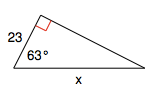
Find the length of side y.

a)

22.32 cm

b)

36.5 cm

c)

76.34 cm

d)

87.76 cm

37.
What is the length of side x?
a)
6.57 cm
b)
7 cm
c)
7.44 cm
d)
26.33 cm
38.
Find the length of side w.
a)
21.4 cm
b)
18.0 cm
c)
36.5 cm
d)
43.6 cm
39.

Find the measure of the indicated angle (?) round to the nearest tenth.

a)

9.4

b)

55.2

c)

20.15

d)

19.4

40.

Choose the correct set up to find the length of the side x.

a)

sin(37)=x/14

b)

cos(37)=x/14

c)

tan(37)=x/14

d)

sin(37)=14/x

41.
Find the ratio for sinA. (Reduce the fraction)
a)
36/27
b)
4/5
c)
36/45
d)
3/5
42.

What is the correct set up for the problem to solve for side w?

a)

sin 40 = w/28

b)

cos 40 = w/28

c)

tan 40 = w/28

d)

sin 40 = 28/w

43.

What is the correct set up for the problem to find the measure of the indicated angle?

a)

sin X = 41/28

b)

tan X = 41/28

c)

cos X = 28/41

d)

sin X = 28/41

44.

Find the length of side x.

a)

10

b)

11.3

c)

12.0

d)

15.0

45.

Find the length of side x.

a)

50.7

b)

50.1

c)

60.7

d)

61.0

46.

Find the measure of the indicated angle. Round to the nearest tenth.

a)

35.8°

b)

43.8°

c)

46.2°

d)

54.2°

47.

Find the measure of the indicated angle. Round to the nearest tenth.

a)

48.9°

b)

60.7°

c)

29.3°

d)

41.1°

48.
Give the Ratio for SIN X
a)
opp/adj
b)
Adj/hyp
c)
Opp/hyp
d)
adj/opp
49.
Give the Ratio for TAN X
a)
Adj/Opp
b)
Opp/Adj
c)
Adj/Hyp
d)
Opp/Hyp
50.
Give the Ratio for COS X
a)
Adj/Hyp
b)
Opp/Adj
c)
Adj/Opp
d)
Opp/Hyp
51.

Find the ratio for cosA. (Reduce the fraction)

a)

36/27

b)

4/5

c)

27/45

d)

3/5

52.
A building 62 feet tall casts a shadow 21 meters long.  At what angle is the sun shining on the building?
a)
19.80
b)
18.71
c)
70.20
d)
71.29
53.
Susan is flying a kite, which gets caught in the top of a tree.  Use the diagram to estimate the height of the tree. 
a)
63 ft
b)
65 ft
c)
74 ft
d)
87 ft
54.
You need a ladder that will reach up a 25 foot tall house when placed 10 feet away from the house. How tall does the ladder need to be?
a)
25 feet
b)
26 feet
c)
27 feet
d)
28 feet
55.
The foot of a ladder is placed 6 feet from a wall. If the top of the ladder rests 8 feet up on the wall, how long is the ladder? 
a)
10 ft
b)
14 ft
c)
17 ft
d)
100 ft
56.
1. Find X 
a)
28
b)
5
c)
55
d)
40
57.
1. Find ∠ AOC 
a)
130
b)
50 
c)
40
58.
Two angles added together to produce 90 degrees
a)
Supplementary
b)
Complementary
c)
Right
d)
Vertical
59.
Find the missing angle.
a)
60
b)
70
c)
50
d)
140
60.
What type of angle is this? 
a)
acute
b)
obtuse
c)
right
61.
These angles are...
a)
Complementary
b)
Supplementary
c)
Neither
62.
These angles are...
a)
Complementary
b)
Supplementary
c)
Neither
63.
Find the missing angle.
a)
47
b)
37
c)
57
d)
137
64.
What kind of angles are shown?(45 + 135 = 180)
a)
complementary
b)
supplementary
c)
adjacent
d)
corresponding
65.
What type of angle is shown? (Less than 90 degrees)
a)
acute
b)
obtuse
c)
right
d)
straight
66.
∠1 and ∠3 can best be described as - (opposite angles formed by intersecting lines.)
a)
complementary angles
b)
supplementary angles
c)
vertical angles
d)
adjacent angles
67.
complementary, supplementary, or neither?
a)
Complementary
b)
Supplementary
c)
Neither
68.
complementary, supplementary, or neither?
a)
Complementary
b)
Supplementary
c)
Neither
69.
What is the measure of the missing angle?
a)
76
b)
66
c)
156
d)
154
70.
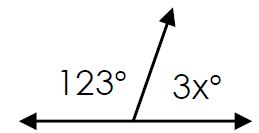
Find the value of x.
a)
15
b)
16
c)
18
d)
19
71.

What does deductive reasoning use to form its arguments?

a)

patterns

b)

specific cases

c)

observed examples

d)

facts, definitions, accepted properties, and laws of logic

72.

How would you describe the Law of Detachment symbolically?

a)

if p -> q is true and q is true; then p is true

b)

if p -> q is true and p is true; then q is true

c)

if p -> q and q -> r, then p -> r

73.

Use the Law of Detachment to determine what you can conclude from the given information, if possible.


If you passed the final, then you pass the class. You passed the final.

a)

You passed the class.

b)

You didn't pass the class

c)

Not possible

74.

Use the Law of Detachment to determine what you can conclude from the given information, if possible.


If your parents let you borrow the car, then you will go to the movies with your friend. You will go to the movies with your friend.

a)

Your parents let you borrow the car.

b)

Your parents didn't let you borrow the car.

c)

Not possible

75.

How would you describe the Law of Syllogism symbolically?

a)

if p -> q is true and q is true, then p is true.

b)

if p -> q is true and p is true, then q is true.

c)

if p -> q is true and q -> r is true, then p -> r is true

76.

Use the Law of Syllogism to write a new conditional statement that follows from the pair of true statements, if possible.


If x < -2, the |x| > 2. If x > 2, then |x| > 2.

a)

If x < -2, then x > 2.

b)

If |x| > 2, then x > 2.

c)

Not possible

77.

Use the Law of Syllogism to write a new conditional statement that follows from the pair of true statements, if possible.


If a figure is a rhombus, then the figure is a parallelogram. If a figure is a parallelogram, then the figure is a quadrilateral.

a)

If a figure is a rhombus, then the figure is a quadrilateral.

b)

If a figure is a quadrilateral, then the figure is a rhombus.

c)

Not possible

78.

Which law of logic is illustrated by these statements?


If you miss practice the day before a game, then you will not be a starting player in the game.

You miss practice on Tuesday. You will not start the game Wednesday.

a)

Law of Detachment

b)

Law of Syllogism

c)

Speed Limit

d)

None of the above

79.

Which law of logic is illustrated by the following statements?


If <1 and <2 are vertical angles, then <1 is congruent to <2. If <1 is congruent to <2, then m<1 = m<2.

If <1 and <2 are vertical angles, then m<1 = m<2.

a)

Law of Detachment

b)

Law of Syllogism

c)

5th Amendment

d)

Not possible

80.

If the school cafeteria sells pizza today, Greg is going to eat four pieces. Pizza is on sale for school lunch today.


Using deductive reasoning, what statement can you make based on this information?

a)

Lots of people will buy pizza.

b)

The school cafeteria sells pizza.

c)

Greg will eat four pieces of pizza.

d)

Greg needs to go on a diet.

81.
The type of reasoning where a person makes  conclusions based on observations and patterns is called...
a)
Inductive reasoning
b)
Deductive reasoning
c)
Conjecture
d)
Experiments
82.
What is a conjecture?
a)
A statement believed to be true based on observations.
b)
An example which disproves an hypothesis.
c)
the performance of tricks that are seemingly magical
83.
Complete the conjecture.  Think of examples to help.
The product of any two odd numbers is _____________
a)
even
b)
odd
c)
zero
d)
positive
84.
Find the next term in the sequence:
A, D, G, J, _____
a)
L
b)
M
c)
P
d)
K
85.
Find the seventh term in the sequence:
A, D, G, J, _____
a)
M
b)
P
c)
S
d)
V
86.
How many cubes would be in the 10th figure?
a)
18
b)
16
c)
17
d)
41
87.
What are the missing numbers in this pattern?
23, 33, ___, 53, ___, 73
a)
32, 62
b)
42, 63
c)
43, 63
d)
42, 62
88.
Where would the next red square be?
a)
bottom left
b)
top right
c)
top left
d)
bottom right
89.
a)
1
b)
15
c)
20
d)
12
90.
What are the missing numbers in this pattern?
12, 15, ___, 21, ____, 27
a)
18,23
b)
18, 24
c)
17, 25
d)
17, 24
91.
What are the next two numbers in this pattern?
12, 17, 22, 27, ___, ___
a)
32, 37
b)
30, 37
c)
30, 33
d)
32, 35
92.
What is the rule for this pattern?
1st term:32
2nd term:36
3rd term:40
a)
4x+28
b)
4x+32
c)
x+4
d)
4x
93.
How would you describe this pattern's rule?
65, 62, 59, 56, 53, 50
a)
Subtract 2
b)
Subtract 3
c)
Subtract 4
d)
Add 3
94.
What is the rule for this pattern?
32,36,40,44
a)
add 4
b)
multiply 2
c)
subtract 4
d)
divide by 2
95.
Used to prove that a conjecture is false.
a)
Counterexample
b)
Inductive Reasoning
c)
Concluding statement
d)
Conjecture
96.
Which number is a counterexample to the following statement? : 
All numbers that are divisible by 2 are divisible by 4
a)
0
b)
12
c)
28
d)
42
97.
Which is a counterexample of: The difference of two numbers is less than the greater number.
a)
(5) - (2) = 3
b)
(-5) - (4) = -9
c)
(2) - 0 = 2
d)
(3) - (3) = 0
98.
What is the next term in the sequence:
1, 1, 2, 3, 5, 8, 13, ...
a)
17
b)
20
c)
21
d)
24
99.
What are the next 2 numbers of this pattern?
23, 27, 31, 35, ___, ___
a)
37, 39
b)
40, 45
c)
39, 43
d)
38, 41
100.
What is the rule for this pattern?
32,36,40,44
a)
add 4
b)
multiply 2
c)
subtract 4
d)
divide by 2
101.
What comes next?
a)
The next term will have 16 blocks
b)
The next term will have 15 blocks.
c)
The next term will have 14 blocks.
d)
This is the end of the pattern.
102.
Identify the hypothesis and conclusion of the conditional statement:
If you give me twenty dollars, then I will be your best friend.
a)
Hypothesis: I will be your best friend
Conclusion: you give me twenty dollars
b)
Hypothesis: you give me twenty dollars
Conclusion: I will be your best friend
c)
Hypothesis: if you have to pay for friends
Conclusion: then you probably should reevaluate your life
d)
Hypothesis: you will not have to pay twenty dollars
Conclusion: if you have lots of friends
103.
Given, "If I have a Siberian Husky, then I have a dog." Identify the hypothesis.
a)
If I have a Siberian Husky.
b)
I have a Siberian Husky.
c)
Then I have a dog.
d)
HI have a dog.
104.
Given, "If angles are congruent, then the measures of the angles are equal." Identify the conclusion.
a)
If the angles are congruent.
b)
The angles are congruent.
c)
Then the measures of the angles are equal.
d)
The measures of the angles are equal.
105.
Given, "If angles are congruent, then the measures of the angles are equal." Identify the converse.
a)
If the measures of the angles are equal, then the angles are congruent.
b)
"If angles are not congruent, then the measures of the angles are not equal."
c)
If the measures of the angles are not equal, then the angles are not congruent.
d)
If the angles are not congruent, then the measure of the angles are equal.
106.
Is this statement true?
a)
True.  Class can't happen if a chair isn't occupied.
b)
False.  There are empty chairs here.
c)
True. 
d)
True.  There are no chairs here, so the hypothesis is true.
107.
If something is an angle, then it is acute. What is an appropriate counterexample?
a)
70⁰
b)
45⁰
c)
120⁰
d)
True. There is no counterexample.
108.
If something is a vehicle, then it is a Ford. What is an appropriate counterexample?
a)
Ford Mustang
b)
Dodge Charger
c)
Ford F150
d)
Both A and C are counterexamples.
109.
If an animal is furry, then it is a hamster. What would be an appropriate counterexample?
a)
goldfish
b)
frog
c)
elephant
d)
cat
110.
When taking the converse we ___________ the hypothesis and conculsion
a)
negate
b)
switch
c)
highlight
d)
switch and negate
111.
Which is the correct if-then statement for: "you will be late to school if you miss the bus."
a)
If you are late to school, then you will miss the bus.
b)
If you miss the bus, then you will be late to school
c)
If you sleep late, then you don't have to go to school.
d)
If you miss the bus, then you'll have to walk and be late.
112.
Given, "If angles are congruent, then the measures of the angles are equal." Identify the contrapositive.
a)
If the measures of the angles are equal, then the angles are congruent.
b)
If angles are not congruent, then the measures of the angles are not equal.
c)
If the measures of the angles are not equal, then the angles are not congruent.
d)
If the angles are not congruent, then the measure of the angles are equal.
113.
Original: If Emily is not late to class, then she will not be marked tardy.
What is this? If Emily is late to class, then she will be marked tardy.
a)
Converse
b)
Inverse
c)
Contrapositive
d)
Negation
114.
Which of the following is the inverse to the statement: 
"If you diet and exercise, then you will lose weight."
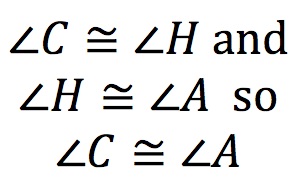
a)
If you don't diet and exercise, then you will not lose weight.
b)
If you don't diet and exercise, then you will lose weight.
c)
If you lose weight, then you dieted and exercised.
d)
If you don't lose weight, then you diet and exercise. 
115.
If <1 and <2 are complementary, then m<1 + m<2 = 90
a)
Addition POE
b)
Subtraction POE
c)
Def of right angle
d)
Def of Complementary Angles
116.
What is the justification?
a)
Symmetric Prop.
b)
Angle addition postulate
c)
Reflexive Prop
d)
Transitive Prop.
117.
AB = AB
a)
Reflexive POE
b)
Transitive POE
c)
Symmetric POE
d)
Distributive POE
118.
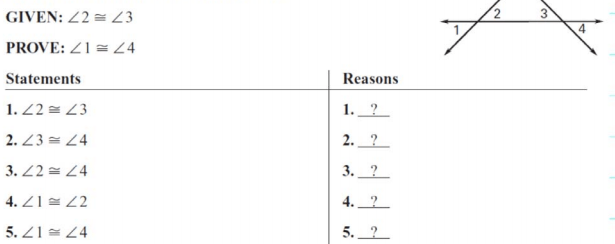
Which is the correct reason for statement 2 in the proof?
a)
Given
b)
Transitive Property
c)
Definition of Congruent Angles
d)
Vertical Angles are congruent.
119.
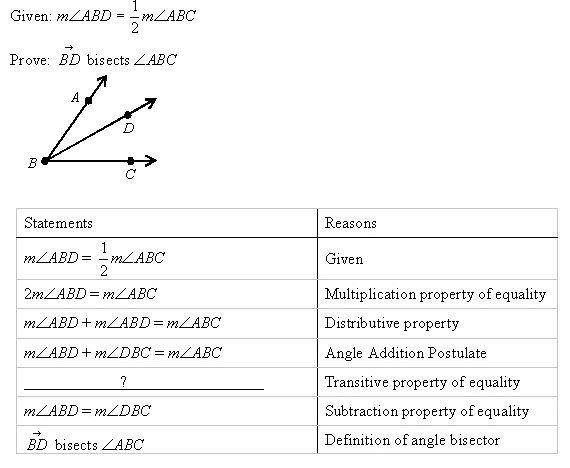
What is the missing statement in the proof?
a)
2m∠ABD=m∠ABD+m∠ABD
b)
m∠ABD=m∠DBC
c)
m∠ABC=m∠ABC
d)
m∠ABD+m∠ABD=m∠ABD+m∠DBC
120.
Step 2 is what
a)
Substitution property (simplify)
b)
Multiplication property of equality
c)
Division property of equality
d)
Distributive Property
121.
What is step 6
a)
Subtraction property of equality
b)
Addition property of equality
c)
Division property of equality
122.
What is reason 3?
a)
Addition Property of Equality
b)
Subtraction Property of Equality
c)
Multiplication Property of Equality
d)
Division Property of Equality
123.
What is reason 5?
a)
Transitive Property
b)
Reflexive Property
c)
Symmetric Property
d)
Prove
124.
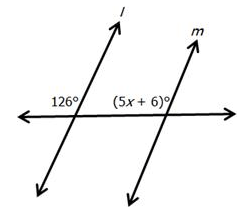
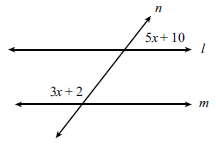
Which value of x will show that lines l and m are parallel?
a)
20
b)
22
c)
24
d)
25
125.
What value of x proves that line p is parallel to line r?
a)
14
b)
12.5
c)
15
d)
25
126.
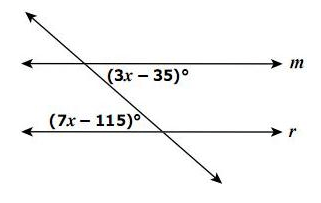
Which value of x will show that line m is parallel to line r?
a)
33
b)
25
c)
24
d)
20
127.

Identify each pair of angles.

a)

alternate exterior

b)

same-side interior

c)

corresponding

d)

alternate interior

128.

Identify each pair of angles.

a)

corresponding

b)

alternate exterior

c)

alternate interior

d)

same-side interior

129.

Identify each pair of angles.

a)

alternate exterior

b)

same-side interior

c)

alternate interior

d)

corresponding

130.

Identify each pair of angles.

a)

vertical

b)

corresponding

c)

alternate exterior

d)

alternate interior

131.

Identify each pair of angles.

a)

alternate interior

b)

alternate exterior

c)

corresponding

d)

same-side interior

132.

Identify each pair of angles.

a)

alternate interior

b)

same-side interior

c)

corresponding

d)

alternate exerior

133.

Identify each pair of angles.

a)

adjacent

b)

corresponding

c)

alternate exterior

d)

alternate interior

134.

Identify each pair of angles.

a)

alternate interior

b)

alternate exterior

c)

same-side interior

d)

corresponding

135.

Identify each pair of angles.

a)

alternate exterior

b)

alternate interior

c)

same-side interior

d)

corresponding

136.

Identify each pair of angles.

a)

alternate exterior

b)

alternate interior

c)

corresponding

d)

same-side interior

137.

Identify each pair of angles.

a)

alternate interior

b)

same-side interior

c)

corresponding

d)

alternate exterior

138.

Identify each pair of angles.

a)

corresponding

b)

alternate interior

c)

alternate exterior

d)

vertical

139.
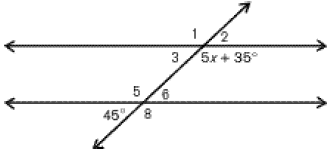
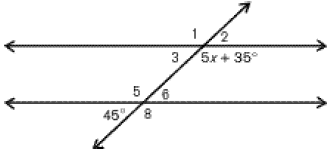
What is the measure of ∠2?
a)
38
b)
58
c)
71
d)
142
140.
What is the value of x?
a)
60
b)
26
c)
14
d)
10
141.
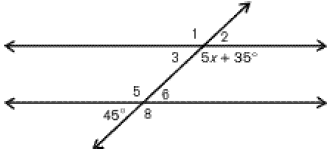
What is the measure of ∠8?
a)
55
b)
155
c)
135
d)
45
142.
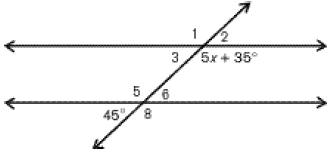
What is the measure of ∠3?
a)
55
b)
155
c)
45
d)
135
143.
What is the measure of ∠6?
a)
55
b)
155
c)
45
d)
135
144.
What type of angle pair is ∠1 and ∠5?
a)
alternate interior angles
b)
corresponding angles
c)
alternate exterior angles
d)
vertical angels. 
145.
What type of angle pair is ∠1 and ∠3?
a)
alternate interior angles
b)
 supplementary angles
c)
corresponding angles
d)
vertical angles 
146.
What is the value of x?
a)
70
b)
28
c)
140
d)
40
147.
What is the value of y? 
a)
20
b)
40
c)
28
d)
140
148.
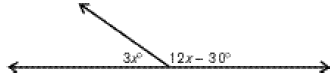
What is the value of x?
a)
-6
b)
22
c)
16
d)
21
149.
What are the values of the two angles? 
a)
18° and 152°
b)
30° and 150°
c)
42° and 138°
d)
45° and 135°
150.
What is the value of x?
a)
22°
b)
10°
c)
d)
151.
What is the measure of ∠ABC?
a)
25°
b)
75°
c)
108°
d)
150°
152.
In the diagram, which of the following statements are false?
a)
∠1 and ∠4 are vertical angles
b)
∠4 and ∠5 are alternate interior angles
c)
∠1 and ∠8 are alternate interior angles
d)
∠2 and ∠6 are corresponding angles