
 Worksheets
Quiz on Waste Incineration and Air Quality Protection
Total questions: 95
Worksheet time: 48mins
Which of the following best defines the term "Lower Heating Value" (Qi) as used in the calculation of heating values?
The amount of energy released per kilogram of fuel, excluding the latent heat of vaporization of water
The total energy released including the latent heat of vaporization of water
The percentage of hydrogen in the fuel sample
The moisture content of the fuel sample
If the hydrogen content (H) of a fuel sample is increased, what effect does this have on the calculated Lower Heating Value (Qi), assuming all other factors remain constant?
Qi decreases
Qi increases
Qi remains unchanged
Qi becomes zero
Explain why the multiplication factor 24.42 is used in the calculation of the Lower Heating Value.
It is derived from the latent heat of vaporization of water
It represents the conversion factor between hydrogen and water
It is the average higher heating value
It is the percentage of hydrogen in the sample
A sample has a higher heating value (Qs) of 30,000 kJ/kg, hydrogen content (H) of 6% (m/m), and moisture content (W) of 4% (m/m). Using the formula Qi = Qs - 24.42·(9·H + W), calculate the lower heating value (Qi).
28,321 kJ/kg
29,321 kJ/kg
30,321 kJ/kg
27,321 kJ/kg
Which formula is used to convert a test parameter (such as heat of combustion or hydrogen content) to another moisture state?
P_W2 = P_W1 * (100 - W2) / (100 - W1)
P_W2 = P_W1 * (W2 - W1) / 100
P_W2 = P_W1 * (100 + W2) / (100 + W1)
P_W2 = P_W1 * (W1 - W2) / (100 - W2)
What does W2 represent in the formula for recalculating a parameter to a different moisture content?
Reference moisture content, %(m/m)
Original moisture content, %(m/m)
Parameter in the original moisture state
Parameter recalculated to the reference moisture content
If you are given the lower heating value of an SRF sample at a certain moisture content, which procedure should you follow to recalculate it for 0%, 20%, and 40% moisture contents?
Use the conversion formula for moisture content
Add the moisture content percentages to the original value
Subtract the moisture content percentages from the original value
Multiply the original value by the moisture content percentage
Which parameter in the formula is recalculated to the reference moisture content?
P_W2
P_W1
W2
W1
Why is it important to recalculate the lower heating value of an SRF sample at different moisture contents?
Because moisture content affects the energy value of the sample
To increase the original moisture content
To decrease the reference moisture content
To avoid using any formula
Which of the following best describes combustion?
A chemical reaction where a fuel combines with oxygen, releasing heat and forming combustion products.
A physical reaction where a fuel is cooled down, absorbing heat.
A chemical reaction where oxygen is removed from a fuel, producing cold.
A physical reaction where a fuel is dissolved in water, releasing light.
Which of the following is NOT a required condition for combustion to take place?
A fuel
An oxidizing agent
Sufficient ignition temperature
High atmospheric pressure
If a system contains a fuel and an oxidizing agent but does not reach sufficient ignition temperature, what will most likely happen?
Combustion will occur immediately.
Combustion will not take place.
The fuel will evaporate.
The oxidizing agent will be consumed.
Strategically, why is it important to ensure all three conditions (fuel, oxidizing agent, and sufficient ignition temperature) are present in a combustion process?
To maximize the amount of light produced.
To guarantee the chemical reaction occurs and releases heat.
To prevent the formation of combustion products.
To reduce the amount of oxygen used.
Which of the following best describes an exothermic reaction?
A reaction that releases energy from the system in the form of heat.
A reaction that absorbs energy from its surroundings in the form of heat.
A reaction that does not involve any energy change.
A reaction that only occurs at low temperatures.
What is required for a chemical reaction to occur according to the information provided?
Collision between reacting molecules.
Presence of a catalyst only.
High temperature only.
Absence of light.
According to the broader sense, what does combustion refer to?
Any reaction that involves the release of heat and the emission of light.
Only reactions that produce visible flames.
Only reactions that absorb heat.
Reactions that occur without any energy change.
How does increasing the concentration of molecules in a given volume affect the reaction rate?
It increases the frequency of collisions and makes the reaction rate faster.
It decreases the frequency of collisions and slows the reaction rate.
It has no effect on the reaction rate.
It stops the reaction completely.
Which of the following statements is true about every chemical process?
It involves both material transformations and changes in energy.
It only involves material transformations.
It only involves changes in energy.
It does not involve any transformations or energy changes.
Why do we speak of fire in the context of chemical reactions?
Because the reaction produces visible flames, glowing embers, and an intense release of heat.
Because the reaction always produces smoke.
Because the reaction absorbs heat from the surroundings.
Because the reaction only occurs in the presence of water.
Which of the following is a necessary condition for combustion to occur?
Presence of combustible material
Absence of oxygen
Low temperature
Lack of fuel
What is the approximate percentage of oxygen in air that is sufficient for combustion?
21%
10%
5%
35%
If the oxygen concentration in air drops below 10%, what happens to combustion?
Combustion stops
Combustion becomes more efficient
Combustion continues as normal
Combustion produces more heat
Which statement best describes combustible materials?
Materials that combine with oxygen while releasing heat
Materials that do not react with oxygen
Materials that absorb heat without burning
Materials that only burn in the absence of oxygen
Why is ignition temperature important for combustion?
It determines the amount of heat needed to release combustible vapours or gases
It prevents the fuel from burning
It increases the oxygen concentration
It cools down the material
Suppose you are designing a combustion process. If the oxygen concentration falls to 15%, what is likely to happen?
Combustion becomes incomplete
Combustion stops immediately
Combustion becomes more efficient
Combustion produces no heat
A material burns easily, while another burns with difficulty. What does this suggest about the boundary between combustible materials?
There is no sharp boundary between materials that burn easily and those that burn with difficulty
All materials burn at the same rate
Only metals can burn easily
The boundary is clearly defined by color
A fuel is heated but does not combust. What could be a possible reason based on the conditions of combustion?
The temperature did not reach the ignition temperature
The oxygen concentration was above 21%
The fuel was already burned
The material was non-combustible

Which of the following best describes combustible materials?
They may ignite, smolder, or char when exposed to heat and continue to burn after the ignition source is removed.
They are not capable of igniting, glowing, or smoldering when exposed to heat.
They may ignite, smolder, or glow, but do not continue these effects after the ignition source is removed.
They melt when exposed to heat and do not burn.

What happens to non-combustible materials when exposed to heat?
They ignite and continue to burn.
They are not capable of igniting, glowing, or smoldering.
They smolder and glow briefly.
They melt and release toxic fumes.

Which statement correctly describes hardly combustible materials?
They continue to burn after the ignition source is removed.
They are not capable of igniting, glowing, or smoldering.
They may ignite, smolder, or glow, but these effects do not continue once the ignition source is removed.
They explode when exposed to heat.

A material is exposed to heat and begins to glow, but stops glowing as soon as the heat source is removed. How should this material be classified?
Combustible material
Non-combustible material
Hardly combustible material
Highly flammable material

If a material continues to burn even after the ignition source is removed, which classification does it belong to?
Non-combustible material
Hardly combustible material
Combustible material
Inert material
Which classification of materials requires reasoning about their behavior after the ignition source is removed?
Only non-combustible materials
Only combustible materials
Both combustible and hardly combustible materials
All three classifications
Which of the following is NOT listed as a factor influencing combustibility?
Chemical composition
Moisture content
Surface-to-volume ratio
Pressure gradient
Recall one of the main factors that influence the extent and nature of thermal transformation.
Chemical composition
Color of the material
Electrical conductivity
Magnetic susceptibility
Which factor would most directly affect the rate at which a material dries before combustion?
Surface-to-volume ratio
Moisture content
Oxygen supply
Ambient temperature
Ambient temperature can influence the combustibility of a material by:
Providing more energy for ignition and increasing the likelihood of combustion.
Having no effect on combustibility.
Always preventing combustion at lower temperatures.
Only affecting the color of the flame.
A researcher is comparing two samples: one with a high surface-to-volume ratio and one with a low surface-to-volume ratio. The sample likely to combust more rapidly is:
The sample with a high surface-to-volume ratio, because it exposes more area to oxygen and heat.
The sample with a low surface-to-volume ratio, because it retains heat better.
Both samples will combust at the same rate, regardless of surface-to-volume ratio.
The sample with a high surface-to-volume ratio, because it contains more moisture.

Which factor mainly determines the amount of oxygen required for combustion in different materials?
The chemical composition of the fuel
The color of the fuel
The temperature of the environment
The size of the combustion chamber
Which of the following is NOT a source of oxygen for combustion?
Combustion air or oxygen supply
Oxygenated fuel
Released oxygen
Nitrogen gas

A student is designing an experiment to compare the combustion of two different fuels. What should they primarily consider when determining the oxygen requirement for each fuel?
The chemical composition of each fuel
The color of the flames produced
The amount of smoke generated
The shape of the fuel pieces
Which of the following is NOT typically considered an ignition source?
Chemical energy
Physical energy
Electrical energy
Solar eclipse
Which of the following is an example of an ignition source that involves direct heat?
Open flame
Solar panel
Wind turbine
Water pump
A factory uses equipment that gets very hot during operation. According to the list of ignition sources, what type of ignition source does this represent?
Heat-producing equipment
Chemical energy
Electrical energy
Open flame
If a fire starts due to a short circuit in a wire, which ignition source category does this incident fall under?
Electrical energy
Physical energy
Chemical energy
Open flame
Which of the following ignition sources can result from a chemical reaction?
Chemical energy
Physical energy
Heat-producing equipment
Open flame
Which of the following is NOT listed as one of the most common ignition sources?
Hot surfaces
Flames and hot gases
Mechanical or visible electrical sparks
Solar radiation
What can hot machine parts or equipment ignite when they reach their ignition temperature?
Flammable vapors
Water vapor
Oxygen
Carbon dioxide
Which ignition source is described as providing extreme heat and energy that can start fires instantly?
Static electricity
Lightning
Hot surfaces
Flames and hot gases
Mechanical or visible electrical sparks can act as ignition sources in industrial environments because:
Sparks from friction, impact, or electrical faults can ignite vapors or dusts.
Sparks only occur in household environments and do not cause ignition.
Sparks are only dangerous if combined with lightning.
Sparks cannot ignite anything unless there is water present.
Which of the following best describes the role of static electricity as an ignition source?
It cools down flammable materials.
It may trigger ignition under suitable conditions due to electrostatic discharges.
It only occurs during thunderstorms.
It is not a concern in industrial environments.
Which of the following is a physical change that occurs during the process of ignition?
Temperature rise
Release of combustible vapors
Charring
Decomposition of material
What happens to the intensity of decomposition as the temperature increases during ignition?
It increases in parallel with the rising temperature
It decreases as temperature rises
It remains constant
It stops completely
Which of the following best describes a chemical change during the ignition process?
Deformation of the material
Change of state (sublimation)
Decomposition of the material releasing combustible vapors and gases
Temperature rise
After decomposition has started during ignition, what further change may occur to the material?
It may undergo charring
It may freeze
It may evaporate
It may become magnetic
Which of the following correctly explains the difference between physical and chemical changes during the process of ignition, with an example of each?
Physical changes involve changes like temperature rise or deformation, while chemical changes involve decomposition and release of gases; for example, temperature rise is physical, and charring is chemical.
Physical changes involve color change, while chemical changes involve melting; for example, color change is physical, and melting is chemical.
Physical changes involve the release of gases, while chemical changes involve deformation; for example, gas release is physical, and deformation is chemical.
Physical changes involve charring, while chemical changes involve temperature rise; for example, charring is physical, and temperature rise is chemical.
Which of the following best defines ignition temperature?
The lowest temperature at which gases and vapors released from a material will spontaneously ignite when mixed with air.
The temperature at which a liquid releases enough vapor to ignite momentarily.
The temperature at which a material melts.
The temperature at which a material freezes.
What is the main difference between flash point and ignition temperature?
Flash point is always lower than ignition temperature.
Flash point is always higher than ignition temperature.
Flash point and ignition temperature are always equal.
Flash point is unrelated to ignition temperature.
Why do materials like charcoal or coke not burn with a visible flame?
They do not release volatile hydrocarbons or other combustible vapors.
They are not flammable.
They have a very high flash point.
They contain water.
Which statement about flash point is correct?
It is the lowest temperature at which a flammable liquid releases enough vapor to ignite momentarily when exposed to an ignition source.
It is the temperature at which a solid material begins to melt.
It is the temperature at which a liquid boils.
It is the highest temperature at which a material can exist.
Gasoline has an ignition temperature of about 246°C and a flash point as low as -40°C. What does this large difference indicate about gasoline?
Gasoline can be extremely hazardous, even at room temperature.
Gasoline is safe to handle at all temperatures.
Gasoline cannot ignite at room temperature.
Gasoline has a low risk of combustion.
When heating a fuel to its ignition temperature, what is essentially provided for the chemical reaction to begin?
Activation enthalpy
Flash point
Freezing point
Boiling point
For both solid and liquid fuels, what actually burns during combustion?
The gases and vapors released from the fuel
The solid or liquid itself
The water content in the fuel
The ash produced by the fuel
At the flash point, why does the fuel not sustain continuous combustion?
It produces just enough vapor to ignite, but not enough to sustain combustion.
It produces too much vapor.
It is completely consumed.
It is not exposed to air.
The flash point of a liquid is always lower than its ignition temperature because:
At the flash point, the fuel produces just enough vapor to ignite momentarily, but not enough to sustain continuous combustion.
At the flash point, the fuel is frozen.
At the flash point, the fuel is not flammable.
At the flash point, the fuel is completely consumed.
Strategically, why is it important to know both the ignition temperature and flash point of a material when assessing fire hazards?
Because knowing both helps determine the conditions under which a material can ignite and sustain combustion, which is critical for safety and hazard assessment.
Because both values are always the same.
Because only the ignition temperature matters.
Because neither value is relevant to fire hazards.
Which of the following can initiate the ignition of a combustible material?
A flame
Water
Cold air
Low pressure
For most fuels, what is the typical indicator of ignition?
Appearance of a flame
Production of smoke only
Formation of ice
Emission of sound
What is required to start the combustion process in every case?
Activation energy
Cooling energy
Magnetic energy
Electrical energy
Which statement best explains why activation energy is needed for ignition?
It overcomes the initial barrier for the chemical reaction between fuel and oxygen.
It cools down the fuel to prevent combustion.
It increases the pressure to stop the reaction.
It removes oxygen from the environment.
A material burns without a visible flame but shows a dark red glow. What does this indicate?
Ignition has occurred without a flame.
The material is not burning.
The material is melting.
The material is evaporating.
Which of the following best defines activation energy?
The minimum excess energy required to make a molecule reactive.
The total energy of all reactants in a chemical reaction.
The energy released when a reaction occurs.
The energy required to cool down a substance.
Which of the following is NOT a way to provide the energy required for ignition?
Mechanical activation
Photochemical activation
Electrical activation
Chemical activation
Activation energy is related to which of the following processes?
Energy absorption
Energy emission
Energy dissipation
Energy storage
Based on the diagram, what effect does a catalyst have on the activation energy of a reaction?
It increases the activation energy.
It decreases the activation energy.
It has no effect on activation energy.
It eliminates the need for activation energy.
Suppose you are designing an experiment to initiate a chemical reaction. Which method could you use to provide the necessary activation energy, and why might you choose it over others?
Mechanical activation, because it can be applied physically to the reactants.
Photochemical activation, because it uses light to excite molecules.
Chemical activation, because it involves adding reactive chemicals.
Any of the above, depending on the nature of the reactants and desired reaction conditions.
Which of the following best describes the innermost zone of a flame?
Unburnt vapors/gases, low temperature
Complete combustion, highest temperature
Partial combustion, visible light
Glowing carbon particles, moderate temperature
What is the main characteristic of the outer zone of a flame?
Complete combustion, highest temperature
Partial combustion, visible light
Unburnt vapors/gases, low temperature
Glowing carbon particles, moderate temperature
Which statement is true about the middle zone of a flame?
It is where partial combustion occurs and glowing carbon particles produce visible light.
It is the hottest part of the flame with complete combustion.
It contains only unburnt vapors and gases.
It is the coolest part of the flame.
A student observes a candle flame and notices a blue outer zone, a yellow middle zone, and a black innermost zone. Based on this observation, which zone is likely to have the highest temperature and why?
The outer zone, because it is where complete combustion occurs.
The middle zone, because it contains glowing carbon particles.
The innermost zone, because it contains unburnt vapors.
The middle zone, because it is yellow in color.
Why do some solids like graphite, coke, and soot glow without producing a flame?
Because they do not produce vapors or gases that combust.
Because they undergo complete combustion.
Because they have the highest temperature.
Because they contain glowing carbon particles.

Which of the following statements is true about flame temperature?
The flame temperature is the same at all layers and heights.
The flame temperature varies in different layers and at different heights.
The flame temperature only depends on the type of fuel.
The flame temperature is always constant during combustion.
What will most likely happen if heat transfer from the flame is interrupted during combustion?
Combustion will continue indefinitely.
Combustion will stop shortly due to cooling.
The temperature of the flame will increase.
The fuel will ignite more rapidly.
In the case of solid fuels, what does the disappearance of the flame indicate?
The end of combustion.
The start of combustion.
Not necessarily the end of combustion.
The fuel has become liquid.
Suppose you are observing a solid fuel burning and the flame disappears, but the material is still hot. What can you infer about the combustion process?
Combustion has definitely ended.
Combustion may still be ongoing even without a visible flame.
The fuel has turned into gas.
The temperature has dropped below freezing.
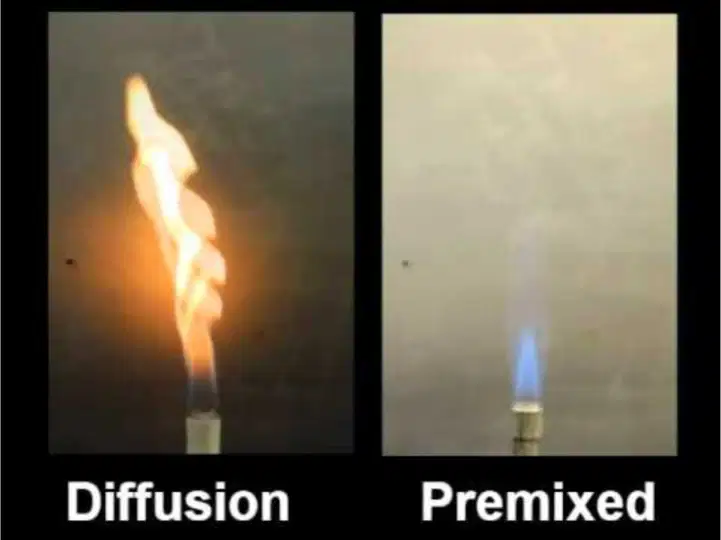
Which type of flame is characterized by oxygen for combustion coming only from outside and a yellow glow due to carbon particles?
Diffusion flame
Premixed flame
Blue flame
Catalytic flame
What is a key characteristic of a premixed flame compared to a diffusion flame?
It has a yellow color due to glowing carbon particles.
Fuel gas is mixed with air before leaving the burner.
Oxygen for combustion comes only from outside.
It is typical for burning solids.
Which type of flame is typically observed when burning solids?
Premixed flame
Diffusion flame
Blue flame
Catalytic flame
Why does a premixed flame usually appear bluish in color?
Because it contains glowing carbon particles.
Because fuel gas is mixed with air before combustion, preventing carbon particles from glowing.
Because oxygen comes only from outside.
Because it is typical for burning solids.
A laboratory experiment requires a flame with no glowing carbon particles and a bluish color. Which type of flame should be used, and why?
Diffusion flame, because it is typical for burning solids.
Premixed flame, because fuel gas is mixed with air before leaving the burner.
Diffusion flame, because oxygen comes only from outside.
Premixed flame, because it contains glowing carbon particles.
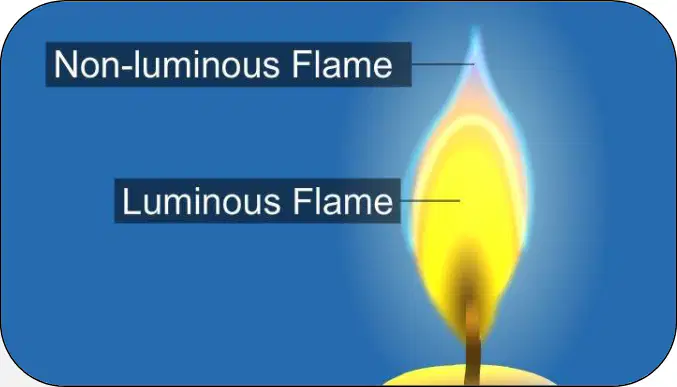
Which type of flame is produced when carbon-rich fuels such as wood, paper, or gasoline burn?
Luminous flame
Non-luminous flame
Blue flame
Invisible flame
Which of the following substances burns at relatively low temperature and produces weak light?
Sulfur
Methanol
Iron powder
Gasoline
Alcohols such as methanol and ethanol typically burn with which characteristic?
Little or no visible light, especially at low temperatures
Very strong and bright light
Blue flame with high temperature
Produces a lot of smoke
Which statement best describes the burning of metals like iron or aluminum powders?
They burn very hot but without strong light compared to typical flames.
They produce a luminous yellow flame.
They burn at low temperature with weak light.
They produce a lot of visible smoke.
What does the color of a flame mainly depend on?
The fuel composition, especially the oxygen, carbon, and hydrogen ratio
The size of the flame
The temperature of the surrounding air
The color of the container

