
 Worksheets
Psychology 3nd 9 weeks
Total questions: 129
Worksheet time: 2hrs 47mins
Why must the scientific method be used in all psychological research and testing?
Because psychology is an experimental science
Because psychology is based on opinions
Because psychology does not require evidence
Because psychology is not related to other sciences
Which of the following is an example of a psychological construct that cannot be measured directly?
Anxiety
Height
Weight
Temperature
What is a hypothesis in the context of scientific research?
An educated guess
A proven fact
A random idea
A final conclusion
Why is it important to test and retest a hypothesis, no matter how good it seems?
To prove it right through repeated evidence
To make it more complicated
To avoid using the scientific method
To skip the research process
What is the purpose of replication in psychological research?
To ensure that a study is only conducted once.
To produce the same results and view wider trends and findings.
To change the hypothesis every time.
To avoid analyzing the data.
How can new research questions arise from psychological studies?
Only if the findings support the original hypothesis.
Whether or not the findings support the hypothesis, further questions can be generated.
Only if the study is not replicated.
Only if the data is ignored.
Which of the following is a disadvantage of the survey method?
People may not be entirely honest in answering questions.
It is the fastest way to collect data.
It always provides accurate results.
It is the most expensive research method.
What is the main focus of the Longitudinal Method in psychological observation?
Observing participants at intervals over an extended period of time
Comparing differences among age groups at a single point in time
Observing behavior in a laboratory setting
Measuring abilities and interests through tests
If a researcher wants to observe the behavior of animals in their natural habitats, which method should they use?
Naturalistic Observation Method
Laboratory Observation Method
Testing Method
Case Study Method
A psychologist wants to measure a person's abilities, interests, and personality using several types of tests. Which method are they using?
Testing Method
Case Study Method
Longitudinal Method
Naturalistic Observation Method
What is correlation in the context of psychological observation methods?
The process of making random guesses
The measure of how closely one thing is related to another
The act of recording only negative outcomes
The method of ignoring unrelated variables
Which of the following best describes a positive correlation?
When one achievement goes up, the other goes down
When both achievements being measured go up together
When neither achievement changes
When one achievement is unrelated to the other
A psychologist observes that as people’s need to achieve increases, their earnings also increase. What type of correlation is this an example of?
Negative correlation
No correlation
Positive correlation
Random correlation
Why must psychologists analyze and interpret their observations?
To make random decisions
To understand how different variables are related
To ignore patterns in data
To focus only on negative outcomes
Which of the following is an example of the placebo effect?
A person feels better after taking a sugar pill, believing it is real medicine.
A person receives the actual treatment and recovers.
A researcher manipulates the independent variable.
A participant knows which group they are in.
Which statement best explains the purpose of using a placebo in an experiment?
To measure the effect of personal belief on the outcome.
To ensure all participants receive the treatment.
To manipulate the independent variable.
To make the experiment double blind.
Which of the following best describes the concept of "ethics" in research?
Standards for proper and responsible behavior
The process of collecting data
The use of technology in experiments
The financial cost of conducting research
Why is confidentiality important in research with people?
It ensures that people's records are private
It allows researchers to share data freely
It increases the number of participants
It reduces the cost of research
What is required for informed consent in a research study?
Participants agree to participate after being given a general description of the research
Participants are forced to join the study
Participants are paid large sums of money
Participants are not told anything about the study
Explain why researchers must provide an explanation to participants after a study involving deception. Use evidence from ethical guidelines to support your answer.
To ensure participants understand the true purpose and to address any potential harm caused by the deception
To increase the number of participants in future studies
To avoid legal consequences
To make the study results more interesting
True or False: The experimental group is not exposed to the independent variables
True
False
Why is replication important in experimental research?
It allows researchers to test the independent variable on different populations.
It ensures that the results of a study are due to the experimental manipulation and not other factors.
It provides an opportunity to test alternative hypotheses.
It confirms the findings of a study by producing similar results when the study is repeated under the same conditions.
How does random assignment benefit an experimental design?
It ensures that the experiment will yield significant results.
It reduces the likelihood that the results will be due to chance.
It increases the variability within each group for more robust findings.
It ensures that each participant has an equal chance of being assigned to any group, reducing selection bias.
any action that people can observe or measure
behavior
psychology
sociology
cognition
What is the scientific method?
A method to generate questions
A method to formulate theories
A method to develop hypotheses
All of the above
Match the following types of Operant Conditioning
Positive Reinforcement
Adding a pleasant consequence in order to encourage a behavior
Negative Reinforcement
Removing an unpleasant stimulus in order to encourage a behavior
Positive Punishment
Adding an unpleasant stimulus in order to discourage a behavior
Negative Punishment
Removing a pleasant stimulus in order to discourage a behavior
Which of the following functions is the human nervous system involved in?
Thinking
Breathing only
Digesting food only
Producing hormones only
What makes learning and memory possible in humans?
The digestive system
The nervous system
The respiratory system
The circulatory system
What is the main function of dendrites in a neuron?
Carry the message away
Produce energy for the cell
Receive information from other neurons and pass the message through the cell body
Insulate and protect the axon
How many axons does a typical neuron have?
Many
None
Only one
Two
Why is the presence of myelin important for the axon?
It helps the cell body produce energy
It allows dendrites to receive messages
It insulates and protects the axon
It branches out from the axon
Based on the structure of a neuron, explain why having many dendrites but only one axon is beneficial for neural communication.
Many dendrites allow the neuron to receive information from multiple sources, while a single axon ensures the message is sent in one clear direction.
Many axons would confuse the message.
One dendrite and many axons would speed up communication.
Having only one of each is more efficient.
What is a synapse?
A junction between the axon terminals of one neuron and the dendrites of another neuron.
The main body of a neuron.
The part of the neuron that receives messages.
The process of sending messages in both directions.
What do neurons use to send messages across synapses?
Hormones
Neurotransmitters
Enzymes
Blood cells
Which part of the nervous system transmits sensory images to the central nervous system and is activated by touch, pain, changes in temperature, and changes in body position?
The Automatic Nervous System
The Somatic Nervous System
The Digestive System
The Endocrine System
What is the main function of the Automatic Nervous System?
Transmitting sensory images to the brain
Regulating vital functions such as heartbeat, breathing, digestion, and blood pressure
Allowing us to feel pain and pressure
Maintaining posture and balance
How does the Somatic Nervous System help us maintain posture and balance?
By regulating blood pressure
By allowing us to feel sensations of hot and cold, pain, or pressure
By calming the body after emergencies
By preparing the body for action
A person is startled by a loud noise and their body prepares for action. Which part of the nervous system is primarily responsible for this response?
Parasympathetic System
Somatic Nervous System
Sympathetic System
Digestive System
What is the primary function of the medulla?
Controls balance and coordination
Regulates body movement, attention, sleep, and alertness
Controls vital functions such as heart rate, blood pressure, and breathing
Processes visual information
Explain how the medulla and pons work together to support vital body functions.
The medulla controls balance, while the pons controls breathing.
The medulla regulates heart rate and breathing, while the pons helps regulate body movement, attention, sleep, and alertness, supporting overall bodily function.
The medulla and pons both control only sleep.
The medulla and pons are not related in function.
Which part of the brain controls vision and hearing?
Midbrain
Hindbrain
Forebrain
Cerebellum
What is the main function of the reticular activating system?
Controls balance and coordination
Regulates attention, sleep, and arousal
Processes emotions
Controls voluntary muscle movements
Which structure in the forebrain serves as the relay sensor for sensory stimulation?
Thalamus
Hippocampus
Cerebellum
Medulla
What is one of the main functions of the hypothalamus?
Regulating body temperature
Controlling voluntary muscle movement
Producing cerebrospinal fluid
Transmitting visual information
Which system is involved in learning, memory, hunger, sex, and aggression?
Limbic system
Endocrine system
Digestive system
Respiratory system
A student is experiencing issues with body temperature regulation and increased aggression. Which brain structure is most likely affected?
Hypothalamus
Cerebellum
Medulla
Corpus callosum
What is the main function of the occipital lobe?
Hearing
Primary visual area
Language
Movement coordination
The cerebral cortex is made up of how many hemispheres?
One
Two
Three
Four
Information received on one side of the body is transmitted to which side of the brain?
The same side
The opposite side
The front side
The back side
Which of the following is NOT a lobe of the cerebral cortex?
Frontal
Parietal
Cerebellum
Occipital
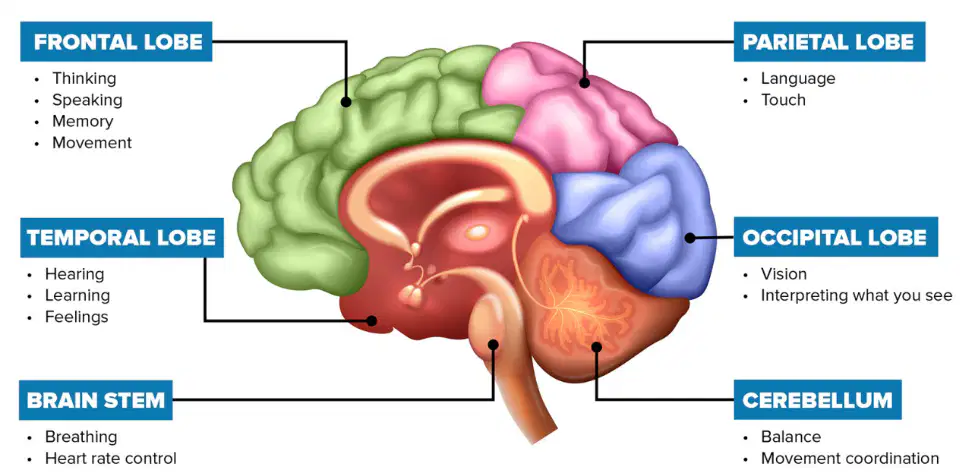
What is the function of the brain stem as shown in the diagram?
Vision and interpreting what you see
Breathing, heart rate control, and temperature
Balance and movement coordination
Thinking and memory
If the body produces too much thyroxin, what condition may develop and what are its symptoms?
Hypothyroidism; fatigue and weight gain
Hyperthyroidism; excitability, inability to sleep, and weight loss
Diabetes; increased thirst and urination
Anemia; weakness and pale skin
What is the function of the cortical steroids produced by the outer layer of the adrenal glands?
Increase resistance to stress and promote muscle development
Regulate blood sugar levels
Control body temperature
Aid in digestion
Which emotion can be intensified by adrenaline?
Fear
Happiness
Boredom
Curiosity
Which of the following is NOT a physical trait mentioned as being transmitted through heredity?
Height
Hair texture
Eye color
Blood pressure
label the parts of the neuron
Dendrites
cell body
axon
axon terminals
Where is the hypothalamus?
Where is the Occipital Lobe?
Click on the cerebrum
Where is the Parietal Lobe?
Where is the Frontal Lobe?
Identify the location of the dendrites on the diagram.
Click the circle that is pointing to the cell body

Match the following structures to their function
cell body
does the work of the cell (contains organelles)
dendrites
receives the signal and brings the impulse toward the cell body
axon
sends the signal away from the cell body
myelin sheath
insulates the electrical signal
neurotransmitters
chemical messengers that carry the signal across the synapse to the receiving neuron
Coordinates all actions and reactions of the body using electrical signals (a)
Which of the following explains how animals are able to sense sounds in their environment?
Each kind of sound triggers a different cell in the inner ear.
Sound waves enter the brain through openings in the skull.
Receptors pick up the information about sound waves and send it to the brain.
The ears send signals out into the environment and interpret what comes back.
Different sensory receptors are located in different parts of the body. How might sensory receptors in the eyes differ from those in other parts of the body? Sense receptors in the eyes need to be -
larger than other kinds of receptors.
sensitive to changes in the light.
able to send information to the muscles.
able to send information to the muscles.
What is the missing step in sensor receptors?
- Receive information from the environment.
- ?
- Information is processed and response is selected.
- Response is sent to the correct body system.
Information stored for later use
Information sent to the brain
Body systems respond to information
Body systems respond to information
What adaptation does a mouse have to allow it to use its sense of smell to find food?
Front paws for holding fruit
Special cells in its nose
Feeding mostly at night
Strong teeth to crush seeds
How does memory help guide the actions of an animal?
Animals can remember things that have happened long ago.
Memories are stored in the brains of most animals.
Animals can avoid actions that have been harmful to them in the past.
Memories will not be passed on from parents to offspring.
What is sense receptor?
a memory in ones brain
things that detect change in ones environment
way to smell things
all the above
Which of these is NOT one of your five senses?
touch
smell
taste
teeth
Some animals sense receptors can be stronger than others.
True
False
Memories are information stored in the brain.
True
False
Animals have special sense receptors that humans don't have?
True
False
James touches a hot pan and yells "ouch", what sense receptor caused him to react and yell ouch?
smell
touch
hearing
sight
Karson sees the smoke from a boiling pan, what sense receptor tells him not to touch the pan
sight
hearing
touch
smell
Riley is playing with her friends and notices a skunk lifting it tail, which explanation best describes why the skunk lifted its tail?
the skunk likes Riley and her friends
the skunk feels threatened
the skunk is hungry
the skunk is getting ready to fly
You are hungry and walk into a kitchen, what sense receptor helps tell you that you are ready to eat?
smell
sight
hearing
touch
Ashlyn likes chocolate and when she sees chocolate, she wants it. What sense receptor is telling Ashlyn that she wants chocolate?
sight
touch
hearing
smell
Which body part(s) is/are associated with the sense of taste?
Brain
Skin
Tongue
Nose
Eyes
When your nose is plugged, you're still able to distinguish different flavors.
False
True
What organ has the ability to use input from the senses to tell us what we smell, see, taste, hear, or feel?
Muscles
Heart
Skeleton
Brain
How many different tastes can your tongue detect?
2
4
5
3
Everyone has a blind spot.
False
True
The sense of taste includes all of the following EXCEPT __________.
Sweet
Spicy
Sour
Bitter
What organ is associated with the sense of touch
Finger Tips
Hands
Skin
Feet
Your dominant eye is always on the same side as the hand you write with.
True
False
Where on your tongue are the LEAST amount of taste buds found?
Front
Back
Sides
Middle
If we were to lose sight from one of our eyes, what would be the result?
Loss of color vision
Loss of depth perception
Loss of vision entirely
Permanent tunnel vision
According to Drive Theory, behavior is primarily motivated by the desire to
achieve social status
maintain internal balance and homeostasis
seek new sensations
receive external rewards
Which of the following is the best example of homeostasis?
A. Eating dinner when bored
B. Eating to reduce hunger
C. Watching TV to relax
D. Studying to earn an A
The Arousal Theory of motivation suggests people are driven to
reduce tension caused by needs
maintain an optimal level of stimulation
seek only physical pleasure
maximize rewards and minimize punishment
Which activity best illustrates the Arousal Theory?
Eating breakfast
Sleeping eight hours a night
Riding a roller coaster for fun
Working to earn a paycheck
The Incentive Theory focuses on
A. unconscious desires
B. rewards and punishments that pull behavior
C. restoring homeostasis
D. internal growth and creativity
Which example shows extrinsic motivation?
A. Painting for enjoyment
B. Running because it reduces stress
C. Studying to avoid failing a test
Which example shows intrinsic motivation?
Cleaning your room to avoid punishment
Practicing guitar because you enjoy it
Working overtime for extra pay
Running to impress others
Maslow’s hierarchy of needs suggests that
all needs are equally important
lower needs must be met before higher needs
higher needs drive behavior first
social needs are unrelated to motivation
Which level of Maslow’s hierarchy involves food, water, and shelter?
Safety
Physiological
Esteem
Self-actualization
The need to feel respected and accomplished refers to which level of Maslow’s hierarchy?
Safety
Esteem
Belonging
Self-actualization
Helping others or seeking personal growth would best fit which level of Maslow’s hierarchy?
Esteem
Love/Belonging
Safety
Self-actualization
Which statement reflects a person motivated by safety needs?
I just want to make enough money to pay rent.
I hope people at school like me.
I want to become a better version of myself.
I feel proud of my recent success.
The overjustification effect is best described as:
A decrease in intrinsic motivation due to external rewards.
An increase in motivation when given external rewards.
A tendency to justify one's actions regardless of motivation.
A preference for intrinsic motivation over extrinsic motivation.
A student who once loved drawing loses interest after being paid for each picture. This shows
incentive theory
intrinsic motivation
overjustification effect
arousal theory
A student studies hard because learning is enjoyable. This reflects
intrinsic motivation
extrinsic motivation
drive reduction
incentive motivation
A person working overtime for a promotion is demonstrating
intrinsic motivation
extrinsic motivation
self-actualization
overjustification
A marathon runner who feels energized after finishing a race is likely experiencing
drive reduction
overjustification
optimal arousal
extrinsic motivation
Which theory best explains why someone eats dessert even when full?
Drive
Arousal
Incentive
Maslow's hierarchy
According to Maslow, someone volunteering regularly at a homeless shelter is likely meeting
esteem needs
self-actualization
belonging needs
Which of the following statements best summarizes motivation?
Motivation is always caused by external rewards.
Motivation results from internal drives and external incentives.
Motivation is only biological.
Motivation has little influence on behavior.
Which of the following best describes encoding?
The process of recalling stored information
The process of organizing information for later use
The process of taking in information and transforming it into memory
The process of permanently forgetting irrelevant details
Which stage of memory involves maintaining information over time?
A. Encoding
B. Retrieval
C. Storage
D. Chunking
Remembering the smell of cookies immediately after walking into a bakery is an example of:
Long-term memory
Sensory memory
Short-term memory
Working memory
Short-term memory typically lasts for about:
A. A few milliseconds
B. 15–30 seconds
C. Several hours
D. One day
According to cognitive research, which strategy most effectively improves long-term memory?
Cramming right before a test
Passive rereading
Spaced practice and self-testing
Listening to background music while studying
We register information into memory first in (a) memory before it is (b) into short-term memory
When information is said to be available but not accessible due to misleading information, failure occurred in the (a) stage
What is an effective strategy for improving memory retention?
Studying the material once in a large block of time
Reading through notes passively
Using mnemonic devices to aid memorization
Listening to music while studying
🎓 In the quest for exam mastery, what's Alejandro's secret weapon for remembering complex formulas?
Writing them on the back of his hand.
Turning them into catchy songs.
Repeating them like a mantra before sleep.
Ignoring them and hoping for the best.
What is the first stage of memory where information is processed from the senses?
Sensory memory
Long-term memory
Working memory
Short-term memory
Which of the following is a technique to improve memory retrieval?
Multitasking while studying
Studying in a loud environment
Using mnemonic devices
Limiting sleep the night before a test
Which type of memory is responsible for holding information temporarily for analysis and is limited in capacity?
Long-term Memory
Sensory Memory
Short-term Memory
Procedural Memory
What is the term for the process of accessing stored information in the brain?
Encoding
Retrieval
Storage
Rehearsal
What is the process called when your brain accesses information from the past?
Encoding
Forgetting
Retrieval
Storage
Which is NOT a part of memory?
Encoding
Storage
Retrieval
Criticism

