
 Worksheets
Intravenous Medication Principles ch 7
Total questions: 89
Worksheet time: 45mins
What is one of the physiochemical considerations mentioned in the contents for intravenous medication principles?
Osmolarity and Tonicity
Drug Absorption Rate
Oral Bioavailability
Tablet Disintegration
Which type of incompatibility involves the use of non-PVC containers for certain drugs?
Container Incompatibility
Chemical Incompatibility
Physical Incompatibility
Temperature Incompatibility
If a drug must be mixed only in saline, under which incompatibility category would it be listed?
Drugs to Mix in Saline Only
Drugs to Mix in Dextrose Only
Diluent Incompatibility
Chemical Incompatibility
Why might some intravenous drugs require protection from light during administration?
To prevent degradation and maintain stability
To enhance absorption
To reduce viscosity
To increase tonicity
What is the purpose of using filters with certain intravenous drugs?
To remove particulate matter and ensure safe administration
To increase drug potency
To change the drug’s color
To reduce the drug’s pH
Which section would you refer to for information on high-risk incompatibilities in intravenous medication principles?
Incompatibilities
Filters
Temperature & Stability
Venous Catheters
What is a recommended storage instruction for some intravenous medications according to the contents?
Do Not Refrigerate
Store in direct sunlight
Freeze before use
Keep at room temperature only
Which of the following is the preferred route for drug delivery?
Enteral administration
Intravenous administration
Intramuscular administration
Subcutaneous administration
Which parenteral route is often used by anesthesiologists and for some chemotherapy, but is contraindicated for certain drugs?
Intravenous
Intramuscular
Intrathecal
Subcutaneous
Why might oral drugs not be suitable for hospitalized patients who are NPO?
They have high bioavailability
The gut needs to be bypassed
They are absorbed too quickly
They are always safe for emergencies
Which of the following is a reason to use a parenteral route of drug administration?
When fast onset is needed
When the drug is always stable
When the drug is always cheap
When the drug is always oral
What does osmolarity reflect in a solution?
The pressure gradient created by solutes
The color of the solution
The temperature of the solution
The viscosity of the solution
Which type of sodium chloride solution is considered hypertonic?
Greater than 0.9% sodium chloride
Less than 0.9% sodium chloride
Exactly 0.9% sodium chloride
0.45% sodium chloride
What can happen if hypertonic saline injections are given erroneously into a peripheral vein?
Water moves out of red blood cells, causing them to shrivel
Red blood cells absorb water and burst
No effect on red blood cells
Red blood cells multiply rapidly
Why is hypertonic saline often restricted to the pharmacy and only dispensed for administration in specific areas of the hospital?
To avoid adverse outcomes and ensure safety
Because it is cheap
Because it is always stable
Because it is always used for nutrition
What is the lowest saline concentration that should be administered intravenously?
0.45% sodium chloride
0.9% sodium chloride
3% sodium chloride
23.4% sodium chloride
What is the normal pH range of blood?
7.35 – 7.45
6.35 – 6.45
8.35 – 8.45
5.35 – 5.45
What happens to blood pH when it becomes more basic?
Hydrogen ions are released from carbonic acid
Hydrogen ions are picked up
Bicarbonate binds with protons
The pH decreases
Why must drugs administered intravenously be formulated to keep the pH within a narrow range?
To avoid damaging the veins and other tissues
To increase the color of the solution
To make the drug taste better
To reduce the cost of the drug
Which buffer system helps maintain blood pH?
Carbonic acid-bicarbonate system
Sodium chloride system
Potassium buffer system
Calcium buffer system
Why is it important for a pharmacist to understand the aspects of intravenous administration, such as compatibility and stability issues?
To ensure safe and effective drug delivery
To make drugs taste better
To reduce the cost of drugs
To increase the color of drugs
How does tonicity differ from osmolarity in terms of intravenous drug administration?
Tonicity reflects the pressure gradient created by solutes that do not cross biological membranes, while osmolarity reflects all solutes per liter of solution
Tonicity measures the color of the solution, while osmolarity measures the taste
Tonicity is only important for oral drugs, while osmolarity is for intravenous drugs
Tonicity and osmolarity are exactly the same
What is the consequence of administering a hypotonic solution intravenously?
Red blood cells will absorb fluid and may burst (hemolysis)
Red blood cells will shrivel
No effect on red blood cells
Red blood cells will multiply
A patient requires rapid onset of drug action in an emergency. Which route of administration would be most appropriate and why?
Intravenous, because it allows for immediate drug effect
Oral, because it is always the fastest
Intramuscular, because it is always slow
Subcutaneous, because it is always delayed
If a hospital pharmacist is preparing a parenteral nutrition solution, what factors must be considered to avoid adverse effects related to osmolarity?
Ensure the osmolarity is appropriate to prevent damage to red blood cells and restrict hypertonic solutions to safe administration areas
Only consider the color of the solution
Ignore the osmolarity and focus on taste
Use only hypotonic solutions
Explain why maintaining blood pH is critical when administering intravenous drugs and how buffer systems help achieve this.
Maintaining blood pH prevents tissue damage, and buffer systems like the carbonic acid-bicarbonate system help stabilize pH
Blood pH is not important for drug administration
Buffer systems only affect drug color
Buffer systems are not present in blood
Which type of catheter is inserted into a vein and used for drug delivery?
Venous catheter
Urinary catheter
Arterial catheter
Nasogastric catheter
What is the main difference between peripheral lines and central lines?
Peripheral lines are inserted into smaller veins, while central lines are inserted into larger veins.
Peripheral lines are used for urinary catheterization, while central lines are used for drug delivery.
Peripheral lines are only used in the legs, while central lines are only used in the arms.
Peripheral lines require X-ray confirmation, while central lines do not.
Which vein is commonly used for peripheral venous catheters in the arm?
Cephalic vein
Femoral vein
Jugular vein
Brachiocephalic vein
What is phlebitis?
Vein irritation
Blood clot formation
Drug dilution
Catheter dislodgement
Which of the following is a benefit of central lines compared to peripheral lines?
Ability to administer higher volumes and infuse at faster rates
Lower risk of infection
No need for X-ray confirmation
Used only for short-term drug delivery
Which type of drug is most likely to require administration through a central line due to risk of severe tissue damage?
Vesicants
Antibiotics
Analgesics
Antihistamines
Why are vesicants safer when administered through a central line?
The line is less likely to become dislodged from the vein
The drug is more concentrated
The catheter is shorter
The vein is smaller
Which of the following is NOT a reason for using a central line?
Administration of highly concentrated drugs
Administration of drugs with high osmolarity
Administration of drugs with a pH close to blood pH
Administration of long-term antibiotics
What is the purpose of confirming central line placement with an X-ray?
To ensure the tip has reached the right location
To check for blood clots
To measure drug concentration
To monitor infusion rate
Which of the following is a potential complication of administering drugs through a peripheral line?
Phlebitis, thrombosis, and extravasation
Severe tissue damage from vesicants
High osmolarity tolerance
Long-term vascular access
A vesicant drug can cause which of the following if the catheter tip comes out of the vein?
Severe tissue damage
Blood pressure drop
Increased drug absorption
Reduced drug efficacy
Which of the following is a vesicant drug?
Doxorubicin
Paracetamol
Amoxicillin
Ibuprofen
What should be done if IV promethazine is used to reduce the risk of severe tissue injury?
Dilute the drug, limit the dose, and monitor
Administer the drug rapidly
Use intra-arterial route
Avoid monitoring the patient
What does "incompatible" mean in the context of intravenous medication principles?
Substances are unsuitable for use together
Substances are always safe to use together
Substances are always chemically identical
Substances are always physically identical
Which of the following is an example of chemical incompatibility?
Drug degradation due to hydrolysis
Drug stored in a glass container
Mixing two drugs in the same syringe
Using a non-PVC container
Physical incompatibility can occur between a drug and which of the following?
The container, the diluent, or another drug
Only the container
Only the diluent
Only another drug
What is the main risk associated with DEHP leaching from PVC containers?
Toxicity that can harm the liver and possibly male fertility
Increased drug potency
Reduced drug absorption in the body
Enhanced drug stability
Which of the following drugs requires a non-PVC container?
Amiodarone
Ceftriaxone
Vancomycin
Metronidazole
Why might clinicians use non-PVC containers for certain drugs?
To prevent leaching, absorption, or adsorption issues
To increase the drug's color
To make the drug taste better
To reduce the cost of administration
Which solution is acceptable for most drugs when diluted for IV administration?
5% dextrose (D5W) or 0.9% sodium chloride (NS)
Only sterile water
Only 10% dextrose
Only 0.45% sodium chloride
Which of the following drugs should be mixed in dextrose only?
Amphotericin B (all)
Lorazepam
Insulin
Nitroglycerin
If a drug is known to adsorb to PVC, what is a suitable alternative container material?
Polyolefin, polypropylene, or glass
Cardboard
Aluminum foil
Paper
A patient requires an IV infusion of insulin. What considerations should you make regarding the choice of container and tubing, and why?
Use non-PVC containers and tubing because insulin adsorbs to PVC, which can affect glucose control
Use any container, as insulin is stable in all materials
Use only glass containers to prevent oxidation
Use PVC containers to enhance insulin absorption
Which of the following drugs should be mixed in saline only, according to the mnemonic "A DIabetic Can't Eat Pie"?
Ampicillin
Vancomycin
Gentamicin
Ceftriaxone
What is the main reason for confirming additive compatibility when mixing drugs in the same container?
Drugs will be in contact for a longer period of time, which may affect compatibility.
It is required by law for all IV medications.
It reduces the cost of medication administration.
It increases the potency of the drugs.
Which combination is considered high-risk and should be avoided due to the risk of precipitate formation?
Ceftriaxone and calcium-containing solutions
Ampicillin and saline
Daptomycin and dextrose
Phenytoin and water
What is the purpose of a Y-site in IV administration?
To join fluids from different IV containers before entering the patient
To filter out bacteria from IV fluids
To increase the speed of drug infusion
To monitor the patient's blood pressure
Which reputable resource can be used to check for drug compatibility information?
ASHP Injectable Drug Information
World Health Organization (WHO) website
Centers for Disease Control and Prevention (CDC) guidelines
Food and Drug Administration (FDA) recall list
A patient is prescribed both ceftriaxone and Lactated Ringer’s solution. What should the pharmacist do?
Avoid mixing them due to the risk of precipitate formation
Mix them together for faster administration
Dilute both drugs in dextrose before mixing
Administer both drugs orally
Why is it important to ensure drugs are compatible with Y-site administration?
Because drugs mix briefly in the common portion of the IV tubing
Because it increases the drug's effectiveness
Because it reduces the need for monitoring
Because it prevents the need for refrigeration
What is a potential fatal risk when mixing calcium and phosphate in intravenous fluids?
Formation of precipitates leading to emboli and fatality
Increased drug absorption
Reduced drug potency
Development of antibiotic resistance
Which of the following statements best describes additive compatibility?
It refers to the compatibility of drugs mixed in the same container or syringe.
It refers to the compatibility of drugs given orally.
It refers to the compatibility of drugs stored in the same pharmacy.
It refers to the compatibility of drugs with food.
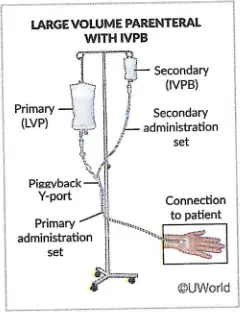
A nurse is preparing to administer two IV medications using a Y-site. What should be checked before administration?
Y-site compatibility of the drugs
The color of the IV fluids
The patient's age
The time of day
Which of the following statements best describes the purpose of a reference table in intravenous medication principles?
To check drug compatibility between a reference drug and a tested drug.
To determine the cost of medications.
To identify the manufacturer of a drug.
To calculate the dosage of a drug.
What does the remark "cloudiness" indicate when mixing cefepime and gentamicin in D5W or NS?
The solution is safe to use.
A precipitate has formed.
The drugs are fully compatible.
The solution is sterile.
According to the reference table, what is the compatibility status of cefepime and gentamicin when mixed in D5W, NS at the concentrations listed in the first table?
Compatible
Incompatible
Unknown
Partially compatible
Which filter size is most commonly used to remove particulates from IV solutions?
0.22 micron
1.2 micron
5 micron
10 micron
For which purpose is a 1.2 micron filter typically used in IV administration?
To catch calcium-phosphate particulates and for injectable lipid emulsions.
To remove bacteria from solutions.
To filter out viruses.
To sterilize the IV tubing.
Why must large molecule drugs, including many liposomal formulations of chemotherapy, not be filtered during IV administration?
The filter may remove the active drug particles.
The filter increases the risk of infection.
The filter makes the drug more potent.
The filter changes the color of the drug.
Which of the following drugs requires a filter when administered by continuous infusion, but not by IV push?
Phenytoin
Amiodarone
Golimumab
Mannitol
What is the main reason for using an in-line filter when administering IV medications?
To remove particulates, precipitates, crystals, and contaminants.
To increase the speed of drug administration.
To reduce the cost of medication.
To improve the taste of the solution.
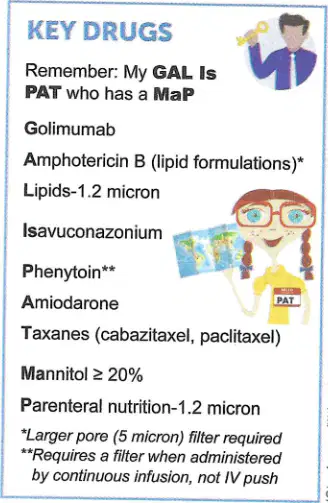
Which of the following drugs listed in the "Key Drugs" box requires a 1.2 micron filter?
Lipids
Golimumab
Infliximab
Abatacept
If compounding IV medications packaged in glass ampules, which tool should be used to prevent glass particulates from entering the IV bag?
Filter needle or filter straw
Syringe without a filter
Regular needle
Cotton swab
Which of the following statements best describes a drug that is considered "stable"?
It remains unchanged at any concentration, temperature, and light exposure.
It is stable only at select concentrations, for a certain time, at a certain temperature, and with a certain degree of light exposure.
It is stable only when refrigerated.
It is stable only in solid form.
What effect does higher temperature have on drugs in solution?
It slows down chemical reactions and increases drug stability.
It speeds up chemical reactions and breaks down proteins, reducing drug stability.
It has no effect on drug stability.
It only affects solid drugs, not solutions.
Which of the following drugs should NOT be refrigerated because they crystallize or precipitate?
Acetaminophen, Acyclovir, Deforoxamine, Levetiracetam, Pentamidine
Furosemide, Phenytoin, Dexmedetomidine, Sulfamethoxazole/Trimethoprim, Metronidazole
Epoprostenol, Doxycycline, Anthracyclines, Dacarbazine
Albumin, Insulin, Monoclonal antibodies
Which process destroys some drugs and can increase a drug’s toxicity when exposed to light?
Hydrolysis
Photodegradation
Oxidation
Crystallization
Which of the following drugs require protection from light during administration?
Acetaminophen, Acyclovir, Deforoxamine
Epoprostenol, Nitroprusside, Micafungin, Doxycycline
Albumin, Insulin, Monoclonal antibodies
Furosemide, Phenytoin, Dexmedetomidine
Why should some drugs not be shaken or agitated during transport or reconstitution?
Shaking increases their potency.
Shaking destroys easily damaged drugs, such as proteins and hormones.
Shaking improves their stability.
Shaking is required for proper mixing.
Which of the following is a correct procedure for reconstituting drugs that foam, such as alteplase, etanercept, rasburicase, and caspofungin?
Shake vigorously until foam disappears.
Swirl gently and wait for foam to dissolve.
Heat the solution to dissolve foam.
Add ice to reduce foaming.
A pharmacy technician is preparing an IV drug that is listed as "DO NOT REFRIGERATE." What is the most likely reason for this instruction?
The drug is more stable at higher temperatures.
The drug crystallizes or precipitates when refrigerated.
The drug loses potency at room temperature.
The drug is sensitive to light.
Which of the following is NOT a reason why drugs may require protection from light?
Light exposure can cause photodegradation.
Light exposure can increase drug toxicity.
Light exposure can improve drug efficacy.
Light exposure can cause drug degradation.
A nurse is about to administer a medication that is sensitive to light. What is the best practice to ensure drug stability?
Store the drug in clear vials.
Protect the drug from light using amber vials or light-protective covers.
Refrigerate the drug at all times.
Shake the drug before administration.

Which color change in nitroprusside indicates nearly complete dissociation to cyanide?
Blue
Orange
Brown
Pink
What is the normal color of tigecycline IV solution?
Green/black
Yellow/orange
Blue
Red
Which IV drug can cause discoloration of teeth if used during teeth development?
Methotrexate
Anthracyclines
Tigecycline
IV Iron
If a parenteral solution contains particulates, what should be done?
Shake the solution
Discard the drug
Warm the solution
Add more solvent
Which drug should not be used if the solution is darker than slight yellow, but is okay to use if it is only slightly yellow?
Dopamine
Morphine
Dacarbazine
Isoproterenol
Explain why oxidation in dobutamine solution does not result in loss of potency, even though the solution turns slightly pink.
The pink color indicates complete decomposition.
The potency is retained despite the color change.
The solution should be discarded if pink.
The color change is due to contamination.
A patient’s urine turns red after receiving an IV drug. Which drug is most likely responsible?
Mitoxantrone
Anthracyclines
Methotrexate
Multivitamins for Infusion (MVI)
What is the recommended action if a solution of isoproterenol appears pink or darker?
Use the solution as normal
Discard the solution
Add more isoproterenol
Heat the solution
Which IV drug is associated with blue colored skin, eyes, and urine?
Rifampin
Mitoxantrone
Anthracyclines
IV Iron
Why is it important for clinicians to check intravenous solutions for color changes and particulates before administration?
To ensure the solution is at room temperature
To prevent administration of degraded or unsafe medication
To confirm the medication is effective
To reduce the cost of treatment

