
 Worksheets
Health Study Period 4 Revision
Total questions: 66
Worksheet time: 43mins
Fill in the blank: The set of activities and components that take food from farm to consumer is called the ____ _____.
(a)
Label the food system diagram
Waste management
Consumption
Access
Packaging & marketing
Processing
Distribution
Primary production
Which statement best defines primary production in a food system?
Refers to growing and harvesting raw food commodities, including agriculture, livestock, and fisheries
Distributing finished goods through wholesalers and retailers
Transforming ingredients into branded packaged foods
Advertising campaigns that shape consumer preferences
Which description correctly defines primary processing in a food system?
Transforms primary processed food into new products with significant changes to physical form
Makes food safe to eat or ready for further processing with minimal change to physical properties
Refers to growing and harvesting raw food commodities
Moves products from manufacturers to retailers and consumers
Categorise the following
Milling brown rice to make white rice
Washing potatoes
Butchering animals for meat
Pasteurising milk
Deshelling walnuts
Baking flour to produce cookies
Processing rice to produce rice bubbles
Fermenting milk to produce yogurt
Frying potatoes to make chips
Which of the following are food system activities?
Affordability, transport and marketing of food
Food accessibility, agricultural inputs and outputs
Food availability, individual accessibility and affordability
Production, processing, transport and consumption
Match the following
Wheat grown in Western Australia
Primary Production
Wheat milled into flour and baked into bread
Processing & Packaging
Truck delivers bread to supermarket
Distribution
“High fibre” bread ad on TV
Media & Marketing
Mouldy bread discarded into compost
Waste Management
Which option identifies a social driver most likely to increase pressure on food systems over time?
A sustained rise in urbanisation rates
A temporary fertilizer shortage
A new agricultural technology
Seasonal rainfall variability
Australia has one of the safest food supplies in the world.
Which of the following are characteristics of a safe food supply?
Food that is not intentionally contaminated
Food that is past its expiry or 'use by' date
Food that is free from food-borne illness
Food that is free from foreign objects
Who is responsible for developing food standards in Australia and New Zealand
Food Standards Australia New Zealand
The Australia Department of Agriculture
The Ministry for Primary Industries
The Therapeutic Goods Administration
What is one of the objectives of the Food Standards Code?
To ensure that food is safe and suitable for human consumption
To reduce the number of food exports
To increase the number of food imports
To promote fast food consumption
Which of the following is NOT a responsibility of FSANZ?
Monitoring foods and nutrients
Enforcing food laws
Coordinating food recalls
Developing food standards
Which of the following is NOT a characteristic of a food safety program?
Outline of safe food handling practices
Correct hygiene practices of employees
Outline of pest control practices
Marketing strategies for food products
A cafe develops procedures for receiving, storing, cooking, and cooling foods based on identifying hazards and setting critical limits. What principle-based system is being applied?
Environmental Health Officer inspection
Food Standards Code compliance
HACCP (Hazard Analysis and Critical Control Points)
Local Food Act licensing
Which of the following are principles of HACCP (Hazard Analysis and Critical Control Points)?
Identification of Hazards
Establishing Corrective Actions
Advertising Food Products
Defining Critical Limits
Determining Critical Control Points
Match the following
A biological, chemical, or physical agent that may cause illness or injury in the absence of its control.
Hazard
The process of identifying and evaluating hazards that could affect food safety.
Hazard Analysis
A step in the food production process where controls must be applied to prevent, eliminate, or reduce a hazard to an acceptable level.
Critical Control Point
The maximum or minimum value to which a hazard must be controlled to ensure food safety.
Critical Limit
A systematic approach to the identification, evaluation, and control of food safety hazards
HACCP
What is the main purpose of establishing corrective actions in the HACCP system?
To increase food production
To ensure hazards are eliminated or controlled when critical limits are not met
To advertise food products
To reduce food costs
Which of the following are requirements for most food businesses under the Food Act 2006 (Qld)?
A food business license
An accredited food safety program
A marketing plan
A nutritionist on staff
A catering company has a written Food Safety Program and a HACCP plan. During a routine visit, who is the responsible authority most likely to verify that the plan is implemented and records are maintained?
Food business owner
Environmental Health Officer
Standards Australia technical committee
Federal Minister for Health
Match the following
State and territory specific laws
that give legal effect to the Food Standards Code
Food Acts
A set of legislative instruments that
detail the requirements food must meet to be sold in Australia.
Food Standards Code
The federal authority that develops the laws and
practices regulating food production in Australia
and New Zealand
Food Standards Australia and New Zealand
People employed by local government who are responsible for inspecting food premises and advising on public health standards
Environmental Health Officer
The removal of food from distribution, sale, or consumption if it poses a health or safety risk
Food recall
A manufacturer recalls a batch due to mislabelled allergens. Which feature on the package allows regulators to trace affected units quickly?
Serving size on the nutrition panel
Directions for use and storage
Lot identification
Best-before date
Which of the following statements is true about the ingredients list on food products?
Ingredients must be listed in ascending order of weight.
Food products do not need to include an ingredients list.
Ingredients must be listed in descending order of weight.
Food additives do not need to be included in the ingredients list.
A chilled, ready-to-eat salad is marked with a use-by date. Which action best aligns with safe storage and date-mark rules?
Eat it any time before quality declines, even after the date, if it smells fine
Freeze it after the use-by date to restore safety and extend shelf life
Consume it on or before the date because it relates to safety, not just quality
Ignore the date if it has low risk-increasing nutrients like sodium
Which of the following allergens must be listed in bold in the ingredient list? Select all that apply
Soy
Egg
Wheat
Milk
Peanut
What does the Plain English Allergen Labelling Law require?
The scientific names of food allergens to be listed on the food label.
The common names of food allergens to be listed on the food label.
The nutritional values of food allergens to be listed on the food label.
The origin of food allergens to be listed on the food label.
What are precautionary allergen labelling statements?
Statements that are mandatory and regulated by the Food Standards Code
Statements that are voluntary and not regulated by the Food Standards Code
Statements that are only used in restaurants
Statements that are used to indicate nutritional value
Which of the following is an example of a nutrition content claim?
"Calcium for healthy bones and teeth"
"Low in price"
"High in fibre"
"Good packaging"
Which of the following is an example of a general level health claim?
'Low in fat'
'Calcium may reduce the risk of osteoporosis in people 65 years and over'
'Phytosterols may reduce blood cholesterol'
'Vitamin C for immune support'
Which of the following is an example of a high level health claim?
'Phytosterols may reduce blood cholesterol'
'Calcium for healthy bones and teeth'
'Vitamin C for immune support'
'Low fat for weight loss'
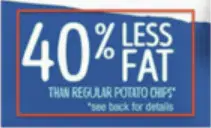
Claims that describe the level of a nutrient in a food, such as "Good source of calcium" or "40% less fat."
Structural claims
Health claims
Nutrition content claims
Structure/function claims
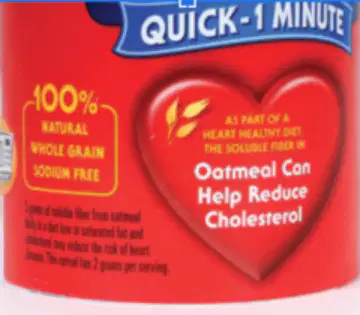
Claims made about a nutrient or substance in a food and its relationship to a serious disease or to a biomarker of a serious disease (e.g., "Oatmeal can help reduce cholesterol").
High-level health claims
General-level health claims
Nutrition content claims
Listed Medicines
A product label states "High in fiber" and "Fiber helps reduce risk of colorectal cancer." Which regulatory distinction best explains why this label may face stricter substantiation requirements than a nutrient level claim?
It combines a nutrition content claim with a high-level health claim referencing disease risk
It is a general-level health claim that never requires evidence
It is a structure/function claim which is exempt from consumer law
It is an ACCC guideline rather than a health claim category
What does the Nutrient Profiling Scoring Criterion (NPSC) determine?
Whether a food is suitable to make a health claim based on its nutrient profile
The calorie content of a food
The vitamin content of a food
The mineral content of a food
Is the health star rating system mandatory for companies?
No, it is optional for consumers
Yes, but only for certain products
No, it is voluntary
Yes, it is mandatory
What is the limitation of the star rating system?
It can only compare products of the same color
It can only compare products of the same price
It can only compare products within the same category
It can only compare products of the same brand
Which system is a voluntary, interpretive, front-of-pack nutrition label that assigns a rating from ½ star to 5 stars based on nutritional profile?
Nutrition Information Panel (NIP)
Health Star Rating System
Plain English Allergen Labelling (PEAL) Law
Advisory Statements, Warning Statements and Declarations
Which label presents nutritional information without additional interpretation or guidance and is mandatory on the back of pack?
Health Star Rating System
Nutrition Information Panel (NIP)
Risk-reducing nutrients panel
Advisory Statements and Declarations
Which agency is responsible for regulating therapeutic goods including prescription medicines, vaccines, sunscreens, vitamins and minerals, medical devices, blood and blood products in Australia?
Dietary Supplement Health and Education Act (DSHEA)
Therapeutic Goods Administration (TGA)
Medicines and Healthcare products Regulatory Agency (MHRA)
Food Standards Australia New Zealand (FSANZ)
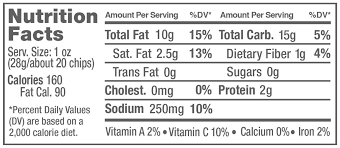
Medicines that primarily contain complementary medicine ingredients that have an established identity and tradition of use, including vitamins, minerals, herbal material, essential oils.
Listed Medicines
Registered Medicines
Over-the-counter Medicines
Complementary Medicines
Low-risk products evaluated by the TGA for safety and quality but not efficacy. Includes most complementary medicines (including dietary supplements).
Unscheduled Medicines
Registered Medicines
Listed Medicines
Registered Or Listed Depending On Ingredients
National law that protects consumers against false, misleading or deceptive advertising.
A Special Act Of Parliament
Customary Law
The Electoral Act
Australian Consumer Law
Which agency is responsible for enforcing compliance with Australian Consumer Law?
Australian Communications and Media Authority (ACMA)
Australian Taxation Office (ATO)
Australian Securities and Investments Commission (ASIC)
Australian Competition and Consumer Commission (ACCC)
A method for evaluating the credibility of sources based on Currency, Relevance, Authority, Accuracy, and Purpose.
Nutrient Profiling Scoring Criterion (NPSC)
CRAAP test
Citation machine
Biomarker
In the CRAAP test, which component primarily evaluates whether information is up-to-date and timely for the topic?
Authority
Currency
Accuracy
Purpose
Which term best fits this definition: Exists when all people, at all times, have physical and economic access to sufficient, safe and nutritious food that meets their dietary needs and food preferences for an active and healthy life.
Food sovereignty
Food citizenship
Food security
Food insecurity
Food security focusses on (a) to food while food sovereignty focusses on the (b) of food systems
Match the dimensions of food security with their definitions
sufficient quantities of appropriate and quality food is available from domestic production, commercial imports, food assistance or food reserves on a consistent basis
Availability
people have adequate income or other resources to access appropriate food domestically through home production, buying in local markets, or as exchange, gifts, borrowing or as food aid.
Access
people being able to use food properly through food storing and processing practices while applying sufficient nutritional, sanitation, socio-cultural and/or spiritual knowledge.
Utilisation
availability of adequate food at all times, meaning that access and utilisation of appropriate food is not prevented by any hinderances, shortages, emergencies or sudden crises
Stability
Healthy food in remote Indigenous communities can cost up to three times more than in urban areas. Which dimension of food security does this relate to most?
Utilisation
Availability
Accessibility
Stability
Applying the definition of food security, which situation best demonstrates food insecurity?
A community with stable access to affordable, nutritious food that meets preferences
Households that can occasionally buy food but not regularly obtain safe, nutritious options
Consumers choosing between several culturally preferred healthy foods every day
Regions where physical and economic access to food is consistently ensured
Which dimension of food security refers to the consistent presence of sufficient quantities of appropriate and quality food from domestic production, commercial imports, food assistance, or reserves over time?
Availability
Access
Utilization
Stability
Which scenario best illustrates the stability dimension of food security?
A household has enough food only right after harvest but faces shortages during lean months
A region consistently maintains food reserves and import agreements that buffer seasonal shortages
A community expands kitchen gardens for micronutrient-rich foods
A farmer’s market lowers prices for one weekend
Which statement best distinguishes chronic instability from transitory instability in food security?
Chronic instability is short-lived and tied to seasonal harvests; transitory instability is long-term and persistent
Chronic instability is persistent and long-term; transitory instability is short-term and often shock-related
Both refer only to instability in food utilization rather than access
Neither involves changes in availability
What does ‘crop diversification’ primarily aim to achieve in the context of food security?
Increase reliance on a single staple crop to boost yields
Spread production risk and improve dietary variety
Eliminate smallholder farming in favor of large monocultures
Reduce the number of crops grown to simplify management
OzHarvest NEST most directly contributes to which food security dimension by teaching practical cooking skills with locally available foods?
Availability—by increasing total national production
Access—by reducing market prices of staples
Utilization—by improving nutrition knowledge and food preparation
Stability—by guaranteeing year-round supply
Food sovereignty emphasizes which core principle?
Control of food systems by multinational corporations
Trade liberalization to maximize exports
Community rights to define and control sustainable food systems
Dependence on food aid during shocks
Which movement aims to ensure producers in developing countries receive fair prices and work under equitable conditions, improving food system sustainability?
Fairtrade Movement
Fast-food Alliance
Greenhouse Gas Offset Coalition
Ultra-processed Foods Association
Most greenhouse gas (GHG) emissions related to food come from which stage of the food system?
Transport of food (food miles)
Retail and packaging
Initial production of food
Household consumption
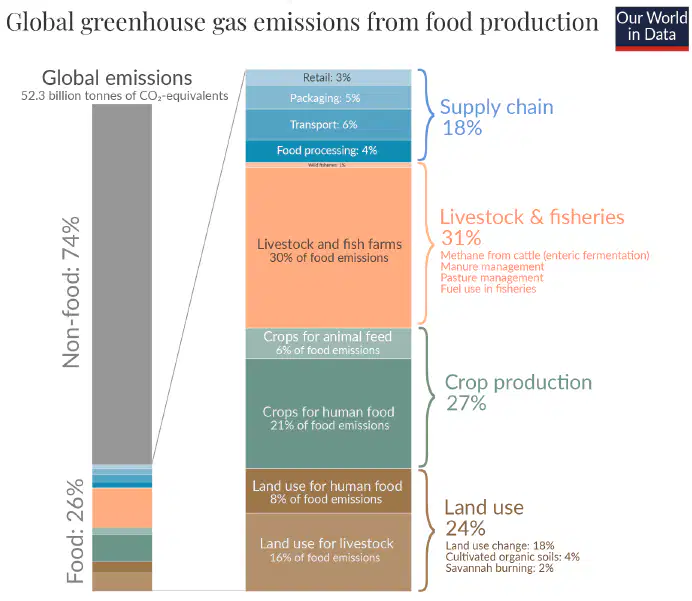
A policymaker wants to cut total food-related GHGs quickly. Based on the breakdown provided, which broad area should they target first for the largest potential reduction?
Livestock and fisheries activities
Retail operations
Food processing
Food transport

Based on the graph, which food has the highest emissions per kilogram?
Poultry meat
Cheese
Beef (beef herd)
Prawns (farmed)
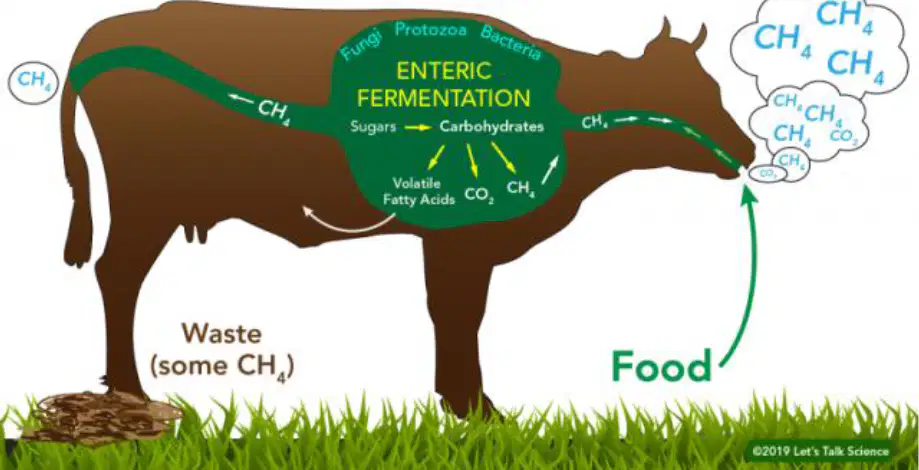
Which statement best explains why ruminant animals like cows contribute substantially to greenhouse gas emissions?
Their muscles store large amounts of CO2 during growth
Gut microbes digest cellulose, producing methane (CH4) through enteric fermentation
They absorb methane from the atmosphere and release it unchanged
Beef production releases only long-lived CO2 with no short-term effects
Select the statement that best describes how water requirements vary by food type in agricultural production.
All foods require roughly the same amount of water per kilogram produced.
Plant-based foods generally require less water than animal-based products, with variation among crops.
Animal-based products always require less water than fruits and vegetables.
Processed foods consistently use less water than raw ingredients.
If policymakers aim to mitigate water scarcity while maintaining food supply, which strategy aligns with concepts in the section?
Shift production toward high-water-use animal products.
Invest in drought-resilient crops and desalination plants.
Ban all irrigation to conserve water immediately.
Prioritize hydropower expansion over agriculture.
Which statement best reflects the general environmental comparison between dairy milk and plant-based milks?
Dairy milk typically has lower greenhouse-gas emissions and land use than most plant-based milks.
Plant-based milks generally require more water and produce more methane than dairy milk.
Most plant-based milks tend to have lower overall environmental impacts than dairy milk, though impacts vary by crop and region.
Dairy milk and plant-based milks have identical environmental footprints across all measures.
Which option best defines biogas in the context of food systems?
a potent greenhouse gas with global warming potential higher than carbon dioxide
a renewable energy source produced from anaerobic digestion of organic waste
the total emissions from all greenhouse gases expressed as CO2e
packaging that naturally breaks down into non-toxic components
"Support local and seasonal food systems; use low‑emission transport options (e.g., ships over planes); improve energy efficiency in retail (e.g., glass doors on fridges)."
This best describes:
Solutions to reduce environmental impacts of food packaging
Solutions to reduce environmental impacts of food production
Solutions to reduce environmental impacts of food waste
Solutions to reduce environmental impacts of food distribution and retail

