
 Worksheets
W14 environmental impacts of food production
Total questions: 70
Worksheet time: 35mins
Recall: According to the instructional material, most greenhouse gas (GHG) emissions related to food come from which stage of the food system?
Transport of food (food miles)
Retail and packaging
Initial production of food
Household consumption
Skill/Concept: Which consideration best explains why emissions vary across different foods within the supply chain? Choose the most accurate option based on the listed considerations.
Whether consumers refrigerate the product
What is produced (e.g., type of food)
How many supermarkets stock the item
The number of marketing campaigns
Strategic Thinking: A policymaker wants to cut total food-related GHGs quickly. Based on the breakdown provided, which broad area should they target first for the largest potential reduction?
Livestock and fisheries activities
Retail operations
Food processing facilities
Packaging materials

Skill/Concept: The diagram groups emissions into categories like supply chain, livestock & fisheries, crop production, and land use. Which category is most directly influenced by decisions about where food is produced?
Land use
Retail
Transport
Food processing

Which statement best defines CO2 equivalent (CO2e) as used to compare the climate impact of foods?
A unit that measures only carbon dioxide mass emitted from a process
A standardised unit that combines different greenhouse gases into one measure based on 100-year warming potential
A percentage that shows methane’s share of total emissions in livestock systems
A rating scale that ranks foods by calorie content and nutritional value

Using the bar chart of greenhouse gas emissions per kilogram of food, which food has the highest emissions per kilogram?
Lamb & mutton
Cheese
Beef (beef herd)
Prawns (farmed)
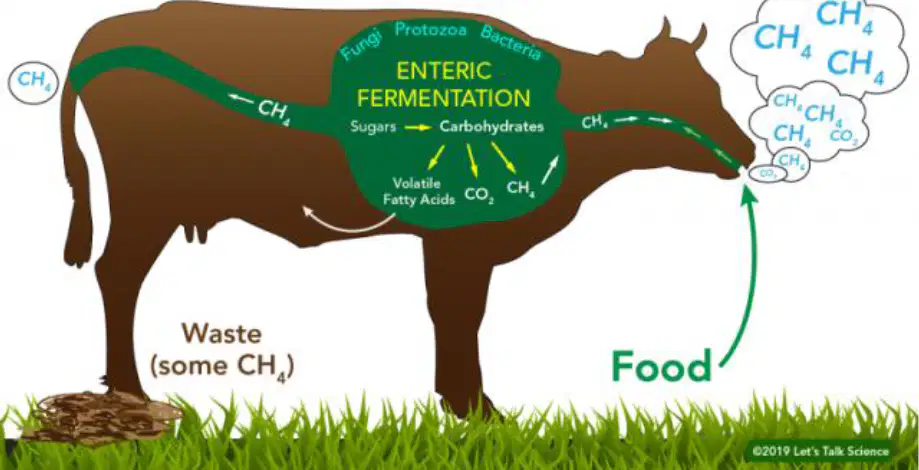
According to the case study, which statement best explains why ruminant animals like cows contribute substantially to greenhouse gas emissions from beef production?
Their muscles store large amounts of CO2 during growth
Gut microbes digest cellulose, producing methane (CH4) through enteric fermentation
They absorb methane from the atmosphere and release it unchanged
Beef production releases only long-lived CO2 with no short-term effects

Which comparison about methane (CH4) and carbon dioxide (CO2) in the beef case study is most accurate for climate impact considerations?
Methane traps more heat than CO2 but persists for a shorter time in the atmosphere
Methane traps less heat than CO2 and remains longer in the atmosphere
Methane and CO2 have identical warming potential and atmospheric lifetimes
CO2 traps more heat than methane but disappears quickly
Recall: Which statement best defines climate change in the context of this lesson?
Long-term changes in Earth’s average climate patterns driven by natural and human factors
Short-term weather events such as storms and daily temperature fluctuations
Seasonal shifts caused only by volcanic activity
Temporary cooling periods during nighttime caused by ocean currents
Skill/Concept: Which gas is most commonly used as the reference for expressing greenhouse gas impacts in carbon dioxide equivalent (CO₂e)?
Methane (CH₄)
Carbon dioxide (CO₂)
Nitrous oxide (N₂O)
Ozone (O₃)
Strategic Thinking: A company reports 1 ton of methane emissions. Using the idea of CO₂e, which rationale best explains why these emissions are converted to a higher CO₂e value?
Methane has a higher global warming potential than CO₂ over a set time horizon, so it is weighted more heavily
CO₂ is more abundant, so all gases are simply multiplied by atmospheric concentration
Methane is less reactive, so its warming effect is ignored and set to zero
CO₂e conversion reduces reported emissions to standardize across industries

Skill/Concept (visual-based): In the case study image showing cows near red algae, which intervention is described as reducing methane produced during digestion, and by approximately what percentage?
Feeding cattle red algae (Asparagopsis taxiformis), reducing methane by about 37.7%
Providing cattle additional grain, reducing methane by about 10%
Administering antibiotics, reducing methane by about 75%
Increasing pasture time, reducing methane by about 2%
According to the case study on carbon emissions from beef, which challenge specifically addresses the upstream environmental footprint of adopting seaweed (Asparagopsis) as a feed additive?
Potential changes to the taste of milk and beef when seaweed is added to the diet
The need to evaluate farming, processing, and transport impacts of producing large quantities of Asparagopsis in sub-tropical waters
Whether gut microbes might adapt and become resistant to bromoform over time
Estimating methane emissions in cattle using respiration chambers

A research team plans to reduce methane from cattle by adding Asparagopsis to feed. Which consideration requires strategic planning that weighs both efficacy and long-term risks?
Selecting a palatable hay mix for cows in the feeding trial
Assessing if gut microbes could adapt and become resistant to bromoform, potentially diminishing the seaweed’s effectiveness
Transporting the seaweed by air to ensure rapid delivery
Choosing sub-tropical waters solely for faster seaweed growth
Recall: According to the instructional material, what proportion of the world’s freshwater withdrawals are used for agriculture?
26%
50%
70%
78%
Recall: What percentage of the world’s habitable land is used for agriculture?
26%
50%
71%
94%
Skill/Concept: Which stage of the food system is directly linked to high water withdrawals as shown, and why? Choose the most accurate explanation.
Retail, because supermarkets use large amounts of water for cleaning shelves.
Agriculture, because crop irrigation and livestock watering drive the majority of freshwater use.
Transportation, because shipping food across oceans requires cooling water.
Household consumption, because dishwashing and cooking dominate global withdrawals.
Strategic Thinking: A government wants to lower eutrophication from food systems. Based on the data presented, which action would most directly target the largest contributor?
Reduce industrial water use in factories unrelated to food.
Limit household detergent sales.
Implement agricultural practices that cut nutrient runoff from farms.
Ban air travel to reduce fuel combustion near coastlines.
Recall: Livestock are fed from two sources. Which pairing correctly lists them?
Pasture grazing and marine algae farms
Pasture grazing and cropland-grown feed such as soy and cereals
Cropland-grown feed and household food waste
Hydroponic greenhouses and pasture mowing
Skill/Concept: Only 48% of the world’s cereals are eaten by humans. How is the remainder used according to the material?
41% for biofuels and 11% for animal feed
11% for animal feed and 41% for biofuels
41% for animal feed and 11% for biofuels
48% for animal feed and 4% for biofuels
Strategic Thinking: If everyone adopted a vegan diet, what approximate reduction in global agricultural land use is indicated, and what is the implication for land competition?
A 25% reduction; competition would intensify as pasture expands.
A 50% reduction; land competition would remain unchanged.
A 75% reduction; cropland and pasture demands would fall, easing pressure the size of North America plus Brazil.
A 10% reduction; land competition would slightly ease near urban areas.
Strategic Thinking: The abstract indicates plant-based dietary patterns can reduce diet-related land use by 76% and greenhouse gas emissions by 49%. Which policy would best align with these outcomes?
Subsidize red meat production to stabilize food prices.
Promote plant-based diets through incentives and set targets for reducing red meat consumption.
Invest solely in faster food transportation networks.
Encourage added sugar intake to replace animal products.
Which stage contributes the majority of greenhouse gas (GHG) emissions in the food system?
Initial food production (on-farm activities)
Retail and packaging
Household cooking and storage
Transport from farm to stores
Livestock and fisheries emissions mainly arise from which source?
Enteric fermentation and manure management
Pesticide manufacturing
Cold-chain refrigeration
Soil carbon sequestration
Crop production emissions are most closely linked to which practice?
Synthetic fertilizer use and soil management
Genetic modification of seeds
Hand harvesting practices
Retail marketing strategies
In a beef carbon emissions case study, which factor is a primary driver of emissions per kilogram of beef?
Methane from enteric fermentation in cattle
Emissions from grocery store lighting
Packaging material selection
Consumer transport to supermarkets
If a policy aims to reduce food-system GHGs quickly, which focus is most evidence-based?
Improving on-farm practices during production
Changing colors of packaging to green
Encouraging shoppers to visit stores less often
Relocating warehouses closer to cities
Which statement best distinguishes emissions sources between livestock/fisheries and crops?
Livestock/fisheries are dominated by methane and manure; crops are dominated by fertilizer-related nitrous oxide and soil disturbances.
Both are dominated by packaging emissions from field to store.
Livestock/fisheries and crops emit primarily from consumer cooking.
Crops mainly emit from fish feed production while livestock emits from soil tillage.
Which intervention would most directly lower beef’s carbon footprint at the farm level?
Improving feed efficiency and manure management
Switching to paper shopping bags
Installing LED lights in supermarkets
Promoting online meat sales
A student claims transport dominates food-related GHGs. Based on the material, what is the best response?
Initial production generally contributes more than transport.
Transport is the single largest source of food emissions.
Household refrigeration exceeds production emissions.
Packaging is equal to production emissions.
Recall: In ruminant livestock, which greenhouse gas is primarily produced during enteric fermentation and targeted for reduction in this case study?
Carbon dioxide
Methane
Nitrous oxide
Ozone
Skill/Concept: What is the proposed mechanism by which certain seaweeds reduce methane production in cattle? Choose the best description.
Seaweed increases oxygen levels in the rumen, oxidizing methane to carbon dioxide
Seaweed supplies extra fiber that traps methane bubbles
Seaweed contains bromoform that inhibits methanogenic archaea during fermentation
Seaweed lowers body temperature, slowing overall metabolism and gas release
Recall: Identify the compound in some red seaweeds that has been researched as a methane inhibitor in cattle.
Chlorophyll
Bromoform
Beta-carotene
Lignin
Strategic Thinking: A farm considers adding seaweed to cattle feed to cut methane. Which challenge would most likely limit scaling this approach across large herds?
Seaweed reduces milk fat percentage slightly
Consistent supply, cultivation, and processing of seaweed at large volumes
Cattle refuse any changes to diet by instinct
Seaweed eliminates all greenhouse gas emissions, making further action unnecessary
Skill/Concept: Why might regulators be cautious about bromoform-based feed additives, even if they lower methane?
Bromoform can accumulate in tissues or pose toxicity/environmental risks, requiring safety evaluation
Bromoform is a vitamin and may cause deficiency
Bromoform has no effect on microbes and only changes taste
Bromoform increases water use but not emissions
Recall: In the context of ruminant digestion, methane is mainly generated by which microbial group?
Methanogenic archaea
Photosynthetic cyanobacteria
Saprophytic fungi
Nitrifying bacteria
Strategic Thinking: If seaweed supplementation reduces methane per cow but is expensive, which plan best balances emissions cuts and practicality?
Apply seaweed to all cattle regardless of cost
Target high-emitting cohorts (e.g., feedlot cattle) while exploring local seaweed sourcing to lower cost
Stop measuring emissions and focus on milk yield only
Replace cattle entirely with poultry on grasslands
Recall: Which sector is highlighted as placing a high demand on both water and land, often contributing to land clearing and degradation?
Urban transport systems
Agriculture and food production
Tourism and recreation
Mining of rare earth metals
Recall: What is a commonly proposed way to reduce total land use associated with food production?
Expanding pasture for livestock
Increasing single-use packaging
Shifting toward plant-based diets
Relying solely on imported foods
Skill/Concept: Which consequence most directly links land clearing for agriculture to environmental impact?
Improved soil biodiversity
Reduced risk of erosion and salinization
Loss of native vegetation leading to land degradation
Increase in groundwater recharge without pollutants
Strategic Thinking: A region faces water scarcity and rapid soil degradation from intensive livestock grazing. Which policy change is most likely to simultaneously lower water demand and reduce land pressure?
Subsidize expansion of rangelands
Promote plant-based dietary patterns and crop diversification
Mandate longer transport routes for food
Increase fertilizer use to boost yields
Skill/Concept: If agriculture uses a large share of freshwater, which practice would most directly help conserve water resources?
Shifting diets toward more water-efficient crops
Increasing irrigation hours during heat waves
Clearing additional land for expansion
Replacing crops with more livestock
Recall: Land degradation in agricultural areas is commonly driven by which factor?
High biodiversity reserves
Land clearing and intensive use
Reduced market demand for food
Strict conservation laws
Strategic Thinking: A government aims to cut national land use tied to food production without reducing nutrition quality. Which strategy best meets this goal using evidence from the material?
Encourage high-meat diets supported by new pasture
Adopt plant-based diets with emphasis on efficient cropping systems
Ban all irrigation to force lower production
Increase packaging to extend shelf life only
Skill/Concept: Which statement best explains the relationship between agriculture’s water use and land degradation?
High water use automatically prevents soil erosion
Large-scale irrigation and land clearing can stress ecosystems, contributing to degradation
Agriculture’s water use has no effect on land conditions
Water-intensive crops always rebuild topsoil
Which sector withdraws the largest share of global freshwater according to the section on food production and water use?
Agriculture
Domestic households
Industrial manufacturing
Energy generation
Select the statement that best describes how water requirements vary by food type in agricultural production.
All foods require roughly the same amount of water per kilogram produced.
Plant-based foods generally require less water than animal-based products, with variation among crops.
Animal-based products always require less water than fruits and vegetables.
Processed foods consistently use less water than raw ingredients.
Foodprint Melbourne is referenced in this section. What is its relevance to water use and food production?
It is a global treaty that limits irrigation volumes.
It is a city-level initiative that analyzes the resource demands of Melbourne’s food system, including water.
It is a farm equipment brand that improves irrigation efficiency.
It is a national drought relief fund for Australian farmers.
During the Australian Millennium Drought, which impact on agriculture was most prominent?
Increased river flows and expansion of rice paddies
Severe water scarcity leading to reduced irrigation and lower yields
Widespread flooding that improved soil moisture
Elimination of water restrictions across farming regions
Which statement accurately connects freshwater withdrawals to agricultural water demand?
Freshwater withdrawals are unrelated to agriculture because farms rely on seawater.
Agricultural water demand contributes substantially to freshwater withdrawals, especially for irrigation.
Freshwater withdrawals only measure household tap water use.
Agricultural water demand is negligible compared to industrial cooling.
If policymakers aim to mitigate water scarcity while maintaining food supply, which strategy aligns with concepts in the section?
Shift production toward high-water-use animal products regardless of local conditions.
Invest in drought-resilient cropping and efficient irrigation informed by food system analyses like Foodprint Melbourne.
Ban all irrigation to conserve water immediately.
Prioritize hydropower expansion over agriculture.
Which food category would most likely reduce a city’s agricultural water footprint if consumption increases, based on typical water-use patterns?
Red meat products
Dairy beverages
Plant-based staples such as legumes and grains
Processed snack foods
What does the term water scarcity refer to in the context of this section?
Temporary oversupply of river water due to seasonal flooding
A situation where available freshwater is insufficient to meet demands, often intensified by droughts and high agricultural use
A government policy that limits tap water pressure in homes
Excessive rainfall causing crop disease
Recall: Which process removes salts from seawater to produce potable water in sustainable water management strategies?
Filtration through sand beds
Desalination using membrane or thermal methods
Aeration to increase dissolved oxygen
Coagulation with alum
Recall: In sustainable water use, what is the practice of treating used water so it can be safely used again for non-potable or potable purposes?
Greywater diversion
Water recycling
Stormwater harvesting
Irrigation scheduling
Skill/Concept: A coastal city faces variable rainfall. Which paired strategy best ensures a reliable supply while reducing freshwater extraction from rivers?
Expand groundwater pumping and build larger dams
Install desalination capacity and implement water recycling
Increase agricultural water allocations and import bottled water
Rely on seasonal rainwater tanks and reduce industrial activity
Skill/Concept: The Wamuran Irrigation Scheme in Australia supplies recycled water to farms. What direct sustainability benefit does this provide compared with using freshwater from rivers?
It increases river flow during droughts
It reduces demand on natural freshwater sources by substituting treated recycled water
It eliminates the need for any water treatment
It guarantees higher crop yields regardless of climate
Strategic Thinking: A region currently discharges treated wastewater to the ocean and imports water from distant reservoirs. Propose the most effective first step to lower overall environmental impact while maintaining supply reliability.
Increase long-distance transfers to meet peak demand
Construct a desalination plant only
Implement advanced water recycling to reuse treated effluent locally
Stop treating wastewater to save energy
Strategic Thinking: When planning sustainable water management for drought-prone communities, which integrated approach provides resilience and minimizes ecological stress?
Single-source reliance on surface reservoirs
Alternating between groundwater and surface water without treatment upgrades
Combining desalination, water recycling, and efficient agricultural schemes like Wamuran-style irrigation
Seasonal rationing without infrastructure investment
Consider sustainable milk choices. Which statement best reflects the general environmental comparison between dairy milk and plant-based milks?
Dairy milk typically has lower greenhouse-gas emissions and land use than most plant-based milks.
Plant-based milks generally require more water and produce more methane than dairy milk.
Most plant-based milks tend to have lower overall environmental impacts than dairy milk, though impacts vary by crop and region.
Dairy milk and plant-based milks have identical environmental footprints across all measures.
You are choosing a milk type with the goal of minimizing environmental impact. Which approach shows strategic thinking using available evidence?
Select any plant-based milk because all are equally sustainable in every context.
Compare life-cycle data (emissions, water use, land use) for dairy and different plant-based milks and choose the option with consistently lower impacts in your region.
Rely on food miles alone, assuming local dairy is always the lowest-impact choice.
Choose the milk with the lowest price, assuming cost correlates directly with sustainability.
Which statement best defines ultra-processed foods (UPFs) in the context of environmental impact?
Foods minimally altered from their natural state, often requiring little energy to produce
Foods created through multiple industrial steps that are energy-intensive and resource-demanding
Foods produced exclusively through organic farming with minimal packaging
Foods prepared at home using fresh ingredients and simple cooking methods
Select the food processing method most likely to be energy-intensive due to repeated heating and mechanical mixing.
Sun-drying whole fruits on racks
Fermenting vegetables in brine at room temperature
Ultra-high-temperature pasteurisation followed by homogenisation
Simple washing and sorting of produce
Which stage of the food chain contributes greenhouse gas emissions when food is ultra-processed and then discarded?
Only the farming stage
Manufacturing, transport to landfill, and decomposition in landfill
Retail storage but not consumer use
Home cooking only
Identify the primary greenhouse gas released when food waste decomposes anaerobically in landfill.
Methane
Ozone
Nitrous oxide
Helium
Which option correctly links a resource impact with UPF manufacturing?
UPF manufacturing saves water because it eliminates farming
UPF manufacturing uses additional energy for refining, shaping, and packaging
UPF manufacturing reduces transport needs because foods are grown locally
UPF manufacturing decreases fertiliser use due to shorter supply chains
A company wants to cut the environmental footprint of its snack line. Which strategy most directly targets impacts across multiple food chain stages?
Increase advertising budgets to improve sales
Shift from ultra-processed formulations to minimally processed ingredients and lighter packaging
Add more artificial flavours to reduce raw material costs
Extend shelf life by adding preservatives without changing production steps
Consider the following: UPFs often undergo energy-intensive manufacturing; wasted UPFs mean the embedded production emissions and resources are lost; transporting waste and landfill decomposition add further emissions. Which conclusion is most supported?
UPFs have negligible environmental impacts compared to fresh foods
Reducing UPF consumption and waste can lower emissions from production, transport, and landfill
Only landfill emissions matter; production emissions are insignificant
Energy used in UPF manufacturing is fully recovered when waste breaks down
Which option best describes an environmental benefit that could arise from the Pringles manufacturing process?
Standardized chip shapes can enable efficient packaging, reducing transport emissions per unit.
Uniform chips require more oil per batch, increasing greenhouse gas emissions.
Factory production prevents any opportunity to recycle materials.
Mass production always increases food waste compared to home cooking.
During a class analysis of Pringles manufacturing, which consideration reflects a likely environmental drawback of the process?
Use of recyclable composite cans eliminates all landfill waste.
Energy-intensive processing and long-distance distribution can increase the product’s carbon footprint.
Automation guarantees zero food waste during production.
Industrial flavoring reduces the need for quality control and therefore saves energy.

