
 Worksheets
8th sem theory assessment
Total questions: 35
Worksheet time: 18mins
Sequestrum is defined as which of the following?
Reactive bone in acute osteomyelitis
Reactive bone in chronic osteomyelitis
Necrotic bone providing a nidus for infection in chronic osteomyelitis
Healthy bone adjacent to chronic osteomyelitis
Cloaca in chronic osteomyelitis refers to:
Dead bone
Opening in involucrum draining pus
Periosteal new bone formation
Chronic sinus tract
Primary osteoarthritis of the knee most commonly affects which compartment?
Lateral tibiofemoral
Medial tibiofemoral
Patellofemoral
All equally
Classical deformity seen in advanced osteoarthritis knee is:
Valgus deformity
Varus deformity
Flexion deformity
Recurvatum
Radiographic hallmark of osteoarthritis is:
Osteopenia
Periosteal reaction
Joint space narrowing with osteophytes
Erosions
The most definitive treatment for end-stage osteoarthritis knee is:
NSAIDs
Physiotherapy
Arthroscopic lavage
Total knee replacement
The most common causative organism of acute osteomyelitis in adults is:
Streptococcus
Staphylococcus aureus
Pseudomonas
E. coli
The most common site of acute hematogenous osteomyelitis in children is:
Epiphysis
Diaphysis
Metaphysis
Apophysis
The involucrum in chronic osteomyelitis is:
New bone enclosing sequestrum
Dead bone fragment
Pus-filled cavity
Sinus tract
The diagnostic imaging modality for early osteomyelitis:
X-ray
MRI
CT
Bone scan
Which joint is most commonly affected by septic arthritis in adults?
Hip
Shoulder
Knee
Elbow
Gold standard for diagnosis of septic arthritis:
X-ray
MRI
Synovial fluid aspiration and culture
CRP and ESR
During examination of swelling, fluctuation test is used to detect:
Solid content
Fluid content
Pulsatility
Tenderness
Transillumination test is positive in:
Lipoma
Ganglion cyst
Fibroma
Neuroma
The most reliable method to assess temperature over a swelling is:
Back of fingers
Palm
Thermometer
Fingertips
Sinus examination should include assessment of:
Number, site, discharge
Shape and tenderness only
Discharge alone
Depth only
The presence of multiple openings with bluish discoloration suggests:
Tuberculous sinus
Pyogenic sinus
Fungal infection
Venous ulcer
In tuberculous sinus, discharge is typically:
Serous
Serosanguinous
Purulent and foul-smelling
Thin watery with caseous material
Mobility of swelling in relation to underlying structures is tested to determine:
Consistency
Origin
Temperature
Tenderness
Fluctuation test is performed by:
Compressing swelling with one finger
Compressing with both hands and feeling impulse on opposite side
Pressing base of swelling
Observing pulsation
A sinus that discharges rice bodies suggests infection by:
Actinomyces
Mycobacterium
Staphylococcus
Nocardia
Colles’ fracture typically results from:
Fall on flexed wrist
Fall on outstretched hand
Direct blow
Twisting injury
Most common complication of Colles’ fracture:
Non-union
Malunion
Infection
Compartment syndrome
The main deforming force in Colles’ fracture is:
Biceps
Pronator quadratus
Brachioradialis
Extensor carpi radialis longus
Smith’s fracture differs from Colles’ by:
Volar displacement of distal fragment
Dorsal displacement of distal fragment
Lateral displacement
No displacement
The most common site of radial nerve injury is:
Spiral groove of humerus
Cubital fossa
Axilla
Forearm
Wrist drop occurs due to paralysis of:
Flexor carpi radialis
Extensor carpi radialis longus and brevis
Pronator teres
Brachialis
The branch of radial nerve that is purely sensory:
Posterior interosseous nerve
Superficial radial nerve
Deep branch of radial nerve
Muscular branch
A patient with fever, bone pain, and raised ESR, with MRI showing marrow edema likely has:
Osteoarthritis
Osteomyelitis
Septic arthritis
Bone tumor
In chronic osteomyelitis, which surgical procedure removes sequestrum and dead tissue?
Arthroplasty
Sequestrectomy
Synovectomy
Osteotomy
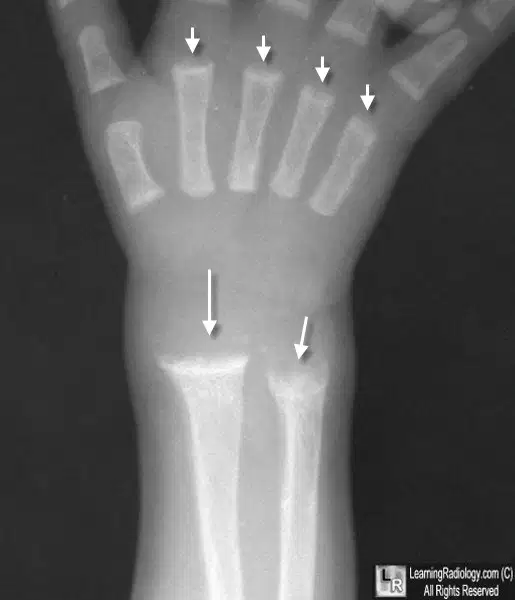
A 2 year old child was brought with complaints of generalised weakness, irritability, retarded bone growth. Based on the x ray given below, what is your diagnosis?
Achondroplasia
Rickets
Renal osteodystrophy
None of the above
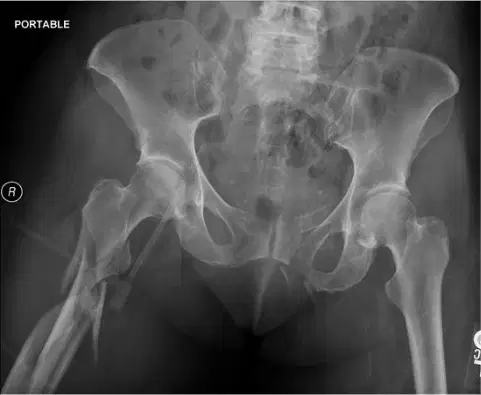
A 20-year-old female presents following a motor vehicle collision with the injuries seen in Figures A and B. She was initially hypotensive and tachycardic however she now has stable vital signs following a 2 liter bolus of saline and 2 units of packed red blood cells. Which of the following would indicate that this patient has occult end-organ hypoperfusion and should be further resuscitated prior to definitive fixation?
Heart rate of 80 beats per minute
Systolic blood pressure of 120 mmHg
Serum lactate of 5 mmol/Liter
Urine output of 40 ml/hour
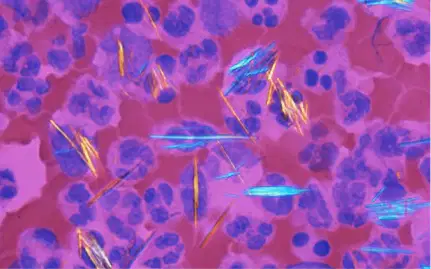
This finding is characteristic of:
Calcium pyrophosphate deposition (pseudogout)
Monosodium urate crystals (gout)
Septic arthritis organism
Oxalate crystals
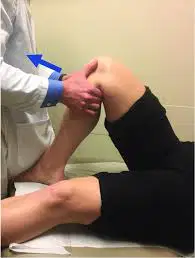
This test is used to diagnose injury of
PCL
Medial meniscus
ACL
MCL
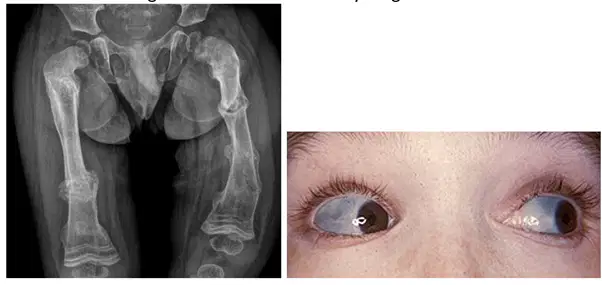
Based on the images what is the most likely diagnosis
Achondroplasia
Osteopetrosis
Child abuse
Osteogenesis imperfecta

