
 Worksheets
Following on from Bingo
Total questions: 47
Worksheet time: 24mins

It is important that we can make our own choices at college because:
it helps us develop independence and responsibility.
it guarantees we will always make the right decisions.
it means we do not need to listen to advice from others.
it makes college life easier without any challenges.
Is it important to be mindful of other people in the session?
True
False
Should you let staff know if you need to leave class?
True
False
Is it a rule to not talk over one another and listen when one person is speaking?
True
False
Is it important to remember that this is a safe environment and that we are all learning?
True
False
Should you avoid hate speech and be respectful of other people's views?
True
False
Do we all agree to these rules?
Yes
No
Individual Liberty means ________ and we see it in everyday life when ________.
having the freedom to make choices and respecting others' rights; people express their opinions or choose their activities freely
everyone follows the same rules without question; people always agree with authority
being able to do anything without consequences; people ignore laws and rules
having no responsibilities; people avoid participating in community activities
Remembrance Day links to freedom because:
It honors those who fought for our freedom.
It celebrates the start of summer.
It marks the end of school exams.
It is a day for shopping discounts.
British Values are:
Democracy, Rule of Law, Individual Liberty, Mutual Respect and Tolerance
Monarchy, Dictatorship, Censorship, Intolerance
Isolationism, Authoritarianism, Discrimination, Inequality
Anarchy, Lawlessness, Oppression, Prejudice

Which British Value is described by 'using politeness and manners – saying “please” and “thank-you”?
Mutual Respect
Individual Liberty
Tolerance of different faiths and beliefs
Rule of Law
Democracy

Which British Value is described by 'choosing your clothes'?
Mutual Respect
Individual Liberty
Tolerance of different faiths and beliefs
Rule of Law
Democracy

Which British Value is described by 'respecting someone else's religious beliefs even if they are different from your own'?
Mutual Respect
Individual Liberty
Tolerance of different faiths and beliefs
Rule of Law
Democracy

Which British Value is described by 'Stopping at the traffic lights'?
Mutual Respect
Individual Liberty
Tolerance of different faiths and beliefs
Rule of Law
Democracy

Which British Value is described by 'Sharing ideas, decision making, having discussions and debates about issues. This gives students responsibility and empowerment.'?
Mutual Respect
Individual Liberty
Tolerance of different faiths and beliefs
Rule of Law
Democracy
Individual Liberty refers to:
The freedom of individuals to act and think as they choose, as long as they do not infringe on the rights of others.
The power of the government to control all aspects of citizens' lives.
The obligation of individuals to follow only majority decisions.
The right of individuals to ignore laws and regulations.
Fill in the blank: Individual Liberty means being free to ______ and speak up – as long as we don’t hurt others.
make choices
break rules
ignore laws
stay silent
follow orders
What does Individual Liberty mean? Fill in the blank: Individual Liberty means each of us having the ______ to make our own choices and do what we want – within reason.
freedom
permission
obligation
restriction
According to the passage, what must we respect in order to pursue our ambitions and follow our own will?
Only our own choices
The other British Values and the rights of other people
The law only
Our ambitions only
Who is Emmeline Pankhurst?
Emmeline Pankhurst was a British political activist and leader of the suffragette movement who fought for women's right to vote.
Emmeline Pankhurst was a famous French artist known for her impressionist paintings.
Emmeline Pankhurst was a renowned scientist who discovered penicillin.
Emmeline Pankhurst was a celebrated American author of detective novels.
Who is Martin Luther King?
Martin Luther King was an American civil rights leader who advocated for equality and fairness for all people.
Martin Luther King was a famous jazz musician from New Orleans.
Martin Luther King was a renowned scientist known for his work in physics.
Martin Luther King was a celebrated author of fantasy novels.
Who is Nelson Mandela?
Nelson Mandela was a South African anti-apartheid revolutionary who fought for racial equality and harmony.
Nelson Mandela was a famous Brazilian footballer known for his World Cup victories.
Nelson Mandela was a renowned physicist who developed the theory of relativity.
Nelson Mandela was an ancient Egyptian pharaoh celebrated for building the pyramids.
What do these people have in common?
They are all famous scientists.
They are all Olympic athletes.
They are all movie directors.
They are all authors.

Which of the following is an example of something you do each day that involves freedom?
Choosing what to eat for breakfast
Sleeping all day without waking up
Flying an airplane
Living underwater like a fish
Based on the image, what historical event or period does this scene most likely represent?
The Industrial Revolution
The Renaissance
The American Civil War
The Age of Exploration
When did World War One end?
11 o'clock on 11th November 1918
10 o'clock on 10th November 1918
12 o'clock on 12th November 1918
9 o'clock on 9th November 1918
What is the name of the day when Germany agreed to stop fighting in World War One?
Remembrance Day
Armistice Day
Victory Day
Memorial Day
Every year on 11th November at 11 o'clock, people in the UK stop and stay quiet for one minute.
True
False
Fill in the blank: Remembrance Day is observed to remember the people who ______ and died to help keep us safe and free.
fought
played
slept
traveled
Fill in the blank: The tradition of staying quiet for one minute on Remembrance Day is observed in the ______.
UK
USA
France
Germany

What does the red poppy represent?
A) Remembrance and hope
B) Peace
C) Animal victims of war
D) Black, African and Caribbean communities' contribution to the war
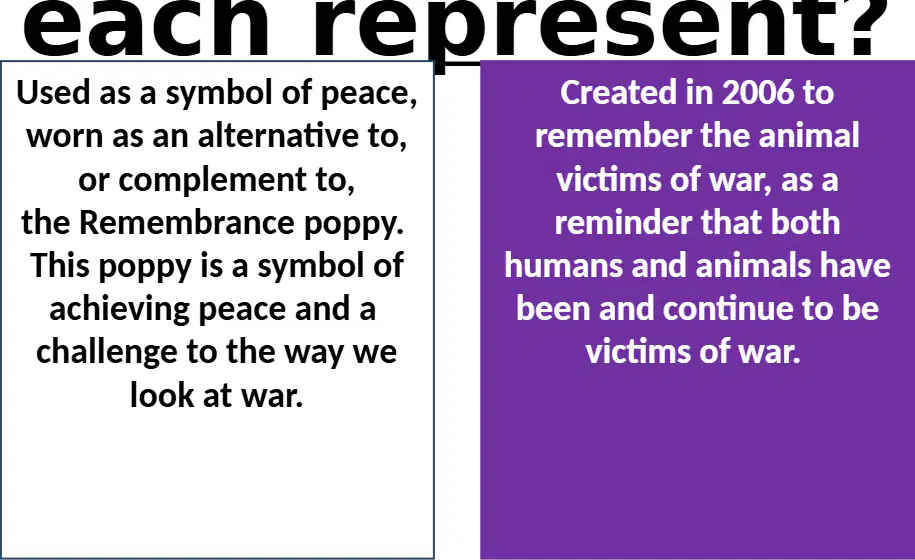
What does the white poppy represent?
A) Remembrance and hope
B) Achieving peace and a challenge to the way we look at war
C) Animal victims of war
D) Black, African and Caribbean communities' contribution to the war

What does the purple poppy represent?
Remembrance and hope
Achieving peace
Animal victims of war
Black, African and Caribbean communities' contribution to the war

What does the black poppy represent?
Remembrance and hope
Achieving peace
Animal victims of war
Black, African and Caribbean communities' contribution to the war

What does the red poppy symbolise according to the Royal British Legion?
Remembrance and hope
Peace and reconciliation
Animal victims of war
The contribution of Caribbean communities.

Which of these statements is NOT something we do to commemorate Remembrance Day?
Wearing poppies
Observing a minute’s silence
Attending parades.
Sending holiday cards.
Who are the two characters shown in the image?
Charlie Brown and Linus
Snoopy and Lucy
Charlie Brown and Snoopy
Lucy and Linus
What is the object being held by the character on the right?
A red flower
A balloon
A book
A hat
Describe what is happening in the image.
A person is watering plants in a garden.
A person is painting a wall.
A person is cooking in a kitchen.
A person is reading a book in a library.
In college, what do we do to support Individual Liberty?
Encourage open discussions and respect diverse opinions
Limit student expression to maintain order
Discourage questioning of authority
Promote uniformity in beliefs
What is one way students can support individual liberty in college? (Fill in the blank) Speak out in _______.
class
library
cafeteria
gym
Which of the following is a way to support individual liberty in college?
Express views freely
Ignore others' opinions
Avoid discussions
Stay silent
What type of goals are students encouraged to pursue to support individual liberty in college? (Fill in the blank) Pursue _______ and academic goals.
personal
financial
social
athletic
How does college encourage students to support individual liberty?
By making independent choices
By following only group decisions
By discouraging independence
By limiting choices
What are students given to support individual liberty in college? (Fill in the blank)
advice
books
rules
uniforms
What is an example of freedom of expression in college to support individual liberty?
Learner voice ambassadors
No student representation
Silence in class
No feedback allowed
What policies and procedures are in place in college to support individual liberty? (Fill in the blank) Policies and procedures are in place to protect students from Anti _______ and Harassment.
bullying
smoking
littering
cheating

