
 Worksheets
Air Separator
Total questions: 30
Worksheet time: 15mins
In a central heating system, what is the primary function of an air separator when the cold feed and vent pipe are positioned close together?
To allow close-coupled pipework while removing entrained air from the water
To increase pump head to move water through long circuits
To throttle flow to radiators for better balancing
To bypass the boiler during warm-up to prevent overheating
An air separator is described as an oversized pipe with cold feed and vent connections. Which operational principle explains how it removes air from the circulating water?
Water swirls within the separator, allowing air to separate out
A mesh filter traps air bubbles mechanically
A chemical additive inside absorbs dissolved gases
A one-way valve purges air only during boiler firing
According to best practice, why does correct pipework layout combined with effective air removal improve system performance?
It reduces system noise and lowers the risk of corrosion
It raises the boiler flow temperature for faster heat-up
It eliminates the need for a circulation pump
It increases static head so more radiators can be added
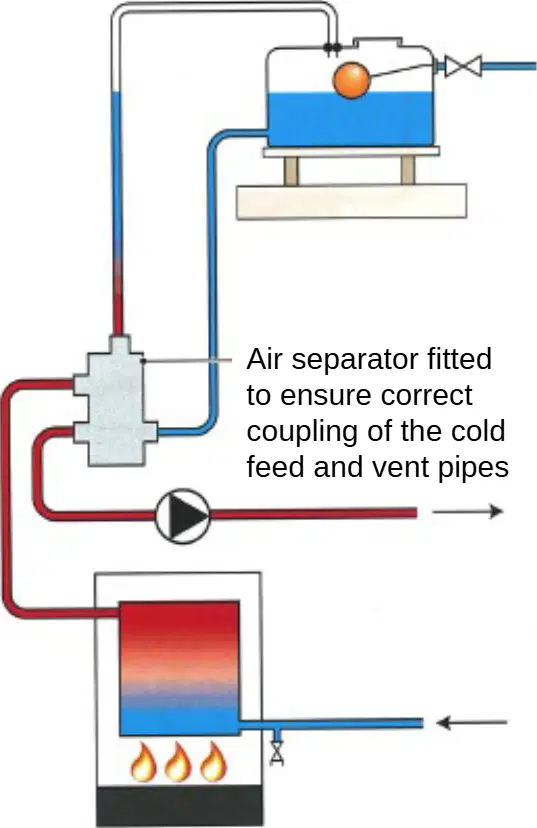
Refer to the schematic of a heating circuit with an air separator installed between the cold feed and vent connections. What installation purpose does this placement serve?
To ensure correct coupling of the cold feed and vent pipes, preventing air-related issues
To isolate the boiler from the system during maintenance
To divert flow away from the expansion vessel under high load
To meter the chemical inhibitor dose into the return line
A heating system shows lukewarm hot water and radiators that do not fully heat. Based on circulator basics, which issue is the most likely cause?
A sluggish or poor performing circulator pump
A thermostat set too high
An expansion vessel that is oversized
A blocked cold feed due to limescale
Which materials are specified for the washers used with pump flanges to maintain a watertight seal?
Rubber or fibre washers
PTFE tape only
Cork gaskets only
Metal-to-metal seals with no washers
Refer to the diagram of the pump and two flange-mounted fittings with integral stop taps. What is the primary purpose of the isolation valves shown?
To allow easy maintenance by shutting off the pump without draining the system
To increase pump head by adding flow resistance
To bleed air automatically from the highest point
To regulate boiler firing rate during warm-up
To prevent air ingress and corrosion, how should the circulator be positioned in relation to the system’s feeds?
It must always draw on the cold feed to maintain positive pressure
It should push on the hot flow to create negative pressure
It must be installed above the feed and expansion tank only
It should be set to the highest speed to purge air quickly
A technician reports system noise after a circulator replacement. Using circulator principles, which adjustment is most appropriate to address this before replacing parts?
Adjust the circulator’s speed settings to the correct level
Close both isolation valves to increase pressure
Swap rubber washers for metal seals
Move the pump to draw on the hot flow instead of the cold feed
Which circulator placement best maintains positive pressure by locating the vent and cold feed on the suction side behind the pump, creating the neutral zone?
Pump ahead of both vent and cold feed so it pushes into the cistern
Pump between the vent and cold feed so it pumps over the vent pipe
Pump after the tee where the vent and cold feed join the flow from the boiler, with both connections within the neutral zone behind the pump
A system requires positive pressure. Based on the illustrations showing three layouts, which outcome occurs if the pump is placed so it pushes into the cistern?
The system runs under negative pressure, drawing air in
The system runs under positive pressure, pumping over the vent pipe
The system creates a neutral zone at the pump inlet and prevents air entry
In an H-frame configuration used instead of an air separator, where must the vent and cold feed be installed relative to the circulator?
On the return from the boiler, on the discharge side of the circulator
On the flow from the boiler, on the suction side of the circulator
On a bypass loop isolated from the boiler, on either side of the circulator
According to the air separator and H-frame schematic, the correct pipework layout ensures the neutral point of the system is located at which position?
At the pump discharge on the flow to the system
At the base of the cold feed where it joins the flow within 150 mm of the vent
At the highest point of the open vent above the cistern
At the boiler return immediately before the circulator
A central heating system includes a device that captures corroded iron particles (magnetite). When the system is serviced, what should be done with this device to maintain good water condition?
Leave the magnet in place so particles remain trapped during flushing
Remove the magnet to flush the collected magnetite away
Replace the entire cleaner housing without disturbing the magnet
Bypass the cleaner so water avoids the magnet during servicing
Which statement best explains the primary role of an inhibitor in a central heating system?
It mechanically filters out rust flakes using a magnetic core
It is a chemical that protects against scale and corrosion and can be topped up
It increases boiler temperature to reduce sludge formation
It replaces the need for regular system servicing and venting
A heating engineer plans to add inhibitor to a system and must confirm the correct route for the primary vent. Based on best practice described, which plan is correct?
Dose inhibitor only through the boiler drain and run the primary vent to atmosphere outdoors
Dose inhibitor via the feed and expansion (F&E) tank or a radiator and terminate the primary vent over the F&E
Dose inhibitor through a magnetic cleaner and cap the primary vent to prevent chemical loss
Avoid using inhibitor if a magnetic cleaner is installed and route the primary vent to the return pipe
A domestic radiator has a valve at each end. One has a wheel head the user can turn to alter water flow; the other is a lock-shield valve used by the engineer for system balancing. Which statement best describes the purpose of the lock-shield valve?
It lets the customer quickly shut off the radiator for maintenance.
It provides engineer access to adjust flow rates for balancing across the system.
It automatically responds to room temperature to control radiator heat output.
It mixes hot and cold water to maintain a constant outlet temperature.
Building Regulations part L and the Heating Compliance Guide require TRVs on systems. A TRV replaces the wheel head valve and has a head that reacts to ambient air temperature. What happens inside the TRV head as the room warms?
A bimetal strip bends to pull the pin outward, opening the valve wider.
A volatile liquid expands, pushing a pin down to close the valve progressively.
A spring compresses to open a bypass, diverting flow around the radiator.
An electronic sensor sends a signal to shut off the system pump.
A room with a TRV cools after occupants open a window. Using how a TRV operates, what adjustment occurs and why? Use the description: the TRV’s volatile liquid contracts when the room cools.
The TRV opens further because the contracting liquid releases pressure on the pin, allowing more flow to heat the radiator.
The TRV closes because the contracting liquid pulls the pin deeper, restricting flow to save energy.
The TRV remains unchanged because ambient air does not affect mechanical TRVs.
The TRV switches off the boiler electrically until the room is reheated.
A customer wants to remove a radiator with a TRV temporarily for decorating. What is the correct procedure to prevent the valve from opening unintentionally?
Shut the boiler down for the duration of decorating
Turn the TRV to its lowest number setting
Fit a decorator’s cap over the head to the valve
Open the lockshield valve fully to release pressure
You are fitting a TRV where long curtains cover the radiator and may affect sensing. Which solution best ensures accurate temperature control?
Install a remote head or sensor so the phial is not obstructed
Fit the TRV on the return pipe instead of the flow
Replace the TRV with a manual wheelhead valve
Increase the system pump speed to overcome the obstruction
Modern TRVs are often reversible, but incorrect flow direction can cause issues. What is the most likely symptom if water flows the wrong way through the valve body?
Radiator remains cold due to air locking
Valve seat rattles and vibrates, causing a noisy radiator
System pressure rises above design limits
Boiler short-cycles due to rapid heat-up
A heating system has several thermostatic radiator valves (TRVs) that have closed while the circulator pump is still running. Which component’s primary function is to prevent excessive system pressure and help prolong pump life in this situation?
Automatic bypass valve (ABV)
Manual air vent
Zone mixing valve
Expansion vessel service valve
In a typical installation, where should an automatic bypass valve (ABV) be connected to ensure circulation when TRVs and zone valves close?
Between the primary flow and return pipes
On the cold mains supply to the boiler
Across each individual radiator
Between the hot water cylinder and the expansion vessel
A boiler keeps short-cycling after most radiators shut off via TRVs. You need to maintain water movement through the boiler. Which action best addresses this using system components described?
Ensure an ABV is installed or enabled so water can flow through the boiler when TRVs close
Throttle the circulator pump speed to its lowest setting to reduce pressure
Open a manual drain-off to relieve pressure temporarily
Bypass the boiler completely by bridging the flow directly to the hot water cylinder coil
In a pressurised sealed heating system, what is the primary purpose of a filling loop as described: a flexible, temporary connection between the incoming mains and the central heating circuit that must be disconnected after use?
To permanently boost circulation pump flow rate
To temporarily add mains water to charge the system pressure
To continuously dose inhibitor into the system
To provide a permanent bypass around thermostatic valves
Regulatory practice for a filling loop states that it must be disconnected after use and the incoming mains protected. Which arrangement best meets these Water Regulations?
A fixed hose with no isolators and a single check valve on the boiler return
A removable braided hose with quarter‑turn isolators on both sides and a double check valve on the mains
A permanent copper link with full‑bore gate valves and a single non‑return valve on the heating side
An automatic top‑up valve with no manual isolation and an air gap instead of check valves
A sealed system begins to repeatedly lift its pressure relief valve (PRV). Considering that PRVs are factory‑set to discharge safely at a set pressure, which underlying fault is most likely according to the guidance?
Undersized circulation pump causing low velocity
Expansion vessel failure or loss of charge leading to pressure build‑up
Blocked double check valve in the filling loop preventing refill
Thermostatic radiator valves stuck open causing over‑flow
Based on the described component, which statement best explains the function of an automatic air release valve in a heating system?
It allows trapped air to escape at high points and then closes automatically.
It introduces air into the boiler to improve combustion efficiency.
It continuously vents water and air from the lowest point to prevent sludge.
It opens manually to drain radiators during maintenance.
A technician is commissioning a closed heating system and wants to avoid air locks near the boiler. Where should the automatic air release valve be positioned to work effectively, and why?
At the lowest pipe run, because air collects at low points.
Inside or near the boiler at a high point, because air rises and must be released there.
On the cold water feed, because incoming water carries most of the air.
On each radiator’s drain point, because air leaves only through drains.

